



A STONE IS HEAVY IN ITS PLACE-165. LET US NOT FORGET, LET US NOT LET BE FORGOTTEN!
Opportunists rush without delay to wherever there is profit, gain, or interest.
It has been this way for centuries.
For the last hundred and fifty years, imperialism, which evolved from capitalism, has been turning the world upside down to increase its power.
It plunders, loots, and cruelly steals the natural and historical treasures of countries and the lives of people through legal or illegal methods.
To enrich its own rootless culture and make its existence seem meaningful, it swarms like flies attacking honey over the culture of lands where humanity once flourished!
***
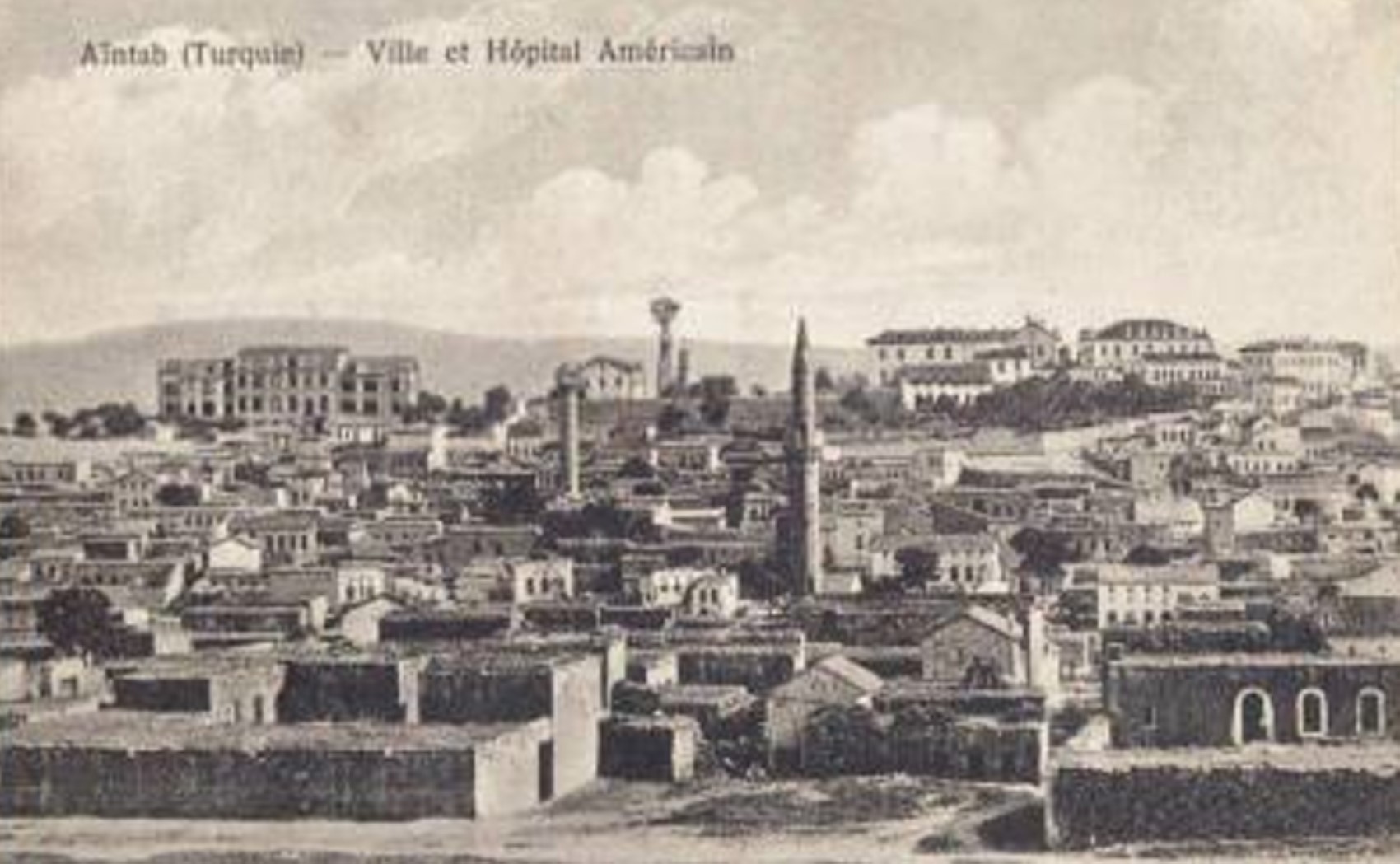
(Old Antep/Ayntab: The City and the American Hospital)
The last quarter of the 19th century was one of the most intense periods of a massive cultural plunder carried out on Ottoman lands under the guise of "archaeology."
During the same years, the event that went down in history as the "Pergamon Robbery"—led by German engineer Carl Humann in Bergama, which saw countless historical artifacts, most notably the Pergamon Altar, transported/smuggled to Berlin—had whetted the appetites of European states, especially the Germans, who had infiltrated every corner of the Ottoman Empire.
The new target of this appetite was Antep, located at the southern tip of Southeastern Anatolia, which housed thousands of years of layers of civilization.
It was the area around the İslâhiye district of Gaziantep.
During this process, the Ottoman Imperial Museum (Müze-i Hümâyun), directed by Osman Hamdi Bey, was on one hand enacting legal regulations to protect antiquities, while on the other hand, through legal loopholes left behind, it was opening new doors that facilitated smuggling to Germany, perhaps providing benefits to certain individuals.
The establishment of this colonial archaeological chain extending from Pergamon to the Gaziantep-İslâhiye-Zincirli Mound, and the interesting and dubious relationships witnessed during this process, were shaped in the shadow of the 1884 Regulation on Antiquities (Âsâr-ı Atîka Nizamnâmesi), which had been enacted to protect historical artifacts.
The doors opened by those at the head of Ottoman archaeological policy had turned into a malicious imperial plunder through the efforts of smugglers backed by the German state.
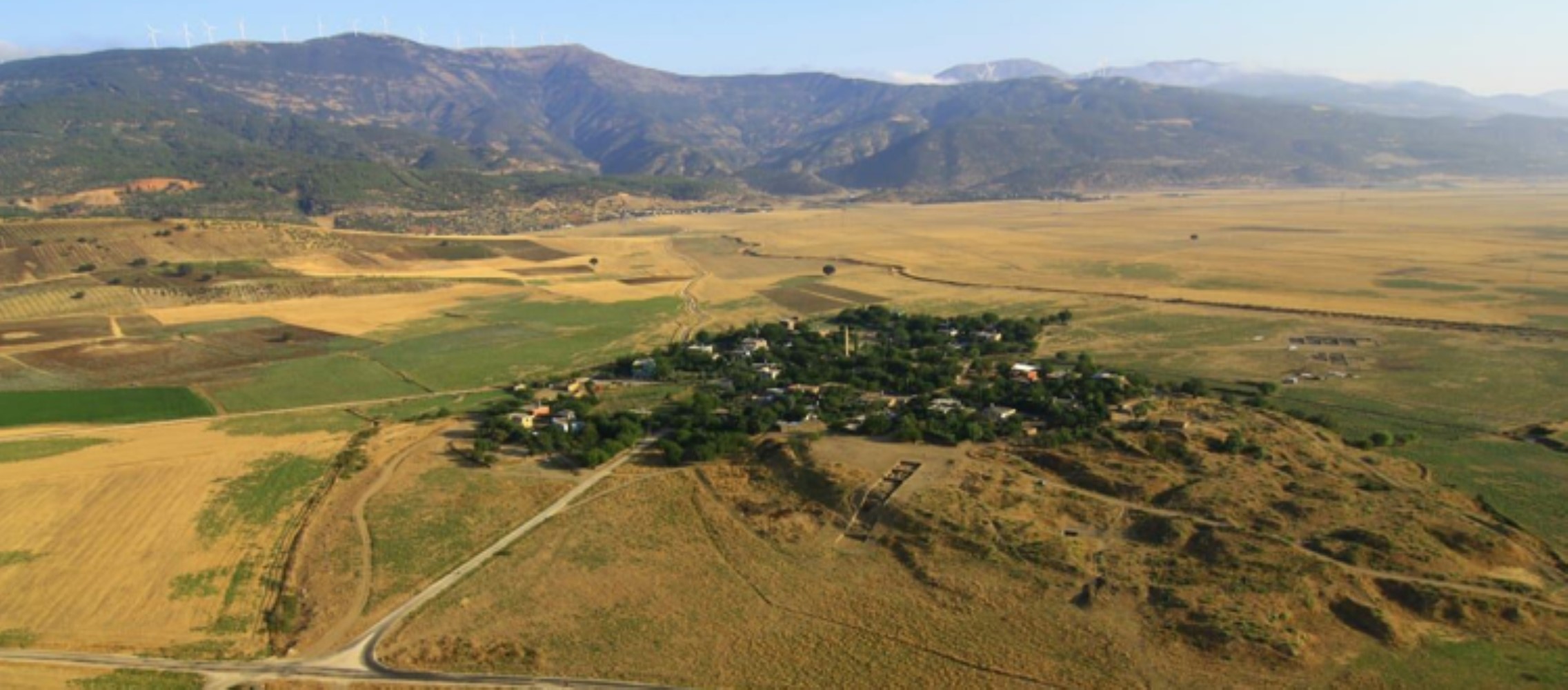
(Gaziantep-İslâhiye-Zincirli Mound: One side is a village, the other is an archaeological site)
***
Located in Southeastern Anatolia, southwest of our Gaziantep province, the İslahiye district possesses a Mediterranean climate that reaches into these areas, despite not being near the sea. It is covered with vineyards and olive groves. It is situated just north of the Aleppo region of Syria.
It is as if these places are a piece of paradise!
The old name of today's metropolis, Gaziantep, is Antep/Ayntab. This word has roots in ancient languages, Arabic (Semitic) or Armenian, and carries meanings such as "water source, spring, beautiful water, or king's land."
Due to the resistance and heroism shown by the people against French Imperialism during the War of Independence, the city was awarded the title of "Gazi" (Veteran) by the "Grand National Assembly of Turkey" in 1921, even before the Republic was founded.
"İslâhiye," on the other hand, is a city with a very ancient history in its surroundings, but the city itself is new.
It was established between 1865 and 1866 during the Ottoman Empire's efforts to settle nomadic tribes in the region and "reform" (improve) order, under the administration of Derviş Pasha and Cevdet Pasha, and the new settlement was named "İslâhiye" in reference to this.
Looking back, it is understood from excavations conducted at the mounds (hills understood to have been created by human hands) in Tilmen, Gedikli, and Zincirli that there have been settlements in this region since very ancient times, dating back to the early Copper Age (5500–5000 B.C.).
This region is already part of the 'Fertile Crescent,' where humanity transitioned from hunter-gatherer lifestyles to settled life with the Agricultural/Neolithic Revolution around 10,000 BC (approximately 12,000 years ago).
The most well-known archaeological site in this area is Zincirli Höyük, located west of the Gaziantep city center and 10 km north of the town of İslâhiye.
The name 'Zincirli' emerged during the Ottoman period.
It is said that an iron chain was found in a military well on the road passing nearby; because this was an unusual occurrence in that rural area, the village/mound began to be called 'Zincirli' (the place where the chain exists). (https://zincirli.uchicago.edu/site-and-setting/?utm)
Archaeological findings at Zincirli Höyük show that it was the center of the 'Sam'al' Kingdom, one of the Neo-Hittite/Luwian Kingdoms that flourished in Southeastern Anatolia alongside 'Carchemish' after the collapse of the Hittite Empire (early 12th century BC).
Zincirli Höyük is located at the northern end of the Kara Su (Aswad) River Valley. This river forms part of the Turkey-Syria border, joins the Afrin River, and flows into the Orontes (Asi) River.
Sam'al is situated on the plain at the foot of the Beyhan Pass in the Amanos Mountains, on the edge of a small marsh on the western side of the valley.
With this location, it lies on the ancient trade routes extending from another major ancient city, Carchemish, to the fertile Çukurova (Cilician Plain) and from there to the west of Anatolia.
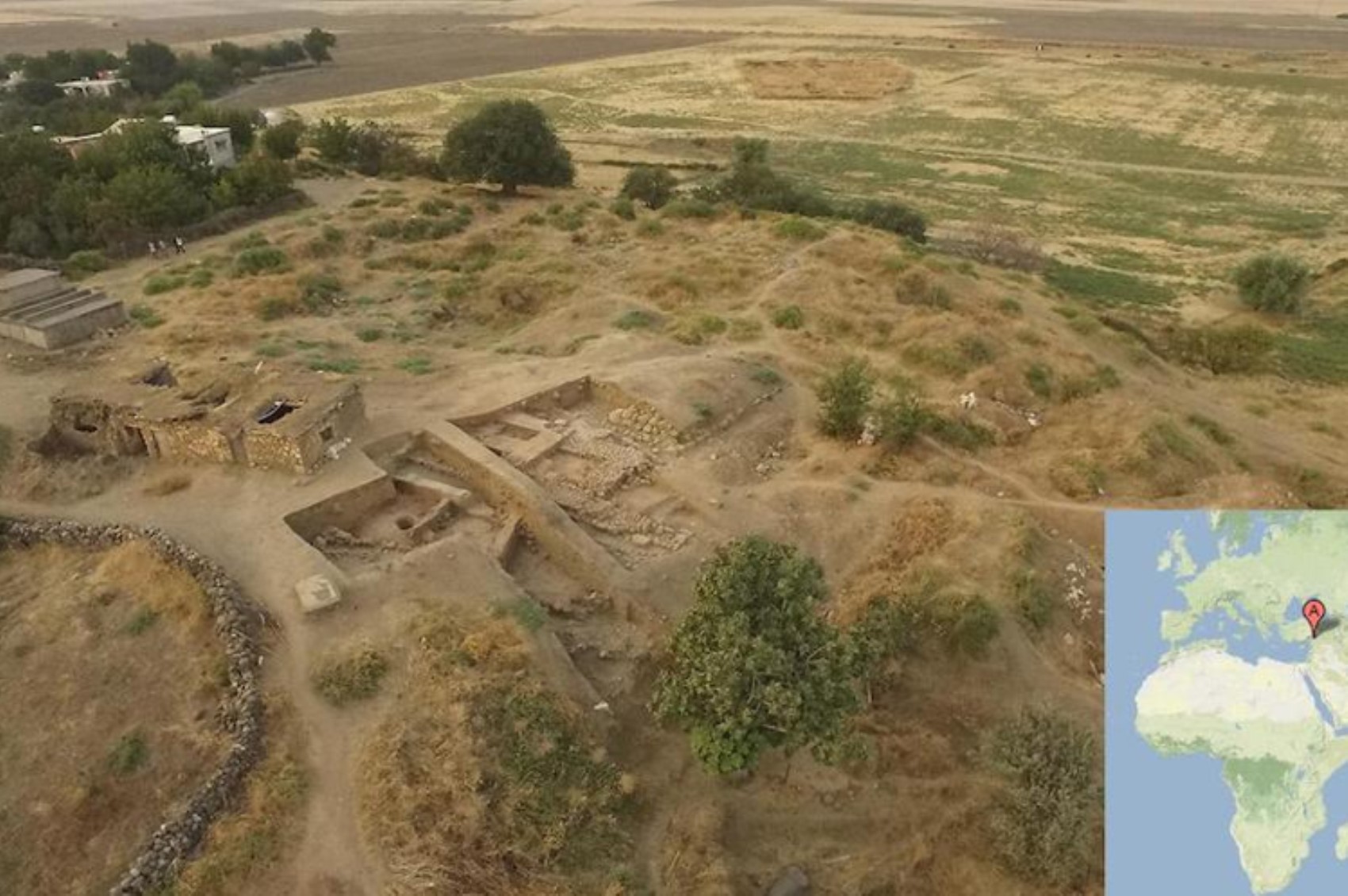
(Zincirli Höyük - Ancient Sam'al)
***
In the 2nd millennium BC, the Gaziantep region was initially under the rule of the Egyptians, and later under the Mittani Kings established by Indo-Aryan rulers.
From the 14th century BC onwards, it came under the administration of the Hittites, who dominated a large part of Anatolia.
The capital of the Hittites was Hattusa (modern-day Boğazköy, Çorum). During the era of the famous Hittite King Suppiluliuma I (died 1322 BC) and his descendants, Carchemish—which remains on the Syrian border today—was the center of the Hittite-governed region due to its dominant position over Mesopotamia. However, the Hittite people did not live directly in this area.
It is known that the oldest peoples of the region were the Luwian communities (who spoke an Indo-European language) and the Hurrian communities (who spoke a Caucasian language), who also lived in Çukurova.
After the collapse of the Hittite Empire, local kingdoms emerged in these areas, referred to by historians as the 'Neo-Hittite States'.
One of these was the kingdom centered in Sam'al (Zincirli Höyük), located near present-day İslâhiye.
Sam'al, a kingdom that maintained the Hittite tradition until 920 B.C., fell under the dominion of the Arameans, one of the Semitic peoples considered the ancestors of the Arabs, who arrived from the south after that date.
With the arrival of the Arameans, an even more multicultural structure emerged in the region.
For this reason, the names of some Sam'al kings are Luwian, while others are Aramaic.
Sam'al, which remained an independent state for many years, was annexed in 743 B.C. by the Assyrian Empire, the new great power of Mesopotamia founded by another Semitic people. It was fully incorporated into Assyria in 723 B.C.
In the inscriptions found at Zincirli Höyük, the name of the city is recorded as Sam'al in Assyrian and Bit Gabbar in Aramaic.
The kingdoms of Carchemish and Sam'al (Zincirli) took their place on the stage of history between the 10th and 8th centuries B.C. as administrations where different cultures were intertwined.
Although the Hittite Empire had physically disappeared during this period, the Hittite state tradition continued to live on in the local kingdoms.
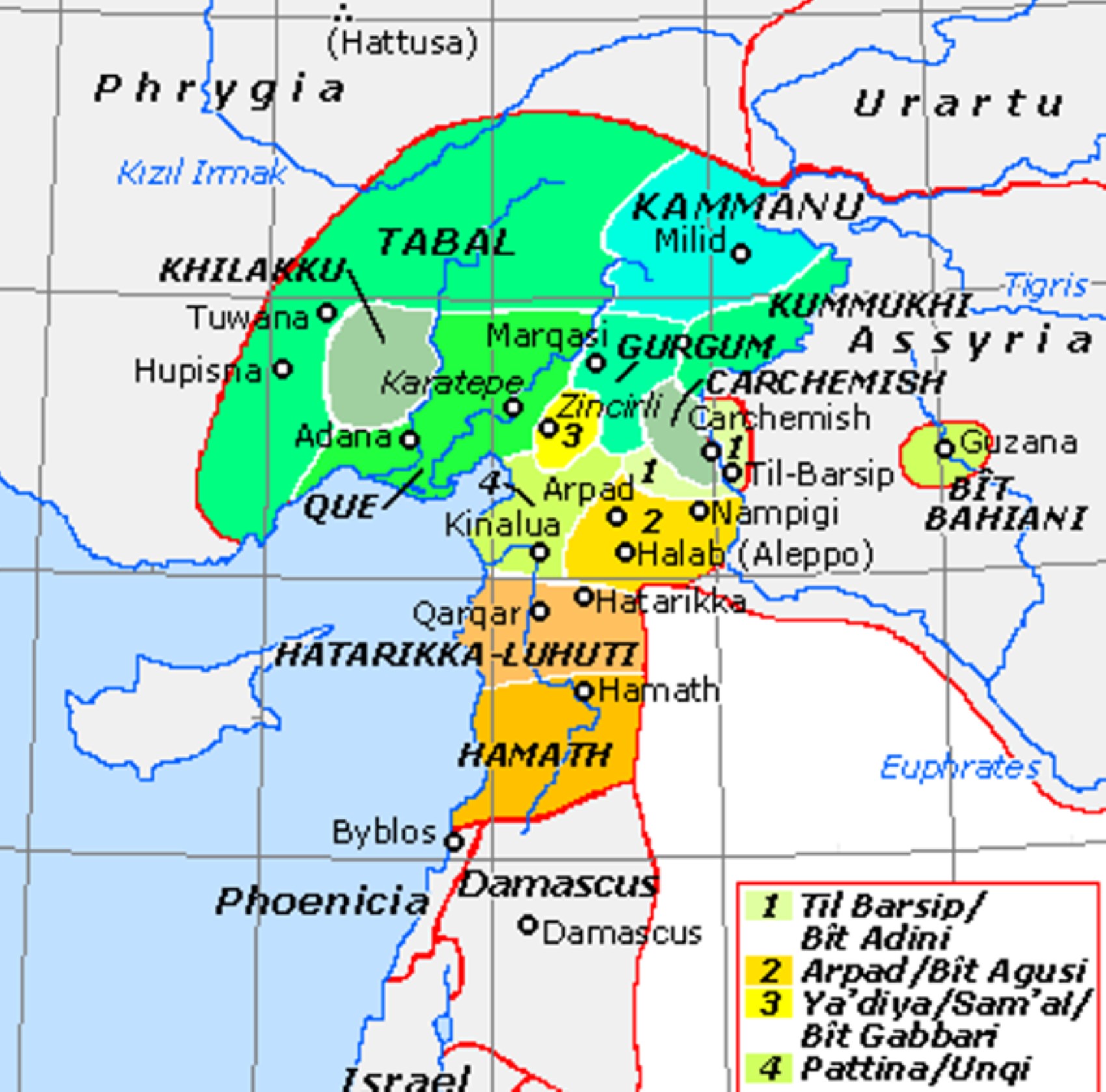
(Beginning of the 1st century B.C. Late Hittite/Luwian States. Carchemish and Til Barsip/Sam'al)
***
Inscriptions found at Zincirli Höyük show a combination of Aramaic, Luwian, and Phoenician (a Semitic people who lived in present-day Lebanon) influences.
Although Aramaic culture appears to have gradually become dominant, Luwian royal names and stone inscriptions written in Luwian hieroglyphs have also been found in the region. (Trevor Bryce, Ancient Syria, p.105)
According to Italian scholar F. Giusfredi, Luwian elements persisted among communities living under Hittite rule in the southern regions of the Middle Euphrates basin, such as Sam'al, during the 2nd millennium B.C. (F. Giusfredi, Sources for a Socio-Economic History of the Neo-Hittite States, pp.29–36)
The names of Sam'al rulers such as Kilamuwa, Panamuwa I, and Panamuwa II are of Luwian origin. Despite this, most of the royal inscriptions were recorded in Aramaic. (Annick Payne, Multilingual Inscriptions and Their Audiences, p.130)
A stone inscription found at Pancarlı Höyük, located 1 km southwest of Zincirli Höyük, was written in Luwian hieroglyphs (pictographic script).
It is said that King Kilamuwa of Sam'al, whose name is of Luwian origin, stated the following in this inscription in the Phoenician language:
“I am king, I bring peace and tranquility; I have bridged the gap between the rich and the poor.” (https://www.islahiye.bel.tr/icerik/zincirlihoyuk)
How fortunate!
May the same be true for all of humanity!
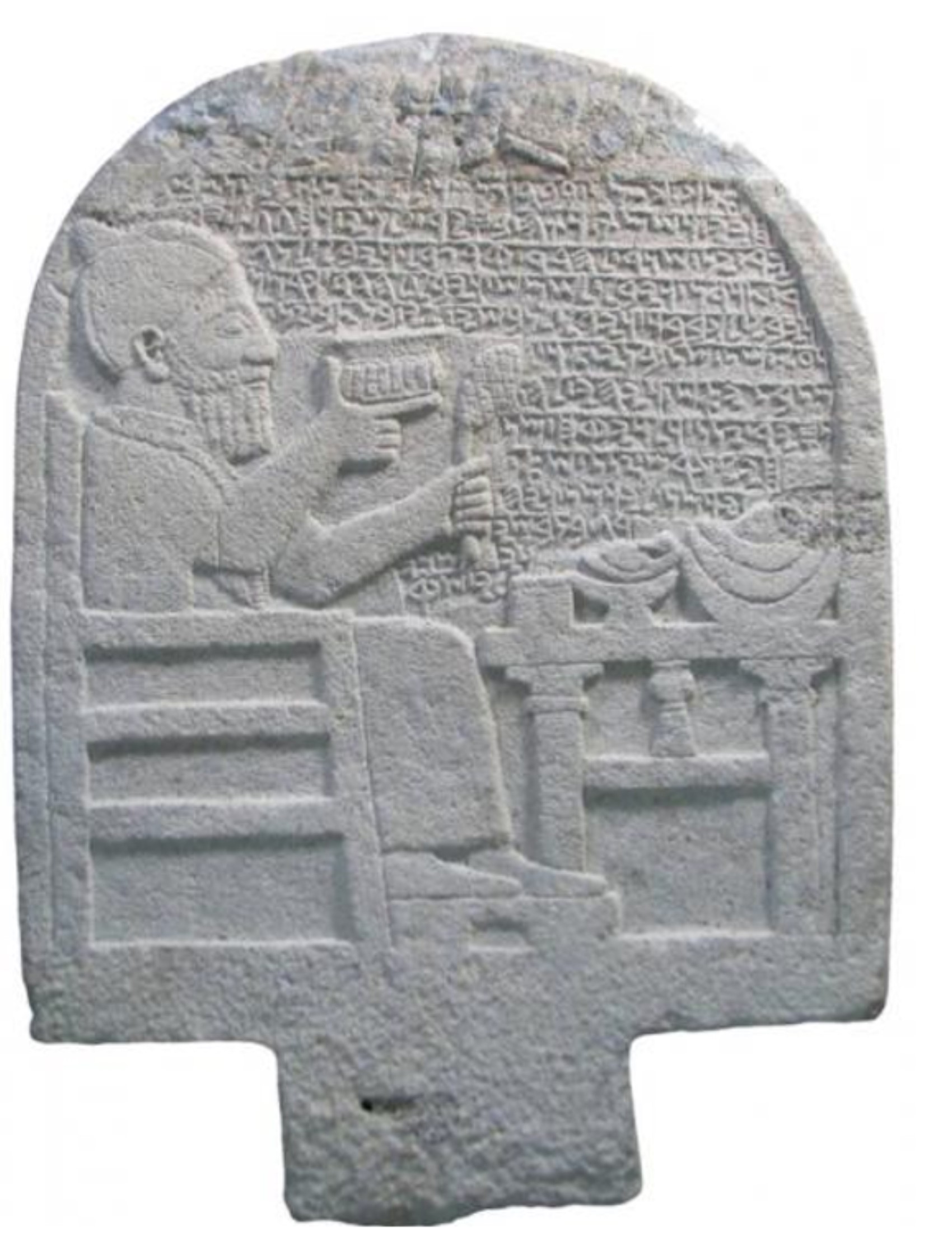
(A small piece of the Gaziantep robbery: The Phoenician inscription on the stone relief of King Kilamuwa, taken/smuggled from Zincirli Höyük/Sam'al to Germany. Pergamon/Berlin Museum/Prison)
***
The re-emergence of Sam'al, a kingdom center centuries ago, onto the historical stage occurred at the end of the 19th century thanks to Osman Hamdi Bey and German archaeologists.
In 1881, when the Director of the Imperial Museum (Ottoman Museum Director), the German Philipp Anton Dethier, passed away, Osman Hamdi Bey was appointed in his place.
Although he was not an archaeologist, he was recognized as the person who knew this field best in the Ottoman Empire.
He was the son of Grand Vizier İbrahim Ethem Pasha, of Greek descent, who had been brought to Istanbul from the island of Chios at a young age. He was an Ottoman intellectual known for his artistic personality, who had received an education abroad and possessed European sophistication.
The first and second wives of Hamdi Bey, who lived in Paris for a time, were both named Marie. It is evident that he was raised and lived in a multicultural environment.
The family of the former Grand Vizier Sakızlı İbrahim Ethem Pasha was one recognized and trusted by the Palace and Sultan Abdulhamid II.
Hamdi Bey, who was a painter, jurist, museum curator, and a bureaucrat who served in various levels of the Ottoman state, had a brother, Mustafa Bey, who was the Istanbul Customs Director; his younger brothers, Halil Ethem Bey, was a museum curator, and İsmail Galip Bey was a pioneer in the field of numismatics (the study of old coins) in the Ottoman Empire.
The entire family was in the service of the Ottoman state. They were also present in highly influential positions.
Halil Ethem Bey conducted historical excavations in the ancient cities of Alabanda and Sidamara (Aydın), while Hamdi Bey's only son, Architect Ethem Bey, carried out excavations in Tralles (Aydın).
As soon as Osman Hamdi Bey became the Museum Director, he enthusiastically launched excavations in 1883–1884 at Mount Nemrut (Kahta district of Adıyaman) and Sidon (in present-day Lebanon), having learned that significant historical remains were located there.
He gained worldwide recognition for the ornate marble tomb he unearthed in Sidon, known as the 'Alexander Sarcophagus'.
This magnificent historical artifact, which was brought to the capital, is now on display at the Istanbul Archaeology Museums.
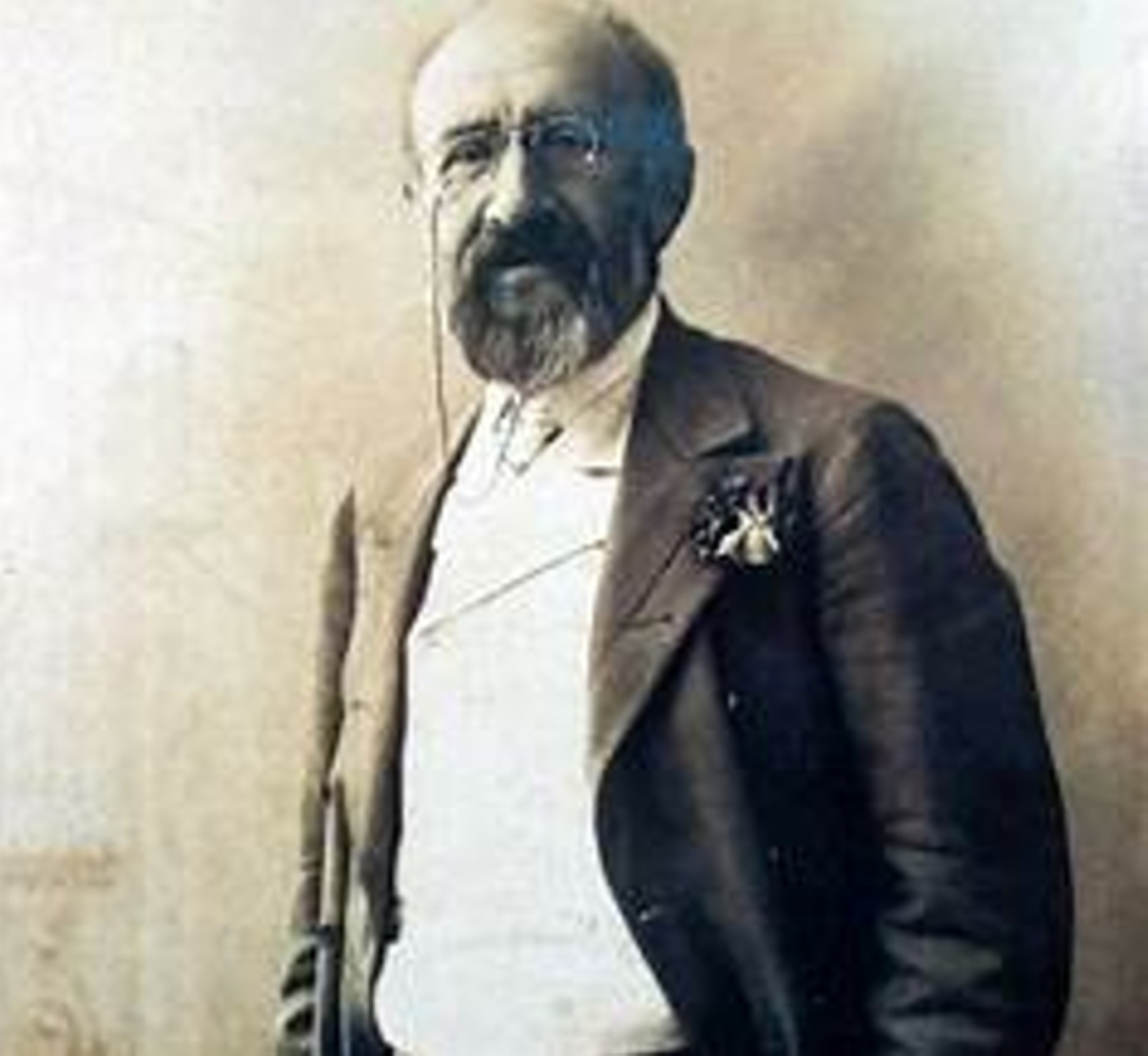
(Osman Hamdi Bey)
***
On April 27, 1883, Osman Hamdi Bey, the Director of the Imperial Museum of the Ottoman Empire, traveled to the region via İskenderun alongside the Armenian sculptor Osgan Efendi to conduct research on historical artifacts at Mount Nemrut and its surroundings.
This trip was organized at the invitation of the German Carl Humann, the mastermind behind the Pergamon historical artifact robbery, who was understood to be a friend of Osman Hamdi Bey.
Engineer Carl Humann, who was involved in shady dealings in the ancient city of Pergamon, set out on April 30 to join this expedition.
He was accompanied by German archaeologists Otto Puchstein and Felix von Luschan. (Oğuz Satır and Ali Çifçi: The “Worthless Stones” of Zincirli: Osman Hamdi Bey and the German Excavations of 1888–1902. Dergi Park, p. 215, footnote 1).
On the return journey, following reports of historical ruins in the area, Hamdi Bey headed toward the village of Zincirli near İslâhiye, Gaziantep, together with the German team of von Luschan and Puchstein. Carl Humann, meanwhile, remained at another archaeological site, Sakçagözü (Nurdağ, Gaziantep).
At Zincirli, they encountered a large mound and a collection of stone structures.
The area was filled with walls covered in stone slabs (orthostats) featuring relief carvings and inscriptions, along with worked stones. Some were still in place, while others had collapsed.
Orthostats (stone slabs) were large, decorated stone blocks that were set into the lower wall rows of city gates and citadel structures at the time, meaning they were part of a city's architectural order.
Hamdi Bey had encountered a significant archaeological site.
The team immediately began excavations.
Eight reliefs were unearthed from underground. (Oğuz Satır & Ali Çifçi, The “Worthless Stones” of Zincirli, Dergi Park)
So, what would happen to these unearthed artifacts and the artifacts likely to be found through future excavations?
Now, Hamdi Bey on behalf of the Ottoman Empire, the accompanying German delegation, and consequently the Pergamon robber Carl Humann, were aware of the existence of the artifacts in Zincirli.
Carl Humann, the architect of the Pergamon plunder, was as eager for this new discovery as a wolf spotting a tender lamb.
His immense appetite would soon become evident from the steps he was about to take!
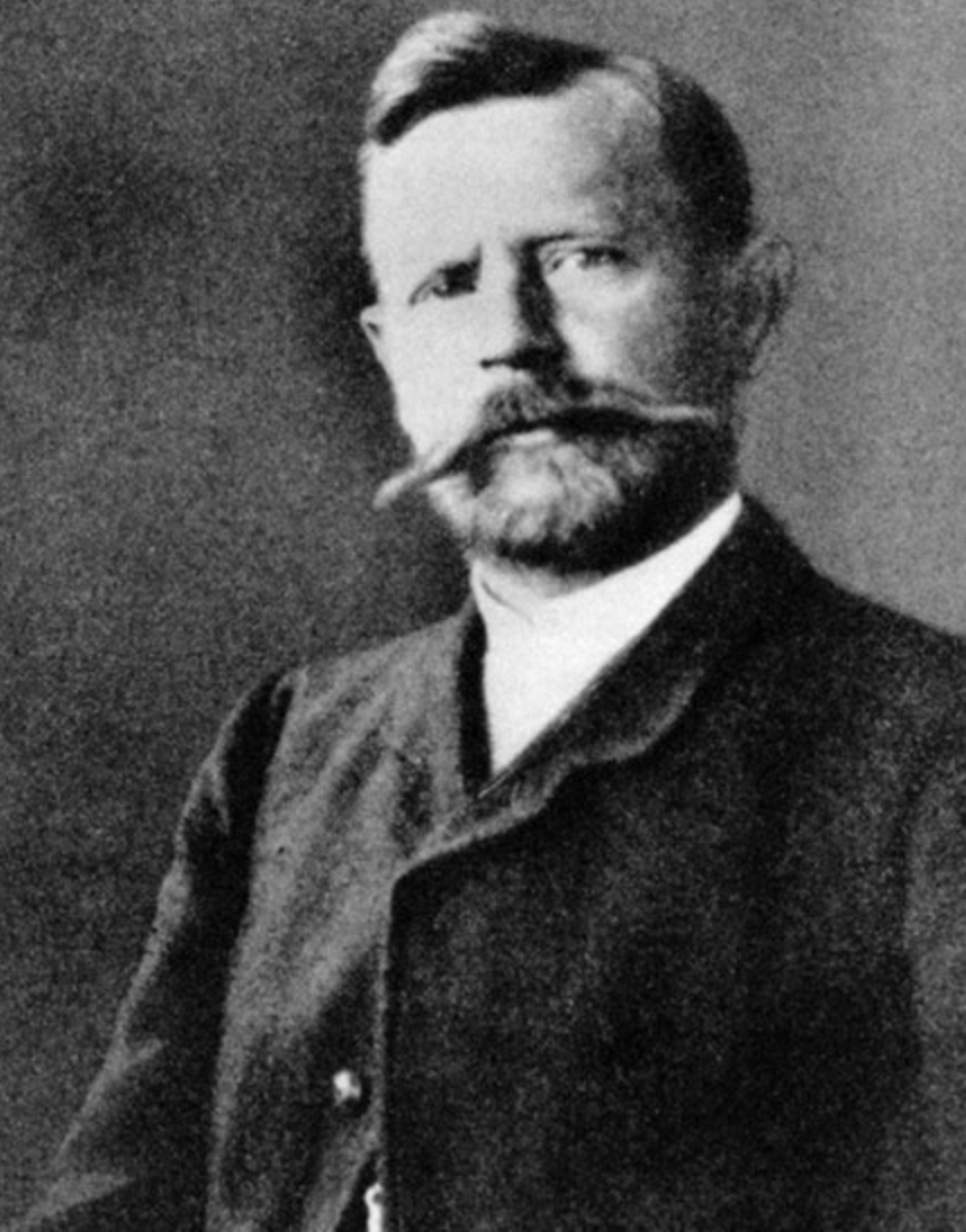
(Pergamon and Gaziantep robber Carl Humann)
***
In the late 19th century, Ottoman lands were being systematically looted by European agents who posed as "archaeologists" while appearing to be enthusiasts of historical artifacts.
To prevent this, the Ottoman Empire issued the Antiquities Regulation (Âsâr-ı Atîka Nizamnâmesi) in 1869, during the reign of Sultan Abdülaziz, which prohibited the removal of historical artifacts from the country.
During these years, the German engineer Carl Humann illegally smuggled many artifacts from Pergamon to Berlin, effectively stealing them.
Under pressure from Germany, a new regulation prepared in 1874 by P.A. Dethier, a German who was the director of the Ottoman Museums at the time, relaxed the ban that had been imposed in 1869.
However, this facilitation was still not implemented, and the removal of artifacts from the country was strictly prohibited.
Following the assassination of Abdülaziz and the accession of Sultan Abdülhamid II, the defeat in the 1877-78 Russo-Turkish War (the 93 War) created an environment where the capital, Istanbul, was at risk of falling into Russian hands, an opportunity that German Imperialism exploited.
With this event, the Ottoman Empire became even more vulnerable to German influence. It was now firmly in the grip of German Imperialism in every respect.
It would take, and then demand even more. Can the appetite of Imperialism ever be satisfied?
Thus, Carl Humann, a tool of the German state, was able to smuggle thousands of artifacts from Pergamon to Berlin.
When Osman Hamdi Bey replaced P.A. Dethier as Director of the Ottoman Museums in 1881, the Pergamon robbery, which had been continuing through unofficial and dubious official permits, must have become so blatant that the Ottoman Empire felt the need to implement new regulations.
Of course, there were also patriots in the country who opposed this situation!
Following this plunder, the Ottoman Empire, under the leadership of Osman Hamdi Bey, sought to enact—and did enact—a new and stricter Regulation on Antiquities (Âsâr-ı Atîka Nizamnâmesi) in 1884.
Representatives from the Ministry of Education (Maarif Nezareti), the Council of State (Şûrâ-yı Devlet), and the Ministry of Justice (Adliye Nezareti) all took part in the preparation process of this law.
According to the records, Osman Hamdi Bey, as the Director of the Imperial Museum (Müze-i Hümâyun), was the primary figure who drafted and defended the regulation.
Minister of Education (Maarif Nazırı) Mahmud Celâleddin Pasha was the statesman who exercised his authority to sign the regulation into effect.
Furthermore, the new regulation came into force with the approval of the Grand Vizier of the period, Mehmet Said Pasha (who was in office in 1884).
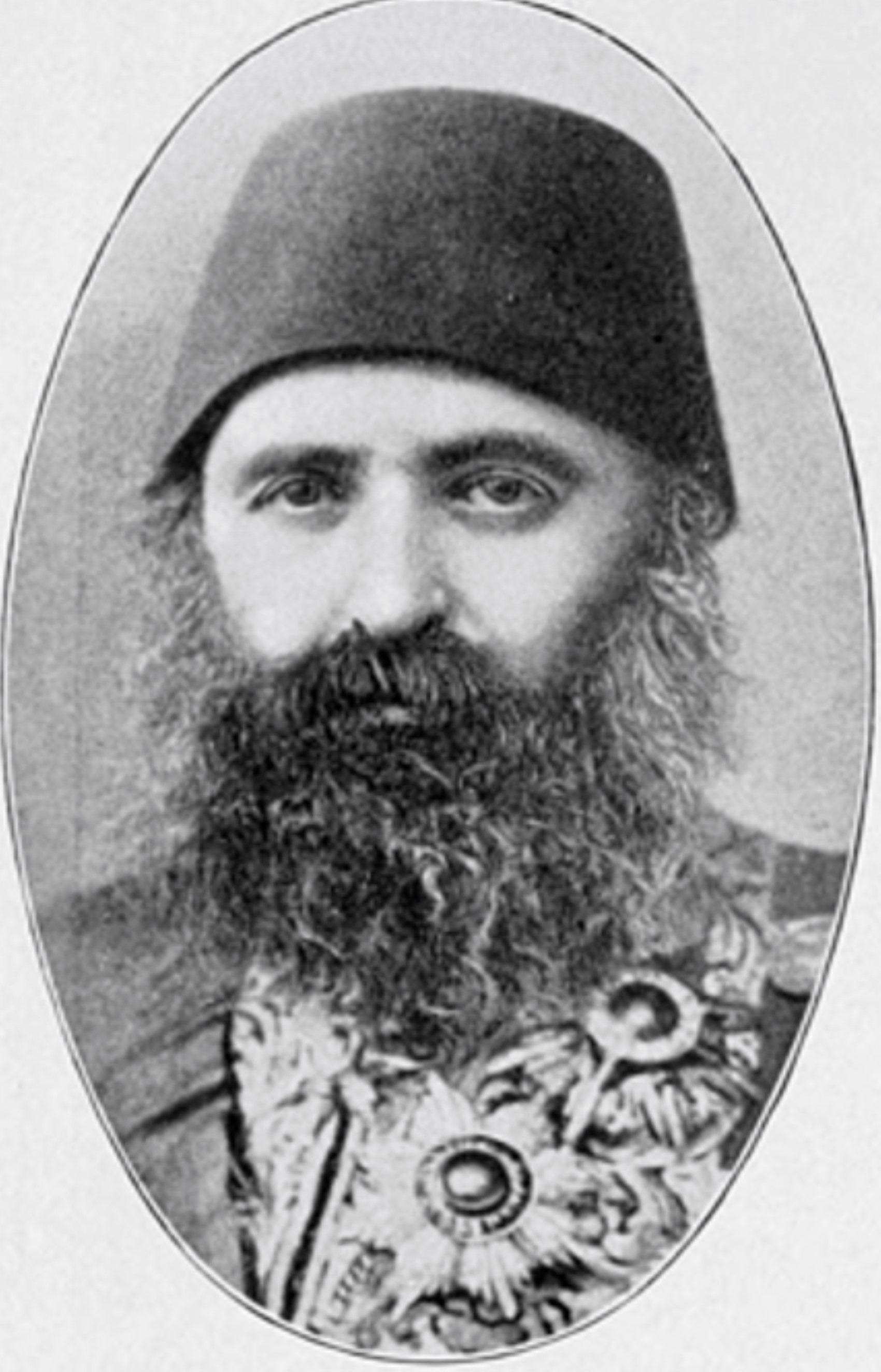
(Grand Vizier Mehmet Said Pasha)
***
This third Regulation on Antiquities (Âsâr-ı Atîka Nizamnâmesi), issued on February 13, 1884, tightened measures against the smuggling of historical artifacts.
The provisions of the regulation were clear:
Article 1: "All antiquities in the Ottoman lands are state property."
Article 2: "Unauthorized excavation is prohibited; those who wish to excavate must obtain permission from the Imperial Museum (Müze-i Hümâyun)."
Articles 3/6: "All artifacts found during excavations belong to the Imperial Museum."
These prohibitions were further strengthened in Article 8 and those that followed, particularly in Articles 9 and 10.
These provisions gave one a sense of confidence that historical artifacts would truly be protected; however, as one moved toward the end of the list of articles, the impact of the previous prohibitions began to diminish.
Article 32, in particular, was truly absurd; this provision was open to all kinds of suspicion.
Article 32:
"All antiquities unearthed during excavations belong to the state. However, if the Director of the Imperial Museum deems it appropriate, he may gift a portion of them to the excavator."
It was stated that, "If a large number of similar artifacts of the same type are found during excavations, a portion of these may be left to the excavation team, meaning they can be taken abroad."
What was the measure for this?
The matter was left to the discretion of the decision-maker!
In other words, the regulation had, in principle, tied all findings to Ottoman ownership; however, in practice, it allowed for artifacts deemed "excess" or "duplicates" to be given to the excavation team.
Moreover, the Museum Director (namely Osman Hamdi Bey) was granted extraordinary legal authority, creating the right to give whichever artifacts he wished to foreigners.
This situation opened the door for foreign archaeological teams, especially those representing powerful states, to acquire a large number of artifacts under the pretext of them being "excess/duplicates."
The same regulation also made it possible for findings to be shared through a "partition" (partage) process under the supervision of the Imperial Museum when excavation permits were granted.
In other words, a certain share was "legally" given to the excavation team, and the remaining artifacts were sent to Istanbul.
How did this system work?
Officials from the Imperial Museum (Müze-i Hümâyun) were sent to the excavation sites, and the artifacts discovered were identified and classified.
Subsequently, the artifacts were transported to Istanbul or to the nearest port to the excavation site, where the distribution took place.
According to the regulations, if there were many examples of the same type, a portion could be given to the excavation team; however, unique pieces, those with inscriptions, or those of high historical significance were reserved for the State.
Many artifacts were left to foreign delegations under the pretexts of them being "duplicates," "excess," or of "secondary importance."
And they were indeed left behind!
This system, which appeared legal on paper, created a great injustice in practice, giving rise to a new form of smuggling environment.
The Ottoman bureaucracy and the Imperial Museum often bowed to the pressure (!) of German, French, and British delegations.
For example, a large number of orthostats and lion statues from the Zincirli excavations were taken to Berlin; only a portion was left to Istanbul.
For this reason, researcher Yaşar Yılmaz describes these distributions as "not a legitimate permit, but a plunder carried out under colonial conditions." (Yaşar Yılmaz, “The Other Side of Osman Hamdi Bey”, Korpus Publishing, pp. 5–7).
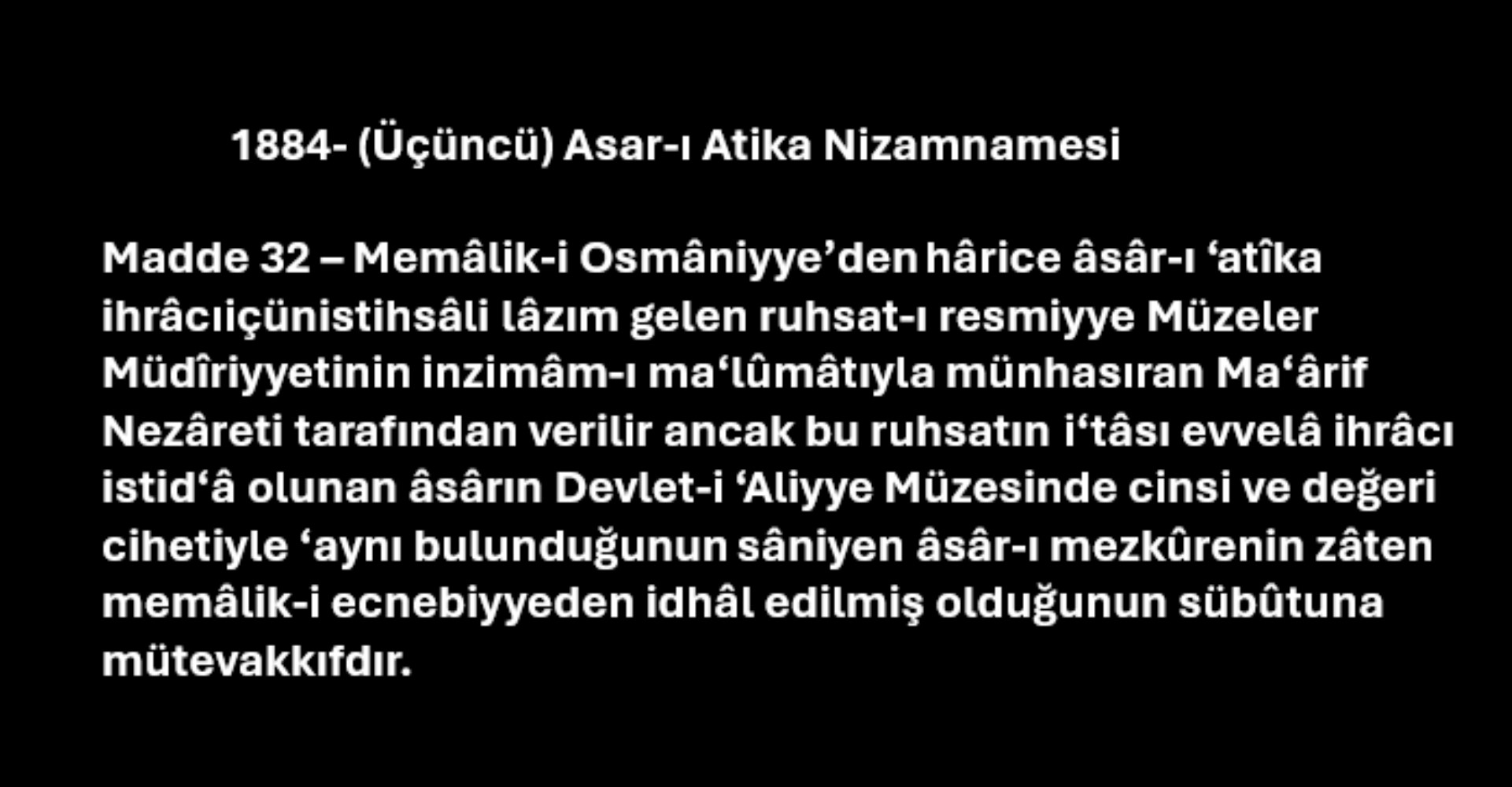
(Article 32 of the 1884 Regulation, enacted under the leadership of Osman Hamdi Bey, which states that historical artifacts could be given to foreigners at the discretion of the Museum Director (Osman Hamdi Bey))
***
In this context, it is evident that Osman Hamdi Bey was the primary actor in the construction of the 1884 Antiquities Regulation (Âsâr-ı Atîka Nizamnâmesi) and in the tightening or loosening of its prohibitions.
It is clear that the provisions linking the ownership of artifacts to the state and the permits for their export abroad were carried out through his initiative/leadership, utilizing the opportunities provided by Article 32.
It appears that Hamdi Bey persuaded the Ottoman State to enact a so-called protective (!) law that gave away in one stroke what it had acquired.
This inappropriate situation was thus embedded within Article 32 of the 1884 Antiquities Regulation, which facilitated smuggling.
Thus, Osman Hamdi Bey, as the Director of Ottoman Museums, was able to grant the artifacts he chose with the approval of the Ministry of Education and the Sultan, and he did so.
Who could possibly oppose the assessment of the "knowledgeable and cultured" person in charge of these matters within the state hierarchy?
The pressure from German Imperialism, and particularly from Emperor Frederick III, was a decisive factor in the creation of this environment.
There was also the close friendship between Hamdi Bey and the German engineer Carl Humann, who had "promoted" himself from the smuggling of Pergamon to the robbery of Gaziantep.
The silence of Abdul Hamid II on this matter is noteworthy.
Either the great Ottoman Sultan was under intense pressure from the German State, or he simply trusted Osman Hamdi Bey, whom he had tasked with this, too much!
In this situation, Hamdi Bey's failure to show sufficient diligence in the removal of historical artifacts abroad certainly cannot be ignored.
Moreover, he was the most authorized person in the Ottoman Empire assumed to understand these matters, and he was practically the decision-making authority for the entire state on this subject.
The law enacted in 1884 ostensibly prohibited the removal of artifacts from the country, but thanks to this massive loophole left open, our artifacts were being continuously smuggled abroad.
The plunder continued.
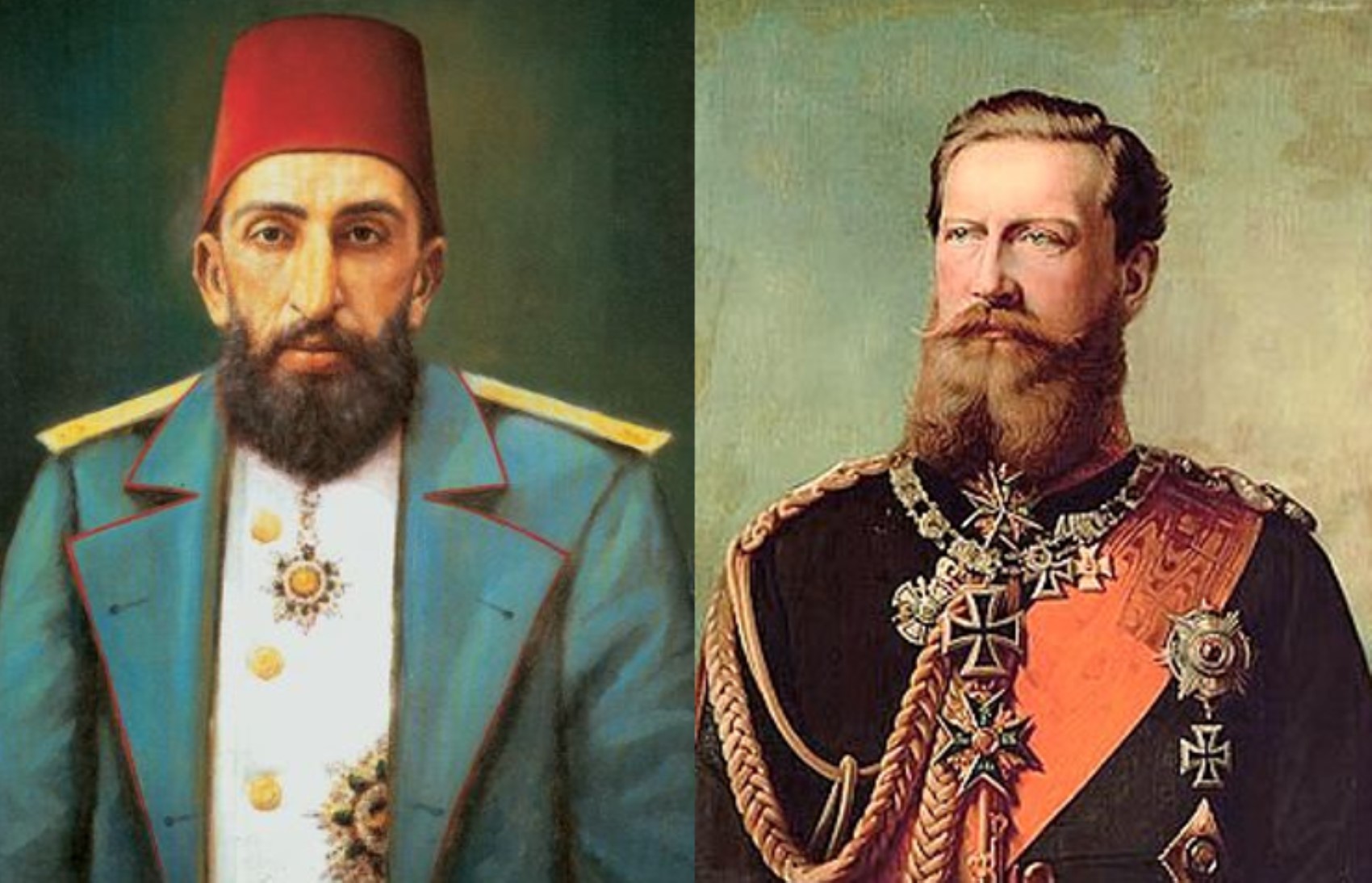
(Ottoman Sultan Abdul Hamid II and King of Prussia, German Emperor Frederick III)
***
So, within this framework, what happened in Gaziantep?
A situation similar to the dubious, and often officially illegal, smuggling of historical artifacts in Pergamon was repeated in Gaziantep, attempted to be cloaked in a legal guise but impossible to hide.
During the trip Osman Hamdi Bey took to Mount Nemrut in 1883–84 alongside the German smuggler Carl Humann and a German delegation, the artifacts he discovered and excavated around Zincirli (Sam'al) were remarkably striking in a way never seen before.
They were unique remains that were both visually stunning from an artistic perspective and shed light on a period of history that had remained in the dark.
It did not belong to the Hellenistic or Roman periods, but to a much earlier time—the dark, historical centuries following the Hittite Age, whose traces remain unknown.
During this process, Carl Humann was managing and continuing the robbery in Pergamon, while other agents of German Imperialism, disguised as "archaeologists," were preparing to seize the entire historical heritage of Anatolia.
To this end, an organization called the "Orient-Comité" (Oriental Committee) was established in Berlin on June 10, 1887.
The founders of the committee included the Egyptian artifact looter Adolf Erman (1854–1937), the Pergamon thieves Alexander Conze (1831–1914) and Ernst Curtius (1814–1896), and Eberhard Schrader (1836–1904). Later, the anthropologist and archaeologist Felix von Luschan also joined this group.
Von Luschan had taken part in the Nemrut expedition alongside Osman Hamdi Bey and Carl Humann, had been with Hamdi Bey at Zincirli Höyük, and had personally seen the ancient artifacts there and understood their value.
With the recommendation of the Berlin Museums, this German archaeological smuggling organization, the "Orient-Comité," decided to finance excavations to smuggle Anatolia's cultural assets from Zincirli Höyük and Sakçagözü to Germany.
(Oğuz Satır & Ali Çifçi, The “Worthless Stones” of Zincirli: Osman Hamdi Bey and the German Excavations of 1888–1902, DergiPark, p. 228.)
And so, Berlin attacked the historical artifacts of Gaziantep like a hungry wolf.
During this process, the 1884 Regulation was in effect; on the surface, the smuggling of historical artifacts was prohibited.
However, the final say on which artifacts could be taken out of the country remained at the discretion of Osman Hamdi Bey.
Thus, there were no obstacles left to conducting excavations in Gaziantep, removing artifacts, and sending them abroad with the approval that could be obtained.
The smuggling adventure was just beginning.
How painful it is that in these events, Osman Hamdi Bey, who is considered to have revolutionized Turkish archaeology and is accepted as the founder of Turkish museology, was not innocent at all!
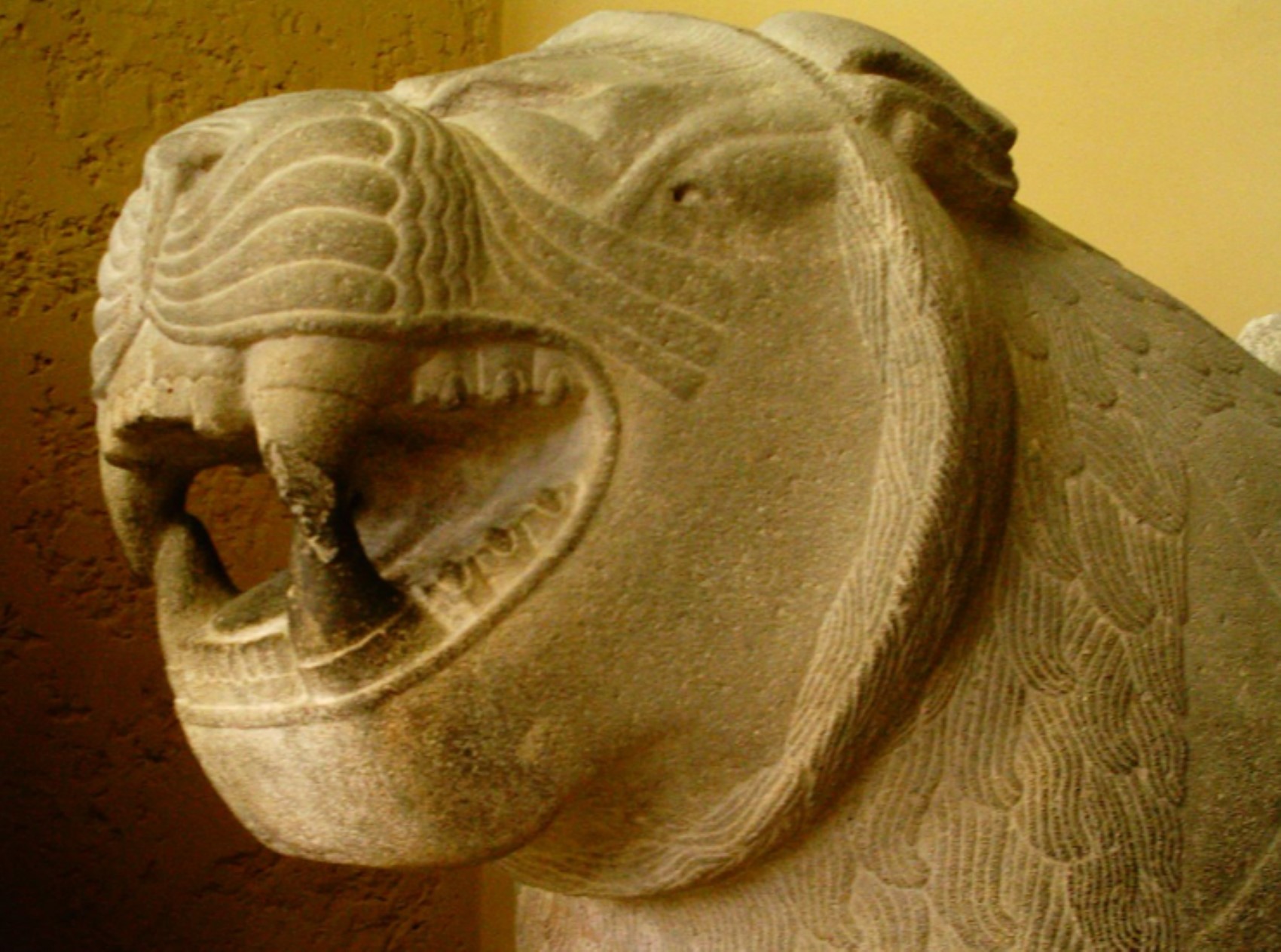
(A basalt lion head, dismantled from the inner castle gate in Zincirli/Sam'al and taken/smuggled to Germany. 8th century BC. Berlin Pergamon Museum/Prison)
***
Antep, which was defended by the National Forces (Kuvayı Milliye) under the leadership of Şahin Bey against French Imperialism in 1920, had come under attack by German Imperialism 35 years prior to this resistance, in 1884.
Imperialism has constantly swarmed to the fertile lands of Anatolia in the past, and it continues to do so today.
To its cultural assets, its gold, its silver, and its precious minerals!
There is a proverb used in Central and Southeastern Anatolia for such situations.
"Flies swarm to honey; everyone runs to a lucrative door."
Just as flies swarm to honey and cats to the smell of fat where there is bounty, profit, or interest, the opportunistic greed of those seeking gain gathers around power and wealth.
The story stretching from Bergama to Zincirli is exactly this.
How they have robbed and continue to rob this country!
To be continued in the next article!
Sefa Taşkın
02.11.2025
Bergama/İzmir
Most Read

Striking picture for Özgür Özel's 'New Party'

Özgür Özel gives a dated response regarding the number of resignations

Forest fire in Antalya brought under control

The PKK opening and Özgür Özel’s path!..

How did the newspapers view Özgür Özel's farewell to the CHP?

He killed his wife by slitting her throat: Their children witnessed the moments

What did the CHP do?

Özel’s new party move in the world press

The New CHP, against CEHAPE

Fire at TUSAŞ engine factory in Eskişehir under control