



HEAVY ON THE STONE-161. LET US NOT FORGET, LET US NOT LET THEM BE FORGOTTEN
Why would a person, an institution, or a state seize someone else's property or heritage?
Inheritance, in its most basic sense, is the entirety of the assets, rights, and debts left behind after a person's death. It has different uses in legal, cultural, and metaphorical contexts.
"Seizing"; means "taking over," "taking by force," or "extorting." In a sense, it is "theft."
Cultural heritage is the sum of the material and spiritual values that a society has passed down from the past to the present.
This heritage reflects the identity, history, and cultural continuity of a country or a community.
Throughout history, some states have extorted, looted, or forcibly detained the cultural heritage of other states or peoples.
This situation has generally occurred during wars, colonialism, occupations, or through dubious permits and illegal excavations.
The material and spiritual phenomena left behind by the people and societies that have lived in Anatolia since time immemorial are a legacy left to us who live on these lands.
Göbeklitepe (Şanlıurfa), Çatalhöyük (Konya), Bergama and Ephesus (İzmir), Aspendos (Antalya), Hagia Sophia and Topkapı Palace (Istanbul), and Divriği (Sivas) are just a few of the places where our cultural heritage is located.
In this context, Anatolia's unique cultural heritage has been looted for decades by foreign individual smugglers and the circles that encourage them, as well as by foreign states and their local collaborators, in ways that are contrary to law and universal morality.
***
So why were the Germans, like the British, French, and Russians, taking historical artifacts abroad?
The smuggling of the Zeus Altar in Bergama by the Germans — or as they call it, "transporting" — is closely related to the colonial archaeological understanding of 19th-century Europe, the race for power, and the quest for scientific prestige.
This event is not just a theft of cultural heritage, but a multi-layered event that reflects the mindset of an era.
In 19th-century Europe, there was a great race to collect ancient artifacts among powers such as England, France, Germany, and Italy.
While the British were taking the Elgin Marbles of the Parthenon in Athens and the French were taking obelisks from Egypt, Germany turned to Bergama, saying, "Let us also have a hand in this soup of smuggling (!), let us have a monument."
Stealing the Zeus Altar became a symbol of national pride and cultural superiority for Germany!
In fact, on July 26, 1886, they held a grand ceremony at the Lehrter Train Station in Berlin with the participation of 1,500 actors dressed in ancient costumes, celebrating the arrival of the historical artifacts smuggled from Bergama as if it were a victory.
Despite the first Asar-ı Atika (Antiquities) Regulation issued by Sultan Abdülaziz in 1869 and the second Asar-ı Atika Regulation of 1874 issued by Dethier, the Director of the Imperial Museum (Müze-i Hümayun), whom the Germans helped appoint, the Bergama artifacts were taken out of the country secretly or through bribery.
After the 1877-78 Ottoman-Russian War, many artifacts that remained were smuggled out with dubious permits.
This act, supposedly done in the name of protecting historical artifacts, was actually a completely malicious removal! In a sense, it was "theft."
The marble friezes and statues of the Zeus Altar consisted of large but portable pieces; this made it easier to transport the pieces to ports that would deliver them to Berlin by ship.
The newly rich German imperialism, whose origins lay in the wild Germanic tribes that lived in dense forests and swamps, was trying to compensate for its own historical deficiency by leaning on Greco-Roman culture.
German intellectuals saw ancient Greek culture as the foundation of German identity. Thus, the old wild past would be covered with a noble cloak!
The Zeus Altar was considered one of the most important structures representing the cultural heritage of humanity and Anatolia.
***
It was with this perspective that the Germans looted Bergama.
At the end of the 19th century, with the support of German colonialists and their henchmen in the country, they plundered the historical artifacts of Bergama/Pergamon that had survived to the present day.
They put them in the frightening stone buildings they called "museums," which were essentially prisons.
Moreover, these buildings, constructed on an island in a river running through the middle of Berlin, are sinking into the mud a little more every day because the ground is swampy.
Still, right now!
To prevent this, they are trying to spend billions of Euros instead of returning our artifacts, and they are closing the so-called museum to visitors for about thirty years.
***
German officials today do not hesitate to use the term "Kulturbesitz" in the records they keep regarding the Zeus Altar, statues, and other artifacts smuggled from Bergama to Berlin.
The German word "Kulturbesitz" means "cultural property" or "cultural heritage."
This concept covers all kinds of assets that societies or humanity have carried from the past to the present, which have historical, artistic, archaeological, scientific, or cultural value.
Artifacts exhibited in museums as tangible cultural heritage, archaeological finds, historical structures, works of art, manuscripts, documents, local objects, and tombs fall within this scope.
Intangible cultural heritage is defined as values that are not physical but are passed down from generation to generation, such as oral traditions, rituals, knowledge, and skills.
These include; folk music, fairy tales, epics; traditional handicrafts such as knitting and weaving, holidays, ceremonies, dances, traditional food culture, idioms, and proverbs. For example, events such as Nevruz celebrations, the Minstrel (Âşık) tradition, and Karagöz–Hacivat are within this scope.
For these reasons, cultural heritage is the memory of a country, of a people.
For one reason or another, one way or another, the extortion or smuggling of cultural heritage is not just a physical loss; it is also an attack on identity, history, and sovereignty.
In this context: "A people's cultural assets must be respected, they must not be looted."
To say it in German for those who do not understand:
“Der Kulturbesitz eines Volkes soll respektiert und nicht geraubt werden.”
The fact that they shamelessly label our artifacts taken/smuggled from Anatolia, which are currently in Berlin, Germany, as "Prussian Cultural Heritage" (Preußischer Kulturbesitz) is an undefined, and even immoral, attitude.
***
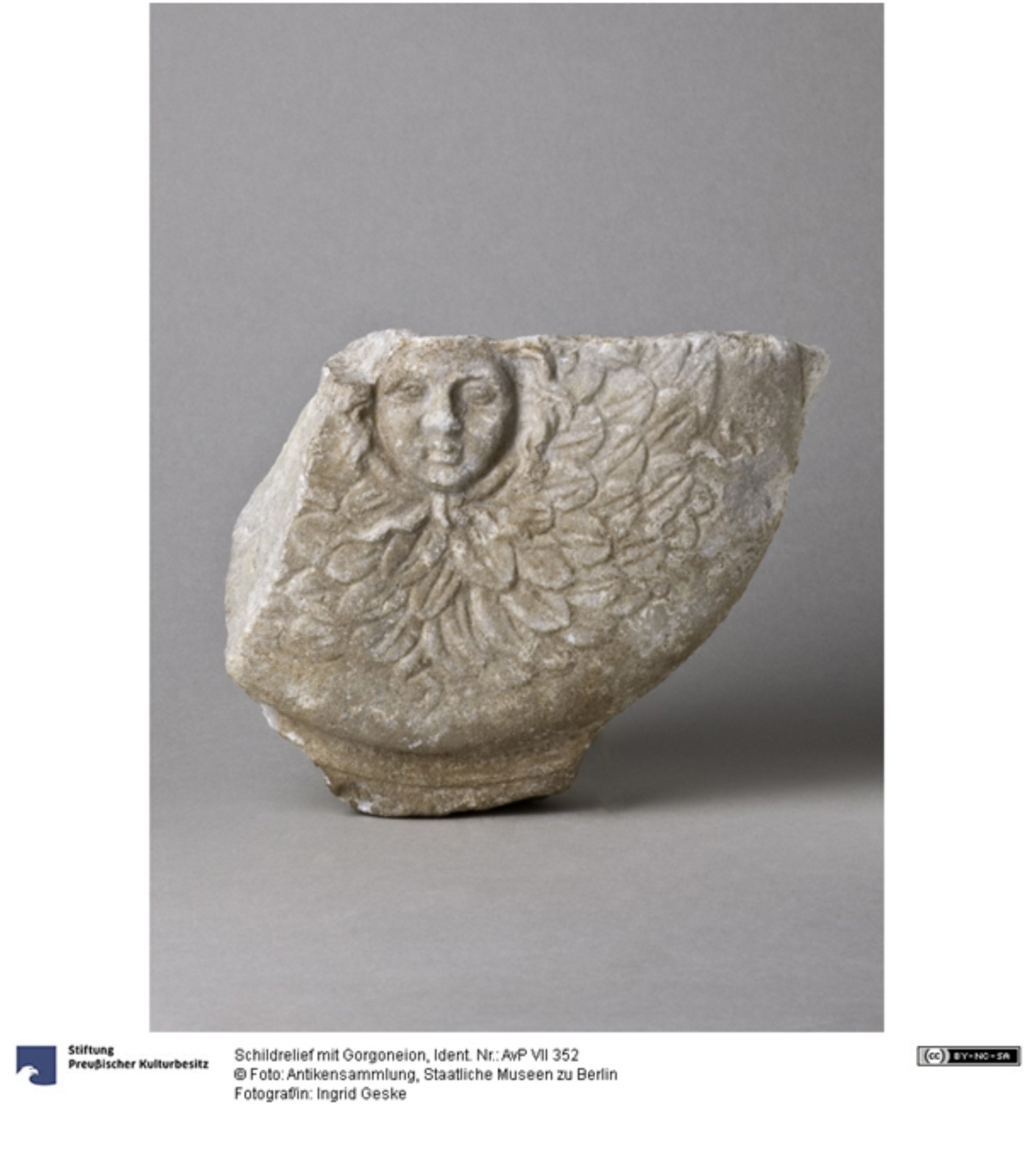
Among these works; a marble piece with the "Gorgon's Shield" engraved on it, which is understood to have been seized during the excavations made to smuggle the Zeus Altar and Bergama statues in the Bergama Acropolis/Castle, is also a prisoner in the Berlin Museum/Prison.
Its dimensions: "12 x 14 x 7.5 cm", and this round marble artifact, which weighs 4 kg, has the Museum/Prison identification number "AvP VII 352".
It is likely a piece of another, larger statue.
Berlin Museum/Prison officials have avoided giving a date for when the marble artifact was seized.
In other words, it is not clear when it was found or smuggled.
It has been reported that the "Gorgon's Shield" was found in the Temple of Dionysus and the sacred area right next to the terrace below the world's steepest theater, which has a capacity of 15 thousand people and is located on the Pergamon Acropolis.
So, the German thieves disguised as archaeologists did not just dig up and smuggle the Zeus Altar; they tore up every part of the Acropolis and the Castle and took whatever they found.
The artifact has been dated to the 2nd century B.C., the most brilliant period of Pergamon history.
In those years, the most talented sculptors, architects, and scholars of the era were gathered in Pergamon.
The figure on the marble shield belongs to the "Gorgon," one of the oldest elements of Hellenic belief and mythology.
The depth in the gaze of the Gorgon, the female figure in the center of the shield, shows that the work came from very skilled hands.
The face of the Gorgon, a mythological being, is not frightening contrary to expectations; even her pathetic expression carries a face that is open to interpretation, far from directly instilling fear in the viewer.
The plumpness of her cheeks makes her almost an affectionate being.
Moreover, despite being a very powerful figure, her gaze is not from above, nor does it carry a meaning that belittles the person in front of her.
The shapes surrounding the Gorgon resemble leaves.
Clearly, the sculptor wanted to reflect the mastery of his art on this shield rather than fearfulness.
Or he preferred to depict the Gorgon in nature, among the leaves.
Since it is stated that this shield is a piece of a statue, who knows, how beautiful a work that statue must have been, which is understood to have come from the hands of a master sculptor…
***
The Gorgons whose image is reflected on this shield are among the oldest elements of Hellenic belief.
There are even views that connect them to the Mother Goddess cult, which is one of the oldest belief entities of Europe and Anatolia.
According to mythology, the Gorgons, who were three sisters, were terrifying-looking creatures with pointed teeth and hair made of living snakes.
Two of them were immortal; only Medusa was mortal. Anyone who looked at her would turn to stone.
Their likenesses were engraved on shields to frighten the enemy in battle. Such shields were called Gorgon shields (Gorgoneion).
It was believed that a warrior carrying such a shield was protected by the Gorgons.
This belief stemmed from the belief in ancient Aegean religion that the chief god Zeus and his daughter Athena also used such "Gorgon shields" and that these shields protected them.
Later, small medallions with the terrifying snake-haired Medusa/Gorgon head, called "aegis," which Athena wore like a medallion around her neck, appeared.
Iron knockers with Medusa heads were placed on the doors of Aegean houses built by island stonemasons until recently.
To scare away thieves.
So they wouldn't rob their houses.
But this Bergama Gorgon could not scare the German smugglers disguised as archaeologists!
They took the Gorgon marble and carried it away.
The Bergama shield smuggled to Germany does not lose anything of its magnificent appearance despite being half-broken.
The fact that the shield is broken may be due to the damage caused by the Prussian/German smugglers while prying it from the ground or ramparts, or while carrying it on the road.
Or it is possible that it was broken in the Berlin Museum/Prison, which was under bombs and destroyed during the Second World War.
And so, this "marble shield" with unique artistic and symbolic value is a prisoner in the Berlin Museum/Prison along with other artifacts smuggled from Bergama.
How sad it is to be far from the motherland...
To be torn from the lands where it lived for hundreds of years...
In the verses of an anonymous folk song that emerged among the people during the labor migration from Turkey to Germany in the 1960s, look at what the poet said, expressing the pain of being away from home:
“Germany, bitter homeland
A person lies in a foreign land
There is every kind of trouble
It is unknown where the one burning is”
THE ZEUS ALTAR AND BERGAMA ARTIFACTS DO NOT BELONG TO COLD AND FOGGY BERLIN, BUT TO BEAUTIFUL BERGAMA. THEY MUST DEFINITELY COME BACK, THEY MUST RETURN HOME.
(Source: http://www.smb-digital.de/eMuseum, Database---/// https://recherche.smb.museum/detail/684279/schildrelief-mit-gorgoneion---https://en.wikipedia.org/wiki/Gorgoneion----Gorgon ///Wikipedia (Deutsch), “Almanya acı vatan,” https://de.wikipedia.org/wiki/Almanya_ac%C4%B1_vatan)
Sefa Taşkın
27.07.2025
Karşıyaka-Dikili/İzmir
Most Read

Striking picture for Özgür Özel's 'New Party'

The PKK opening and Özgür Özel’s path!..

How did the newspapers view Özgür Özel's farewell to the CHP?

He killed his wife by slitting her throat: Their children witnessed the moments

What did the CHP do?

Özel’s new party move in the world press

Fire at TUSAŞ engine factory in Eskişehir under control

The New CHP, against CEHAPE

From self-efficacy to despair

Kılıçdaroğlu's first message on Özgür Özel's new party announcement