



STONE IS HEAVY IN ITS PLACE-163. LET US NOT FORGET, LET US NOT LET BE FORGOTTEN.
Since very ancient times, those setting out on long journeys or those who would be in restricted environments have carried water containers that are not too large.
These containers meet the need to "carry water/beverages on the road."
These containers, also called "suluk" (water bottle) among the people, are generally made of metal.
They are also called "matara" (canteen).
They have been used since prehistoric times.
In very ancient times, in the Stone Age, the first examples of "canteens" were actually natural containers.
Materials such as animal skin bags, animal bladders, and hollowed-out gourds served the need to carry and store water and milk.
According to archaeological findings, in Neolithic settlements in Mesopotamia and Anatolia, in the first agricultural societies, people used bags made of animal skin to carry water and grain.
Later (around 4000–3000 B.C.), the Sumerians and Egyptians developed containers made of fired clay. Small portable jugs are the first "canteen-like" objects.
It is known that small ceramic canteens were given to soldiers and travelers, especially in Egypt.
In Ancient Greece, small containers called "aryballos" and "askos" were used to carry oil and water.
Roman soldiers and travelers carried canteens made of leather or metal called "laguncula." This can be considered the ancestor of today's military canteens.
During the Roman period (before and after the 1st century A.D.), water containers were also made of glass.
In the Byzantine period (4th century A.D. and later), special canteens called "ampulla" were produced for pilgrims going to Jerusalem.
The word "ampul" (ampoule) that has entered our dictionary today perhaps comes from the shape of these containers.
These containers were usually made of fired clay, ceramic, or metal.
They featured depictions of crosses, saints, or holy places. They functioned as both religious souvenirs and drinking vessels.
Throughout the Middle Ages, soldiers and travelers in Europe used leather bags and metal canteens.
In the Ottoman Empire, water containers/canteens were made of both copper and brass, as well as leather. The canteen was an important piece of equipment for the Janissaries.
Water is everything!
In the modern era, with the development of industry in the 19th century, aluminum and steel canteens became widespread.
Today, plastic, stainless steel, and aluminum are the most common materials used in canteen manufacturing.
***
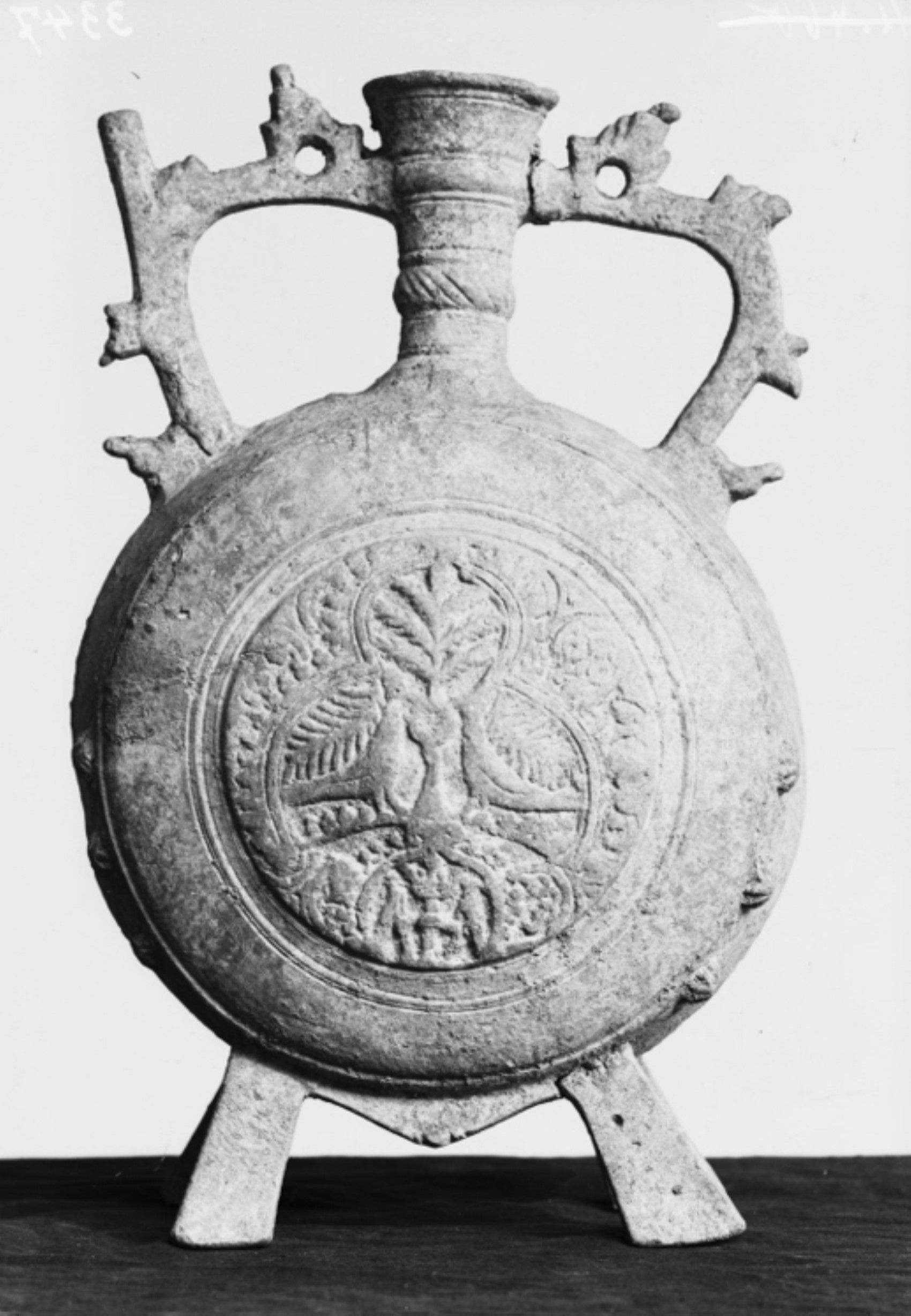
(Bergama's lead canteen)
Of course, among the many historical artifacts smuggled from Bergama, a canteen-like vessel stated to date back to the Byzantine period could not be missing.
Because they took whatever they found!
This vessel, which was reported to be kept in the Berlin Museum/Prison at one time, is made of lead.
Its height is 27.4 cm, and its body width is 16 cm.
Looking at its picture and the records kept about it, it is understood how elegant and labor-intensive it was to produce.
Art has been infused even into a canteen, such a water-drinking vessel.
The lead vessel stands on four feet, and its neck widens from bottom to top.
Handles with protrusions were attached to both sides, connecting the body of the vessel to its neck.
The fork-shaped protrusions on the upper part are perforated; perhaps they were made to be tied somewhere.
The vessel is round in shape and flattened on both sides. On both lateral surfaces of the body, there are four decorative buttons in the shape of nine-pointed stars, two of which are missing. Cracks are visible on the body, neck, and the base of one of the handles.
A circle has been drawn on the side surfaces. The inside of the circle is decorated with carved leaf, flower, and dot motifs.
Two pigeons are preparing to drink water from a fountain on an oval pedestal inside, or perhaps they are singing.
There are two large palm leaves next to them. Behind the fountain is likely a date palm tree.
If such a canteen-shaped water vessel, whose "origin" is reported to be Bergama, was manufactured in Bergama, how much care the people of Bergama must have taken to make it.
According to the introductory document, the exact date of its manufacture could not be determined, but it has been associated with the Byzantine period.
Nevertheless, it has been reported that the vessel is different from other known Byzantine lead vessels in terms of size, shape, and the images on it.
If the date/palm tree image on it is a narrative sign, perhaps this vessel, which can be called a canteen, was made for Christian pilgrims.
While its small size confirms this view, the fact that it can stand on four feet and that its mouth part has been worked in great detail also suggests that this lead canteen might have been used on a table.
Perhaps another person from another place or a Christian pilgrim brought this canteen as a gift from Jerusalem.
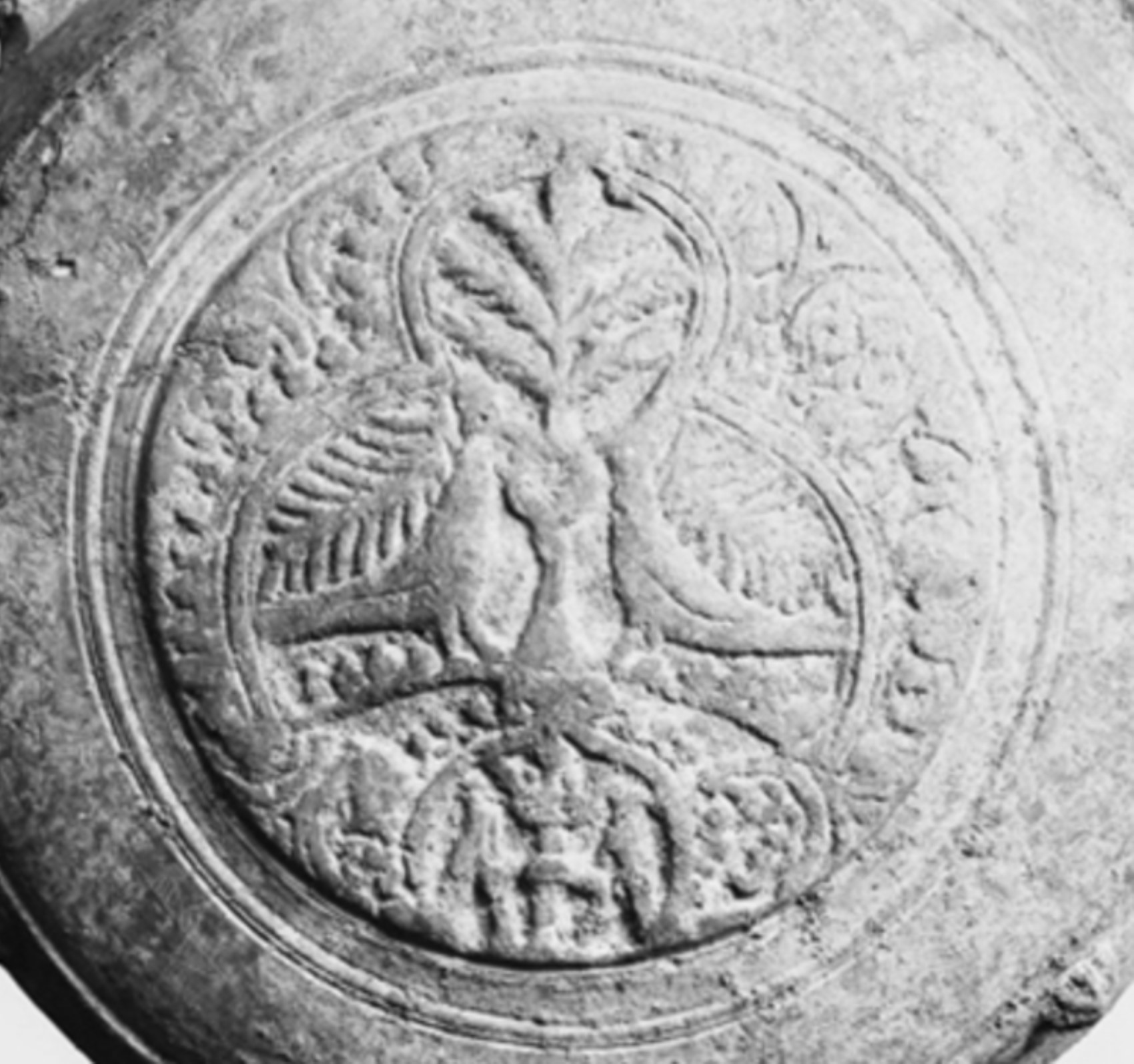
(The engravings on the canteen)
***
This is how German smugglers took such a wonderful-looking historical artifact to Berlin in 1902.
The vessel was given an identification number as "Ident. Nr. 3347" and placed in the Byzantine artifacts section of the Berlin Museum/Prison.
In the records, the authorities did not explain how and when the artifact was taken from Bergama.
The year 1902, when it is understood that the artifact was stolen, is a critical date in terms of the smuggling of historical artifacts in Anatolia.
The Ottoman Empire, with the decree-law it published on April 27, 1884, considered all artifacts found in excavations carried out with permits granted for the discovery of historical artifacts as state property, and only gave the person conducting the excavation permission to take photographs, copies, or molds.
The removal of artifacts abroad was strictly prohibited.
In other words, it was legally impossible to take historical artifacts out of the Ottoman Empire in 1902.
The 1884 Antiquities Regulation (Âsâr-ı Atîka Nizamnâmesi) was very strict on this matter.
Despite these prohibitions, some artifacts may still have been taken abroad in those years with the dubious permits or turning a blind eye by some responsible persons in the Ottoman Empire.
Or a civilian smuggler had somehow obtained this artifact and was looking for an uncultured enthusiast to sell it to.
So, who was he going to sell it to?
At that time, between 1900 and 1913, archaeologists of the German Empire were excavating in Bergama, and they were responsible for the artifacts found.
Their names were: W. Dörpfeld and H. Hepding from Germany, and P. Schatzmann from Switzerland. They were the bosses of the archaeological excavations carried out in Bergama.
In other words, this unique, priceless lead artifact, according to the German Museum/Prison documents, was seized in Bergama and entered into the Berlin records in 1902.
This historical artifact, which was found where German and Swiss archaeologists were excavating or brought from outside, was snatched and sent to Berlin.
Sleight of hand is a skill!
Moreover, even though it was strictly forbidden to take such a historical artifact abroad according to the laws of the Ottoman Empire.
So what does this mean?
***
Should it be called robbery, smuggling, or theft?
But one cannot say "may their sins be on their own heads"!
This is clearly a universal crime. And robbing a country is a very serious crime!
In this context, the Bergama robbery is multi-dimensional.
The problem does not end with smuggling and taking away Anatolian artifacts.
For years, it has been claimed that they were taken abroad to protect the historical artifacts of Anatolia and Bergama. And many domestic and foreign circles believed and still believe this.
This perception is especially the success of the famous German Imperialism's propaganda method.
Or the negligence and indifference of some Turkish officials and intellectuals!
According to that logic; the Anatolian people were ignorant, and the culture of German Imperialism, which drenched Europe in blood in World War II, was "hoch," "high."
High culture would snatch and protect valuable historical artifacts from the hands of the "ignorant," the "low culture."
For this, huge museums/prisons were built in Berlin on an island in the middle of a swamp, which is sinking into water today.
Could they protect them?
A big "no"!
The Berlin Museum/Prison was almost razed to the ground during World War II.
They supposedly moved them to bunkers! Nonsense!
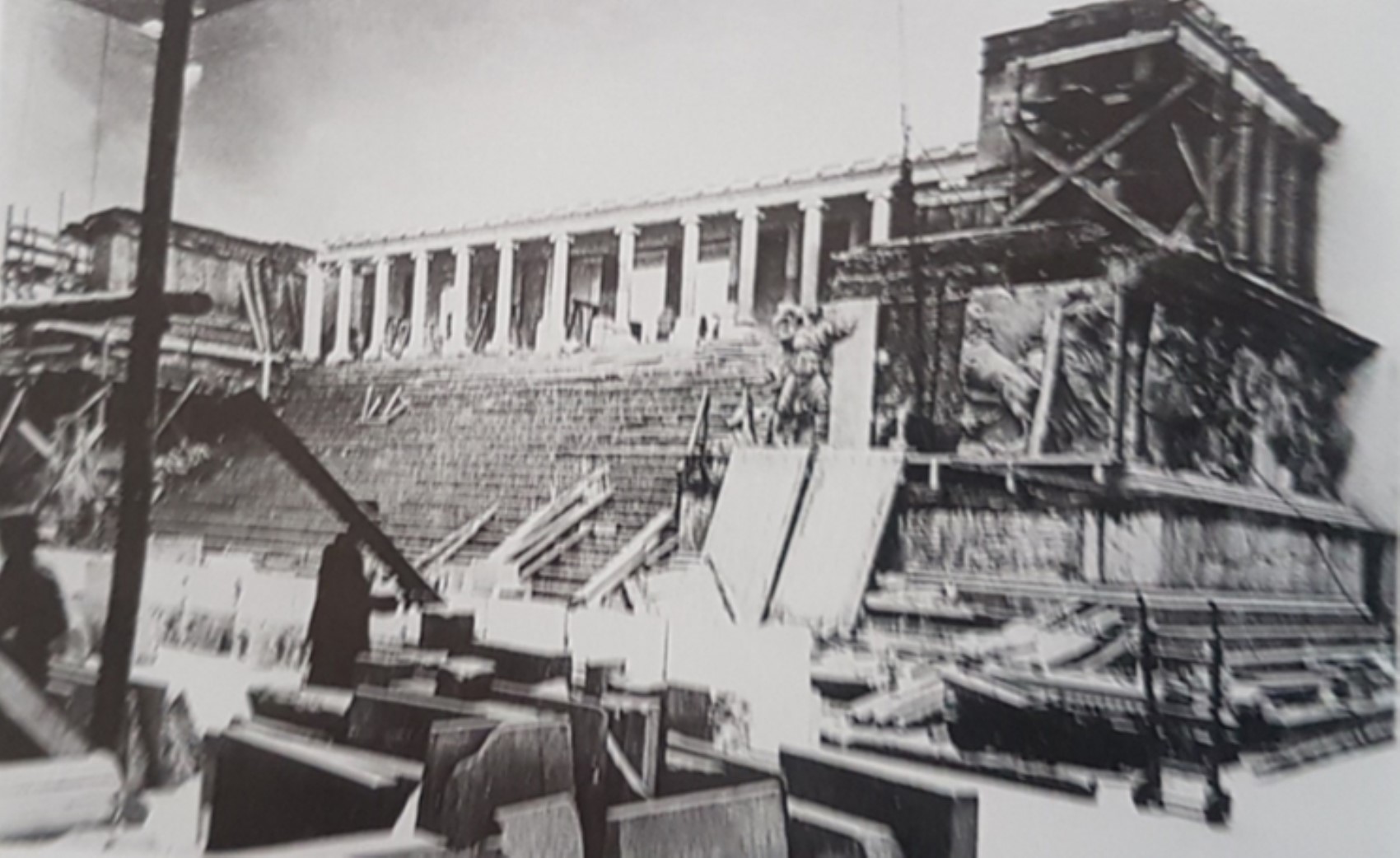
(The Zeus Altar and Bergama artifacts in the Berlin Museum/Prison, which remained under bombs during World War II)
Who knows what was lost and destroyed under that bombardment. Even thousands of artifacts, including parts of the Zeus Altar, were put on wagons and went to St. Petersburg, Russia, and came back.
The artifacts were left in a miserable state!
"What kind of protection is this!"
***
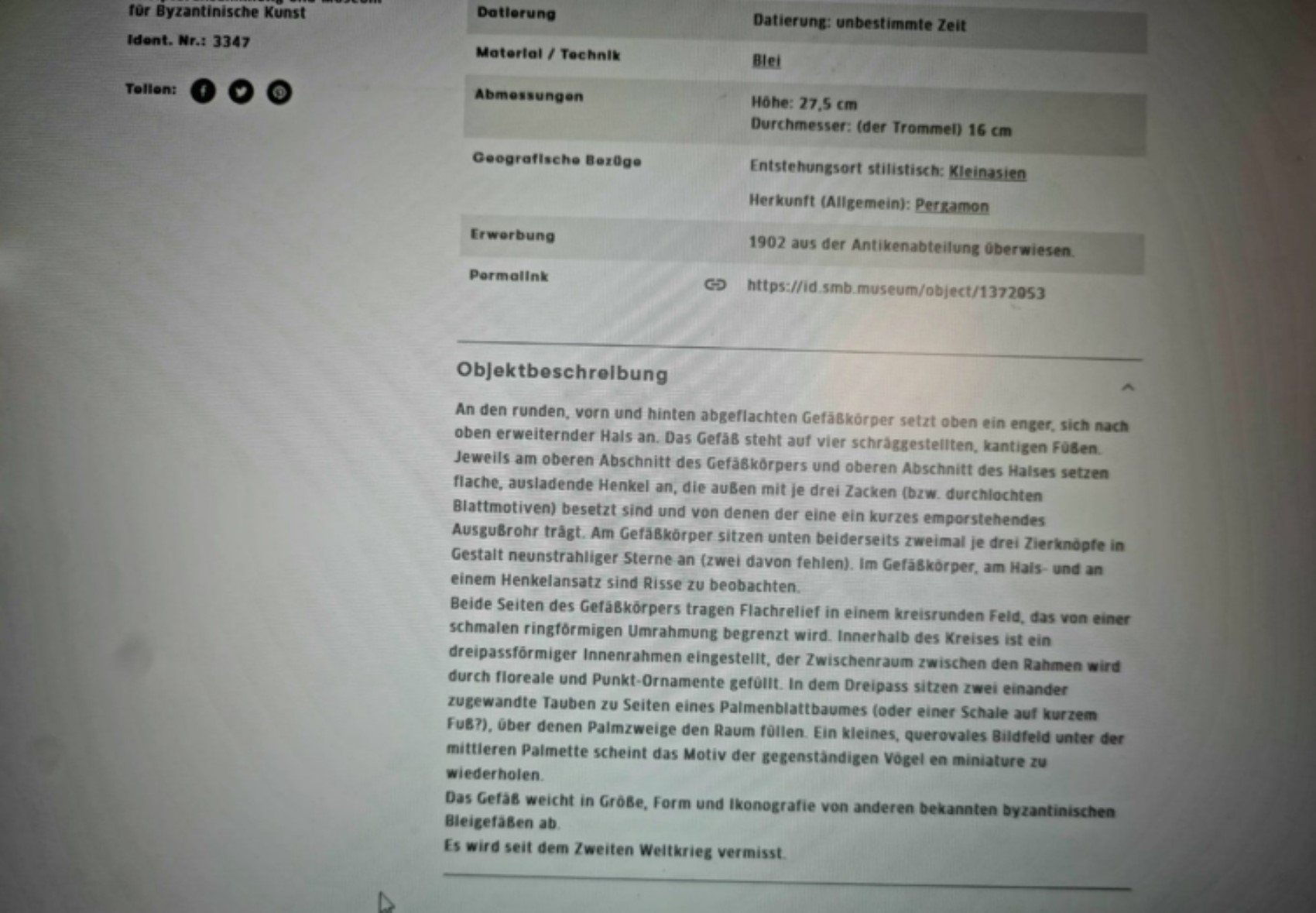
(The document stating that the canteen is missing in the Berlin Museum/Prison)
So, what happened to the extremely ornate and meaningful lead water vessel, the "canteen" from the Byzantine period taken from Bergama to Berlin?
After this "canteen" was stolen from Bergama to Berlin in 1902, it was registered in the Museum/Prison records as "Ident.Nr. 3347."
In other words, its existence was officially documented.
It is a good thing that a black-and-white photograph of it was taken in those years and examinations were made on it, so its existence is known today. Thanks to the relevant person who made that record!
So what happened later? Where is it now?
Did it "vanish into thin air," I wonder?
According to the statement of today's Berlin Museum/Prison documents:
"Es wird seit dem Zweiten Weltkrieg vermisst."
In English: "It" (the canteen), "has been missing since World War II."
At least they acted honestly and did not hide that the artifact was lost.
It means that in the Berlin Museum/Prison, which remained under bombs in World War II, or on the transport routes, Bergama's "canteen" practically evaporated into thin air.
Or it is adorning the collection of a very wealthy person in the world!
Then someone must have made a lot of money from this transaction!
In the end, the fate of the "canteen" has been "disgraced" (madara olmuş); it did not turn out well at all.
The "canteen" was subjected to a disgraceful fate; it was not only torn from its homeland but also disappeared.
"Madara" is a word that passed into Turkish from Persian. "Madara olmak" is also a slang idiom in Turkish; it means "to be disgraced, to be in a pathetic situation, to face a bad fate."
No matter how many people try to ignore it, no matter how many people stay silent because it does not suit their interests, the sun cannot be plastered with mud.
"It," the "truth," is shining brightly above us!
This valuable historical artifact of Bergama was first stolen, then lost.
This is clearly a double crime!
The time for confession has come:
Bergama's artifacts could not be protected in Berlin. They cannot be protected!
Go find it, where is that ornate "canteen" of the Byzantines of Bergama?
THE ZEUS ALTAR AND BERGAMA ARTIFACTS DO NOT BELONG TO COLD AND FOGGY BERLIN, BUT TO BEAUTIFUL BERGAMA. THEY MUST DEFINITELY COME BACK, THEY MUST RETURN HOME
(Source: http://www.smb-digital.de/eMuseum, Database-https://recherche.smb.museum/detail/1372053/henkelgefass)
Sefa Taşkın
07.09.2025
Bergama-Dikili/İzmir
Most Read

Striking picture for Özgür Özel's 'New Party'

Özgür Özel gives a dated response regarding the number of resignations

The PKK opening and Özgür Özel’s path!..

Forest fire in Antalya brought under control

How did the newspapers view Özgür Özel's farewell to the CHP?

He killed his wife by slitting her throat: Their children witnessed the moments

What did the CHP do?

Özel’s new party move in the world press

The New CHP, against CEHAPE

Fire at TUSAŞ engine factory in Eskişehir under control