



STONE IS HEAVY IN ITS PLACE-142. LET US NOT FORGET, LET US NOT LET BE FORGOTTEN.
Humans have been using scissors to cut things since ancient times.
The word “makas” (scissors), which we adopted from the Arabs, and the Central Asian Turkic word “sındı/zındı” are derived from the act of shearing sheep's wool.
This tool, which has sharp faces facing each other and is made especially of hard steel today, is essential for cutting paper, fabric, rope, and even metal pieces.
The history of scissors or their equivalents goes back to the Bronze Age (3rd-2nd millennium BC), when humanity had not yet invented steel.
The first scissors were made of bronze and iron.
Hinged iron scissors became widespread during the Hellenistic (Alexander the Great and his successors) and Roman periods.
Traces of the iron scissors used by the people of Pergamon, who dominated Western Anatolia in the 3rd and 2nd centuries BC and established a high civilization, have survived to the present day.
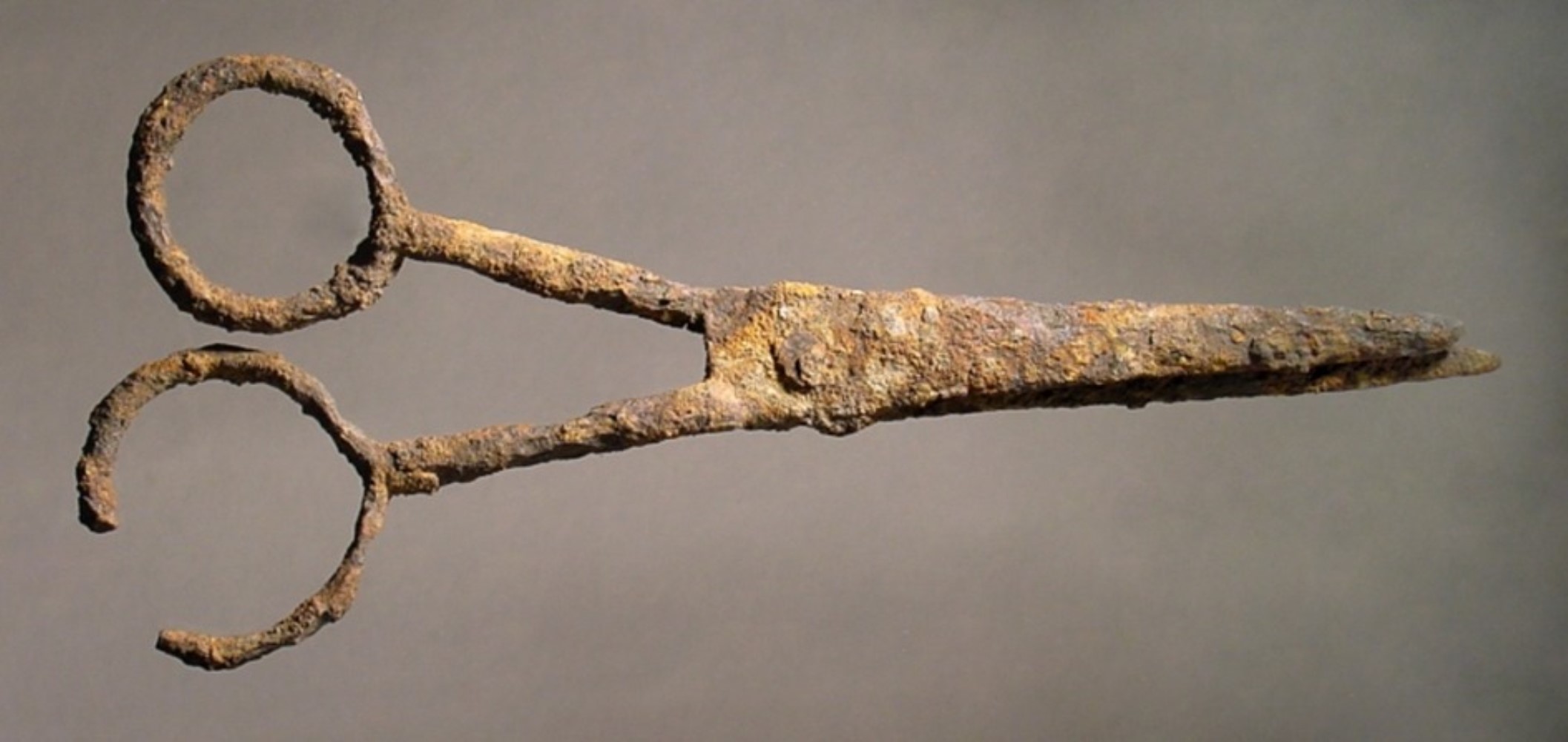
There is such a rusted iron pair of scissors among the Pergamon artifacts from the Hellenistic/Roman years kept in the Berlin Museum/Prison.
Records state that it was found in the Pergamon Asklepion, one of the largest hospitals of its era. The scissors are 2000 years old.
It was entered into the prison records with the number “Ident.Nr. 31537”.
According to the inventory book, it is 15.5 cm long.
When one sees this information, one cannot help but ask: What business do historical artifact smugglers have with the scissors sleeping under the soil of Anatolia?
What are they doing in Berlin?
*
The German engineer Carl Humann, who came to Pergamon in Western Anatolia in 1864, robbed Pergamon of its historical artifacts through outright theft until 1878, and through dubious permits until 1886.
These artifacts were generally obtained through excavations carried out at the Pergamon Acropolis/Castle and by dismantling them from the castle walls.
However, because the smuggler Carl Humann and his gang were very busy (!) stealing the Altar of Zeus, they could not discover the Pergamon Asklepion, one of the first hospitals of humanity, which had the inscription “Death cannot enter here” at its gate.
It is a good thing they did not find this sacred place!
Otherwise, they would have likely smuggled and stolen whatever they found there as well.
At that time, the place where the Asklepion is located was the field of a man from Pergamon named Ayvaz Ali.
Shepherds living in the area would occasionally see sheep disappearing into some cave-like holes in the ground and then reappearing, and they would sense that something was going on there.
But no one could even imagine that a magnificent historical site was located there.
The Ottoman Empire effectively put a stop to the robbery by C. Humann, his assistant A. Conze, and their gang in 1886. There were no excavations in Pergamon for a long time.
However, they continued their robbery through trickery and lies, such as claiming they were taking things that had been taken previously.
Subsequently, C. Humann died in 1996 and A. Conze in 1914.
The officials of German Imperialism did not let go of Pergamon.
Excavations were carried out on the Acropolis for a while between 1900-1913 by the German W. Dörpfeld, H. Hepding, and the Swiss P. Schatzmann.
Meanwhile, in 1910, the Swiss archaeologist Paul Schatzmann thought there was something historical where Ayvaz Ali's field was located and drew a plan of the area, but he could not determine what it was or where it was.
In the meantime, Aziz Ogan (1888-1956), one of the first Turkish archaeologists, was appointed as the Inspector of Antiquities in İzmir in 1914. When World War I broke out, he was drafted into the military.
During the war, in 1917, Aziz Ogan was appointed as an assistant to the German archaeologist Theodor Wiegand, who served as the “Advisor for Antiquities” in the 4th Army of Cemal Pasha, the commander of the Ottoman fronts in Syria and Palestine.
After the war, Aziz Ogan returned to his post as inspector in İzmir.
During the Republican era, in 1927, excavations in Pergamon resumed under the direction of Theodor Wiegand.
During one of his trips while Aziz Ogan was in Pergamon, T. Wiegand identified that the Asklepion, this famous hospital of the ancient world, was located in Ayvaz Ali's field, where the lambs used to disappear and reappear, and he began excavations.
In 1928, a temporary excavation depot was created where the unearthed artifacts were collected.
Osman Bayatlı, a teacher who was curious about history and historical artifacts, was appointed as the Museum Director.
The theater, temples, underground corridors, colonnaded roads, library, and sleeping rooms of the Asklepion were unearthed through official archaeological excavations under the administration of the young Republic of Turkey.
The findings were placed in excavation depots until the modest museum of Pergamon was built in 1936.
This new museum is the first excavation museum of the young Republic of Turkey.
*
The fact that the 2000-year-old rusty Pergamon scissors, which were seized in the Asklepion and smuggled from Anatolia to Germany, are found in the Berlin Museum/Prison today is clearly illegitimate, just like the Altar of Zeus and other historical artifacts!
Since the Pergamon Asklepion began to be excavated by archaeologists in 1927, the situation is obvious.
In other words, the rusty scissors of Pergamon were found in the Asklepion after 1927.
The current public records of the Berlin Museum/Prison say so.
However, the excavation of historical sites by foreigners in Anatolia has been prohibited since 1884, and the removal of historical artifacts from Pergamon has been banned since 1886!
How was this artifact taken to Germany?
The certain situation is: The presence of the Pergamon scissors in Germany is illegal.
Therefore, these scissors were smuggled to Berlin through theft or secret purchase.
It is, of course, impossible (!) for a historical artifact to have been given as a gift to foreigners during the Republican era.
It is clearly seen that the presence of the Pergamon scissors in Germany is absolutely illegal.
The fact that this Anatolian/Pergamon artifact is registered in the Berlin Prison/Museum records as Prussian (the old name of Germany) Cultural Heritage/Property “Preußischer Kulturbesitz” is a separate disgrace.
Do not dismiss it as just scissors!
It is also a piece of Pergamon/Anatolia.
It is a product of the labor and knowledge of the Anatolian people.
The Pergamon smuggling is indefensible from any angle!
THE ALTAR OF ZEUS AND PERGAMON ARTIFACTS DO NOT BELONG TO COLD AND FOGGY BERLIN, BUT TO BEAUTIFUL PERGAMON. THEY MUST DEFINITELY BE RETURNED, THEY MUST RETURN HOME.
(Source: http://www.smb-digital.de/eMuseum, Database-Antikensammlung),
İlhan Pınar: https://www.dokuzeylul.com/bergama-asklepionunun-kesfi)
Most Read

Striking picture for Özgür Özel's 'New Party'

The PKK opening and Özgür Özel’s path!..

How did the newspapers view Özgür Özel's farewell to the CHP?

He killed his wife by slitting her throat: Their children witnessed the moments

What did the CHP do?

Özel’s new party move in the world press

Fire at TUSAŞ engine factory in Eskişehir under control

The New CHP, against CEHAPE

From self-efficacy to despair

Kılıçdaroğlu's first message on Özgür Özel's new party announcement