



STONE IS HEAVY IN ITS PLACE-162. LET US NOT FORGET, LET US NOT LET BE FORGOTTEN.
The “kantar” (steelyard balance) was a large scale used in the past, especially in marketplaces.
It measured the weight of masses.
A steelyard is a device consisting of a long metal rod with measurement marks like a ruler on it, and a movable cylindrical weight in the middle.
The round metal “knob” (topuz) that balances the arm and enables measurement is located at one end of the rod.
In the middle of the rod, there is a large hook on top, and two hooks attached to chains underneath. While the large hook on top allows the scale to be hung somewhere, the chained hooks at the bottom are used to attach the load to be weighed.
Measurement is performed by sliding the cylindrical weight along the measurement lines on the metal rod. The measurement line where the cylindrical weight is balanced with the knob indicates the weight of the load.
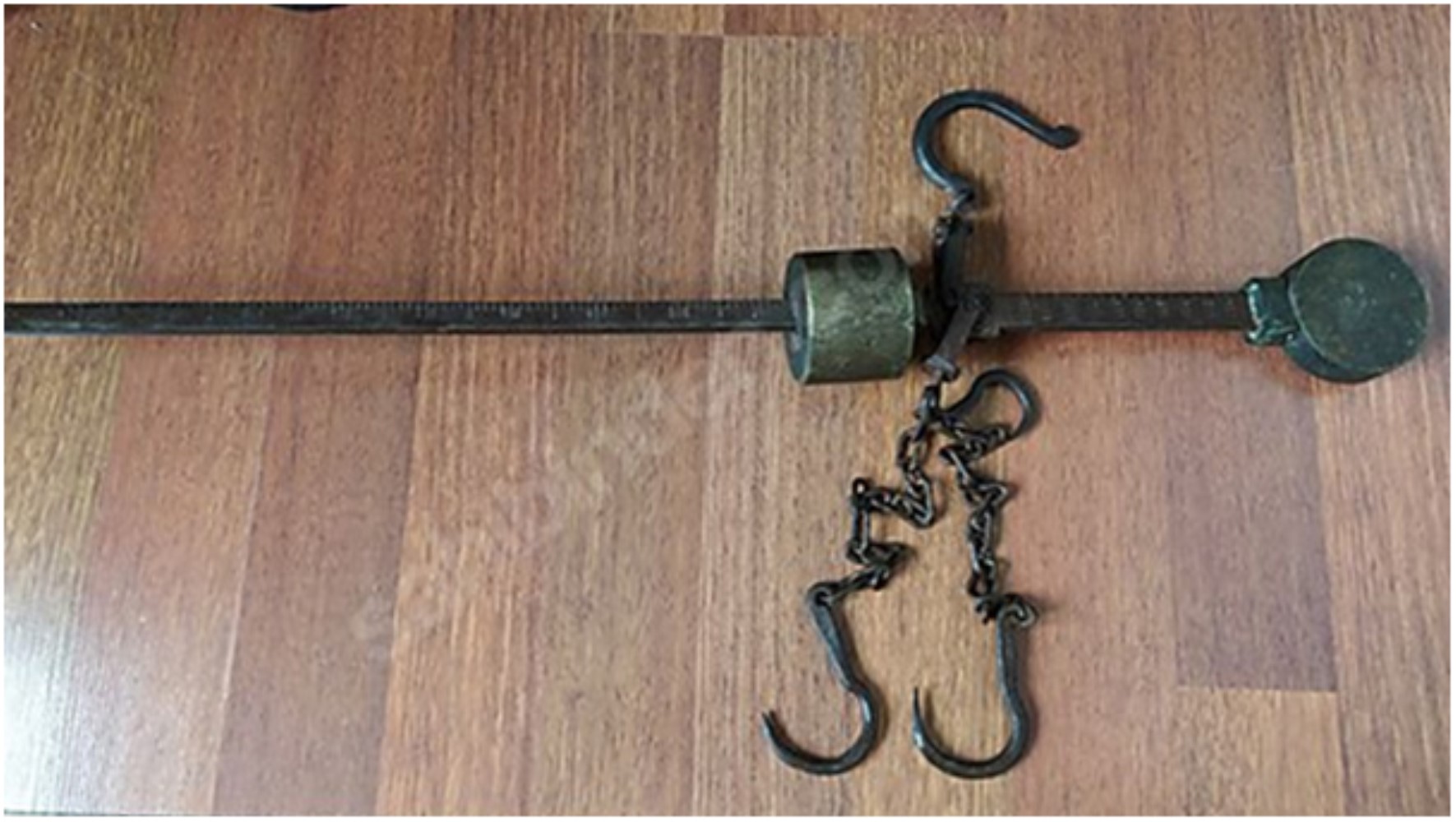
(The steelyard and its knob)
If the cylindrical weight performing the measurement cannot reach equilibrium with the knob, if it slips from the point where balance should be achieved, or if it is deliberately slid to the wrong place, the measurement will be faulty; that is, the object whose weight is to be measured is weighed as too heavy or too light.
This is called “kantarın topuzu kaçtı” (the scale has lost its balance/the knob of the scale has slipped).
When “the scale loses its balance,” the equilibrium is disrupted.
In old times, some unscrupulous sellers/buyers would play with the knob of the scale to perform false weighing and gain unfair profit.
While such scales are still used in some places today, modern scales are produced equipped with mechanical and electronic components.
In this context, in measurements made with a steelyard in the old days, the position of the knob and the location of the cylindrical weight on the metal rod of the scale were very important for accurate weighing.
The knob was the most striking part of the scale that ensured the determination and adjustment of the weight measurement.
During the Ottoman period, while the “narh (fixed price) system,” where the prices of goods were determined by the state, was applied, not weighing correctly with a steelyard was both a legal crime and considered a great moral shame.
In the Ahi tradition, which ensured the work discipline of artisans and tradesmen, honest measurement and weighing were the fundamental conditions of “halal earnings.”
If the knob is not in balance, the measurement would be wrong and unfair.
The scale was also a symbol of justice.
It distinguished right from wrong, the rightful from the unjust.
Therefore, the idiom “kantarın topuzunun kaçması” (the scale losing its balance) eventually turned into a metaphorical expression meaning to lose balance, justice, or measure.
Because if balance is not achieved with the knob, the weighing has no meaning; just as in immoderate practices, the reliability of the system would disappear.
For these reasons, the necessity of “not losing the balance of the scale” in politics, social, and cultural life had taken its place in the public consciousness in the context of universal morality.
Universal virtue does not look kindly upon “losing the balance of the scale.”
Of course, just as in the past, there are not few times today in every area of life, especially when administrators “lose the balance of the scale”!
Such environments are frequently encountered in world governance and country governance as well!
This situation sometimes leads to disasters.
***
 One of the areas where the scale has lost its balance is the smuggling of our historical artifacts and cultural assets abroad.
Archaeological and illegal excavations were not carried out “to learn history, to uncover our cultural assets, to take lessons from them”; they were torn from the lands where they were found for the purpose of buying and selling them as a commodity and using them as an object of prestige.
Our country has been plundered ruthlessly and recklessly.
This situation manifests itself through smuggling, theft, and dubious permits granted.
Moreover, they are not well protected in the places called museums where they are smuggled and imprisoned, and they are even damaged.
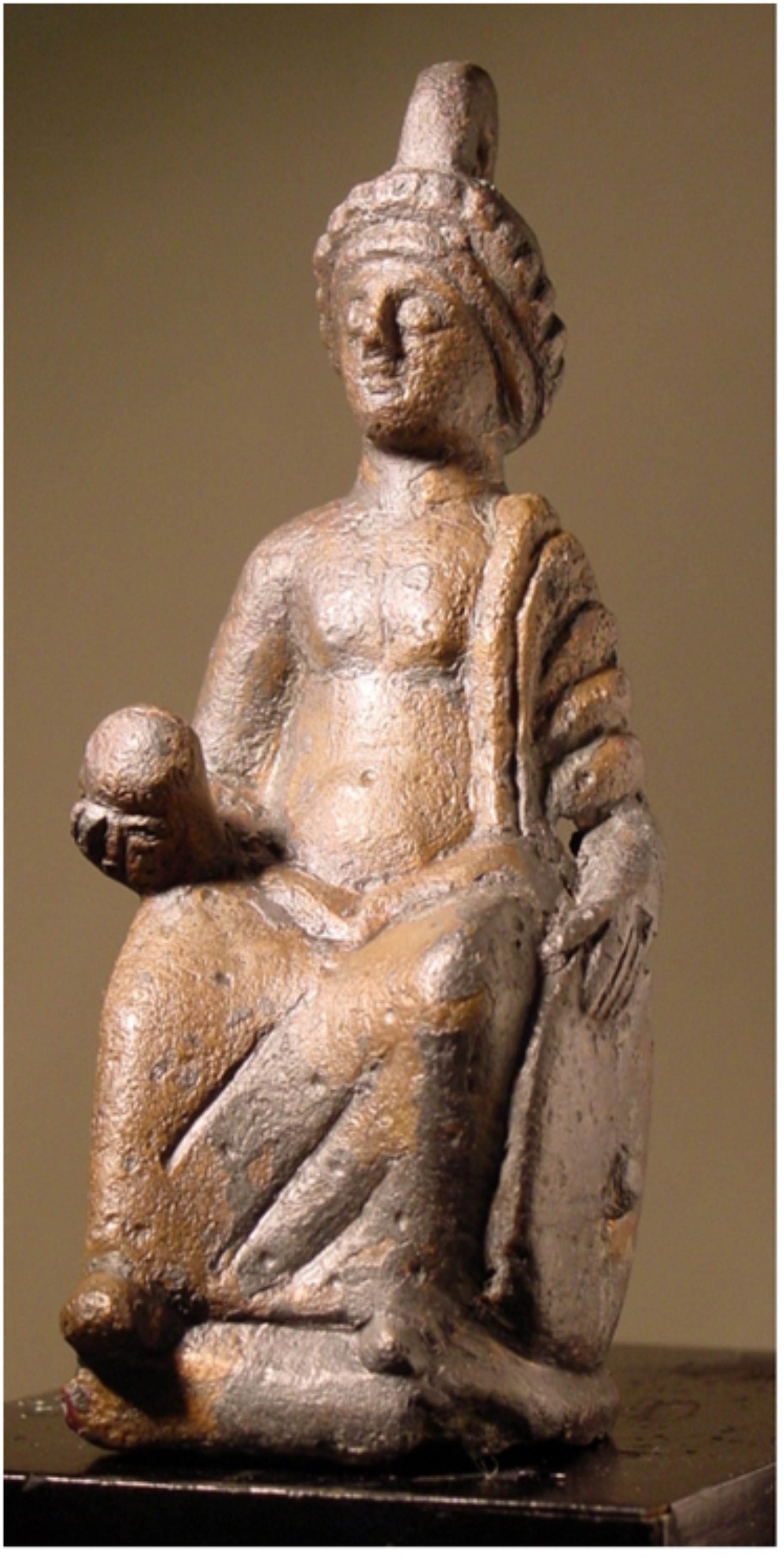
One of these is a small figurine, which is one of the clearest examples of how Bergama’s historical artifacts were smuggled and how they were damaged in Berlin, which was bombed during World War II.
The statue is small, but the meaning it carries is great.
It is perhaps a symbol of what happened to thousands of other artifacts smuggled from Anatolia!
This metal (likely bronze) figurine, 37.2 cm tall and 10.8 cm wide, is a piece used as a scale knob for a weight scale.
Archaeologists call these types of scale knobs the Constantinople/Istanbul type.
In the statue, a person, likely depicted as an emperor/king, is sitting on a throne. With his right hand, he is holding a round object, implying that this piece was used as a scale knob.
The man is naked from his right shoulder down to his waist. A cloak covering his left shoulder covers his body from the waist down to his feet.
He has a double-layered, crown-like headgear on his head. The hole in the middle of the protrusion on top must have been opened for the strap/hook to which it could be attached during measurement.
This figurine, used as a scale knob, is dated to the 5th century A.D., the Byzantine Empire period.
This king-shaped scale knob, which is recorded in the Berlin Prison/Museum records as having been found in Bergama, can be said to reflect the artistic identity of Pergamon in earlier periods if it was not brought to Bergama from outside.
During the Byzantine era, Christianity had become well-established in Western Anatolia and Pergamon.
Nevertheless, it is seen that the cultural and artistic heritage remaining from the age of the Altar of Zeus, where polytheistic/pagan beliefs were dominant, maintained its existence during this period.
Those living in these places did not shy away from making such elegant, ornate scales for weighing in markets and shops.
This means that even in those times, there was a tradition and sophistication in Pergamon/Bergama that produced such a work of art and used it as a weight measurement tool.
This artifact was found in Bergama in 1906, likely in a place where excavations were being conducted, hidden, and taken abroad on some pretext.
Or it was acquired by purchasing it from civilian smugglers; it was transported or smuggled to the Berlin Museum/Prison.
Where and how it was found in the city is not disclosed.
It was added to the Berlin Museum/Prison records with the number “Ident.Nr. Misc. 10817”.
***
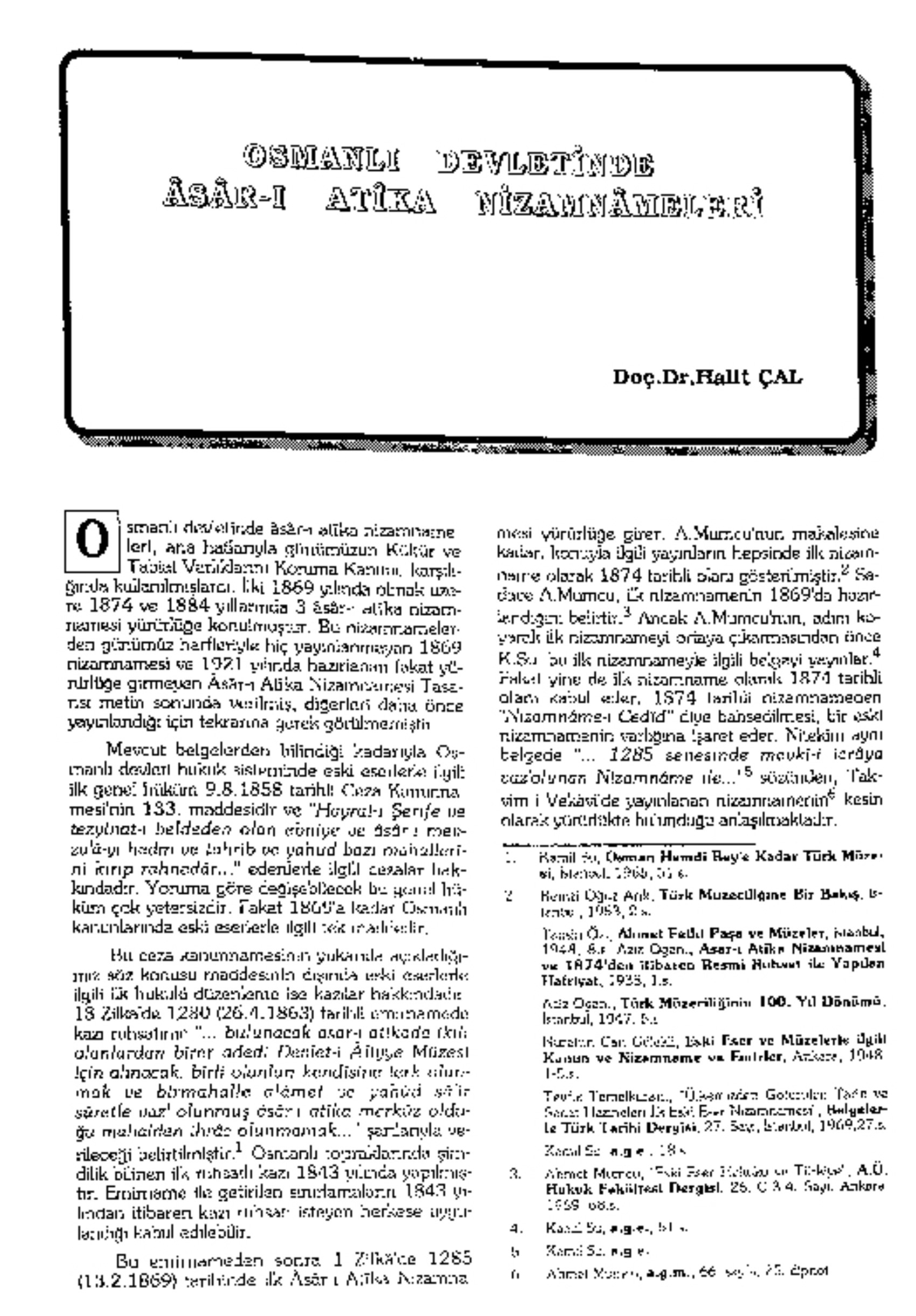
However, according to the “Third Antiquities Regulation” (Asar-ı Atika Nizamnamesi) of the Ottoman Empire, published on “13 Recep 1302” (April 27, 1884), the conditions for conducting excavations in historical sites were made much stricter:
“It was made a condition to obtain permission from the Ministry of Education (Maarif Nezareti) to conduct excavations. All unearthed artifacts were considered state property. The person conducting the excavation was only given permission to take photographs, copies, or molds. Taking artifacts abroad was strictly prohibited.”
During this process, some artifacts were taken abroad with dubious permits and with the connivance of some people (!) at the head of the Ottoman Imperial Museum.
With the more comprehensive “Fourth Regulation” issued on “13 Cemaziyelahir 1324” (July 24, 1906), the previous regulation was updated and stricter measures were introduced against smuggling:
“Excavations on Ottoman lands, the removal of finds and cultural assets abroad were almost completely prohibited.”
While this was the case, excavations were carried out in the Pergamon Acropolis for some time between 1900-1913 by German archaeologists W. Dörpfeld, H. Hepding, and the Swiss P. Schatzmann.
The artifacts found in the excavations appeared on paper to have been left/remained in Bergama.
So, how did this historical artifact, the “king-looking scale knob,” which the Germans stated they obtained in 1906 in the Berlin Museum/Prison records, go to Germany?
Moreover, at that time, renowned German archaeologists were still excavating in Bergama!
Let us write it again:
Which one of them put this meaningful artifact in their pocket or bag and left?
It is a heavy statement, but which one stole it?
Or bought the stolen goods!
Buying an object knowing it is stolen is also being a partner in the act of “stealing”!
It seems “the scale has lost its balance” completely.
One way or another, what was smuggled was not enough, and Bergama artifacts were taken abroad even during a process when there were strict prohibitions.
Who knows how many more!
“However, it is worth repeating: Archaeological excavations are conducted to understand and learn history.”
Protecting the finds is one thing, theft is another.
In any case, the smuggled artifacts could not be protected either!
“The scale, and the king holding the knob of the scale!”
Look what happened!
Along with the elegant, figurine-shaped scale knob found in the Berlin Museum/Prison records with the number “Ident.Nr. Misc. 10817”, the other parts of the scale, like many other Pergamon artifacts, disappeared under fire in the environment where Berlin was bombed during World War II.
This situation is officially recorded!
It is recorded that important parts of the artifact were acquired (!) and taken to Germany, but the entire artifact is not on the shelves/in the warehouses of the Berlin Museum/Prison!
The meaning of this disappearance is essentially a “summary execution”!
What right did they have to destroy the artifacts of Anatolia, of Bergama!
To take them to places where they could be destroyed!
Especially when it is known that German kaisers and chancellors loved to fight!
There is no need to beat around the bush! This situation is a disgrace to German imperialism!
Today’s German authorities should not be partners in this disgrace!
***
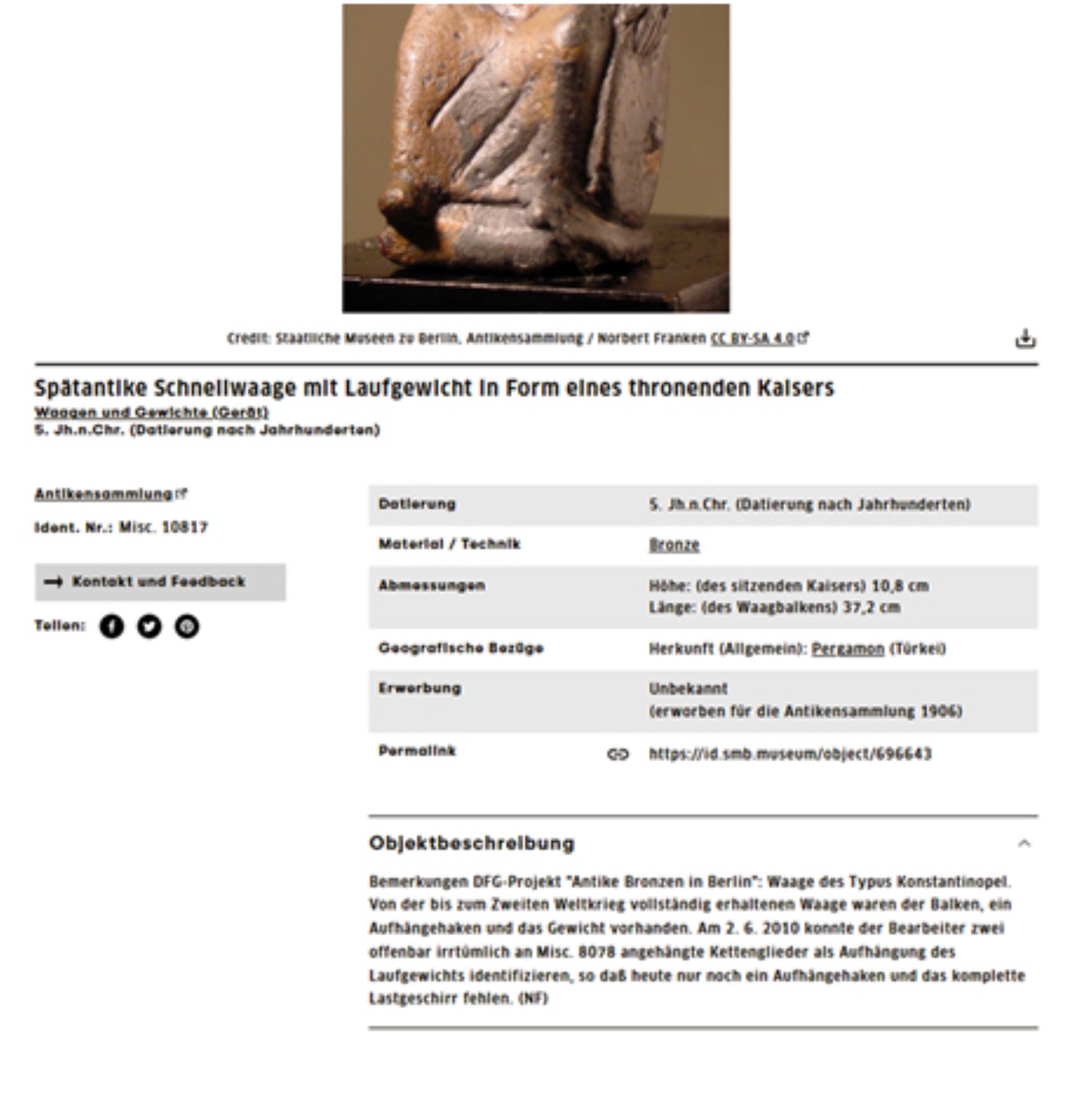
(https://recherche.smb.museum/detail/696643...Berlin Museum/prison record.)
Look at what the Berlin Museum/Prison documents say about this situation:
“Until the Second World War, the beam, suspension hook, and weight were present on the scale, which was completely preserved.”
“Von der bis zum ZweitenWeltkriegvollständigerhaltenenWaagewaren der Balken, einAufhängehakenunddasGewichtvorhanden.”
“…today the suspension hook, the beam, and the load hook are missing.”
“sodaßheute nur nocheinAufhängehakenunddaskompletteLastgeschirrfehlen.”
In other words, today’s German authorities do not say, cannot say, in the records they keep: “A large part of this unique artifact disappeared because of us,” they only say “missing.”
They do not openly confess past mistakes either!
That is, the parts of this figurine measurement tool, the scale, were stolen in their entirety from Bergama and smuggled to Berlin; however, a part of it disappeared there during World War II.
Or someone else stole it from there too!
The Berlin Museum/Prison documents state this clearly.
What more?
I thought Bergama artifacts were taken to Berlin “to be protected”! I thought they were being protected in Germany!
I thought ignorant Turks could not protect them and would turn them into lime!
Yet, they turned to dust and evaporated under bombs in Berlin!
For years, the world and Turkish public opinion have been deceived with such fallacies.
Attempts were made to cover up these thefts!
Shame, shame!
Admitting one’s fault, one’s crime is also a virtue.
The great German philosopher Arthur Schopenhauer says; “The world is founded on certain fundamental causes and mechanisms that do not fully conform to logic and cannot be easily grasped by reason....
Virtue is doing good without expecting a reward.”
THE ALTAR OF ZEUS AND BERGAMA ARTIFACTS DO NOT BELONG TO COLD AND FOGGY BERLIN, BUT TO BEAUTIFUL BERGAMA. THEY MUST DEFINITELY BE RETURNED, THEY MUST RETURN HOME.
(Source:http://www.smb-digital.de/eMuseum,Database-Antikensammlung) /// https://recherche.smb.museum/detail/696643 ///
https://www.academia.edu/90919807/Osmanl%C4%B1_Devletinde_Asar_%C4%B1_Atika_Nizamnameleri)
Sefa Taşkın
17.08.2025
Bergama-Dikili/İzmir
Most Read

Striking picture for Özgür Özel's 'New Party'

Özgür Özel gives a dated response regarding the number of resignations

Forest fire in Antalya brought under control

The PKK opening and Özgür Özel’s path!..

How did the newspapers view Özgür Özel's farewell to the CHP?

What did the CHP do?

Özel’s new party move in the world press

The New CHP, against CEHAPE

From self-efficacy to despair

The return of craftsmanship in the age of artificial intelligence