



A STONE IS HEAVY IN ITS PLACE-158. LET US NOT FORGET, LET US NOT LET BE FORGOTTEN!
The great Turkish poet Nazım Hikmet says the following in his magnificent poem titled "Invitation," which most of us know:
“Galloping from Far Asia
stretching to the Mediterranean like the head of a mare
this country is ours…”
Yes!
This longing, this invitation, and this country are all ours.
Yes, this country; Anatolia, Turkey is ours.
With its underground and surface, its stones and soil, its past and present, this country, this homeland is ours.
A homeland is a country, a territory considered sacred enough to give one's life for.
As Mustafa Kemal Atatürk said, "When the homeland is at stake, everything else is a detail."
This is the reason why we protect our historical values, our cultural assets, all the cultures that have existed and still exist in our land, the traces they left behind, and their unique heritage!
This is why we resist businesses that cause environmental pollution, especially gold mines that seek to extract gold using cyanide.
This is why we oppose the pitting against each other of people who have lived side by side in peace on these lands for hundreds of years.
This is why we claim our historical artifacts that were torn away and smuggled from many Anatolian lands, starting with Bergama, as well as Bodrum, Gaziantep, Datça, and Troy-Çanakkale, at the end of the 19th century.
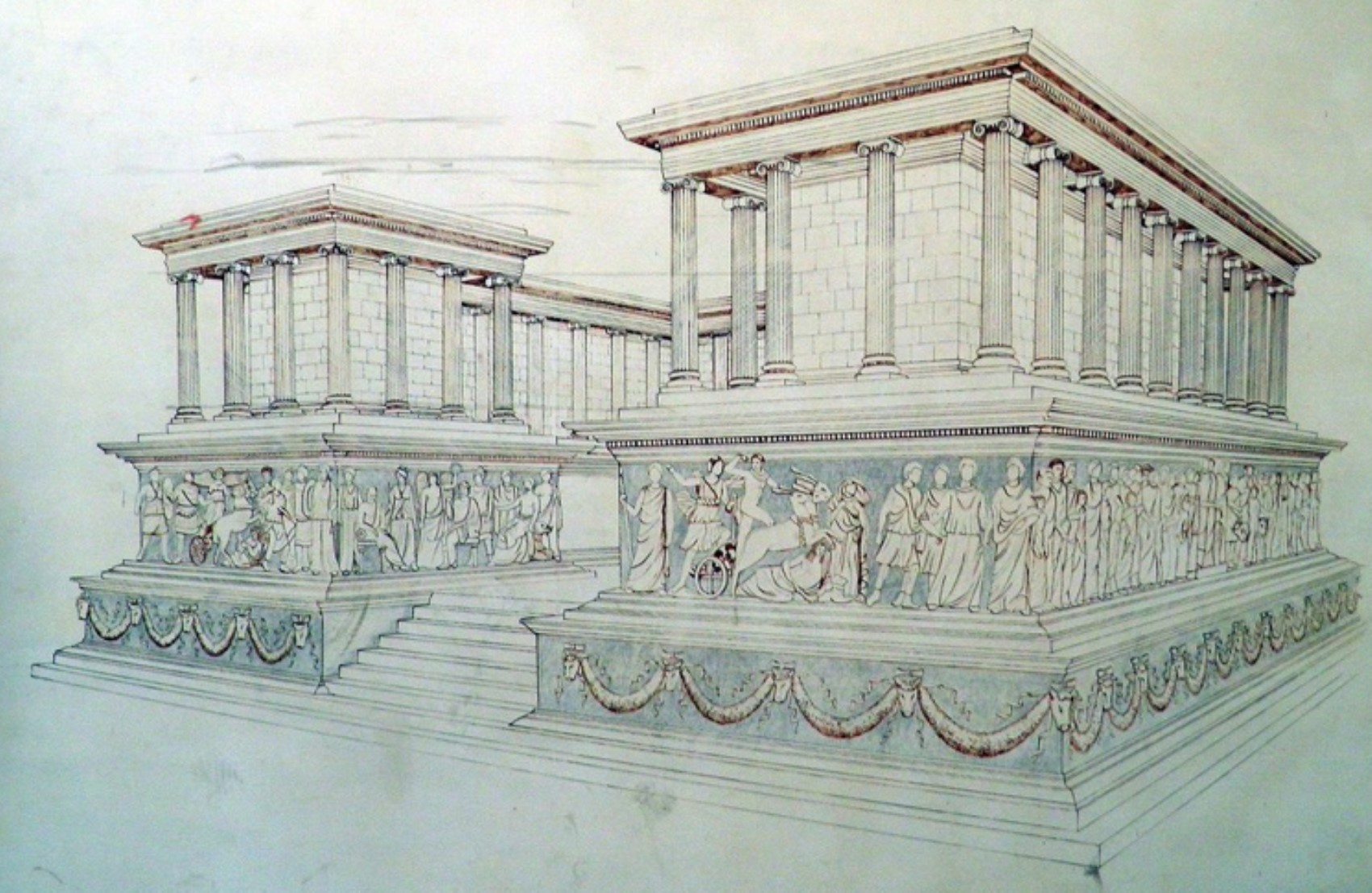
(Zeus Altar of Bergama-drawing)
***
In this context, all artifacts that have been smuggled, stolen, or taken abroad with dubious permits from our country must be returned.
Fallacies such as 'they could not be protected in Anatolia,' 'they would have been destroyed,' or 'the Sultan sold them' can in no way serve as an excuse for the theft of our artifacts.
The most well-known of our artifacts smuggled abroad is the Pergamon Altar.
As seen in Ottoman documents, the findings of our esteemed historians, and the records of German archaeologists and state officials, the removal of the Pergamon Altar and the Pergamon sculptures to Germany/Berlin by the pawns of German Imperialism was more than just a smuggling incident; it was plunder.
Carl Humann, a so-called German road engineer who arrived in Pergamon in 1864, smuggled Pergamon artifacts to Berlin until 1878.
He confessed to this in his own handwritten records, and contemporary German scholars have confirmed it.
Despite the prohibition on taking historical artifacts abroad, enacted by the regulation (law) issued by Sultan Abdülaziz in 1869, this robbery continued.
Despite immense pressure, patriotic Ottoman officials, with the knowledge of Sultan Abdülaziz, refused to implement the 1874 Regulation—which had been enacted under pressure from the Prussian/German State by a German named P.A. Deither, who was appointed director of the Müze-i Hümayun (Ottoman State Museum), and which permitted one-third of the artifacts to be taken abroad. They did not hand the artifacts over to the Germans.
However, somehow in 1878, Sultan Abdülaziz was murdered by strangulation. Abdülaziz is the last sultan to have been killed.
Could it be that Prussian/German imperialism, which was desperate to seize our historical artifacts, had a hand in the murder of Abdülaziz, who was determined to keep our historical treasures in the country despite all kinds of pressure?
“Everyone knows that ‘imperialism is ruthless!’”
The Ottoman Empire, under the young Sultan Abdülhamit who had become sultan shortly before, was defeated by the Russians attacking from the north, despite the glorious resistance of Osman Pasha at Plevna.
The Russian army reached the gates of Istanbul, to present-day Yeşilköy/Ayastefanos.
They were on the verge of taking Istanbul, occupying the Payitaht (capital), and destroying the Ottoman Empire.
To ensure this situation would not be forgotten, the Russians erected a 30-meter-high monument at the gates of Istanbul, in Ayastefanos/Yeşilköy.
The Ottoman Empire, a supposed ally, sought help from German Imperialism, which had infiltrated every level of the state, from museums to the military.
A drowning man will clutch at a straw!
At the conference held in Berlin, the Russians agreed to withdraw from Istanbul in exchange for taking Romania and Bulgaria. Cyprus was also given to the British.
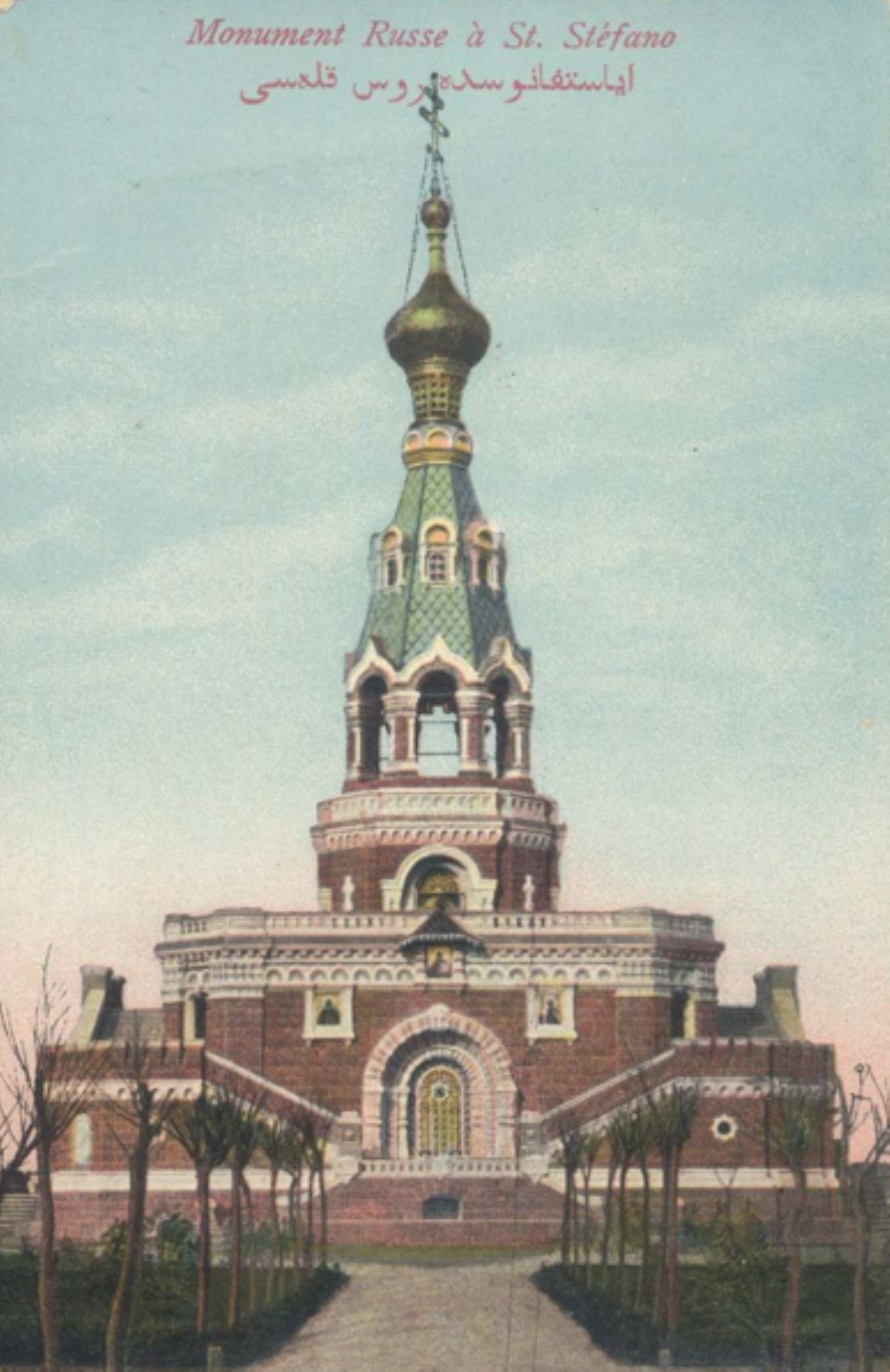
(The Ayastefanos/Yeşilköy monument, built by the Russians in 1898 and demolished by Enver Pasha in 1914)
Among the leaders of the German state, the history-obsessed Prince, later King Frederick III, was one of the organizers of the Pergamon robbery. At his insistence, a so-called law that the previous Sultan, Abdülaziz, had not implemented was enforced. It was permitted for a portion of the historical artifacts unearthed from the ground, specifically one-third, to be taken out of the country.
The Sultan, under heavy pressure, requested a donation to the Ottoman Museum so that this permission would not be without compensation. This donation amount was 20,000 francs/marks. You couldn't even buy a car with that money today.
Those who act as mouthpieces for those attempting to legitimize the smuggling of Pergamon artifacts to Berlin—this theft—are waving this laughable sum of money like a flag.
Thus, the Pergamon artifacts began to be transported to Berlin via the Pergamon-Dikili pier-Izmir-Genoa/Hamburg route.
Following the initial removal, German Prince/Emperor Frederick III placed heavy pressure on Abdul Hamid II through letters written to the Ottoman Empire in order to acquire the remaining two-thirds of the artifacts found during the excavations that had been left to the Ottomans.
He was the boss, after all!
The Ottoman Empire had already fallen into the lap of imperialism.
P.A. Diether, whom the Germans had appointed as the Director of the Ottoman Museums, was also assisting the smugglers:
Diether submitted a report to the Ottoman Ministry of Education claiming that the remaining Pergamon artifacts (the two-thirds) that the Ottomans had refused to hand over were worthless, in order to ensure they were given to the Germans:
In this report, it was stated: 'It would require the expenditure of hundreds of liras to transport these pieces of stone (?) belonging to the Ottomans from Pergamon to Istanbul, which Abdul Hamid is being pressured to hand over. It is much easier to abandon them to the Germans for a thousand Napoleons (a currency unit).' 'It is unnecessary to spend so much money on such dirty, broken, and ordinary marble fragments,' it read.
How many traitors there were, and are, in this country!
Sultan Abdulhamid of the Ottoman Empire, which was financially bankrupt, militarily collapsed, and mired in political turmoil, was able to hold out for only one more year.
Once again, in exchange for a small donation and with dubious permits, the Pergamon Altar and its statues were taken to Germany.
This happened despite the new restrictive 1884 Regulation issued by the Ottoman Empire's new museum director, Osman Hamdi Bey.
With the addition of clauses at the end of this regulation that loosened the restrictions, the dubious looting continued until 1906.
***
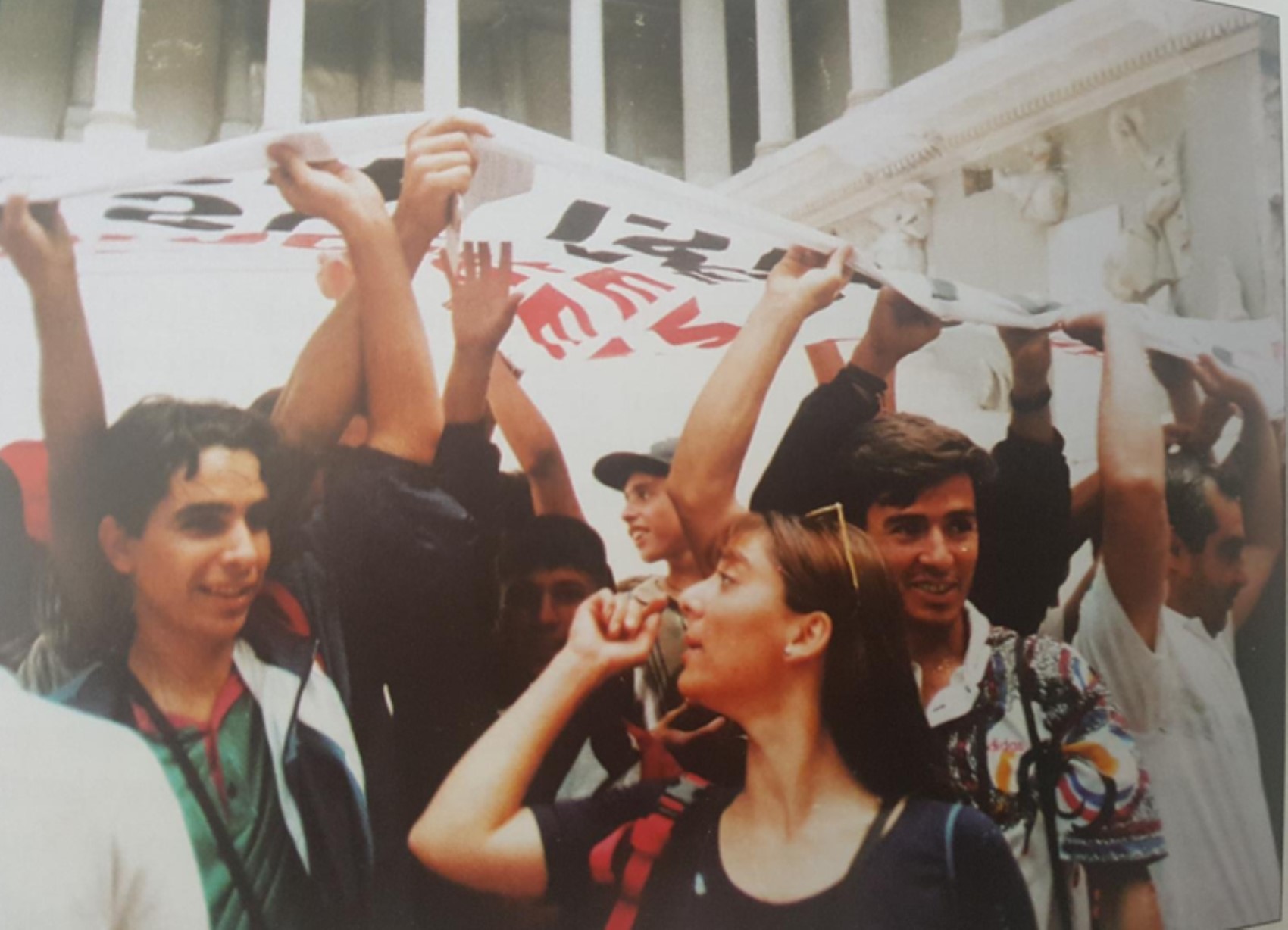
(Young people from Bergama protesting at the Museum/Prison in Berlin in 1992)
The pieces of the Pergamon Altar and the Bergama statues were restored and placed in 1930 inside a large stone building—a Museum/Prison—built on an island in the Spree River, which flows through the center of Berlin. They are still being held there.
Despite this building being subjected to heavy destruction under bombs during World War II.
Despite the Pergamon artifacts being packed into crates after the war in 1945, transported by train to St. Petersburg, Russia, and returned to Berlin ten years later.
However, it seems that Zeus, the greatest god of the ancient world, the King of Gods, must have been angered by the fact that the altar built in his name was kept in a Berlin prison and subjected to so many misfortunes (!) because this unsettling building, which housed his altar, began to slowly sink into the water as the island it was built on, which was essentially a swamp, began to collapse.
The metal components of the statues rusted and decayed.
The wrath of 'Zeus,' the chief god of the ancient Aegean region, is truly formidable! Noticing this situation, the modern German state closed the area where the Pergamon Altar is located to visitors in 2013, ostensibly to repair the prison, but in reality, to stop this collapse.
Supposedly, restoration and modernization were to be carried out!
However, the damage the structure sustained must have been so severe that it was announced the Museum/Prison would open in 2019, but it did not. The closure was extended until 2019.
Then the opening was postponed, first to 2023, then to 2027, and finally to 2037.
In other words, the island carrying the artifacts that were supposedly taken away from Bergama for protection is slowly sinking into the water. Perhaps the museum will not even open in 2037.
It is reported that 1.5 billion Euros will be spent on these repairs.
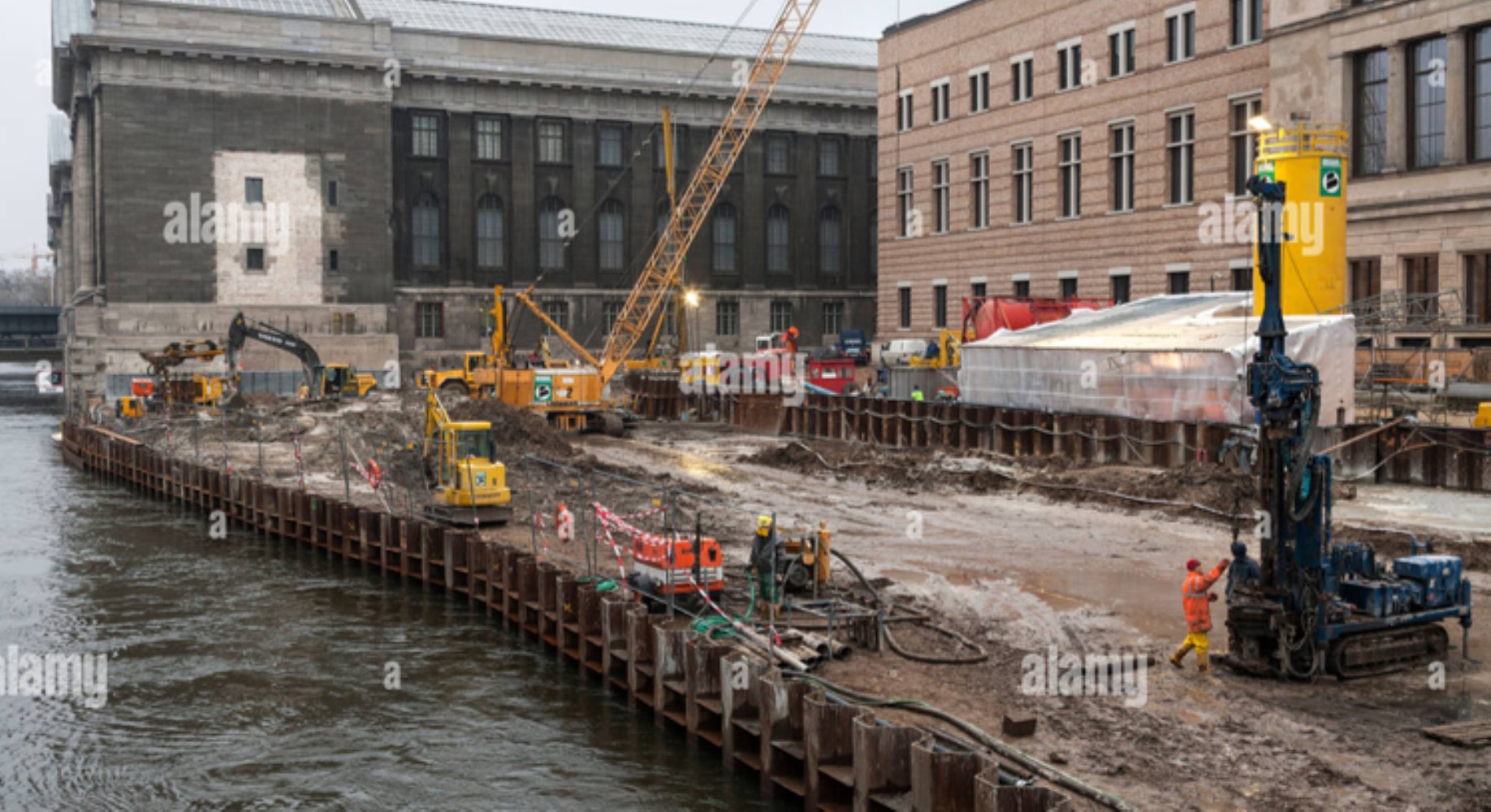
(The building in Berlin, Germany, where the Pergamon Altar is housed and which is sinking into the river)
Yet, with this money, several museums could be built in Bergama, and the returned Pergamon Altar and our artifacts could be preserved in a wonderful way.
All the information we have provided above is documented and accurate.
In this context, the people of Bergama have been conveying this information to the Turkish and global public for years, taking ownership of their city and their country.
They say, "A stone is heavy in its own place."
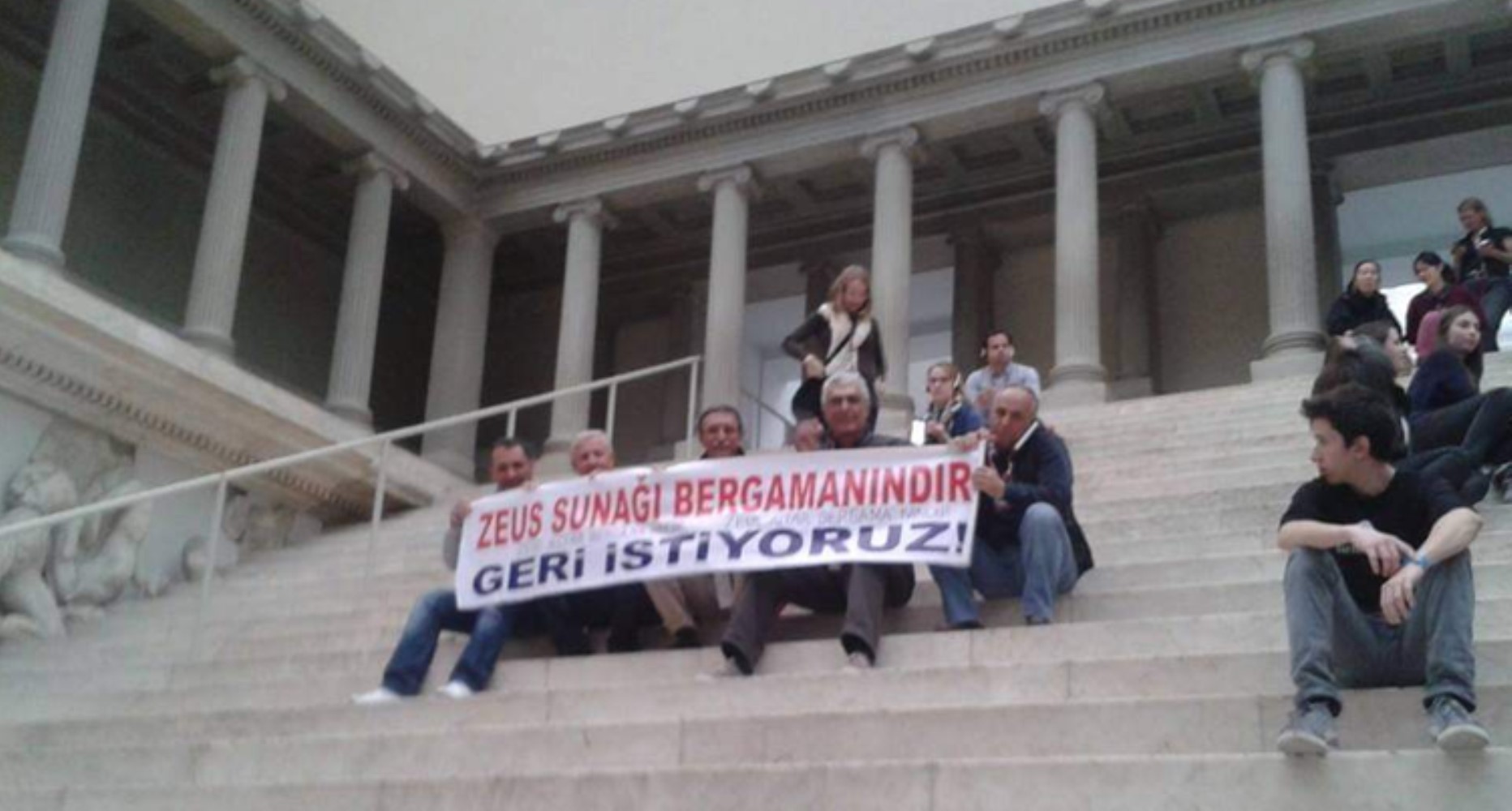
(Teachers from Bergama expressing their wishes at the foundations of the Pergamon Altar in the Berlin Museum/Prison)
***
With this being the case, on April 26, 2025, the "Görkemli Hatıralar" (Magnificent Memories) program, supported by the Bergama Municipality to promote the city, was filmed and broadcast live by Halk TV at the Pergamon Acropolis.
The famous (!) detective novelist named Ahmet Ümit, invited by program producer Serhan Asker, did not hesitate to convey false and inaccurate information regarding the smuggling of the Pergamon Altar—information he had acquired without any research or questioning—while looking directly into the eyes of the people of Bergama and the Turkish public during this program, where he appeared as a guest of Bergama due to a book he had written.
Naturally, this situation deeply saddened the people of Bergama, who protect the stones, soil, and homeland of their country.
This sadness was not because they could not imagine such misinformation coming from the mouth of this famous (!) person, but because he expressed with great enthusiasm false and misleading words that even today's Germans are hesitant to utter.
What did it mean to defend smugglers in the face of those who defend the values of their country!
The crime novelist A.Ü. was shouting to the public that a German engineer named Carl Humann came to Bergama in 1878 and took the artifacts away.
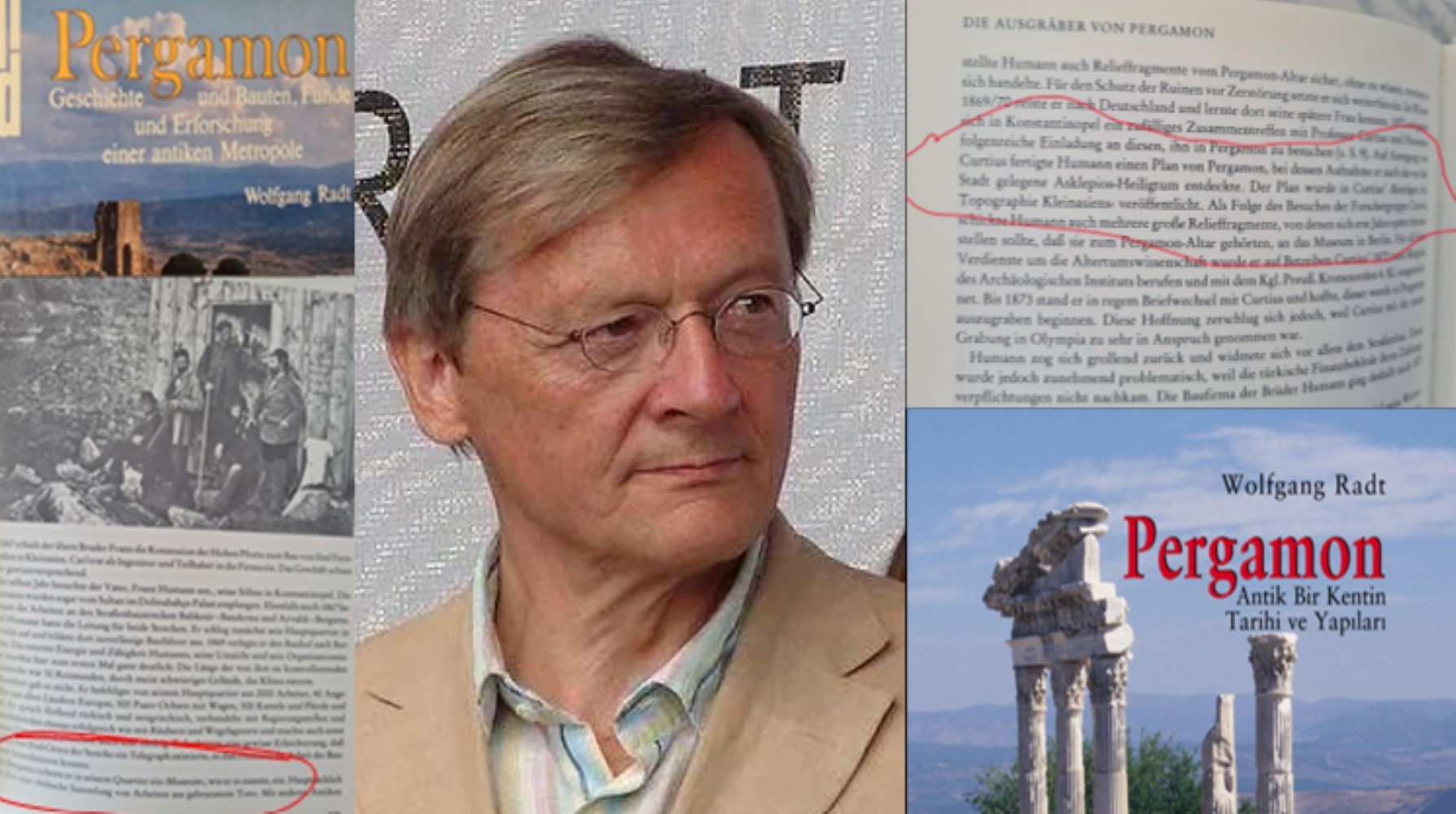
(Archaeological excavations conducted in Bergama between 1971-2005, Prof. Wolfgang Radt and the Pergamon book)
If this was not a deliberate statement, it was nothing short of sheer irresponsibility!
Even in the documents and publications of the German State and those who carried out the smuggling, it was recorded that the smuggling began years ago, long before 1878, in 1864.
The actions of Carl Humann, a so-called engineer who came to Bergama in 1864 to build a road but turned into a historical artifact smuggler, were described by Prof. Wolfgang Radt, who directed the archaeological excavations in Bergama between 1971 and 2005 on behalf of the German Archaeological Institute (DAI), in his 1988 book titled "Pergamon: History and Buildings of an Ancient City."
He explained that C. Humann had collected so many historical artifacts in Bergama that he even established an (illegal) museum:
"In Bergama, he set up a museum in his quarters, as he called it,
this was mainly a nice collection of terracotta works. Along with other antiquities, Humann also secured relief fragments from the Pergamon Altar," without indicating what it was about. He continued to advocate for the protection of the ruins from destruction.”
Translated: “(C. Humann) established a museum in Bergama, in his own words,
in the neighborhood (where he settled in Bergama), he primarily ‘created a beautiful collection made of terracotta. Along with other antiquities, he also collected relief (marble frieze) fragments without mentioning (without letting anyone suspect) that they were related to the Pergamon Altar,”
Moreover, Humann, the leader of the network that smuggled Bergama artifacts, had listed and written down the artifacts he smuggled on the page concerning the year 1871 in the excavation records he kept with his own hand.
All of these actions were in violation of the 1869 Regulation on Antiquities (Law on Antiquities) issued by the Ottoman Empire.
In other words, this was blatant smuggling.
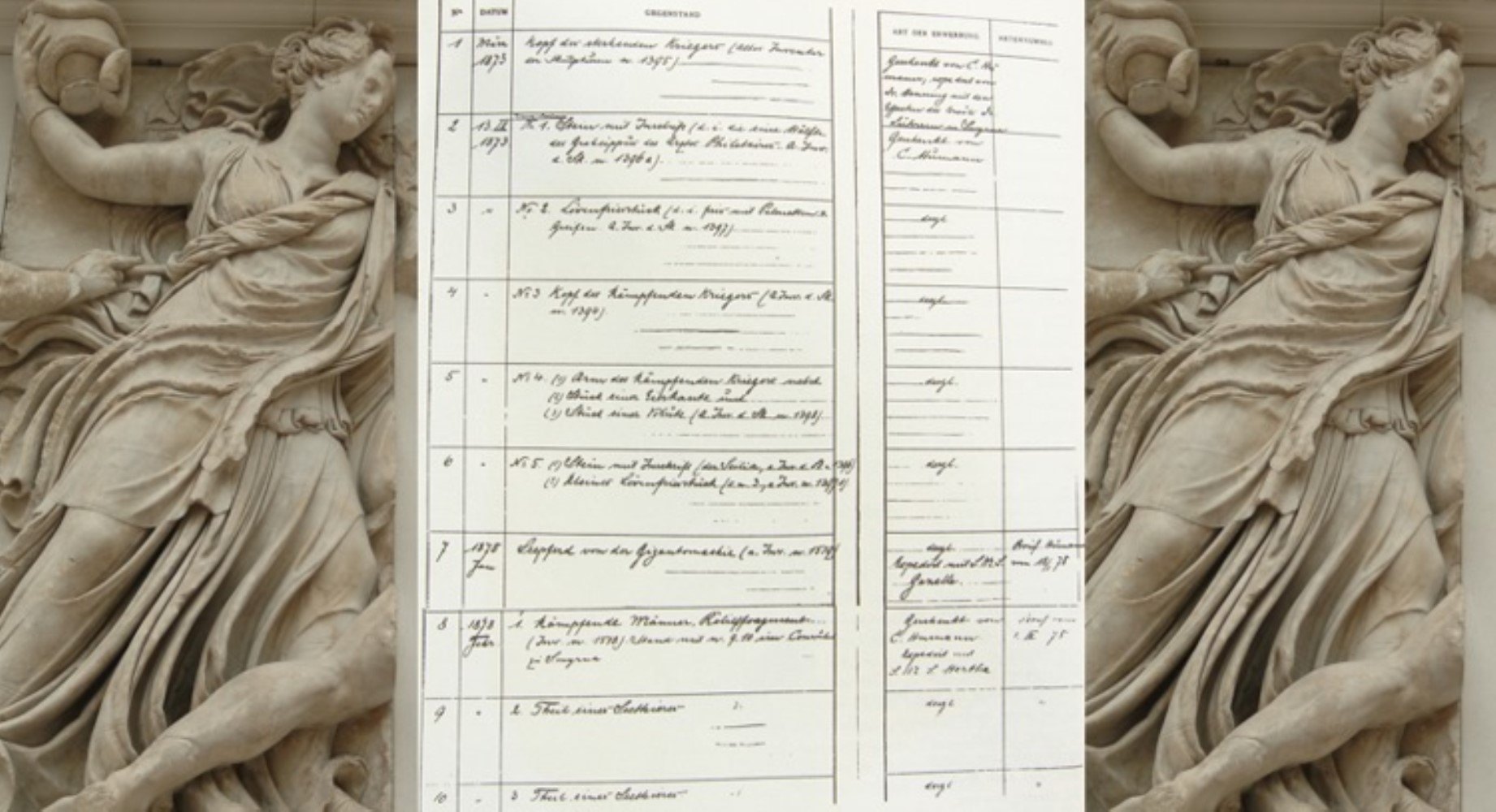
(The list of what the German smuggler Carl Humann smuggled in the 1870s, from the excavation notebook he kept with his own hand)
Because the so-called engineer Carl Humann, who spearheaded the smuggling of Bergama’s historical artifacts, arrived in Bergama in 1864 and, until 1878, had taken hundreds of artifacts abroad without permission, in violation of Ottoman laws.
Anything to the contrary was a blatant lie!
With this incorrect statement, the crime novelist A.Ü. was effectively covering up the smuggling carried out by German smugglers over a 12-year period between 1864 and 1878.
And this lie was being told right on the Pergamon Acropolis, next to the steps of the Altar of Zeus, at the foot of the smuggler Carl Humann’s grave.
This misleading information was being broadcast to the public via the microphone held by program producer Serhan Asker during a live Halk TV broadcast.
Moreover, it was said right to the faces of the people of Bergama, who have been fighting for years to bring back the Altar of Zeus, which was torn from Bergama soil and smuggled to Germany.
In front of the orphaned steps of this unique historical monument.
What a great disrespect to those who protect their homeland.
There is an ulterior motive behind every “murder”!
***
Furthermore, the claim, asserted with great enthusiasm by A.Ü., that Sultan Abdul Hamid II sold the Pergamon Altar to the Germans for "5,000 francs" is not only completely false in the context of the information above and the conditions of that day, but it is also shameful.
The historical conditions and documents are clear!
The environment of the Ottoman-Russian War, the threat of Istanbul falling, the exhaustion of the Ottoman Empire, political pressures, and the resistance of the Ottoman bureaucracy form the backdrop of the plunder carried out by German Imperialism in Anatolia.
Although Abdul Hamid II possesses a specific historical identity, he is a significant political figure of the lands we live in today. Even now, there are those who admire and those who criticize his identity.
Every situation must be examined within the context of its political, physical, and social conditions and environment.
Every event and person is judged by history in the context of objective data.
It is recorded that at the end of the 19th century, as the Ottoman Empire was collapsing, many positions—from the military to the directorship of museums—fell into the hands of the German Kaisers, yet despite this, the bureaucracies of Abdulaziz and Abdul Hamid resisted the Germans as much as their power allowed.
Under these circumstances, attempting to whitewash the Bergama robbery—the smuggling network's theft of the Zeus Altar under the protection of German Imperialism—with the motto that 'the Sultan sold it' is, to put it mildly, an unpatriotic stance.
It is astonishing that A.Ü., considered a well-known author, would applaud German smuggling with incorrect and misleading words!
***
In this context, it is even more comical that the German Archaeological Institute, one of the German state's representatives in Turkey, would reward A.Ü.—who writes crime novels using historical sites like Bergama—by declaring him an 'archaeologist member'.
The fact that this award was presented to him by the Director of the German Archaeological Institute and archaeologist Felix Pirson, who is still the head of excavations in Bergama, with the participation of Germany's Consul General in Istanbul, Johannes Regenbrecht, makes the situation even more intriguing.
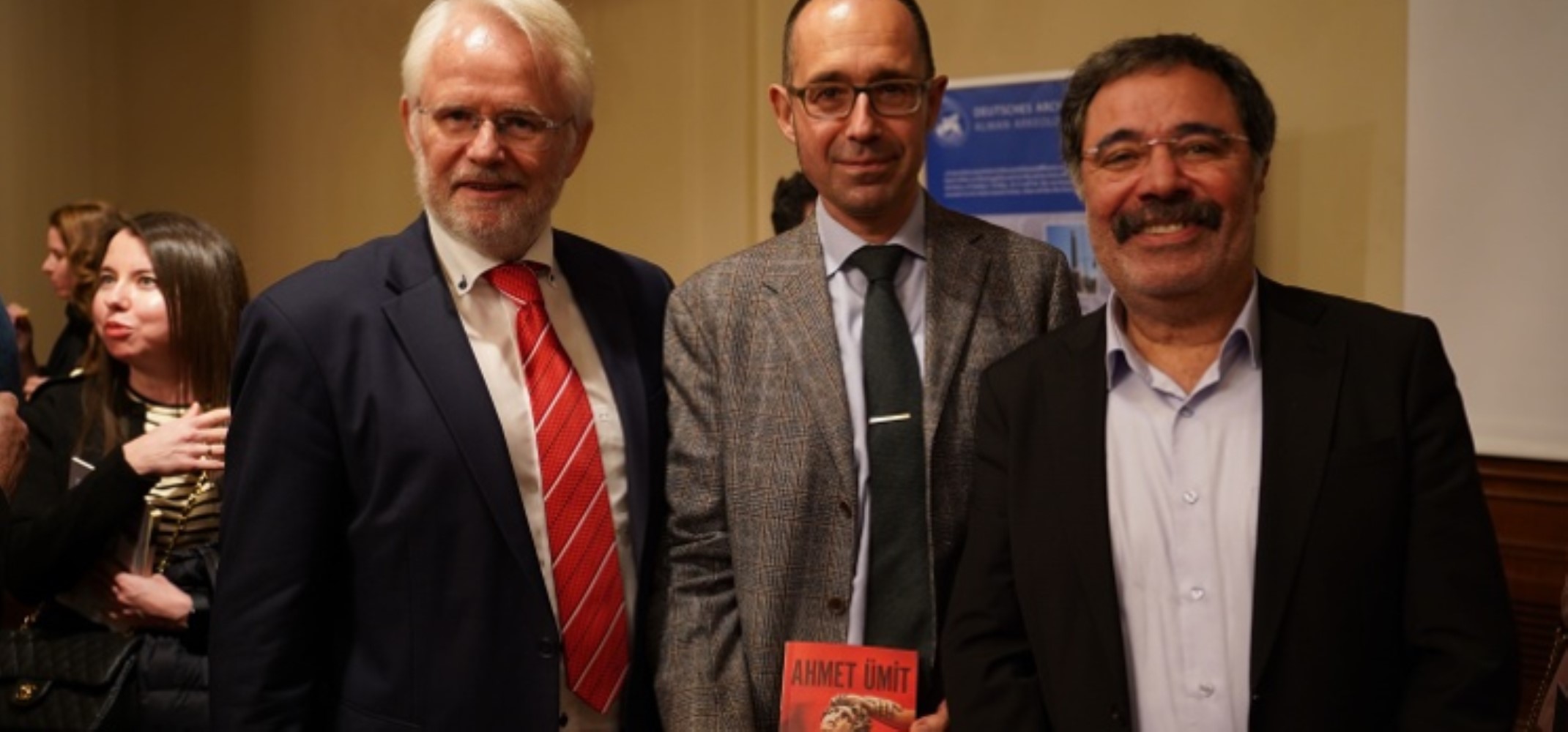
(Germany's Consul General in Istanbul Johannes Regenbrecht, Director of the German Archaeological Institute and head of the German excavation team still working in Bergama, archaeologist Felix Pirson, and Ahmet Ümit)
The fact that this famous (!) person ignores the robbery committed by German Imperialism in Bergama, to put it mildly, or rather, is in a position to whitewash this robbery, and the affection he shows to the German excavation team currently in Bergama, makes this intrigue even more interesting!
Especially when Prof. Yusuf Sezgin, who has been appointed by the Republic of Turkey as the Coordinating Head of Excavations for the Bergama/Pergamon excavations starting this year and who has been working wonders in the archaeological excavations at the nearby Aigai (Manisa) site, is conducting very striking work alongside the local Bergama Museum.
While the century-long German dominance in the Bergama excavations is being limited by the Republic of Türkiye Ministry of Culture.
In addition to these, shortly before this Halk TV program, it is surely a coincidence that German Ambassador to Ankara Sibylle Katharina Sorg and German Consul General in İzmir Ralf Schröer visited Bergama on March 18, 2025, toured the historical sites, and met with German Excavation Director Felix Pirson!
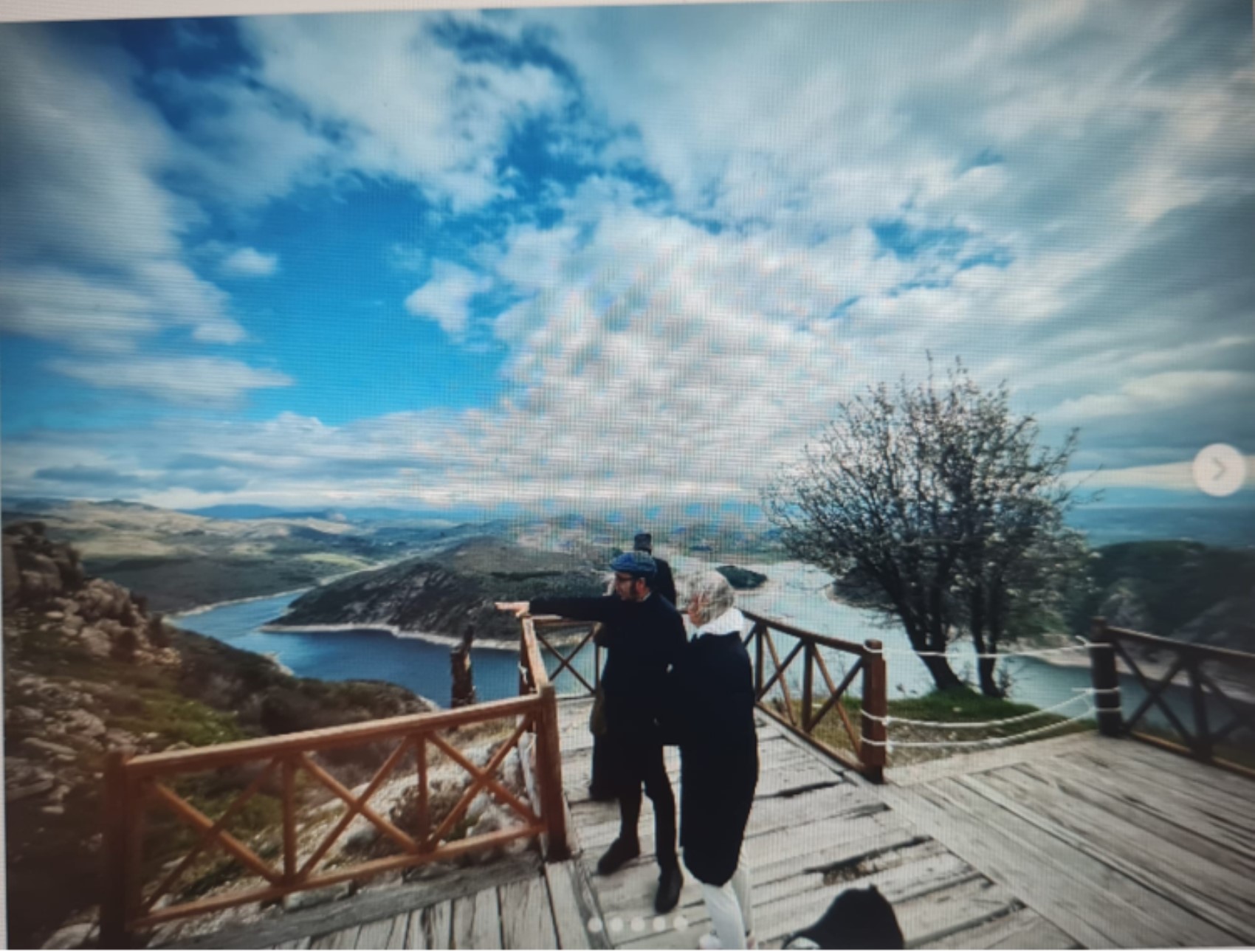
(German Ambassador to Ankara Ms. Sibylle Katharina Sorg and Germany's Bergama Excavation Director Felix Pirson at the Bergama Acropolis)
It is likely that these high-ranking German state officials never mentioned "returning the Altar of Zeus to Bergama," ignored this robbery and plunder, and made empty, deceptive promises to silence Bergama.
Of course, they also have a friend like the crime writer A.Ü.!
***
In this context, protecting the stones and soil of our country and standing against the robberies of imperialism is a virtue, alongside being a culture lover, a patriot, and a nationalist.
People who eat the bread, drink the water, and breathe the air of these lands, whoever they may be, must say like Nâzım Hikmet, "This Country is Ours."
Atatürk has already had the final word: "When the subject is the homeland, everything else is a detail."
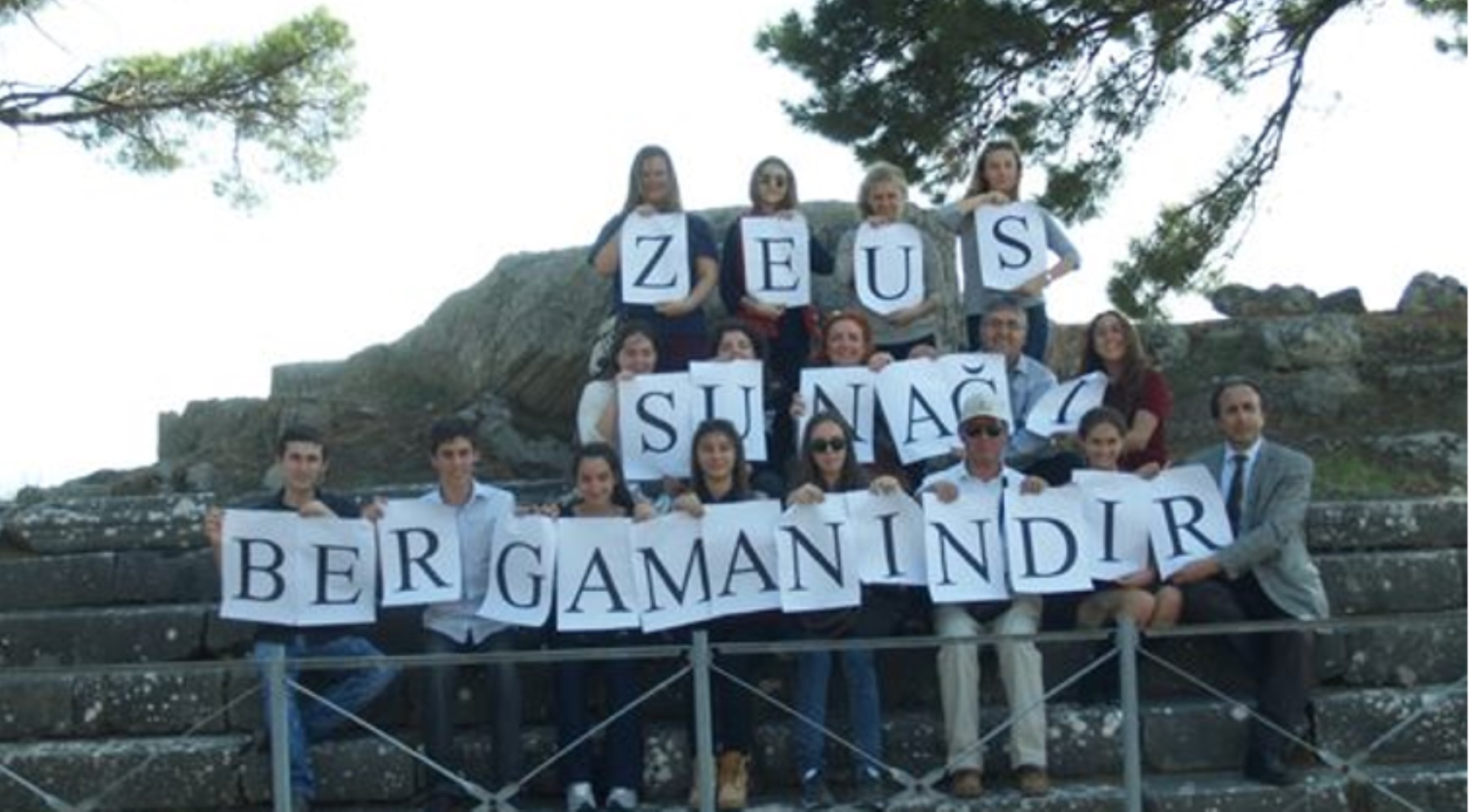
(Young people from Bergama are taking ownership of their country and their homeland at the foundations of the Altar of Zeus in Bergama)
This country, this homeland, Bergama is ours. With its stones, its soil, and its future.
The noise made by those who speak without knowledge is nothing but a "cacophony"!
As Uğur Mumcu said, to "have an opinion without having knowledge" is trivial nonsense!
Those who attempt to convey false information to our people, those who consciously act as supporters for smugglers, and those who try to erode the will of Bergama and its historical monument preservationists should know their place and not overstep their bounds.
These lands do not forget those who love them, nor those who attempt to betray them!
We will solve this problem together with the true intellectuals and wise people of Turkey and Germany, and with the conscience and initiative of the world public.
Because the path we have come from and the path we are going to is the path of our country, our homeland, and human culture!
THE ZEUS ALTAR AND THE BERGAMA ARTIFACTS DO NOT BELONG TO COLD AND FOGGY BERLIN, BUT TO BEAUTIFUL BERGAMA. THEY MUST ABSOLUTELY BE RETURNED; THEY MUST COME HOME!
(Source: “Carl Humann (1930 “Der Entdecter von Pergamon” /// Hermann Brückelschen (1959), “Der Pergamon Altar” /// (Source: Wolfrang Radt (1998): “ Pergamon, gesichteund…”, p.335-6) ///Yaşar Yılmaz (2015): “Anadolu’nun Gözyaşları” (Tears of Anatolia), Istanbul: Anadolu Cultural Entrepreneurship Publications. /// Ali Sönmez (2020): “Yitik Miras Zeus Sunağı” (Lost Heritage: The Zeus Altar). Istanbul: İdeal Publishing/// https://www.instagram.com/p/DHv7qfYIC69/?utm///https://unesco.bergama.bel.tr/haberler/gorkemli-hatiralar-programi-bergama-akropolisinde-gerceklestirildi/?utm
Sefa Taşkın
Karşıyaka/Izmir
05/18/2025
Most Read

Striking picture for Özgür Özel's 'New Party'
Özgür Özel gives a dated response regarding the number of resignations
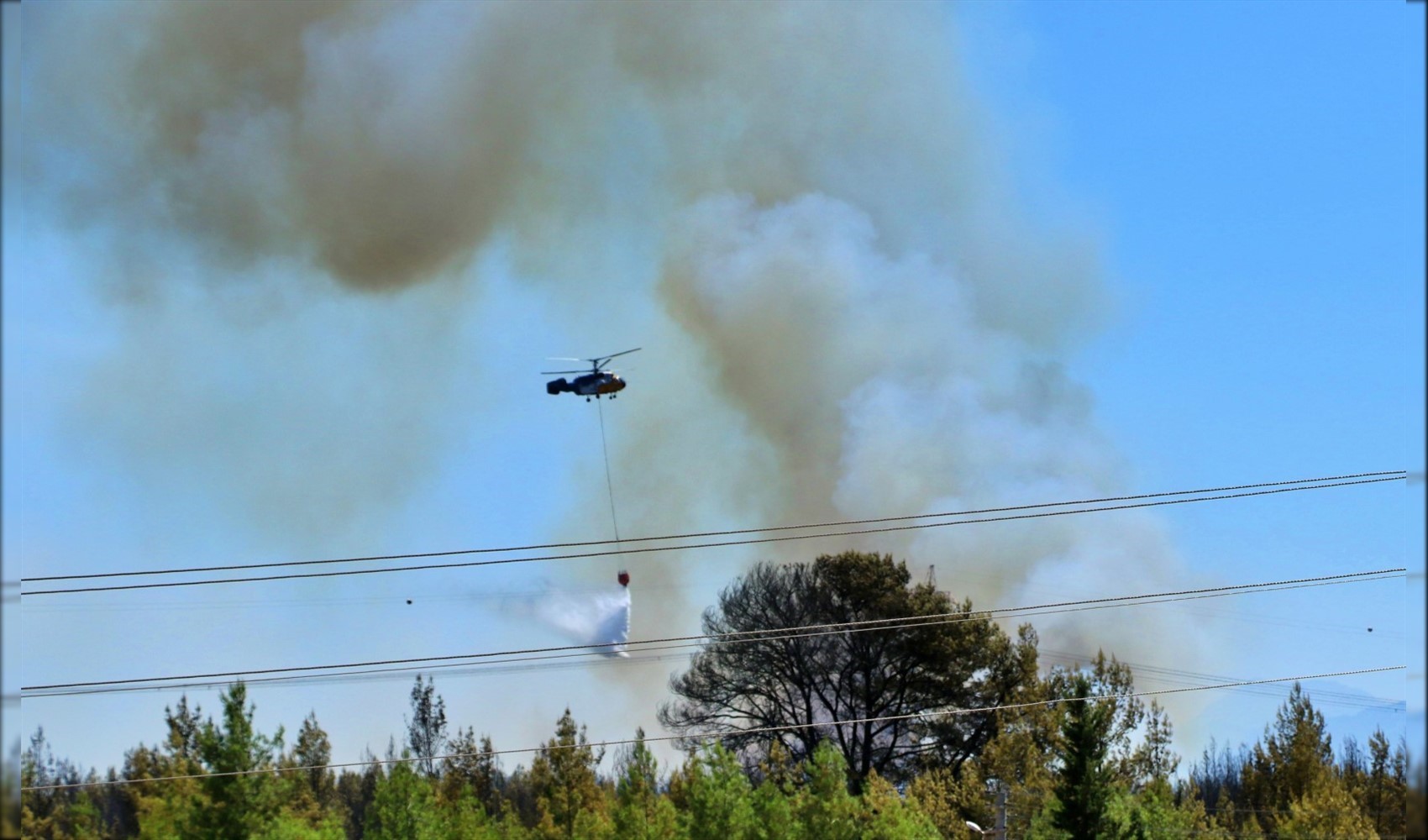
Forest fire in Antalya brought under control

The PKK opening and Özgür Özel’s path!..

How did the newspapers view Özgür Özel's farewell to the CHP?

He killed his wife by slitting her throat: Their children witnessed the moments

What did the CHP do?

Özel’s new party move in the world press

The New CHP, against CEHAPE

Fire at TUSAŞ engine factory in Eskişehir under control