



STONE IS HEAVY IN ITS PLACE-145. LET US NOT FORGET, LET US NOT LET BE FORGOTTEN.
Just as historical artifacts tell us about the past and teach us, they also demonstrate the heights reached by the creative artists and human talent of those periods.
They broaden one's horizons and help one better grasp the day they live in.
They make one think deeply.
They inspire new works.
This is why, in countries that have reached a high level of development, it is common to see children being taught in museums and amidst historical structures.
As sophistication increases, so does consciousness.
Life carries a higher meaning.
What whispers might the magnificent friezes and statues of the Zeus Altar of Pergamon—built approximately 2200 years ago and whose pieces were smuggled to Germany at the end of the 19th century—not murmur to the people who see them in the Pergamon Museum/Prison in Berlin!
How could they not tell the people wandering around its desolate foundations on the Pergamon Acropolis about their longing for the pieces smuggled to Berlin!
Which beauty-loving ruler commissioned it, which skillful hands shaped it, and which crude hands, thinking of nothing but their own gain, tore it from its place and smuggled it away!
That its true home is Anatolia!
One of the most meaningful of these works is the "Telephos" friezes, the pictorial marble reliefs that decorate the walls surrounding the inner courtyard of the magnificent Zeus Altar, which was designed in the shape of a rectangle open on one side.
They are a work of art that is unique in concept, groundbreaking artistically, and exemplary in terms of creating urban memory.
The Telephos friezes, which contain cautionary tales and are drawn on marble as if creating a comic book, are sculptural reliefs that serve as a symbol of the formation of Pergamon's history.
They are a part of that magnificent capital, reflecting the personality of the city of Pergamon, which dominated Western Anatolia for 150 years in that era.
There are very few, if any, thematic, additive plastic artworks in the world that tell such long stories and are crafted with such unique skill.
The roots of the Baroque style of art, which spread throughout Europe in the Middle Ages and contains dynamism, depth, and exaggeration, are based on the sculptural style that emerged in Pergamon, which created the Zeus Altar.
It is incomprehensible that a work with such high artistic qualities, a special part of a city, should be taken from where it was found, moved to a place that has nothing to do with the culture and time in which it was made, and still be insistently kept there.
In fact, if one may say so, it is psychologically a "diseased situation"!
Moreover, it is another traumatic situation that Anatolia's works are presented and exhibited without any shame as "Prussierkulturbesitz", "Prussian (the old name for Germany) Cultural Heritage", as if they were a part of their own culture.
The marble "head," which was torn from the Telephos friezes of the Zeus Altar and surrounds the inner walls of the main structure, and which was likely modeled after a young man from Pergamon, is one of these smuggled pieces.
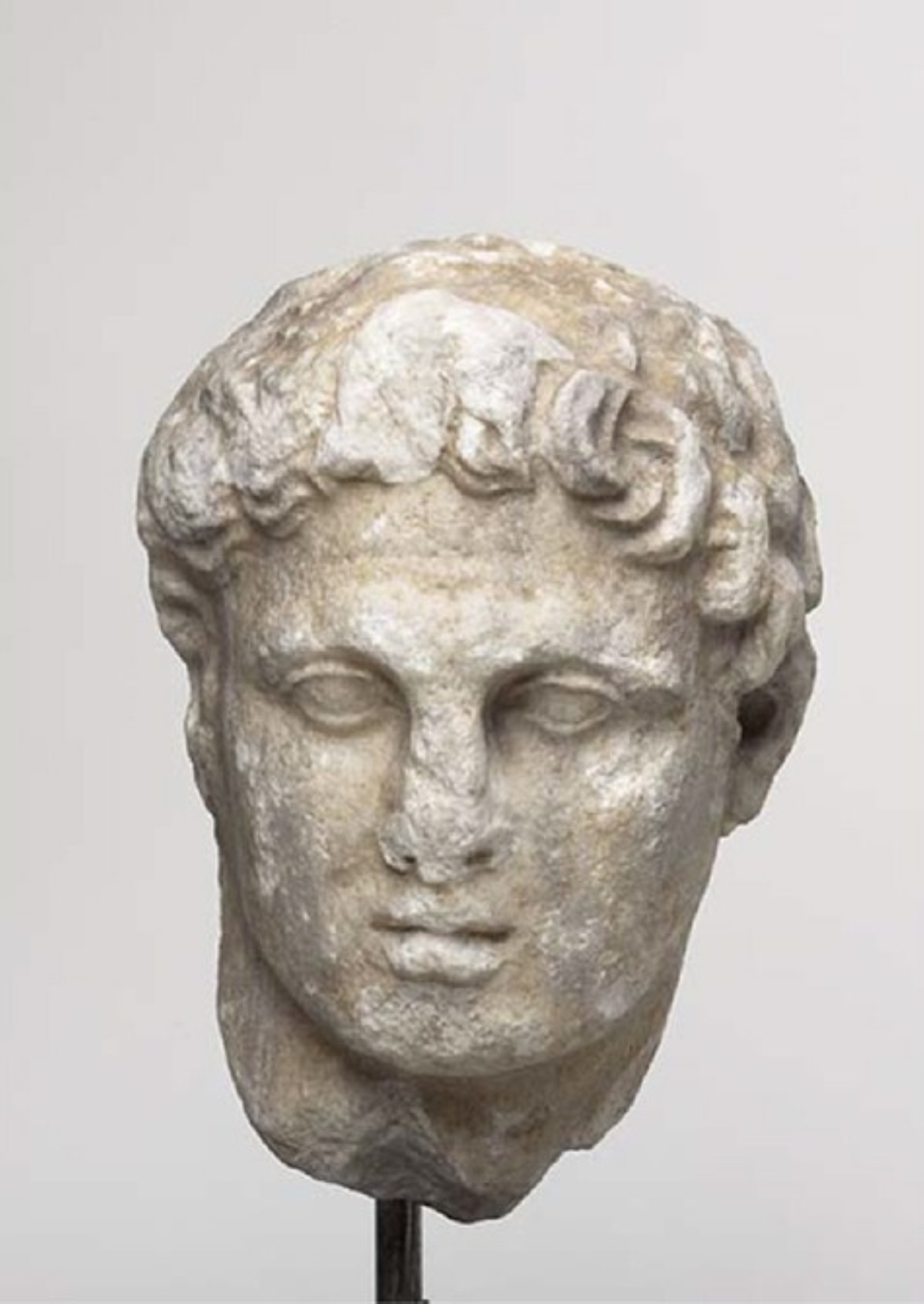
Dating back to the second half of the 2nd century B.C., this work is 17 cm high.
With the aesthetic connection established between his long face, pursed and curled lips, and smooth cheeks, the young man looks at the world with a thoughtful and striking expression of innocence.
His hair falling onto his forehead and his slightly narrowed eyes support this expression.
The marble seems to speak!
In addition to these, the lime patch on top of his head, which is part of the friezes and was likely added later, is a sign that this work was damaged in one way or another in the hands of German smugglers.
It is a cultural crime beyond shame that not only were such works smuggled, but they were also subjected to destructive procedures in the name of repair.
Our works were supposedly taken away to be protected!
This young man from Pergamon is imprisoned in the Berlin Museum/Prison with the registration number "Ident.Nr. T.I. 123".
Those responsible for this shameful situation are those who took it from Pergamon to Berlin through smuggling and dubious means.
They are those who keep it in the Berlin Museum/Prison.
They are those who dismantle and reassemble it under the name of repair.
Historical artifact smuggling and theft are not a moral burden to be carried by holding onto them.
This situation, caused 150 years ago by Imperial Germany through its officials, must be ended through international solidarity by contemporary and enlightened German officials and intellectuals.
The brothers of the ants must emerge!
THE ZEUS ALTAR AND PERGAMON ARTIFACTS DO NOT BELONG TO COLD AND FOGGY BERLIN, BUT TO BEAUTIFUL PERGAMON. THEY MUST DEFINITELY COME BACK, THEY MUST RETURN HOME!
(Source: http://www.smb-digital.de/eMuseum, Database-Antikensammlung)
Sefa Taşkın
28.06.2024
Dikili/İzmir
Most Read

Striking picture for Özgür Özel's 'New Party'
Özgür Özel gives a dated response regarding the number of resignations

Forest fire in Antalya brought under control

The PKK opening and Özgür Özel’s path!..

How did the newspapers view Özgür Özel's farewell to the CHP?

He killed his wife by slitting her throat: Their children witnessed the moments

What did the CHP do?

Özel’s new party move in the world press

The New CHP, against CEHAPE

Fire at TUSAŞ engine factory in Eskişehir under control