



STONE IS HEAVY IN ITS PLACE-139. LET US NOT FORGET, LET US NOT LET BE FORGOTTEN.
Thousands of years ago, in the beliefs of the people of the Aegean and Mediterranean, "Triton" was a god who lived in the seas.
"Triton" is the son of Poseidon, who is considered the god of the seas, earthquakes, and horses, and the brother of the chief god Zeus.
He is a hybrid creature, human from the waist up and fish from the waist down, with feet resembling those of a horse.
He acts as a messenger for his father Poseidon and lives with him in a palace at the bottom of the sea.
The name "Triton" is kept alive today in astronomy.
One of the moons of Neptune (Poseidon), one of the planets orbiting the Sun along with Earth, is named Triton. Its direction of rotation is opposite to that of Neptune.
While the outer walls of the Zeus Altar in Bergama, which is considered the eighth wonder of the world, were decorated with sculptural reliefs (friezes) depicting the War of the Gods against the Titans/Giants, and the inner walls told the legend of the founding of Pergamon, the corners and edges of its roof were adorned with sculptures and carvings called "acroteria".
Pergamon designers placed magnificent sculptures of the son "Triton" on the edges of the roof of the Zeus Altar, just like the statue of his father Poseidon (See: Stone is Heavy in its Place-88).
They also considered them as acroteria, edge and corner decorations.
Of course, these sculptures emerged from the hands of unique Pergamon sculptors.
Two of these Triton sculptures were seized on the Pergamon Acropolis by a German robber named Carl Humann and his gang, who looted Bergama, and were smuggled to Germany along with other artifacts.
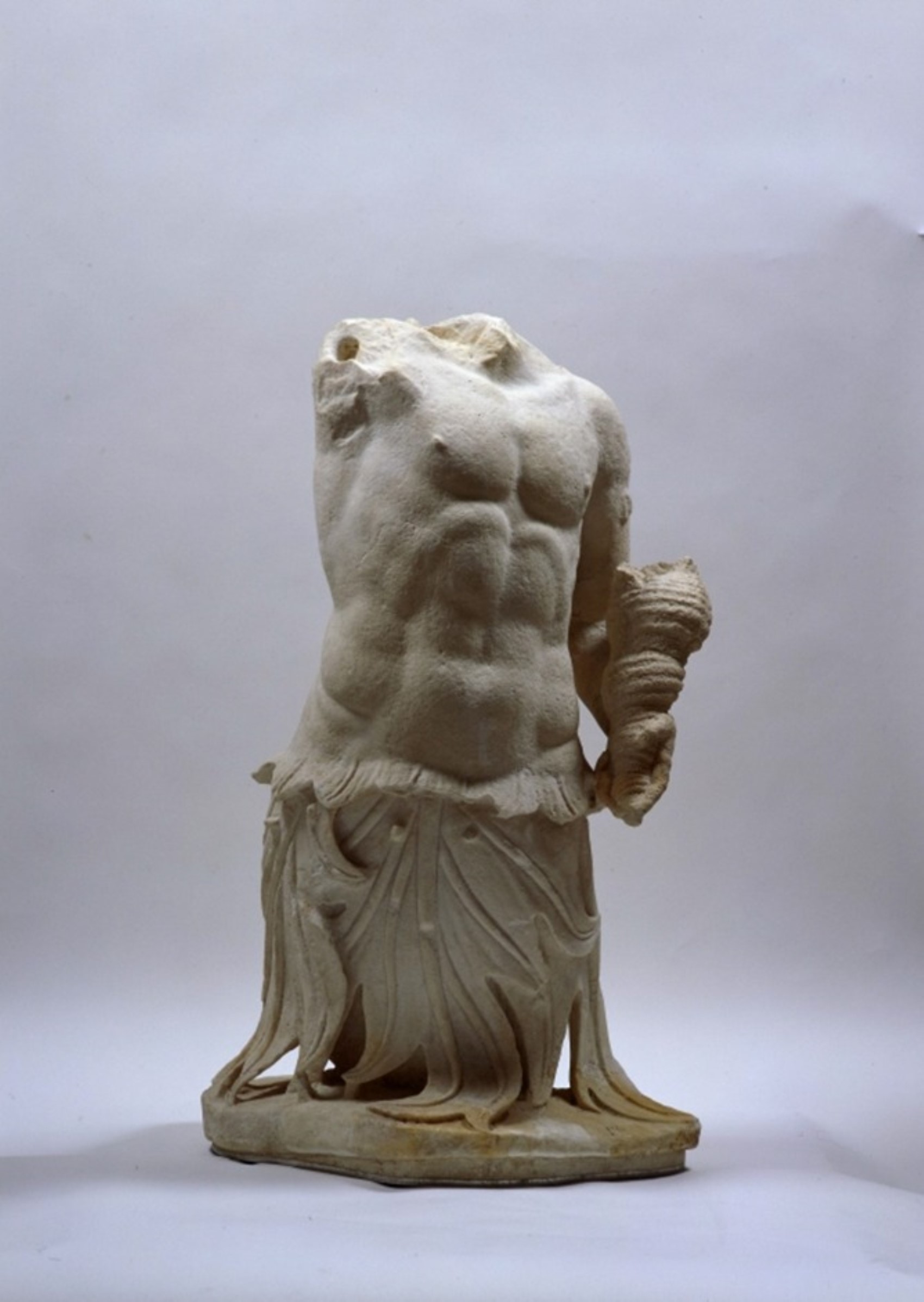
The "first Triton sculpture", 91 cm tall and 51 cm wide at the hips, holds a trumpet made of a seashell in its hand. It is as if it is about to blow it to notify his father Poseidon. The statue has no head.
The other is almost identical to the first, but half of its head remains.
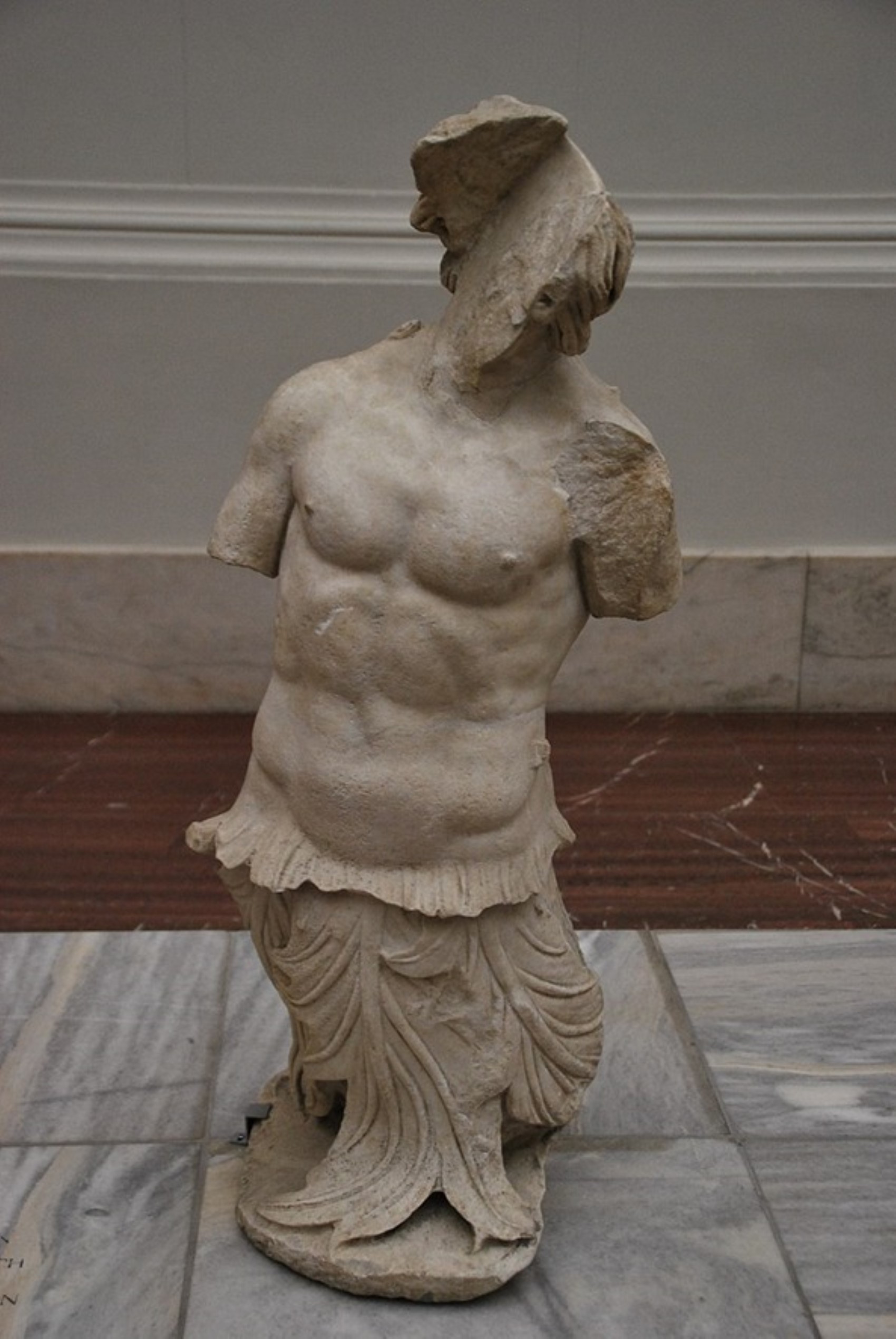
It can be seen that the hair is wavy on the remaining part of the head, which appears to have been broken with an excavating tool.
It can be said that the head of the statue was broken during the brutal excavation carried out by German smugglers using unskilled laborers.
Or by the first fanatical Christians who forbade the worship of statues.
Dated to 160 BC, the sculptures were made of Proconnesian marble from Marmara Island. In other words, the stone itself came from the heart of Anatolia. The marble quarries on this island have been operated for 2500 years.
It is certain that the sculptures, which represent robust and very healthy male bodies, possess a distinct, fine craftsmanship.
The Pergamon sculptors who created these magnificent works and opened a new era in art succeeded in combining elegance with strength in these sculptures as well.
From the front ribs to the waist muscles, and from the broad shoulders to the powerful chests, the details of the sculptures point to Triton's divinity.
The trumpet made of a seashell in the hand of the first sculpture must point to his relationship with the sea and his duty to convey messages to his father Poseidon. The second one has its head tilted slightly to the left, and its arms are broken.
The lower parts of these sculptures, which represent this hybrid creature, are depicted with wavy lines resembling fish scales.
There is a slightly raised protrusion at their waists that separates the upper and lower parts of the body.
This must be a belt separating the human-looking upper part from the fish-looking lower part.
The sculptures were placed on a pedestal, but their feet were not shown.
These unique sculptures probably slept for centuries under the mound, the hill of earth formed where its foundations were located, after the Zeus Altar was destroyed by the first Christians who were hostile to paganism.
They were unearthed from under the ground on the north side of the foundations of the Zeus Altar by an organized smuggling network led by a gang leader disguised as an engineer named C. Humann, supported by the Prussian/German State, who looted Bergama 140 years ago.
They were taken abroad secretly or with dubious permits.
Created in Aegean culture and imagined to exist in the Aegean Sea, Triton, son of Poseidon, is now far from the lands where he was brought into existence as marble sculptures.
And there are two of them. As if they were twins.
It was not enough for the smuggler Carl Humann and his gang to take one and leave; they took the other one too.
If only they had left one behind (!)
But that is "greed!".
Imperialism is never satisfied!
Both "Triton" sculptures, like many related Pergamon sculptures, have been locked up in a prison called a Museum in Berlin.
Museum/Prison Identification Numbers are "AvP VII 166" and "AvP VII 167".
How can one's heart not ache!
How can one not be angry at this absurdity!
Come on, let's put the issue of smuggling and dubious permits aside. Let's look through the glasses of the German authorities: Let's assume they were taken to Berlin for protection!
Come on, without saying "damn such protection", let's say, "they have been protected enough".
"Zeuses, Poseidons, Tritons" are the products of the belief of this geography.
Foreign to the arrogance of today's Central Europe!
Let ears be opened now! Let this stubbornness be abandoned!
Let Anatolia's historical artifacts be returned!
THE ZEUS ALTAR AND PERGAMON ARTIFACTS DO NOT BELONG TO COLD AND FOGGY BERLIN, BUT TO BEAUTIFUL BERGAMA. THEY MUST DEFINITELY COME BACK, THEY MUST RETURN HOME!
(Source:http://www.smb-digital.de/eMuseum, Database-Antikensammlung---
https://artsandculture.google.com/asset/triton-with-trumpet-unknown/lwGNlCalasMs7A?hl=de---https://commons.wikimedia.org/wiki/File:Triton,_from_the_Pergamon_Altar_terrasse,_Hellenistic,_160_BC,_Pergamon_Museum_Berlin_%288404174581%29.jpg.--- Pausanias: Description of Greecewith an English Translationby W.H.S. Jones, Litt.D., and H.A. Ormerod, M.A., in 4 Volumes. Cambridge, MA, Harvard University Press; London, William Heinemann Ltd. 1918)
.jpg)
Most Read

Striking picture for Özgür Özel's 'New Party'

Özgür Özel gives a dated response regarding the number of resignations

The PKK opening and Özgür Özel’s path!..

Forest fire in Antalya brought under control

How did the newspapers view Özgür Özel's farewell to the CHP?

He killed his wife by slitting her throat: Their children witnessed the moments

What did the CHP do?

Özel’s new party move in the world press

The New CHP, against CEHAPE

Fire at TUSAŞ engine factory in Eskişehir under control