



People express their feelings and thoughts most simply through words, and most meaningfully through art.
The expression, whether recorded or unrecorded, becomes concrete and socialized as it is perceived as beauty.
As art develops, the human and societal understanding of taste and aesthetic evaluation becomes more refined and selective.
The culture that forms it turns toward innovations and changes through leaps in the material and spiritual accumulation it possesses.
Since very ancient times, humanity has been making sculptures, figurines, and statue-like reliefs out of stone, wood, metal, and terracotta.
The oldest works depicting human figures also portrayed animals related to the human world.
These figures were likely, at the same time, sacred objects representing the common beliefs of societies, entities that influenced their communal lives.
Or they were figurative symbols describing the environments in which they existed.
Over time, depictions of gods, kings, queens and royal families, heroes, and people important to society were added to them.
These works had a static appearance, and this method continued during the 7th-4th centuries B.C., when Greek/Hellenic art was taking shape.
In ancient Greek/Hellenic art, it was not personal characteristics that were sought in human statues, but the ideal proportions of the human body.
This aesthetic understanding, which reflected mobility based on contrasts, rose upon nobility. Art could not escape idealism.
During the time period known as the Hellenistic period, which occurred between the 4th and 1st centuries B.C., a new understanding of art emerged in the vast geography dominated by Alexander the Great of Macedon and his successors.
A new style suitable for the conditions was born in the Empire of Alexander the Great, which stretched from Greece to India, and in the kingdoms that formed after it, where many different peoples lived and various languages were spoken.
The art that developed in an environment where different cultures existed was now directed toward daily life, far from divine idealism.
Human statues could be coarse, ugly, and far from ideal, just as they could reflect beauty.
This was a major change never before seen in art.
The new sculptural style to be created in the Pergamon Kingdom, one of the kingdoms that emerged with the collapse of the Alexander Empire, flourished in such an environment. It pioneered the change in art.
The Pergamon Altar and Pergamon sculptures are the most important and distinct examples of this innovation.
The new style paved the way for architectural movements such as Baroque and Gothic much later.
One of these sculptures, an elegant young male head among the Pergamon works, draws attention.
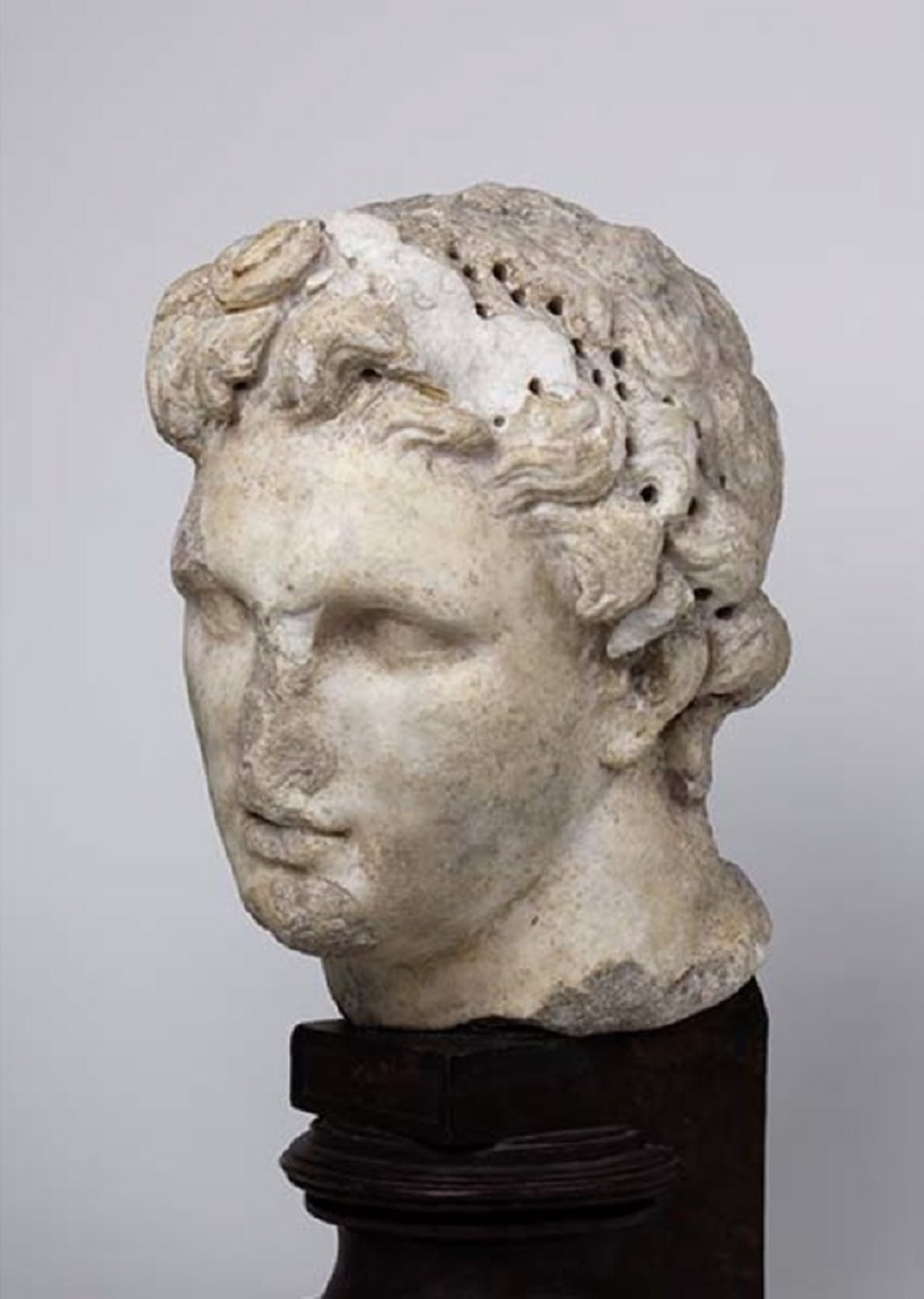
This highly valuable historical artifact, a young male head with wavy hair and a meaningful expression on his face, is one of the sculptures smuggled from Pergamon to Germany, to Berlin.
It is also dated to the Hellenistic period, the mid-2nd century B.C.
The head is smaller than a normal human head. It measures “29.5*9.5 cm”.
It is accepted as the head of a statue whose body has been lost.
This statue may have been a work placed inside a niche with a triangular pediment, also called an “aedicula,” carved into a wall to decorate it and fill the void.
The marble from which it is made is grayish-white, low-mica, and fine-grained.
His cheeks are smooth, yet a unique vitality is sensed in his face.
His wavy hair forms curls that descend from the middle of his forehead toward the top of his head, framing his face with a ring of full, curly hair. It hangs down toward the nape of his neck.
It is also felt that this head, covered with wavy, curly hair resembling the famous hairstyle in the statues of Alexander the Great, wears a wreath.
With his head turned to the left and his parted lips, the statue face, which resembles a young man who has just passed puberty, gives the viewer the impression of someone who has stepped out of a dream.
There is no indication that this exquisite statue head is a member of the famous Attalid dynasty, the ruling family of Pergamon.
However, the fact that the marble was worked into a head with such a beautiful appearance is a sign that the model for this statue was a very beloved and admired young man.
It is clear that this charming statue head has suffered damage and has been tampered with in recent times.
As seen in the scarring on his nose, chin, and above his right eyebrow, there is an addition, a patch made later with plaster on top of his head.
There are 40 very distinct, wide holes made with a drill or by driving nails along the border line between the hair on his forehead and the hair on top of his head.
The existence and reason for these holes are not reported in the open records by the Berlin Museum/Prison authorities.
The holes in the head of this statue, which likely decorated a niche, have no meaning if they were opened in ancient times.
If these holes were opened for a reason such as joining broken parts during the smuggling process, or if something happened to it after it was brought to the Berlin Museum/Prison, this situation is unacceptable.
Intervening in this artifact, which was damaged while being torn from its home or afterward, by drilling such holes with a drill causes it much greater harm than good.
Moreover, it is clearly seen that a part covering the hair on the upper left side of his forehead was later covered with plaster.
This is a great cultural crime committed against a very valuable historical artifact, the Pergamon youth whose image has survived to the present day.
If this is the case, smugglers, even if the Berlin Museum/Prison authorities consider it “Prussian (the old name of Germany) Property/Heritage,” have no right to batter Pergamon works.
What happened to the statue head of this young and beautiful lad who lived in Pergamon is the direct responsibility of the German gang disguised as archaeologists at the end of the 19th century.
Like the Pergamon Altar, this work was also found between 1864-1886 by an engineer named Carl Humann and his gang, supported by the Prussian/German State, in the Pergamon “Gymnasium” on the Pergamon Acropolis, “the place where sports were practiced,” and was illegally smuggled from Pergamon with dubious permits.
Now it is a prisoner there, in the Berlin Museum/Prison, with the registration number “AvP VII 42”.
This work, about which many art historians have written pages of commentary while looking at its meaningful face, has been cruelly torn from the lands where it was produced.
There is an end to injustice!
In the not-so-long history of humanity, goodness, truth, and beauty have always prevailed, even if there were occasional disruptions.
Otherwise, there would be no humanity!
The place of this beautiful person, who is in exile in Berlin, is Anatolia, is Pergamon.
THE PERGAMON ALTAR AND PERGAMON WORKS DO NOT BELONG TO COLD and FOGGY BERLIN, BUT TO BEAUTIFUL PERGAMON. THEY MUST DEFINITELY COME BACK, THEY MUST RETURN HOME!
(Source: http://www.smb-digital.de/eMuseum, Database-Antikensammlung, https://recherche.smb.museum/detail/684341/Bildniskopf%20eines%20jungen%20Mannes%20mit%20Anastol%C3%A9)%7D, https://arachne.uni-koeln.de/arachne/index.php?view[layout]=objekt_item&search[constraints][objekt][searchSeriennummer]=113753)
Sefa Taşkın
05.05.2024
Bergama-Karşıyaka-Izmir
Most Read

Striking picture for Özgür Özel's 'New Party'

The PKK opening and Özgür Özel’s path!..

How did the newspapers view Özgür Özel's farewell to the CHP?

He killed his wife by slitting her throat: Their children witnessed the moments

What did the CHP do?

Özel’s new party move in the world press

Fire at TUSAŞ engine factory in Eskişehir under control

The New CHP, against CEHAPE

From self-efficacy to despair

Kılıçdaroğlu's first message on Özgür Özel's new party announcement