

A Communist Perspective on the Republic
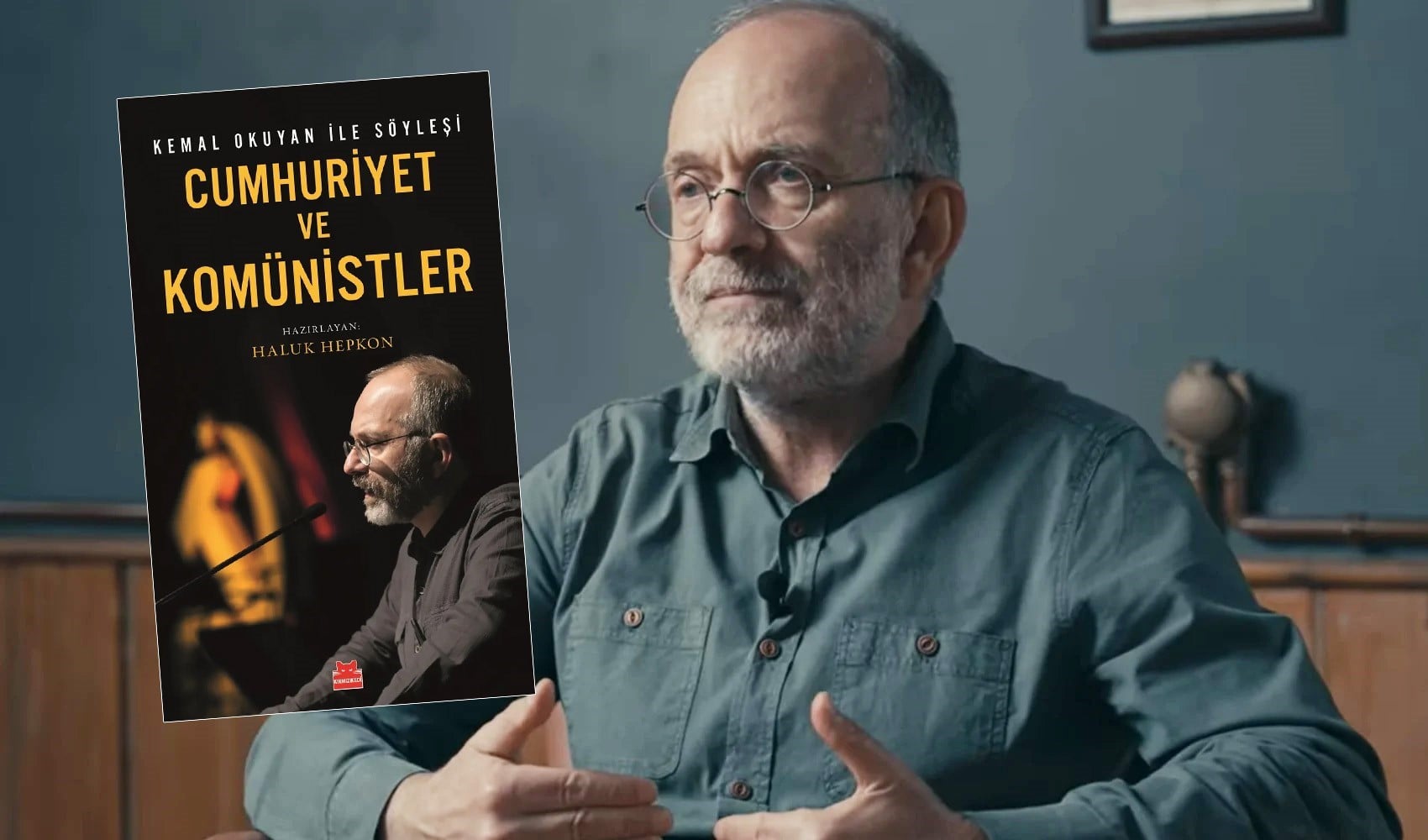
Writer and critic Toprak Işık reviewed the book "The Republic and the Communists," prepared by Haluk Hepkon together with TKP General Secretary Kemal Okuyan.



Author: Toprak Işık
"The Republic and the Communists," which conveys the views of Communist Party of Turkey (TKP) General Secretary Kemal Okuyan accompanied by the questions and commentary of Haluk Hepkon, is an interview book that challenges conventional wisdom in its field. Published by Kırmızı Kedi Yayınları, the work analyzes the position of the communist movement in Turkey while simultaneously inviting the reader to re-examine the founding of the Republic and the background of today's political framework.
As Hepkon emphasizes in the preface of the interview, almost all political debates in Turkey are conducted using pre-determined patterns. The positioning of the right and left, their ways of relating to the public, the impact of identity politics, and the interpretation of Republican history often carry a superficiality detached from historical context. Kemal Okuyan's approach in the interview challenges this superficiality and these rote assumptions: he does this not by becoming trapped within existing lines, but by drawing support from the historical ground beneath those lines.
One of the issues Okuyan focuses on most is that the Turkish left has lost its own independent course... He argues that, especially after September 12, the left was confined to the cultural sphere and its capacity to produce political goals and programs narrowed. According to him, the left remaining in the shadow of identity politics, being dragged into the trap of "civil society-ism," and failing to develop an anti-establishment ideological line are among the fundamental factors weakening the movement. Although this assessment is related to some criticisms that have been voiced in Turkey for many years, Okuyan bases his argument on the class struggle—which is deliberately attempted to be portrayed as outdated—and does not settle for mere diagnosis, but reveals the historical infrastructure of his findings.
In this context, he concretizes his criticism with questions regarding the partnerships established with the CHP and DEM. According to Okuyan, these two actors create a balance that, for various reasons, drains the energy of the Turkish left. He states that the TKP maintains its independent line; he emphasizes that the left must stand on its own feet without entering the orbit of other powers. This stance opens an important area of debate regarding both the fragmentation within the Turkish left and the contradictory positions of the centers that claim to speak on behalf of the left.
One of the most interesting aspects of the interview is the attitude Okuyan displays regarding the relationship between the Republic and Communism. The tendency to "reject the Republic entirely," which is common among a segment of the left in Turkey, and the sharp opposition built upon Kemalism are re-evaluated here.
Hepkon and Okuyan ask the reader new questions by considering a wide historical universe, from Nâzım Hikmet to Deniz Gezmiş, from Mustafa Kemal to the support the Soviet Union gave to the National Struggle: Is progressivism an abstract label in history? Or is progressivism related to where we stand within a given historical conflict? Both suggest that instead of sticking a time-independent "progressive/reactionary" label on history, each period should be handled within its own concrete conflict. They position the 1919–1923 interval as an "anti-imperialist ground" and state that the struggle waged carried a historically revolutionary content. Therefore, they view the proclamation of the Republic as a more advanced move compared to the Ottoman order.
A remarkable part of the interview is based on the left's loss of its enlightenment character. When Okuyan says, "The left in Turkey has been left without intellectuals," he does not just mean individual intellectuals; he points to the disappearance of a broader ideological framework. This loss leads to a decline in the capacity to produce thought, the blurring of concepts, and the left's inability to connect with its own historical accumulation. Thus, the book goes beyond an interview and turns into a kind of call for intellectual renewal.
Okuyan states that the Turkish left's attitude toward imperialism has become increasingly ambiguous, whereas this attitude was very clearly progressive during the founding years of the Republic. Especially in his criticism regarding the relations of some Kurdish movements with the US, he points out that the foreign policy readings of today's left are not sufficiently consistent. The goal here is not to present a nationalist view; on the contrary, it is to remind of the necessity of an anti-imperialist line on a historical and class basis...
In the final sections of the interview, Turkey's current situation is analyzed. According to Okuyan, the current order has become "unsustainable": deep poverty, institutional decay, social distrust, foreign policy risks, and successive crises are driving Turkey to a crossroads. At the root of this assessment is the knowledge of how various breaking points in history have led to a social awakening.
Okuyan believes that society has the potential to "rise up" despite all pressures, and that historical examples of this potential exist. In this framework, the interview puts forward an idea of hope born from within reality without oscillating between pessimism and optimism. The emphasis on the country's own internal dynamics and secular accumulation, in particular, indicates that the competence to build the future still exists at the social base.
Okuyan uses a language that is sometimes harsh, sometimes provocative, but always forces one to think. In this respect, the book pulls the reader out of comfortable political positions. It does not give easy answers; it asks difficult questions. This makes the book valuable even for those who do not agree with Okuyan; because thinking in the shadow of provocative questions promises a more productive world of thought than living with the sterilizing effect of rote memorization.
Stating that the left in Turkish politics has an area of influence not limited to the votes it receives in elections, what Okuyan says goes beyond the transmission of an individual opinion due to his position in politics; it offers strong clues about his party's strategic orientations. By providing important data regarding both the course of intra-left debates and the general political framework of the country, the analyses in the book make the interview a valuable resource for current and near-future political readings, while also opening a window to many productive speculations: With this approach, it is quite possible to include the People's Republic of China as a rising power when evaluating the book.
The Chinese experience serves as a threshold that multiplies questions about what tools, what priorities, and what founding language the left will use to conduct politics as power balances change in the world, regarding topics such as the Turkish left's search for an independent route, the clarification of the anti-imperialist line, the reconstruction of an enlightenment ideological framework, and the strengthening of program production capacity. For communist parties, this threshold provides the opportunity to connect socialism to a concrete economic-political capacity debate, rather than it being merely a moral objection or a memory of the past. Precisely for this reason, the area of debate opened by "The Republic and the Communists" extends not only to Turkey's internal political balances but also to the way we look at the world again: It calls for abandoning the comfort of leaving oneself rudderless and sail-less in the flow, and for seeking an independent and founding leftist mind that speaks from within historical conflicts.

News Source: 12punto
Most Read

Striking picture for Özgür Özel's 'New Party'

Özgür Özel gives a dated response regarding the number of resignations

Forest fire in Antalya brought under control

The PKK opening and Özgür Özel’s path!..

How did the newspapers view Özgür Özel's farewell to the CHP?
Houthis strike Saudi-owned tanker

What did the CHP do?

Özel’s new party move in the world press

The New CHP, against CEHAPE

From self-efficacy to despair