

Byzantine treasure found in ancient city's trash pit
Archaeological excavations in the ancient city of Apollonia-Arsuf in Israel have unearthed numerous Byzantine-era artifacts, including gold coins and jewelry, from a 1,500-year-old waste site.



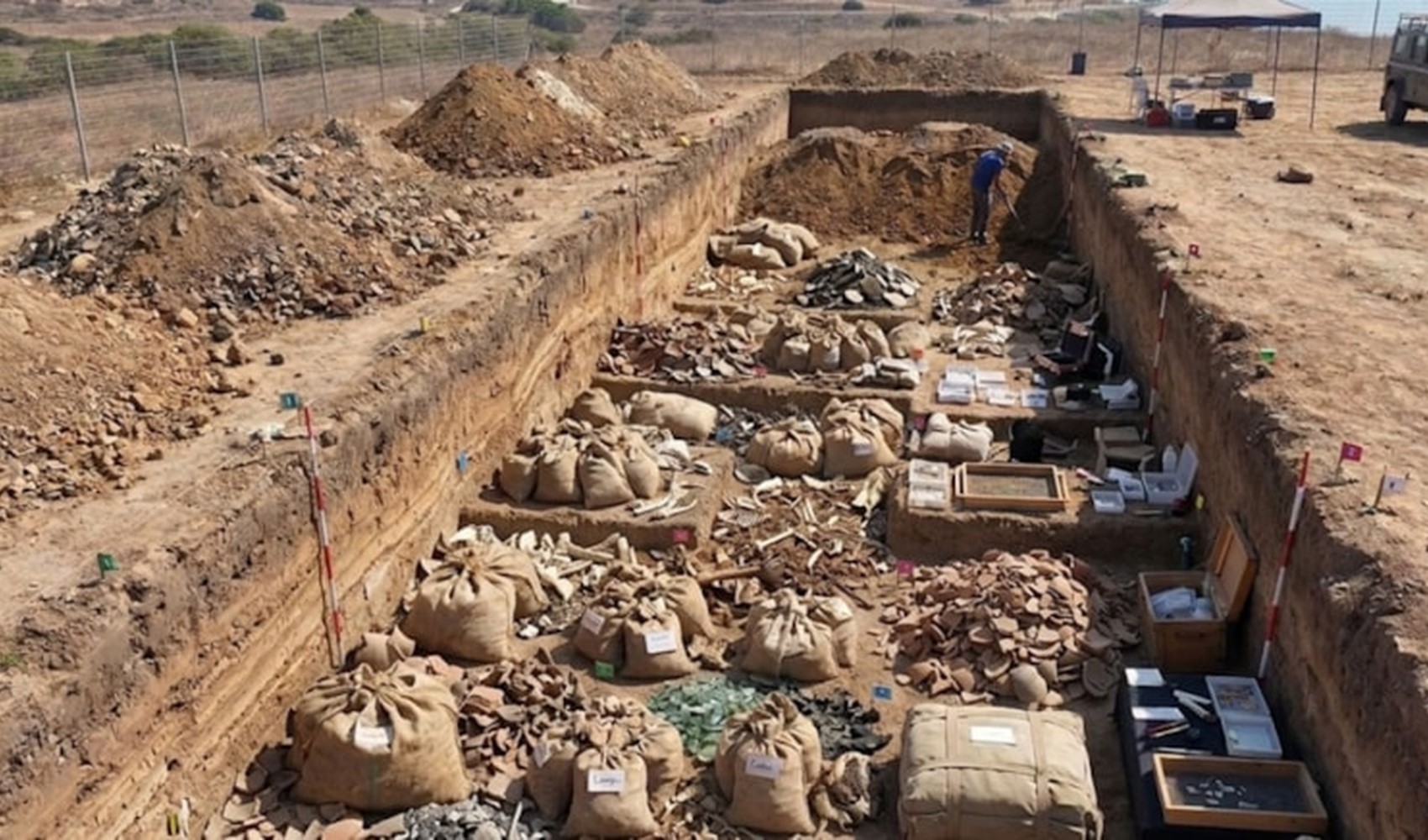
Excavations ongoing in the historic city of Apollonia-Arsuf in Israel have reached surprisingly well-preserved Byzantine-era findings. The excavation team made an unexpected discovery in an area initially interpreted as an ordinary trash site, containing hundreds of ancient artifacts.
During the work conducted by experts from Tel Aviv University, hundreds of oil lamps, jewelry, and valuable coins, most in intact condition, were found inside a pit exceeding 30 meters in width. The discovery of gold coins and jewelry, in particular, stunned the archaeologists. In the early stages of the excavation, it was noted that the area was used as a waste dump, where pottery shards, glass remains, and animal bones were encountered. However, as they dug deeper, they encountered historical artifacts that were almost completely undamaged.
Professor Oren Tal and Dr. Moshe Ajami, following the results of their work in the region, stated: "You do not expect to find intact oil lamps in dumps and waste areas because they should be used or sold. The data we have obtained points to a religious or ritualistic tradition that led the Samaritan community living in the region during the late Byzantine period to intentionally leave intact vessels in this area."
According to the excavation team's findings, more than 400 coins dating to the Byzantine period, covering the years between 330 and 1453 A.D., were recovered from the pit. In addition to the gold coin, these coins, the majority of which are bronze, draw attention with the rich variety of the findings. Furthermore, approximately 200 Samaritan oil lamps, gold jewelry, and rings were unearthed with their surfaces intact.
The extraordinary nature of the findings is not limited only to their material value. Considering the environment in which the artifacts were found, it was emphasized that their degree of preservation is very high. Archaeologists are also evaluating the possibility that this area, known as a dump, may have been used in the past in accordance with a special ritual that carried religious significance.
It was reported that the ancient city of Apollonia-Arsuf has a stratigraphic structure bearing the traces of many civilizations from the Persians to the Crusades, with various settlement layers overlapping. The latest discovery has also raised new questions about the social life of the region during the Byzantine period.
News Source: 12punto
Most Read

Striking picture for Özgür Özel's 'New Party'

Özgür Özel gives a dated response regarding the number of resignations

Forest fire in Antalya brought under control

The PKK opening and Özgür Özel’s path!..

How did the newspapers view Özgür Özel's farewell to the CHP?

He killed his wife by slitting her throat: Their children witnessed the moments

What did the CHP do?

Özel’s new party move in the world press

The New CHP, against CEHAPE

Fire at TUSAŞ engine factory in Eskişehir under control