

Hakan Fidan declares there is a 'risk of World War III'
Foreign Minister Hakan Fidan, when asked, "Should the world be expecting a regional or global war, including the expectation of a third world war?" replied, "I think the world should take this scenario seriously, take this threat seriously. There is such a risk."



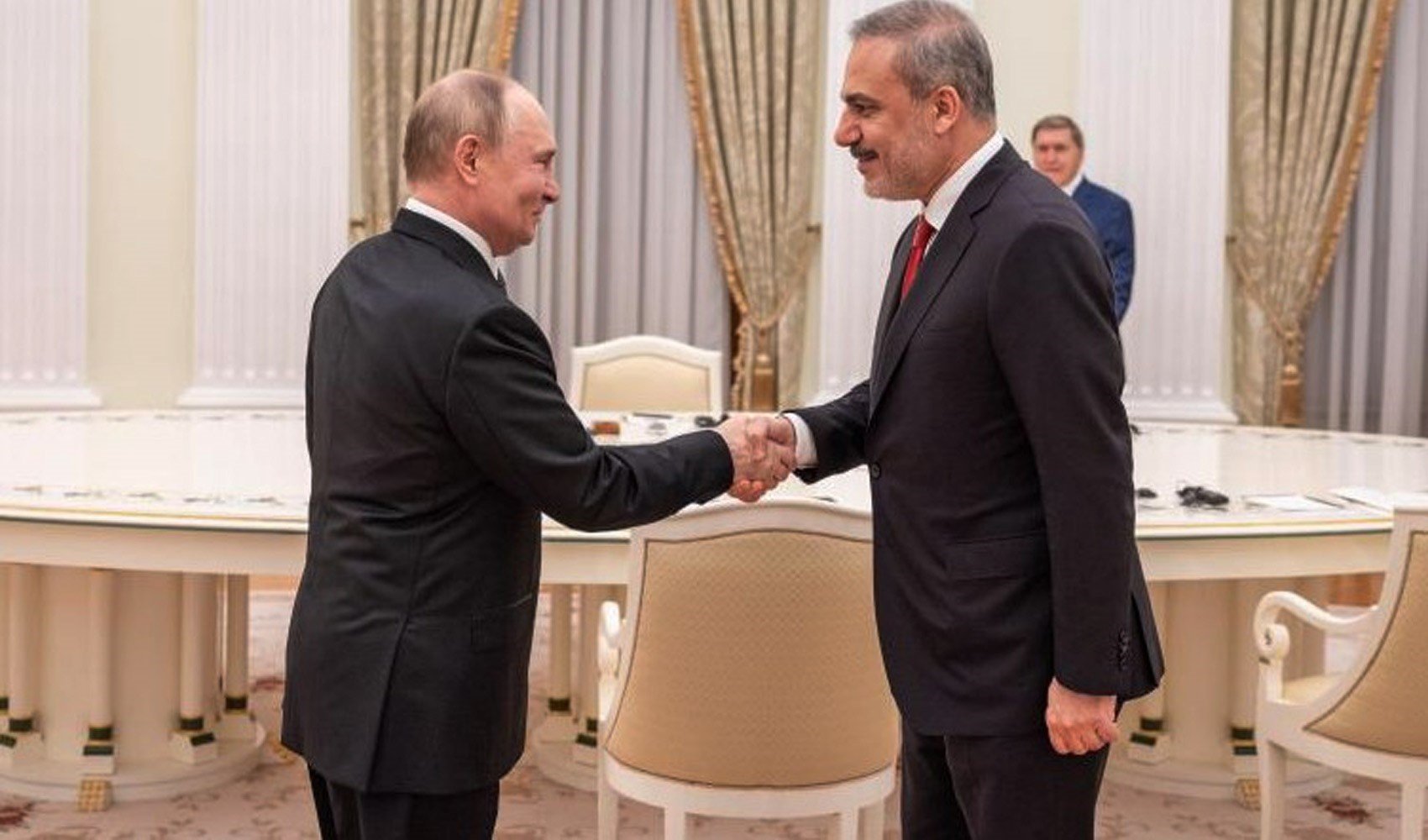
Here are the highlights from the statements made by Foreign Minister Hakan Fidan, who answered questions on HaberTürk:
Since my youth, I have been someone focused on looking at the Turkish national security system as a whole. It has many legs, including military and intelligence. All sub-branches of national security disciplines have their own unique characteristics. At the Ministry of Foreign Affairs, you are involved in more strategic issues than at the MIT.
At the MIT, the focus was primarily on operational matters, counter-espionage, and intelligence gathering. Now, we are in the position that utilizes that information. At the Ministry of Foreign Affairs, you need a lot of information from both closed and open sources. In terms of mental and strategic perspective, the ministry's responsibility is a bit heavier.
On the first day of the holiday, there was a Ukraine Peace Conference in Switzerland. The President had assigned me there. I returned on the second day and went to kiss my mother's hand. Events in international relations do not stop during the holiday either. It requires constant work. I didn't go anywhere during the holiday; I was here in Ankara.
"AN ECONOMICALLY ORIENTED PLATFORM"
Especially within the framework of the vision of our President, it has been a long time since we removed the issue of 'axis shift' from our agenda in the policy we implement. We are in search of what aligns with our own interests, principles, and stance. It is also important that our counterparts remain committed to the alliances we belong to. We are at a point where we are closely following alternative economic platforms.
What makes BRICS different is the presence of Russia and China there. The G7 is more of a place where political issues are discussed and countries that think within the same civilizational sphere come together. BRICS is an economically oriented platform. It does not have a rule-based, structural form. The different and beautiful aspect of BRICS compared to the EU is that it encompasses all civilizations and races. If it can become a bit more institutionalized, it will produce significant benefits.
Our relations and dialogues here are extremely normal. We are trying to keep our relations with BRICS member countries good. The two countries with which we have the highest foreign trade volume, China and Russia, are BRICS members. To conduct our country's foreign policy route more healthily, one must look at it within this framework. We have a relationship; we are holding our meetings and negotiations with BRICS member countries. They are already in a process of evolution themselves.
"THERE IS A RULE-BASED SYSTEM IN THE EU"
It is not a place where a Customs Union, a common currency, or free trade agreements are implemented. They are operating a credit-lending system. They are trading among themselves in local currencies. This is a subject we are also a party to. There are efforts toward de-dollarization. This is a strategy imposed by politics. We have memberships in both the EU candidacy process and other economic cooperation organizations.
We have an application for further membership in the massive economic platform in the Asia-Pacific. These platforms should be seen as complementary rather than alternatives to each other. There is a rule-based system in the EU. If we were not in the current situation regarding the course of our relations with the EU, and if the EU had been able to show the will to take a step forward, our perspective on certain issues here could have actually changed even more.
Currently, there is the issue of military alliance within NATO. The area of economic alliance has not become concrete in the same way. Therefore, our search continues.
DETAILS OF HIS MEETING WITH PUTIN
I met not only with Mr. Putin but with all actors. We had long discussions. Finally, I was received by Mr. Putin. There are messages sent by our President. We had the opportunity to discuss them in detail. There is a possibility that our President will meet with him in Kazakhstan in the coming days. For us, the Syrian theater is extremely important in our relations with Russia, energy issues in bilateral cooperation are extremely important, as is the trade volume and the situation of Turkish companies.
I met with Turkish companies. We addressed the issues they are facing. In general, they are satisfied. On the other hand, the Ukraine issue is extremely important. We stated where we stand. The ongoing war has a very high cost to the region and the world, and more alarmingly, this risk could grow and spread. It could spread geographically and methodically. Nuclear weapons could come to the agenda. I saw this during my trip to China and Russia.
The war has not spread elsewhere, but we see that polarization in the world is increasing. Russia, China, and Iran are moving toward a structural partnership. This is the expansion caused by this war. We conveyed to our counterparts that peace is essential regarding Ukraine and that Russia needs to determine its stance. Indeed, two days later, Mr. Putin listed the conditions for Russia to stop the Ukraine war point by point.
"OUR CONCERN IS THE CONTINUATION OF THE WAR"
It was important that Mr. Putin voiced this. Our biggest concern is the continuation of the war. We are in a situation where more than 500,000 people have died and the country's infrastructure is on the verge of destruction. The war has now moved into Russia. I always see a foundation for a negotiation process. It just needs a little help. There are critical elections in Europe and the US. There is a trend toward waiting a bit. Neither side wants to show weakness in their position by being the first to speak of peace, negotiation, or dialogue. There is serious mobilization. This is becoming structural.
"THERE IS A RISK OF WORLD WAR III"
Mr. Putin, in particular, has stated that he would have no hesitation in using nuclear weapons. This is the very issue we have underlined and warned about from the very beginning. As long as the war continues, this risk will persist. There is a possibility of it spreading to other places with a single spark. We are in the Black Sea basin. There is a security problem and a chaotic environment in our south, in the Eastern Mediterranean, due to Israel. There is a risk of World War III.
These must be read well and managed well. Turkish diplomacy is making efforts to stop the wars.
"WE HAVE PROBLEMS WITH 3 COUNTRIES REGARDING THE YPG"
There are 2.5 active members with whom we have problems regarding the YPG. The US, the UK, and to some extent France. America is continuing its presence there. We bring this issue to the agenda at every level. We are conducting the highest possible level of diplomacy to convey that this is contrary to the spirit of the alliance and that Turkey cannot live with such a reality.
If the other party is acting irrationally toward you, it is clear that there is an intent directed at you rather than their own interests. There are other behavioral models you can put forward.
We always tell the Americans and the British: we carry a greater sensitivity in our fight against the PKK than you do in your fight against terrorism. We will continue until this threat is eliminated by itself or by other means. I believe we have reached a certain level of understanding.
THE BOOK HAKAN FİDAN IS READING
When asked about the books he has been reading recently, Fidan added the following:
"Throughout the process, you read texts on religion, philosophy, psychology, history, and all kinds of subjects.
There are times when you read 3-4 books at the same time.
Recently, I've been reading a very original book about China and Chinese culture. I'm going through it in slow motion because I'm constantly wrestling with it during my travels. I also keep it by my bedside. It's a book called 'I Ching'.
The Book of Changes. It has been translated into English as 'Book of Changes'. There is a German Sinologist named Richard Wilhelm who stayed in China for 25-26 years in the 1920s and 30s. This is a book that came into existence around 1150 BC."
WHAT IS I CHING? WHAT IS THE SUBJECT OF I CHING?
The I Ching, or Yijing, translated as the Book of Changes or Classic of Changes, is an ancient Chinese divination text that ranks among the oldest of the Chinese classics.
Between the 18th and 20th centuries, the book played an influential role in the West's understanding of East Asian philosophical thought.
As a divination text, the I Ching is used in China for a form of cleromancy known as I Ching divination, in which bundles of yarrow stalks are manipulated to generate a set of six random numbers ranging from 6 to 9. Each of the 64 possible sets corresponds to a hexagram that can be consulted in the I Ching. The hexagrams are arranged in an order known as the King Wen sequence. The interpretation of the readings found in the I Ching has been and continues to be debated for centuries. Many commentators have used the book symbolically to provide guidance on moral decision-making, often informed by Confucianism, Taoism, and Buddhism. The hexagrams themselves have often taken on cosmological significance and have been paralleled with many other traditional names used for processes of change, such as yin and yang and the Wu Xing.
News Source: 12punto
Most Read

Striking picture for Özgür Özel's 'New Party'
Özgür Özel gives a dated response regarding the number of resignations
Forest fire in Antalya brought under control

The PKK opening and Özgür Özel’s path!..

How did the newspapers view Özgür Özel's farewell to the CHP?

He killed his wife by slitting her throat: Their children witnessed the moments

What did the CHP do?

Özel’s new party move in the world press

The New CHP, against CEHAPE

From self-efficacy to despair