

Supreme Court of Appeals files criminal complaint against Constitutional Court
The Supreme Court of Appeals has filed a criminal complaint against the members of the Constitutional Court regarding the rights violation ruling issued by the Constitutional Court concerning Can Atalay.



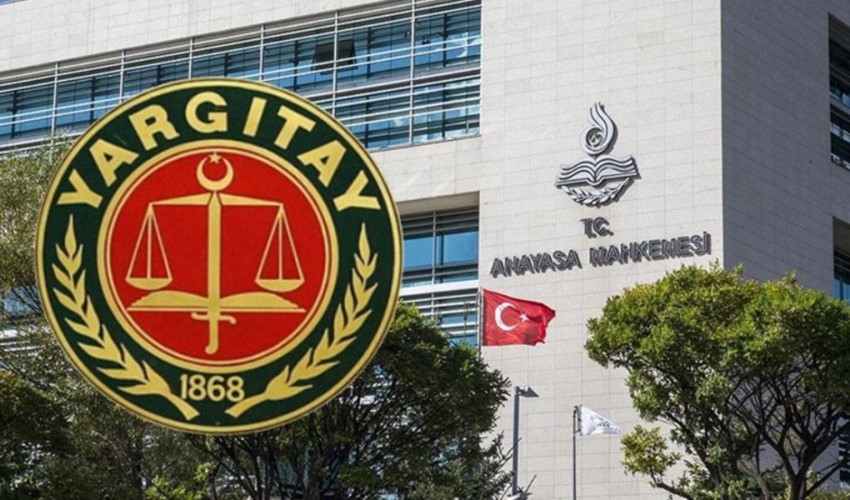
A new link has been added to the legal scandals occurring in Turkey. The ruling issued by the Constitutional Court (AYM) for the release of Can Atalay, who was elected as a TİP Hatay MP in the May 14 general elections, was not recognized by the Supreme Court of Appeals.
Stating that the Constitutional Court violated the Constitution and exceeded its authority, the 3rd Criminal Chamber of the Supreme Court of Appeals also filed a criminal complaint against the members of the Constitutional Court who voted in favor of the violation ruling regarding Atalay.
Evaluating the requests regarding the file, the 3rd Criminal Chamber of the Supreme Court of Appeals argued that in the violation ruling issued concerning Can Atalay, the Constitutional Court conducted an examination without taking into account the Chamber's final and enforceable decision.
In its ruling, the Chamber stated, "Although a decision should have been made regarding the immediate revocation of his parliamentary membership by submitting this matter to the General Assembly once the final judgment concerning him was notified to the TBMM (Grand National Assembly of Turkey), and although no decision could be made by the TBMM on this matter during the process, there is no possibility of application to the Constitutional Court regarding Article 84/2 of the Constitution, which regulates this issue, nor does the Constitutional Court have the authority to examine this matter."
“EVALUATED AS AN IRONY”
The 3rd Criminal Chamber of the Supreme Court of Appeals included the following statements in its ruling: "Furthermore, in the rights violation ruling it issued regarding Şerafettin Can Atalay, the Constitutional Court, unlike its previous rulings on Ömer Faruk Gergerlioğlu and Leyla Güven, stated that determining which crimes are covered by Article 14 of the Constitution regarding parliamentary immunity through judicial interpretation rather than constitutional or legal regulation would lead to serious problems; however, it found it noteworthy and evaluated it as an irony that it cited as a justification one of its own previous rulings, which was a result of judicial activism and is known to the public as the headscarf ban in universities, a ruling which we also do not accept."
The 3rd Chamber of the Supreme Court of Appeals stated, "In its ruling, the Constitutional Court, which says that it would not be healthy for judicial bodies to interpret which crimes fall under Article 14 of the Constitution and that a constitutional or legal regulation must be made, has, with the comfort of not being audited by any body despite having no constitutional or legal authority, continuously increased and abused its constitutional authority through jurisprudence in both its norm-audit rulings (for example, issuing a stay of execution or canceling the institution of deferment of the announcement of the verdict on the grounds that it was not applied correctly) and in the individual application rulings subsequently given to it as a secondary duty. This has caused the criticisms that it is a tutelary body over the legislative organ, which were frequently voiced during its previous norm-audit duty, to emerge over the entire judiciary, including high courts, upon the granting of the authority regarding individual applications."
“THE CONSTITUTIONAL COURT THREATENED US”
Pointing out that in the violation ruling issued by the Constitutional Court regarding the convict Şerafettin Can Atalay, the court went as far as threatening the members of the 3rd Criminal Chamber of the Supreme Court of Appeals who issued the ruling by stating they 'committed the crime of negligence' by mentioning the 'objective function of Constitutional Court rulings,' despite there being no legal basis for this and it being a controversial issue even in doctrine, it was stated, "It is regrettable and meaningful that our Chamber members, who have been constantly threatened by many terrorist organizations or their members through social media, written and visual press, or through petitions sent during first-instance trials or appellate reviews, are now being threatened in this way by the Constitutional Court."
“THE CONSTITUTIONAL COURT ACTS LIKE A TUTELARY AUTHORITY”
In the ruling, it was alleged that the Constitutional Court in Turkey does not only interfere in the field of the legislative organ by canceling laws; it also acts like a tutelary authority as a super-appellate court over high courts, between which there is no hierarchical relationship according to the Constitution, by sometimes acting like a legislator.
“THE CONSTITUTIONAL COURT IS ENGAGING IN JUDICIAL ACTIVISM”
Emphasizing that what is expected from the judiciary is to be able to make decisions in accordance with laws, the Constitution, and most importantly, the law, it was stated, "By engaging in judicial activism in this way, the Constitutional Court, with its rulings issued contrary to the Constitution in the form of 'rendering a constitutional provision that it cannot formally audit inapplicable, accepting individual applications without exhausting all administrative and judicial remedies provided for in the law, intervening in investigations, and making prosecutions impossible,' has caused itself to be questioned and its legitimacy to be debated by seeing its duties and powers as superior to the Constitution and laws, and by effectively rendering the Constitution inapplicable. It is obvious that the continuous use of public power by those who hold the coercive power of the State and the public power of the State due to their duties in a manner contrary to the Constitution will facilitate the commission of the act of violating the Constitution."
DECISION MADE NOT TO COMPLY WITH THE CONSTITUTIONAL COURT'S RULING
The 3rd Criminal Chamber of the Supreme Court of Appeals stated that the Constitutional Court's violation ruling dated September 25, 2023, regarding Şerafettin Can Atalay's individual application has no legal value or validity, and in this context, there is no ruling that needs to be implemented within the scope of Article 153 of the Constitution. Emphasizing that the conviction ruling issued against Şerafettin Can Atalay was upheld by a decision on September 28 as a result of the appellate review conducted upon the appeal of the conviction, it decided not to comply with the aforementioned ruling of the Constitutional Court in the face of the finalized decision.
NOTIFICATION SENT TO THE TBMM
Furthermore, stating that with the upholding of the conviction against Şerafettin Can Atalay, he has acquired the status of a convict, that according to the Constitution, "being convicted by a final judgment or being restricted" is regulated as one of the reasons for the loss of parliamentary membership, and that a conviction ruling established for crimes incompatible with parliamentary membership listed in Article 76 of the Constitution will cause the loss of parliamentary membership, the court pointed out that the Constitutional Court also has no authority to examine this matter and decided to send a copy of the ruling to the Presidency of the TBMM to initiate the procedures for the revocation of the parliamentary membership of the convict Şerafettin Can Atalay.
CRIMINAL COMPLAINT AGAINST MEMBERS WHO ISSUED THE VIOLATION RULING
Finally, it was decided to file a criminal complaint with the Supreme Court of Appeals Chief Public Prosecutor's Office for the appreciation and fulfillment of the necessary actions against the relevant Constitutional Court members who violated the provisions of the Constitution and voted in favor of accepting the rights violation by exceeding the limits of the authority granted to them in an unlawful manner.
WHAT HAPPENED?
Can Atalay was elected as an MP from the TİP in the 28th Term Parliamentary General Election held on May 14 after being sentenced to 18 years in prison in the Gezi Park case. Atalay's application with the request that "the trial against him be stopped and he be released because he was elected as an MP" was rejected by the 3rd Criminal Chamber of the Supreme Court of Appeals. An individual application was made to the Constitutional Court, claiming that his right to "be elected and engage in political activities" was violated because the trial continued, and his right to "personal liberty and security" was violated because his request for release was rejected.
The file of Lawyer Can Atalay, who was elected as an MP after being convicted in the Gezi case and about whom the Constitutional Court issued a violation ruling, had been sent by the Constitutional Court to the local court, the Istanbul 13th High Criminal Court. The court recently sent the file to the 3rd Criminal Chamber of the Supreme Court of Appeals, stating that the authority to make a decision on the file lies with that chamber.
News Source: 12punto
Related News



Most Read

Striking picture for Özgür Özel's 'New Party'

The PKK opening and Özgür Özel’s path!..

How did the newspapers view Özgür Özel's farewell to the CHP?

He killed his wife by slitting her throat: Their children witnessed the moments

What did the CHP do?

Özel’s new party move in the world press

The New CHP, against CEHAPE

Fire at TUSAŞ engine factory in Eskişehir under control

From self-efficacy to despair

Kılıçdaroğlu's first message on Özgür Özel's new party announcement