

How will markets be affected by the Iran crisis?
The US Federal Reserve maintained its wait-and-see policy by keeping interest rates steady. Geopolitical developments stemming from Iran have intensified the search for direction in financial markets.



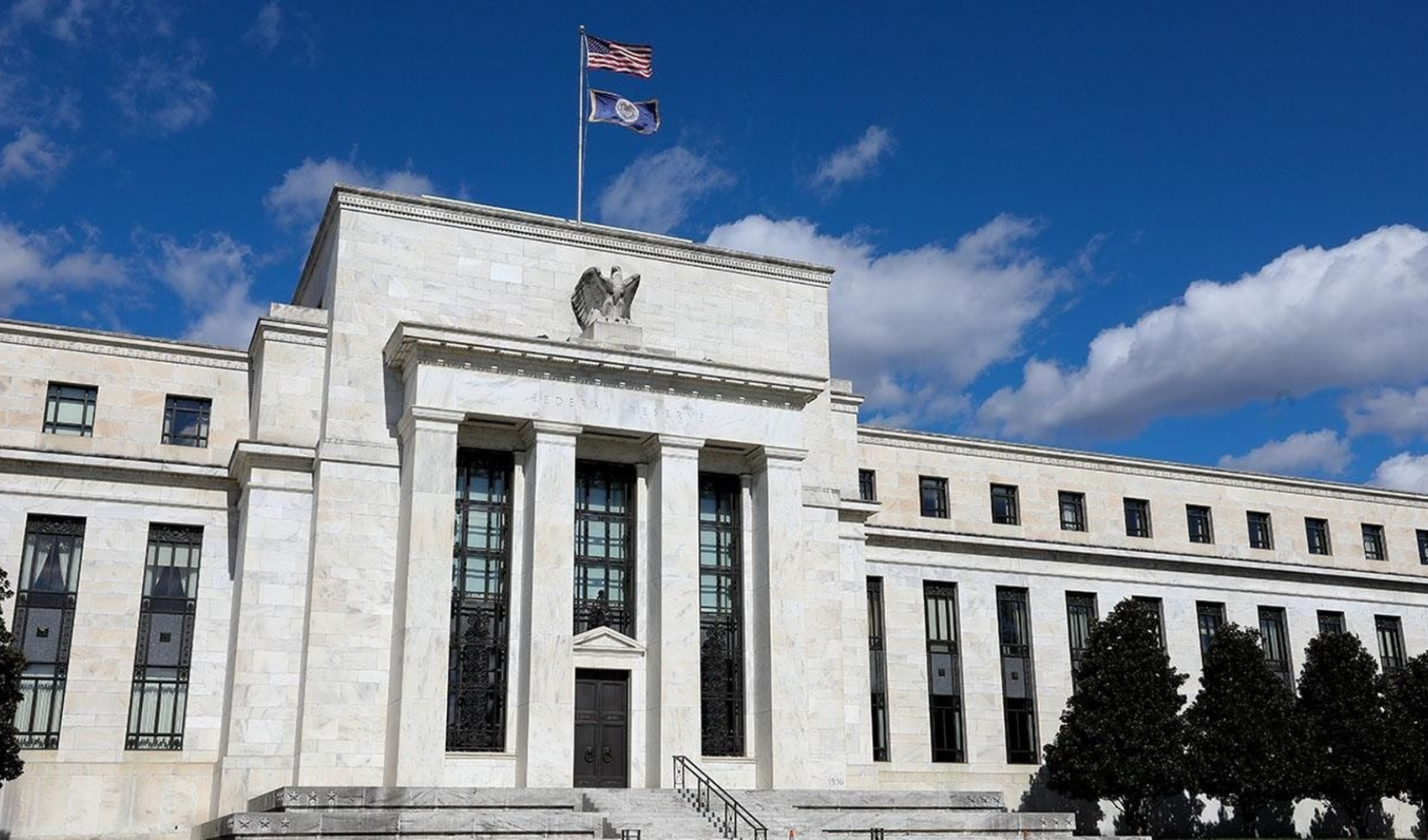
The US Federal Reserve (Fed) decided to keep its policy rate unchanged, maintaining it in the 3.50-3.75 percent range. Following the decision, uncertainty in the economic outlook has come to the fore in markets due to geopolitical developments, primarily the deepening war in Iran. Fed Chair Jerome Powell emphasized that various scenarios regarding the future of interest rates are on the table, but that a rate hike as the next step is not considered the base scenario.
GEOPOLITICAL TENSION INCREASES UNCERTAINTY IN FED'S POLICY PATH
The recent Iran-centered crisis and rising energy prices have highlighted the vulnerabilities of world economies, making it difficult for the US Federal Reserve to clearly define its medium-term policy path. Vishnu Varathan, an economist at Mizuho Securities, described the current environment as having “extremely low predictability and high volatility.”
The fact that conflicts are driving up energy prices and their reflection on inflation is forcing the Fed into a cautious stance. The general expectation among analysts is that, barring major surprises, the Fed may put limited interest rate cuts on the agenda during the year.
ING estimates that the Fed will implement two 25-basis-point interest rate cuts in September and December of 2026. According to this forecast, the US Dollar will remain more dependent on volatility in energy prices and fluctuations in risk appetite in the short term. However, the view prevails that potential interest rate cuts later in the year could weaken the dollar.
In an assessment report published by BBVA Research, it was stated that the Fed emphasized the war in Iran and increasing uncertainties in its decision text. The institution notes that for monetary easing to come to the agenda sooner than planned, there must be a serious weakening in the labor market or a sharp decline in goods inflation. BBVA analysts point out that a rapid resolution of the conflict in Iran would be a development that supports the Fed's easing process.
The report shared the estimate that the Fed could lower the policy rate to the 3.00-3.25 percent band in two steps this year; the impact on inflation is expected to come to the fore in updated projections. The assessment included the statement, “The Fed's cautious stance continues; there is no urgency for an interest rate cut in the short term.”
“DON'T WORRY” MESSAGE
Bob Michele of JPMorgan Investment Management pointed out that the Fed is sending a “don't worry” message to the markets due to rising oil prices and the war in Iran. Speaking to Bloomberg, Michele said, “They are telling us not to worry.” However, expressing his skepticism regarding the effects on prices and the labor market, he added that “there will be a real impact on inflation and ultimately on the labor market.”
Michele also stated that uncertainty regarding the term of Fed Chair Jerome Powell continues, and he believes that his remaining in office until after the midterm elections would have a stabilizing effect.
ASSESSMENT FROM FORMER FED VICE CHAIR
Richard Clarida, one of the Fed's former officials, also commented on the current inflation process. Emphasizing that the Fed does not have definitive information regarding the persistence of high inflation, Clarida said, “The short answer is that no one, including the Fed, knows.”
While describing the Fed's general stance as “dovish” and “constructive,” Clarida stated that he sees the impact of geopolitical risks on the inflation outlook as a significant factor. He also added that technological changes, such as advancements in artificial intelligence, are also among the factors in the Fed's evaluations.
The US Federal Reserve's continued cautious stance on monetary policy in the short term makes a very limited easing cycle possible for the remainder of the year. However, global geopolitical developments and domestic economic dynamics indicate that the search for direction in monetary policy will continue to shift.
News Source: 12punto
Most Read

Striking picture for Özgür Özel's 'New Party'

The PKK opening and Özgür Özel’s path!..

How did the newspapers view Özgür Özel's farewell to the CHP?

He killed his wife by slitting her throat: Their children witnessed the moments

What did the CHP do?

Özel’s new party move in the world press

Fire at TUSAŞ engine factory in Eskişehir under control

The New CHP, against CEHAPE

From self-efficacy to despair

Kılıçdaroğlu's first message on Özgür Özel's new party announcement