

Questions from the ECHR to Turkey regarding Ekrem İmamoğlu: Answers requested on six points concerning the detention process
The European Court of Human Rights has requested an explanation from Turkey regarding the detention of Istanbul Metropolitan Municipality Mayor Ekrem İmamoğlu. The Court also questioned whether there is a link between İmamoğlu's detention and his presidential candidacy.



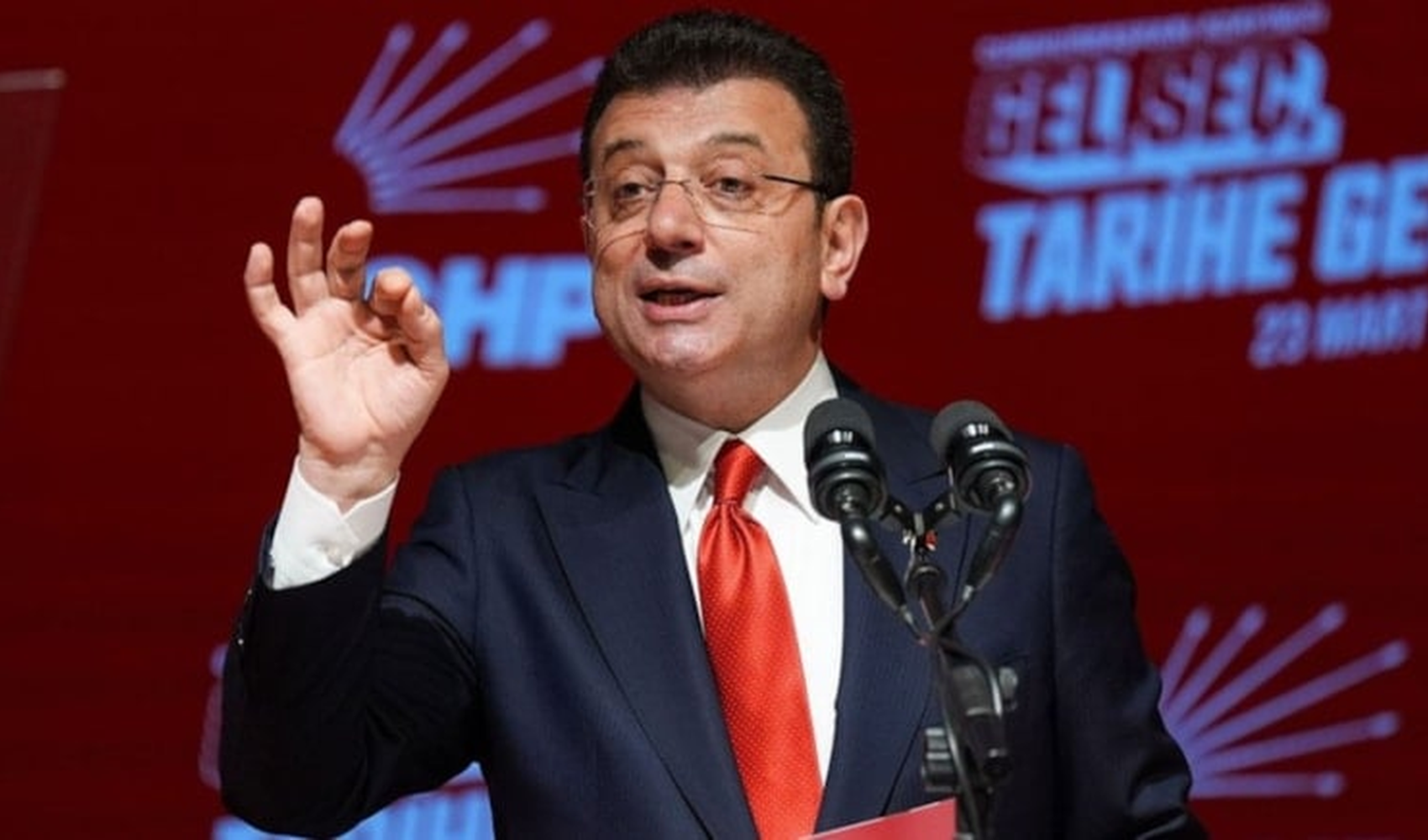
The case of Istanbul Metropolitan Municipality (IMM) Mayor Ekrem İmamoğlu, who was arrested after being taken into custody on March 19, 2025, has been brought to the agenda of the European Court of Human Rights (ECHR). In this context, the ECHR has directed six separate questions to the Ministry of Justice. These questions cover a broad framework, ranging from the legal basis cited for the arrest to potential political motivations and whether it restricts the right to be elected and democratic participation.
The court's first four questions concern the legality of the decision to detain İmamoğlu, the existence of reasonable suspicion, the reasonableness of the duration of detention, and the adequacy of legal remedies. In the fifth and sixth questions, the issue of whether the proceedings against İmamoğlu carry political motives and whether these processes have had an impact on his presidential candidacy was raised.
The fact that İmamoğlu was being shown among the presidential candidates at the time he was taken into custody, and his potential connection to the election process, were also among the points highlighted by the ECHR. In line with the fundamental principles of the European Convention on Human Rights, the Court directly asked the government whether “the detention of İmamoğlu was carried out for political reasons as specified under the Convention” and “whether the right to participate in elections and the right to be elected have been violated.”
In similar cases, the ECHR had previously ruled in the detention decisions of Selahattin Demirtaş and Osman Kavala that there was no element of “reasonable suspicion.” This time, the Court is questioning the sufficiency of the suspicions that formed the basis for İmamoğlu's arrest. Furthermore, it has placed under scrutiny whether the restriction on access to the investigation file prevented the applicant from effectively exercising his right to challenge the detention. In this regard, reference was made to violation rulings previously issued for Figen Yüksekdağ and certain HDP deputies.
An application was filed with the ECHR on behalf of İmamoğlu on November 10, 2025, on the grounds of “unlawful detention,” and it was announced to the public by his lawyer, Mehmet Pehlivan, on December 26 that the Court had decided to prioritize the examination of the application. Pehlivan had specifically noted that the priority examination process is rarely seen in files concerning Turkey.
These question headings opened by the ECHR have been expanded to cover not only the legal grounds for the detention measure against İmamoğlu but also significant dimensions such as political rights, participation in elections, and the restriction of democratic representation.
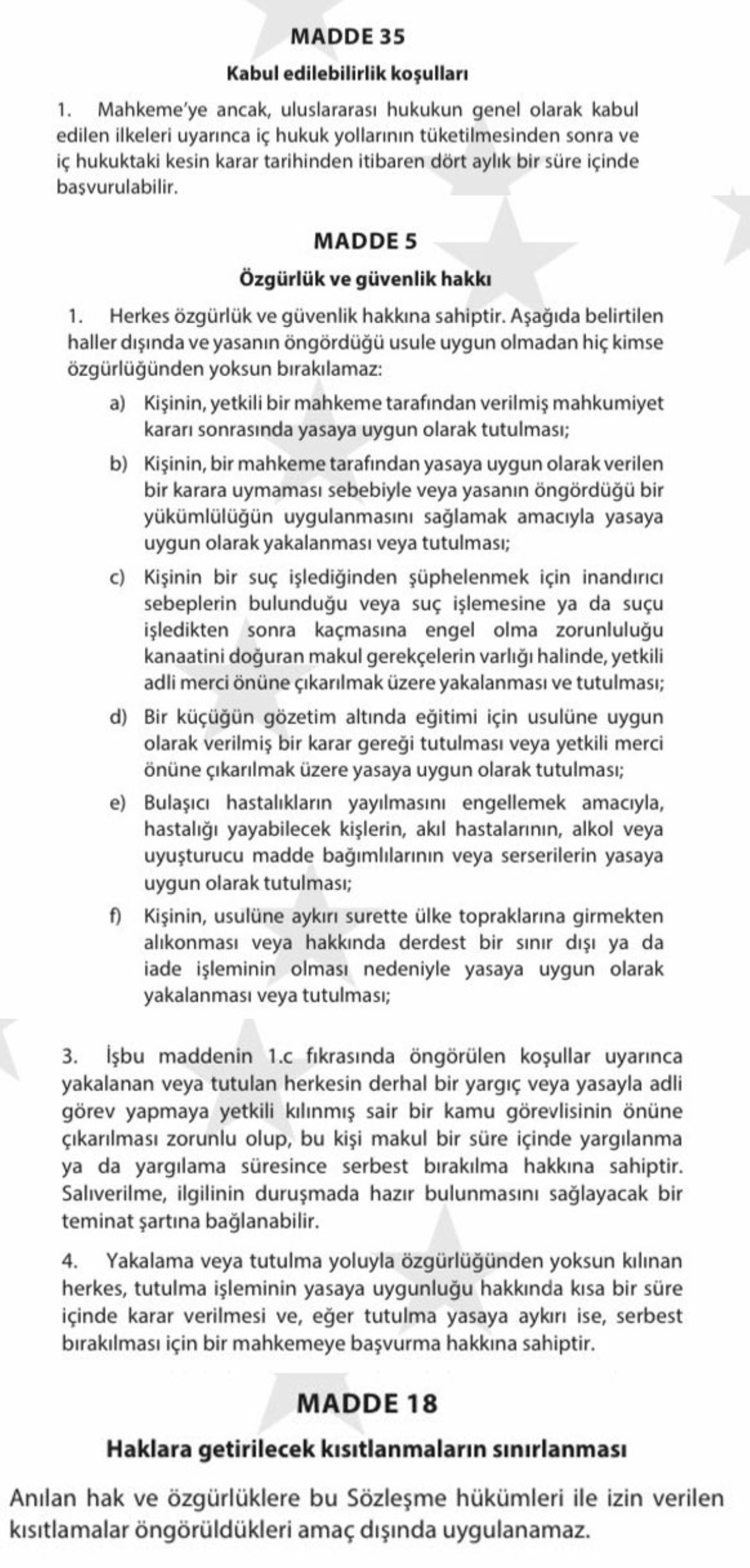
QUESTIONS POSED BY THE ECHR TO TURKEY
1. Has the applicant exhausted all effective domestic remedies for the purposes of his application in accordance with **Article 35, paragraph 1 of the Convention**? (For general principles, see *Vuckovic and Others v. Serbia* (preliminary objection) [Grand Chamber], no. 17153/11 and 29 other applications, §§ 69-77, March 25, 2014)
2. Was the applicant's pre-trial detention compatible with the requirements of **Article 5, paragraph 1 of the Convention**? In particular, can it be accepted that the applicant was detained on the basis of a “reasonable suspicion” regarding an offense he allegedly committed within the meaning of **Article 5, paragraph 1(c)**? (See, in particular, *Fox, Campbell and Hartley v. United Kingdom*, August 30, 1990, § 32, Series A no. 182)
Was the evidence available in the file at the time the detention decision was made sufficient for an objective observer to believe that the applicant might have committed the alleged offenses? (See *Mergen and Others v. Turkey*, no. 44062/09 and 4 other applications, §§ 46-55, May 31, 2016, and *Yüksel and Others v. Turkey*, no. 55835/09 and 2 other applications, §§ 51-60, May 31, 2016)
3. Did the magistrates' court judges who ordered the applicant's initial detention and his continued detention provide relevant and sufficient reasons supporting the deprivation of liberty in accordance with **Article 5, paragraph 3 of the Convention**? Furthermore, did the duration of the applicant's pre-trial detention violate the “reasonable time” requirement in **paragraph 3 of Article 5**? (See, in particular, *Buzadji v. Republic of Moldova* [Grand Chamber], no. 23755/07, §§ 84-102, July 5, 2016)
4. Was the applicant provided with a legal remedy to challenge the lawfulness of his deprivation of liberty, as required by **Article 5, paragraph 4 of the Convention**? In particular:
(a) Was he unable to effectively challenge his detention due to the restriction placed on his access to the investigation file? (See *Yüksekdağ Şenoğlu and Others v. Turkey*, no. 14332/17 and 12 other applications, §§ 573-579, November 8, 2022, and other cited case law)
(b) Did he have an effective remedy before the Constitutional Court where the lawfulness of his detention could be determined quickly and his release could be secured if necessary? (See *Khokhlov v. Cyprus*, no. 53114/20, §§ 72-83, June 13, 2023, and cited case law)
5. Is the State's application of the alleged restrictions in this case, which are claimed to be under Article 5 of the Convention, for a purpose other than those prescribed by these provisions contrary to **Article 18 of the Convention**? (See *Rasul Jafarov v. Azerbaijan*, no. 69981/14, §§ 153-163, March 17, 2016, and *Selahattin Demirtaş v. Turkey (no. 2)* [Grand Chamber], no. 14305/17, §§ 421-438, December 22, 2020)
6. Is **Article 3 of Protocol No. 1** applicable regarding the alleged restrictions placed on the applicant's participation in the presidential elections? (For general principles, see *Brito da Silva Guerra and de Sousa Magno v. Portugal* (admissibility decision), no. 26712/06 and 26720/06, June 17, 2008, and other cited case law)
Did the initiation of the criminal investigation and the pre-trial detention, by allegedly being applied for political purposes, prevent the applicant from standing as a candidate in the elections and participating effectively in the election process, and thereby violate **Article 3 of Protocol No. 1**? (For general principles, see *Selahattin Demirtaş*, cited above, §§ 382-389)
News Source: 12punto
Most Read

Striking picture for Özgür Özel's 'New Party'

Özgür Özel gives a dated response regarding the number of resignations

Forest fire in Antalya brought under control

The PKK opening and Özgür Özel’s path!..

Houthis strike Saudi-owned tanker

How did the newspapers view Özgür Özel's farewell to the CHP?

What did the CHP do?

Özel’s new party move in the world press

The New CHP, against CEHAPE

4 drones shot down near US Consulate General in Erbil