

Legal experts comment to 12punto: The Constitutional Court's decision is a blow to press freedom!
The Constitutional Court (AYM) reviewed the controversial disinformation law following an application by the CHP. Legal experts evaluating the court's decision to reject the requests described it as a blow to press freedom.



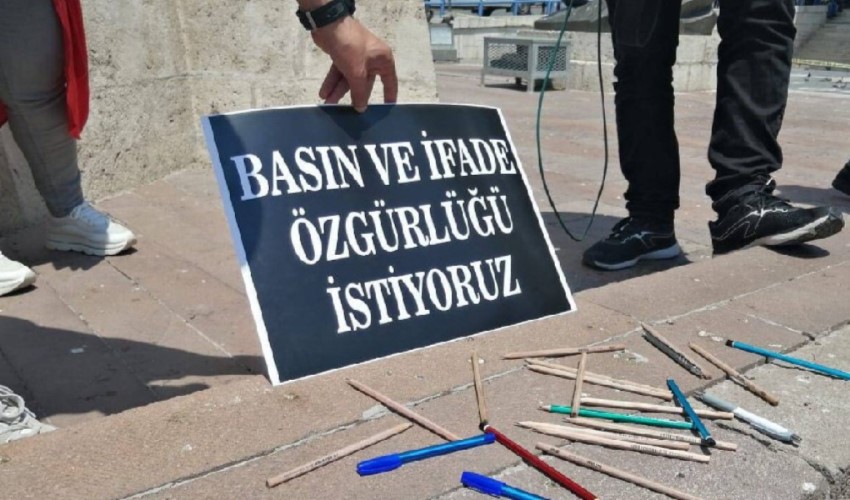
The Constitutional Court (AYM) has rejected, by a majority vote, the request for the annulment and stay of execution of the regulation that prescribes prison sentences for the crime of "publicly disseminating misleading information." With the AYM's decision, a 10-year ban on applying for the annulment of the law has been imposed. Legal experts who evaluated the decision for 12punto.com.tr pointed out that the law contains ambiguous expressions and stated that it restricts the right to access information.
The CHP had applied to the AYM with a request for the annulment and stay of execution of the article added to the Turkish Penal Code (TCK) via the Law on Amendments to the Press Law and Certain Laws No. 7418, known in the public eye as the fight against disinformation. The AYM reviewed the request today. In the decision reached, the AYM rejected the request for the annulment and stay of execution by a majority vote. We asked legal experts about the decision.
Attorney Turan Karakaş emphasized that laws should be written in a way that the public can easily and comfortably understand, stating that the law in question contains ambiguous expressions. Stating that the debated law causes irreparable harm, Karakaş spoke as follows:
'THERE ARE AMBIGUOUS EXPRESSIONS IN THE LAW'
"I do not see the Constitutional Court's rejection of the stay of execution request as a lawful and fair decision. The reason is this: there are very ambiguous expressions in the law. That is, expressions whose meaning is left to the discretion of the judge. For example, public interest. By what standard will we define public interest? A person without some expertise or knowledge in law cannot know or understand what public interest means. People in their natural daily lives cannot understand it. However, penal codes are laws that everyone is required to know. You cannot say 'I did not know the law.' That is, an ordinary citizen sitting in a coffeehouse also knows it.
"Penal codes should be laws that the public can easily and comfortably understand, without ambiguous expressions. This law is full of such articles. That is why a large number of lawsuits have been filed. Especially against members of the press. The reason for filing these numerous lawsuits is: 'You published news contrary to the truth and therefore you incited the public.'
IT RESTRICTS THE RIGHT TO ACCESS INFORMATION
"How can you know that my intent was to incite the public? You can understand it from evidence. If there is no evidence, it means there is suspicion. Suspicion is interpreted in favor of the defendant. In that respect, this law is a law that significantly restricts the right to access information and the right to receive news, is misused by certain politicians and judges, and causes injustices used against society.
If there is irreparable harm, you decide to stay the execution. There is irreparable harm here. It should be annulled.
It should have been annulled because the principle of certainty is not present, and because it is not clear and specific. Because the Constitutional Court has annulled many laws in its previous decisions due to the lack of the principle of certainty; that is, there are precedents for annulment.
10-YEAR BAN ON APPLICATIONS
Attorney Nilda Baltalı emphasized that the debated article is also contrary to the criminal law system. Stating that the decision is a blow to press freedom, Baltalı said:
With the decision taken by the AYM today, a 10-year ban on applying for the annulment of the law has been imposed. The rejection decision is a blow to freedom of expression. It disregards press freedom and silences the press, which we call the 4th estate.
This law article is actually also contrary to our criminal law system. It does not comply with certain principles in criminal law. Many elements, such as 'misleading information to the public,' are very open to debate and interpretation. However, in our legal system, the texts of laws in the sense of criminal law must be very clear, specific, and written in a way that indicates what fact they refer to.
'THE AYM SHOULD HAVE ANNULLED IT DIRECTLY'
Therefore, there will be an applicability problem, and it is an issue that opens the door for everyone to interpret it differently in practice and to make decisions that they deem correct for themselves. Therefore, of course, it was not possible for the AYM to reject this, even by a majority vote. It should have annulled it directly. In fact, the AYM performs both norm review and examines individual applications. It should generally examine whether it is in accordance with the constitution.
We see that the AYM acts timidly on issues that concern the entire society. As years pass, due to interventions in the judicial system applied in Turkey, judges and prosecutors now think they are acting politically and are afraid of this.
While it should be a braking mechanism, both the way the members are selected and the political process it has gone through have brought us here. The President, before whom the AYM president bows, and the members appointed by the President are making this decision. While making this decision, the AYM should have foreseen that, due to the danger that the concept of 'misleading information to the public' could be interpreted very broadly, any expression incompatible with the government could be prosecuted.
We will see the consequences of this crime not being subjected to norm review by the AYM as the whole country. This crime makes not only press workers but also social media users potential targets.
WE SAW IT IN THE TOLGA ŞARDAN FILE
Lawyer Ruşen Gültekin also reacted to the AYM's decision. Emphasizing that the controversial article is subjective, Gültekin said:
"Article 217A of the TCK is an article added to the Turkish Penal Code titled 'Publicly disseminating misleading information.' The justification for the article actually says that by emphasizing the importance of freedom of expression, information contrary to the truth at this point actually eliminates the security of news and information in society, and therefore mentions the need to fight against this. First of all, one must say this: Since no one is saying it, we see it in practice. Now everyone can be prosecuted for this crime.
"For one thing, by saying 'in a way capable of disturbing public peace' in the article, it is actually talking about a concrete danger crime. A behavior must be capable of disturbing public peace. However, as we see in the Tolga Şardan file, he himself says in his defense: 'The act I committed is not capable of disturbing public peace,' and he is right. But despite this, this article was enough for his arrest.
Therefore, this article is actually a subjective article and, in this sense, an article that is not appropriate to be in the penal code in practice. Why? Because what should be understood from the concept of 'information contrary to the truth' is actually not explained at all. Even though concepts such as lies, false, manipulative content, disinformation, and fabricated content are included, it cannot be known what should be understood from the concept of 'information contrary to the truth,' which constitutes the material element of the crime.
"I am saying this as a former press prosecutor. I also have an article from the past titled 'Making fake news is not a crime.' That is exactly what I am saying. Because since no one can decide what is a lie and what is not, a journalist cannot be accused of fake news.
"Now this article has returned. It is not possible to make a determination as to whom and according to what, and what criteria will be taken as a basis for the concept of information contrary to the truth. Are we obliged to respect every statement made by official authorities? Or should every statement made by official authorities be accepted as true?
"This is something that can only happen in authoritarian states. Since it is not possible to say that information that rejects these statements as justification, that reveals with scientific findings and concrete justifications that the statements are erroneous, and that is far from fabricated findings and evaluations that have apparent reality, is misleading the public and contrary to the truth, the public dissemination of this news should not actually fall within the scope of this crime.
"However, we saw in the Tolga Şardan file that our judges and prosecutors can use this article directly in the practice of enemy criminal law, just like Article 216 'inciting the public to hatred and hostility,' without even evaluating it according to the article, even though the article is wrong. One: The principle of legality in crime and punishment is regulated in the first paragraph of Article 38 of the Constitution and Article 2 of the Turkish Penal Code, and according to this principle, crime and punishment are only established by law.
"Therefore, it states that this should be an article in the real sense, not in the formal sense. We can say that it is contrary to this, and since this regulation is closely related to the freedom of expression and dissemination of thought in Articles 26 and 28 of the Constitution, and press freedom, we see that it is so. Therefore, it is also contrary to Article 13 of the Constitution, titled 'Restriction of Fundamental Rights and Freedoms.' Because in this way, it affects people's freedom to express and disseminate thought and press freedom. That is, we saw this in the Tolga Şardan file. On the other hand, abstract and difficult-to-determine concepts such as the country's internal and external security, public order, general health, and public peace are included in the text of the article. Since these concepts are ambiguous, it can be seen from the examples in practice that they can lead to arbitrary application. At this point, we can say that it is a law article that does not comply with the principle of certainty, which is one of the elements of the principle of legality in crime and punishment.
"When this is the case, the issue of publicly disseminating misleading information is also contradictory. We can say that if the error in the article title had been corrected and it had been regulated as 'disseminating information contrary to the truth,' it might have made more sense, as it is not clear what misleading information and information contrary to the truth mean, and how information that is not contrary to the truth can be used as misleading.
"However, as a result, we should draw the following meaning from what I have said: First, when applying this article, judges and prosecutors must take into account the decisions of the ECHR and the Constitutional Court. But what do we see in practice? They do not.
"We can determine that this article can be clearly used as an application of enemy criminal law to silence the opposition in a country. When this is the case, I think that the fact that this article is not annulled by the Constitutional Court means that this practice can be applied arbitrarily to opposition figures and journalists as an application of enemy criminal law, and that no one can stand in its way anymore."
News Source: 12punto
Most Read

Striking picture for Özgür Özel's 'New Party'

The PKK opening and Özgür Özel’s path!..

How did the newspapers view Özgür Özel's farewell to the CHP?

He killed his wife by slitting her throat: Their children witnessed the moments

What did the CHP do?

Özel’s new party move in the world press

The New CHP, against CEHAPE

Fire at TUSAŞ engine factory in Eskişehir under control

From self-efficacy to despair

Kılıçdaroğlu's first message on Özgür Özel's new party announcement