

Mahfi Eğilmez explains what happened with KKM
Economist Mahfi Eğilmez commented on the reasons for the rise in the dollar exchange rate following the latest steps taken regarding the FX-protected deposit scheme (KKM). Stating, "I have lost count of how many steps have been taken to correct the series of mistakes we started by cutting interest rates in September 2021," Eğilmez added, "The cost aspect of this is a separate disaster, and moreover, we still haven't been able to correct that first wrong step."



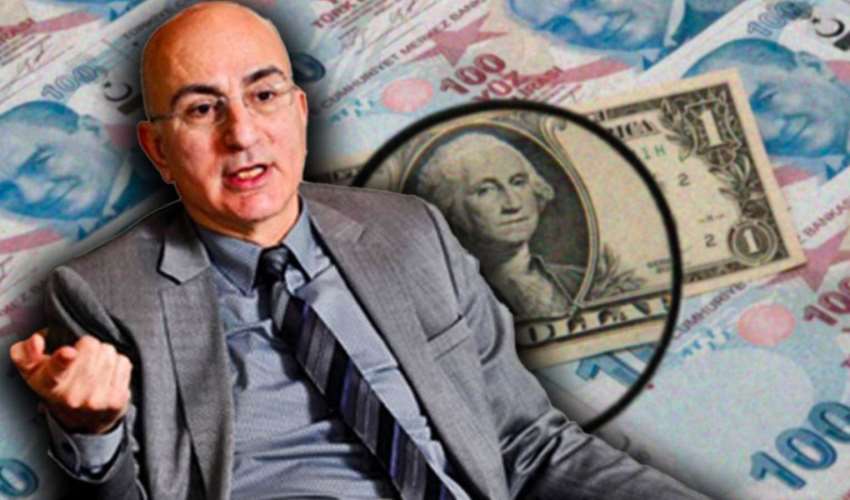
Mahfi Eğilmez, in an article titled "What Happened with KKM?" published on his blog, stated the following:
"The Central Bank (TCMB) has removed the minimum interest rate regulation applied to FX-protected deposit (KKM) accounts. The TCMB has lifted the mandatory minimum interest rate for Turkish Lira-converted FX-protected deposit (KKM) accounts.
While this regulation was in place, banks were applying the policy rate (currently 30 percent annually) that the TCMB uses when providing weekly loans to banks for KKM accounts opened from foreign currency deposits. Under the old practice, banks were paying 30 percent interest on KKM accounts, and the TCMB was calculating the exchange rate difference between the start and end of the maturity period.
If the exchange rate difference was higher than the amount calculated with the policy rate, the portion of the support amount up to the amount calculated with the policy rate was paid by the bank, while the portion above it was paid by the Central Bank.
Let me give a numerical example; suppose a 100 thousand dollar KKM account is opened, the bank pays the KKM account holder 7.5 percent interest for 3 months (since it is 30 percent annually), and the exchange rate is 1 USD = 23 TL.
Accordingly, the TL equivalent at the date the account is opened is 2,300,000 TL. If 1 USD = 27 TL on the date the account is closed, the principal TL equivalent of the account becomes 2,700,000 TL. Accordingly, the exchange rate difference for the period is (2,700,000 – 2,300,000 =) 400,000 TL. In this case, the owner of this KKM account will receive (2,300,000 x 7.5% =) 172,500 TL in interest from the bank and (400,000 – 172,500 =) 227,500 TL in exchange rate difference from the TCMB.
The TCMB made changes to this system and freed banks regarding interest rates. Thus, banks can now offer interest rates below the policy rate. In return, banks are required to convert at least 10 percent of KKM accounts originating from foreign currency deposits (50 percent for KKM accounts originating from TL) into TL deposit accounts. A requirement to purchase Government Bonds is applied to banks that cannot achieve this.
Let's explain this new situation using the numerical example above. Let's say the bank has set the interest rate at 20 percent (5 percent for the 3-month period) after this regulation and all other indicators have developed as in the example above. In this case, the bank will first pay the KKM account holder 5 percent interest (115,000 TL) and then the difference between the interest it pays and the policy rate (2.5 percent, i.e., 57,500 TL) as the exchange rate difference, totaling 172,500 TL to the depositor. The TCMB will also pay 227,500 TL as the exchange rate difference, just as in the example above.
Although it may seem like nothing has changed at first glance, the benefit of this change for banks has been to shift foreign currency accounts returning from KKM to TL deposit accounts by increasing TL deposit interest rates. On the other hand, foreign currency KKM accounts that banks cannot convert may put pressure on them.
Let's say the bank has not been able to convert at least 10 percent (the 500,000 TL portion) of a 5 million TL foreign currency-denominated KKM account into a TL deposit account in this way; then it is forced to buy that much in Government Bonds for this 500,000 TL. Considering that the benchmark interest rate is 24 percent, it is clear that these bonds purchased are a negative-yield asset for the bank.
Initial information from banks suggests that there is a slow unwinding from KKM and that TL deposit interest rates, which have risen to 50–55 percent, are attractive to KKM customers. On the other hand, the dollar/TL is on an upward trend. It would not be correct to immediately look for the reason for this in the changes to KKM accounts, because the dollar is gaining value against all currencies. It also has a significant effect on the rise in the exchange rate. We can observe this from both the dollar index and the dollar/euro parity.
I have lost count of how many steps have been taken to correct the series of mistakes we started by cutting interest rates in September 2021; the cost aspect of this is a separate disaster, and moreover, we still haven't been able to correct that first wrong step. As the Chinese sages said, "A thousand right steps cannot correct one wrong step." Before taking a step, especially one that concerns the future of such a large society, one must think three times and look at past experiences."
News Source: 12punto
Most Read

Striking picture for Özgür Özel's 'New Party'

Özgür Özel gives a dated response regarding the number of resignations

The PKK opening and Özgür Özel’s path!..

Forest fire in Antalya brought under control

How did the newspapers view Özgür Özel's farewell to the CHP?

He killed his wife by slitting her throat: Their children witnessed the moments

What did the CHP do?

Özel’s new party move in the world press

The New CHP, against CEHAPE

Fire at TUSAŞ engine factory in Eskişehir under control