

Mehmet Özdağ writes: Price hikes for citizens, double subsidies for companies! There is no energy in the bill, there is a wealth transfer
Electronics Engineer Mehmet Özdağ writes... Price hikes for citizens, double subsidies for companies! There is no energy in the bill, there is a wealth transfer



A 2000 percent increase in distribution fees over the last 10 years has turned the electricity bill into a tool that transfers resources to distribution companies.
Energy policy in Turkey has long appeared to be a financial mechanism where public resources are redistributed in favor of specific companies. Despite our warning on April 2 that 'you cannot prevent price hikes without stopping the subsidization of distribution companies,' the Energy Market Regulatory Authority (EPDK) further deepened this structure with the new tariff it put into effect on April 4. The main point of debate is no longer the justification for price increases; it is to whom and in what way these costs are transferred.
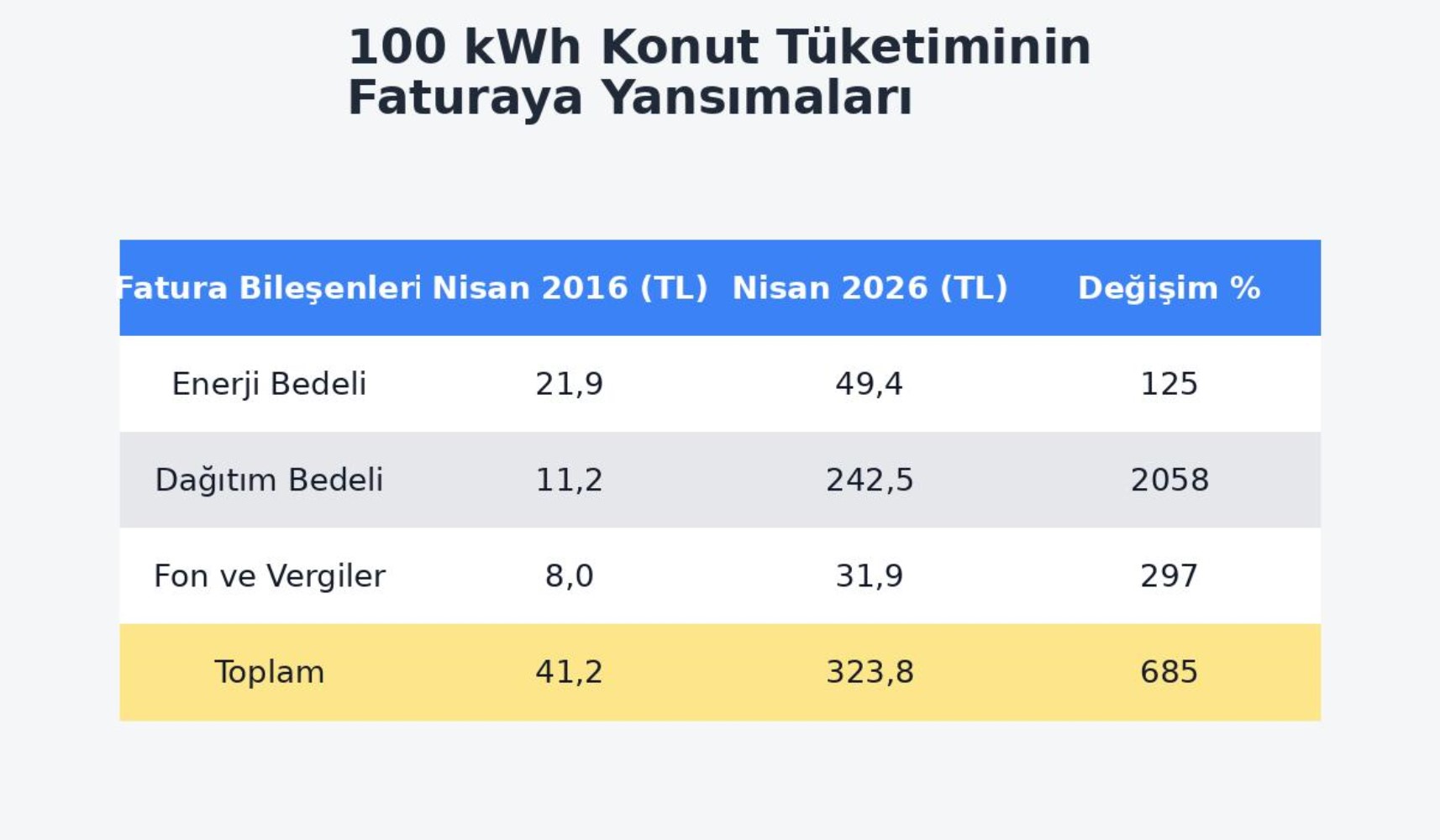
75 AGAINST 15 PERCENT
As of April 2026, 100 kWh of electricity consumption for a low-tier residential subscriber reached 323.8 TL. While only 15 percent of this amount represents the cost of electricity production, approximately 75 percent consists of the distribution fee; the remaining 10 percent consists of taxes and funds. In other words, the electricity bill has essentially ceased to be an “energy cost” and has turned into a payment made primarily to distribution companies.
In OECD countries, at least half of the electricity bill consists of electricity production costs; the distribution share hovers between 25-30 percent. In Turkey, this balance has been deliberately reversed. In other OECD countries, electricity distribution is accepted as a 'natural monopoly' and is therefore extremely strictly regulated. In the current system, however, the bill is structured to support holding companies. While the distribution fee is a service cost across the OECD, it has become a method of resource transfer here.
THE "SUBSIDY" FAIRY TALE
The narrative frequently presented to the public that 'the state is subsidizing the citizen' becomes highly controversial when the figures are examined. During the 2025 budget negotiations, the Ministry of Energy and Natural Resources admitted that the public institution Electricity Generation Inc. (EÜAŞ) purchased electricity from the market at an average cost of 2.24 TL/kWh in 2024 and allocated it to authorized supply companies—the paper-twin brothers of distribution companies—at a price of 0.48 TL/kWh, which is one-fifth of the cost.
THE THREE PILLARS OF CAPITAL TRANSFER
Regulated Asset Base (RAB): Under this practice, the investments and expenditures of companies are directly reflected in tariffs. As the company spends, the citizen's bill swells. The current model creates a structure where it is more profitable for the company to increase spending rather than to increase efficiency.
14.46 Percent Guaranteed Real Return: This rate, which is significantly above market conditions, creates a hybrid structure where the risk remains with the public, while the return is guaranteed for the private sector. In short; profit is guaranteed for the companies, while the loss is left to the state.
Inadequacy in Cost Auditing: In this structure where increasing spending is more profitable for the company, the lack of sufficient cost auditing by the public inflates the costs reflected in the bills. Considering that the cumulative increase in distribution fees over the last decade has exceeded two thousand percent, it is clearly understood that this transformation is not coincidental.
These three elements are not independent technical details, but a whole that complements and strengthens each other. RAB makes spending profitable: the more the company spends, the larger the tariff base, and the higher the bill. The guaranteed real return shields this profit against risk: no matter how inflated the asset base calculated through RAB is, the company collects this rate, which is well above the market, with a guarantee. The inadequacy in cost auditing leaves the keys to these two doors open: since it is not sufficiently questioned whether the expenditures are necessary or efficient, inflated costs enter the tariff without being audited, the guaranteed return is calculated over the tariff, and the cycle closes. If the three did not work together, this system could not have increased distribution fees by two thousand percent in ten years.
VERTICAL MONOPOLY FROM PRODUCTION TO BILL
To understand why this picture is so resilient, one must look at the entire structure. We are talking about a structure that produces, distributes, and sells electricity, and also largely controls the transformer capacity and grid connection used while doing so. Even in infrastructure decisions required for connecting renewable energy power plants to the grid, these companies have a decisive influence. The fact that a number of holding groups that can be counted on the fingers of one hand are involved in every link of the energy chain from beginning to end eliminates competition and makes auditing meaningless.
ALL LINKS PROFIT SEPARATELY
This system is not the product of a failure, but of a perfectly functioning design; however, this design does not work for the citizen, but for those who feed off their back.
EÜAŞ sells the electricity it buys from the market for 2.24 TL to authorized supply companies for 0.48 TL, and the public bears this massive difference. The same companies charge a distribution fee of 2.4 TL to deliver this electricity to the citizen. The public both feeds the company with cheap production subsidies and creates a second source of income for the same company through the high distribution fee on the citizen's bill. The result; profit for the company from both sides, loss for the public from both sides.
Moreover, these companies have a say in production, distribution, retail sales, and renewable energy infrastructure at the same time. This structure, which is present in every link of the chain, has given birth not to the competition promised by privatization, but to a 'vertical monopoly' operated with state guarantees and with guaranteed profits.
SOLUTION: PUBLIC INTEREST, NOT PROFIT
Distribution fees should be linked to real costs, the guaranteed return structure should be abolished, the production-distribution-sales chain should be effectively separated, and cost auditing should be made fully independent. Electricity should be managed as a fundamental right to life, not as an investment tool with guaranteed profit.
Energy is not an ordinary commodity bought and sold in the market, but an inseparable part of a citizen's dignified life. The duty of the state is not to guarantee the profit of certain companies, but to meet the basic needs of the citizen under accessible, fair, and sustainable conditions. This distorted order, where the public writes losses and the private sector gains guarantees, must change. What Turkey needs is a new energy model that is transparent, auditable, truly open to competition, but based on public interest. Because the resources of this country are not the right of a handful of privileged structures, but the common right of all citizens.
Mehmet Özdağ - Electronics Engineer
CHP Samsun Provincial Chair
News Source: 12punto
Most Read

Striking picture for Özgür Özel's 'New Party'
Özgür Özel gives a dated response regarding the number of resignations
Forest fire in Antalya brought under control

The PKK opening and Özgür Özel’s path!..

How did the newspapers view Özgür Özel's farewell to the CHP?

What did the CHP do?

Özel’s new party move in the world press

The New CHP, against CEHAPE

From self-efficacy to despair
The return of craftsmanship in the age of artificial intelligence