

The emperor's last supper
Written by Esra Deniz Karagöl... The emperor's last supper



Esra Deniz KARAGÖL
“Dinosaurs were one of the most elaborate feeding machines evolution ever produced.”
— Steve Brusatte (The Rise and Fall of the Dinosaurs)
The roars we heard in Jurassic Park were not fiction. The earth was truly shaking. The world had surrendered its longest and most magnificent reign to the dinosaurs. That sound, which made the horizon tremble with a single roar, changed the direction of the wind, and declared absolute dominion over the entire planet, was the most powerful symphony of authority nature had written to that day. They were not just big; they were perfect. Their teeth were not a weapon, but a system. Their muscles were not just strength, but calculated engineering. Their metabolisms were the refined product of millions of years of evolution. They were at the peak of the ecosystem, and no one had the power to challenge that peak.
If we rewound time 250 million years, we would land in the Triassic Period. The world had emerged from a great destruction, but nature was preparing to hit the reset button again. The climate was changing rapidly. Volcanic eruptions were constant. Sea levels were rising and then receding. The world of that era was a single supercontinent: Pangea. As Pangea began to crack, landmasses moved, climates shifted, and life relocated. Some species could not handle this chaos and were wiped out. The fact that dinosaurs had to disperse and migrate was rooted in the same causes as the migration phenomenon we discuss today: the search for resources and security. Some adapted and changed their evolutionary direction. It was in this void that dinosaurs rose. New geographies, new food sources, and reduced competition made them the masters of the planet. However, this rise had a price: a massive dependence on energy.
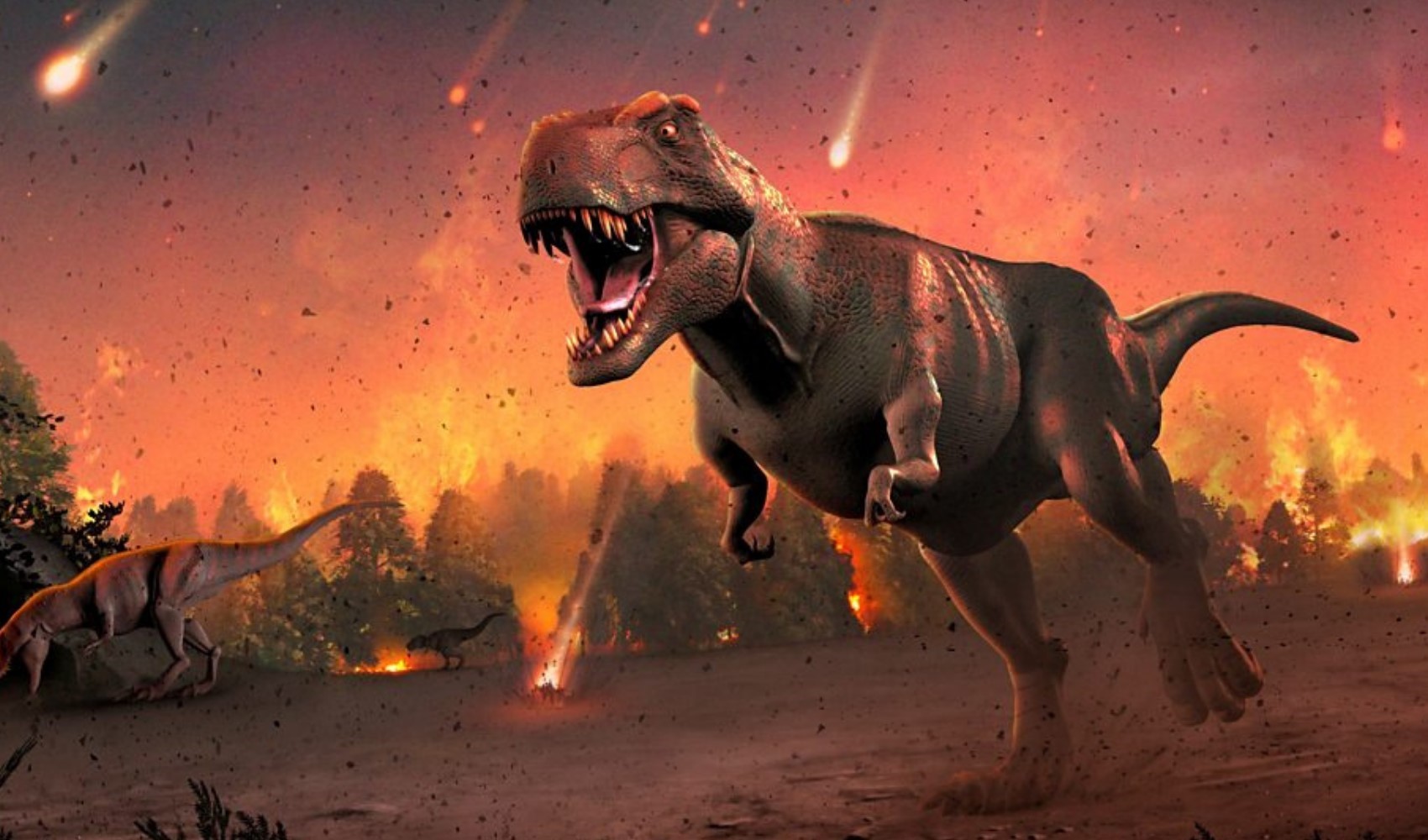
66 million years ago, the sky shattered. A giant asteroid struck Earth. A crater approximately 150, perhaps 200 kilometers wide and 20 kilometers deep was formed. The earth's crust shook, the oceans surged, and forests ignited simultaneously. But the disaster did not end there. It was just beginning. Dust, sulfur, and carbon dioxide released into the atmosphere veiled the sun. The world cooled rapidly. Then, photosynthesis stopped. This was the collapse not just of plants, but of the entire ecosystem.
Plants vanished. Herbivores went hungry. When the herbivores were gone, the carnivores' table was also cleared. The food chain broke. The asteroid did not kill every living thing. There was a population of dinosaurs that survived the moment of impact, and this number would have been sufficient for the continuation of the species had there been no famine. But the famine began. Giant carnivores that needed to consume 100 kilos of meat a day began to roam a world without prey. Their teeth were in place, their muscles were strong, and their instincts were perfect. But their stomachs were empty. Nature's justice is harsh; when the food chain is broken, it no longer matters how strong you are. Size was no longer an advantage, but a burden. What brought an end to the dinosaurs was the hunger created by the impact.
At this point, the scene changed. Small mammals survived. Those who could make do with little, those who could sustain their lives with seeds, insects, and carrion. Seeds were the food source that lasted the longest in the ecosystem, and this small difference changed the course of history. And then there were the birds. The birds we see in the sky today. They were dinosaurs. Dinosaurs did not disappear completely. A small, feathered, and flying branch survived; over time, it evolved into birds. The last trace of the dinosaurs remained in the sky.
If the asteroid had never struck, evolution would not have stopped. Dinosaurs might still be ruling the world today. If that meteorite had not fallen, perhaps we would not be writing these lines today. Evolution does not ask for power. Evolution asks: Who is full?
However, that great rupture opened a new door for mammals. While dinosaurs knelt before hunger, those who could make do with little and adapt rapidly to changing conditions built the world of today. The fossils of the past are not just bones; they carry a warning. As Steve Jobs said in that famous speech at Stanford University: “You can't connect the dots looking forward; you can only connect them looking backward.” The global debates shaping up today around the topics of climate, food, and migration remind us of the modern footprints of the process that led to the extinction of the dinosaurs. As Jobs emphasized, when we connect the dots backward, we see that learning lessons from the past leads us not to get stuck, but to survive. This ancient dataset leads us to one vital question: Who gets fed in a moment of crisis?
Dinosaurs died because they were too big. They were too strong. And they consumed too much. In a moment of crisis, this power turned not into an advantage, but a burden. The small ones, those who made do with little, and those who adapted quickly survived. We are now walking on the planet that was once the table of the dinosaurs.
The only truth that must not be forgotten is this: The greatest power in history was defeated by hunger. Because power is not muscle, it is not teeth. Power is the table.
Food is the future of the future.
News Source: 12punto
Most Read

Striking picture for Özgür Özel's 'New Party'

The PKK opening and Özgür Özel’s path!..

How did the newspapers view Özgür Özel's farewell to the CHP?

He killed his wife by slitting her throat: Their children witnessed the moments

What did the CHP do?

Özel’s new party move in the world press

Fire at TUSAŞ engine factory in Eskişehir under control

The New CHP, against CEHAPE

From self-efficacy to despair

Kılıçdaroğlu's first message on Özgür Özel's new party announcement