

The Middle East, Turkey, and Germany: For Berlin, 'foreign policy' is an 'internal affair'
Written by Işın Ertürk: The Middle East, Turkey, and Germany: For Berlin, 'foreign policy' is an 'internal affair'



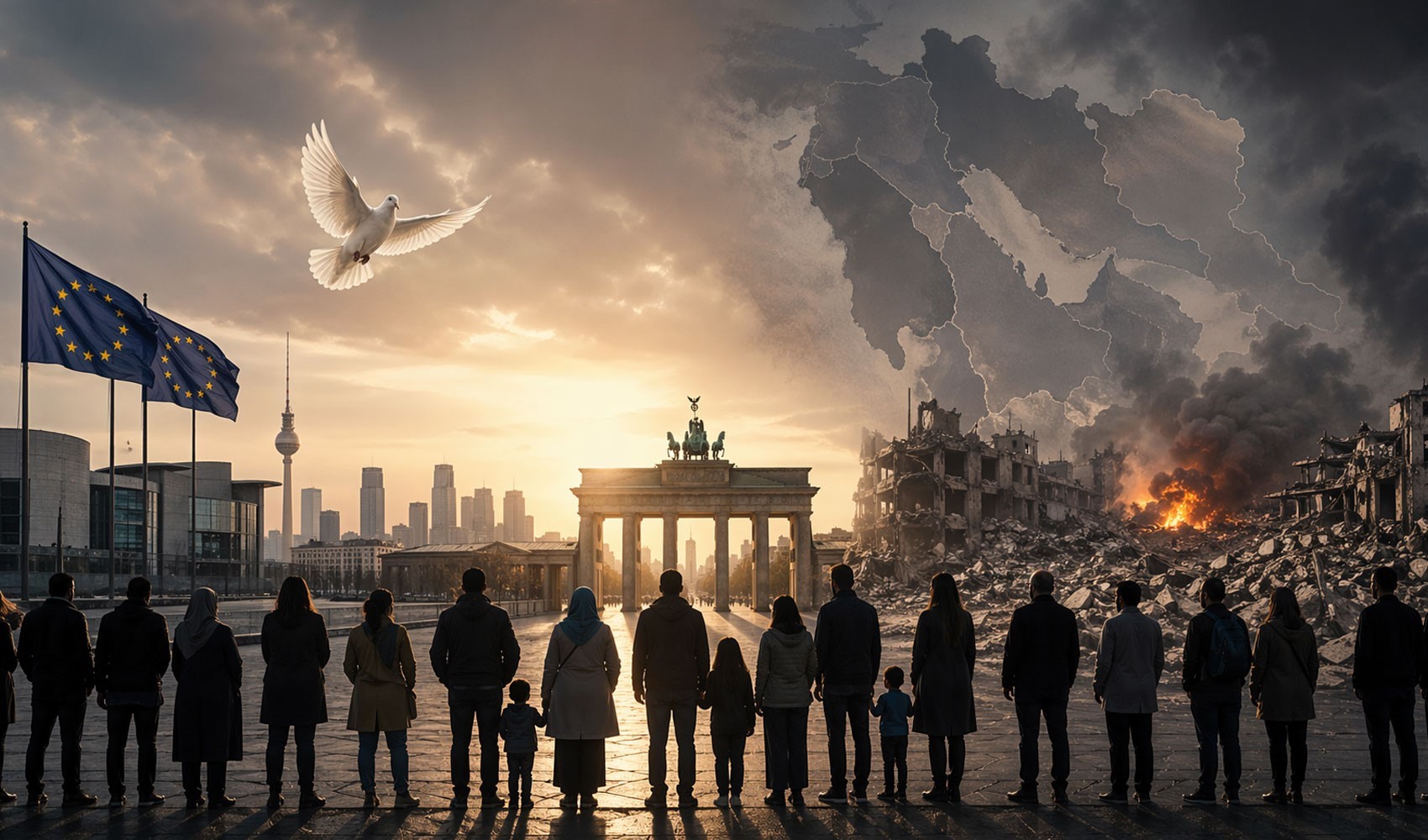
Let us look together at a topic that right-wing populists in Germany would find very pleasing and advantageous.
For millions of people living in the European Union's economic powerhouse, the war in the Middle East is no longer a development happening far away.
The destruction in Gaza continues. Tensions along the Iran axis are growing. And this situation has long since turned into a reality that directly affects Germany's internal balances.
Let us look at the Middle Eastern population in the country. While it is not entirely accurate to place Turks in Germany into this category, it is possible to use them as a partial example in terms of geographical and cultural positioning.
So, let us look together.
According to Destatis data, the population with ties to Turkey, Syria, Iraq, Iran, and Lebanon exceeds 5 million. Together with unofficial estimates for those of Turkish origin, this number is approaching 6 million.
To this, one must also add the proportion of Muslims in the country: 6.7 percent of the population.
The picture that emerges is clear. The Middle East is being experienced in Germany.
It is not actually a new situation. It has been this way for a long time.
“AT THE AXIS OF THE CONTRADICTION LIES THE EU-ISRAEL ASSOCIATION AGREEMENT”
Let us continue to insist on reminding everyone: In Europe, the Middle East is no longer a foreign policy headline. We are proceeding by looking at the subject from this perspective as well. In other words, the issue in question is an “internal affair” where economy, trade, and geopolitics intersect. The ongoing destruction in Gaza and the Iran-centered tension serve as a litmus test that reveals the European Union's own internal contradictions. Maike Gosch, a writer for NachDenkSeiten, one of Germany's leading critical news analysis portals, points out that the 1995 Association Agreement between the European Union and Israel lies at the center of this contradiction.
According to Gosch, this agreement, which enables a trade volume of approximately 45 billion euros annually, is not only an economic but also a political lever. Article 2 of the agreement is actually very clear: Relations must be based on human rights. However, as Gosch also reports, although a 2025 EU review based on Amnesty International data revealed that Israel has committed grave human rights violations in Gaza and the West Bank, this finding has not turned into a political sanction.
EUROPEAN CITIZENS' INITIATIVE FORCES THE EU TO TAKE A POSITION
At this point, the European Citizens' Initiative, which has exceeded one million signatures, comes into play. Gosch emphasizes that although this initiative is not binding, it creates significant pressure by forcing the EU Commission to officially take a position. However, it is also known that Brussels usually softens or neutralizes such initiatives. This shows that Europe has difficulty producing political will despite its own laws.
WHERE EXACTLY DOES BERLIN FIT INTO THIS PICTURE?
Let us come to the main actor: Berlin.
Germany's role in this process is indeed decisive. As a matter of fact, Maike Gosch reports that Berlin was one of the actors that blocked the process in 2025 by preventing the suspension of the agreement together with Hungary, and states that this stance reveals that Germany is caught between historical responsibility and current geopolitical interests in its Israel policy. In the same analysis, it is pointed out that anti-Semitism combat mechanisms within the EU sometimes function to limit criticism directed at Israel.
IS THE ORDER BASED ON THE WEST'S MONOPOLY ERODING?
On the other hand, an assessment by Thomas Trares on the same news portal reveals that the crisis should be read within a broader framework. Based on the work of economist Patrick Kaczmarczyk, the analysis defines the current situation as the “dissolution of the world order.” According to Trares, globalization did not produce equality as claimed; “on the contrary, it systematically excluded the Global South. As a result of the structural vulnerabilities created by IMF and World Bank policies, debt interest payments in countries where 3.3 billion people live today have exceeded health and education expenditures. All of this points not so much to the West's loss of power, but to the erosion of its monopoly-based order.”
US AND EU INTERFERENCE IN HUNGARY'S ELECTION PROCESS
The mentioned global dissolution is also witnessing a new power struggle within Europe itself. According to an analysis by the influential “German Foreign Policy” portal, which is published in Germany and primarily puts German foreign relations under a magnifying glass, the Hungarian elections are one of the most concrete examples of this struggle. The direct interference of the US and the European Union in the election process showed that the issue is a geopolitical competition beyond a change of government. The struggle over Budapest's direction reveals that Europe's future strategic position is also being debated.
ENERGY CRISIS VIA THE STRAIT OF HORMUZ
The same analysis also points to the disconnect between the West's military capacity and its power to produce political results. Operations carried out in the Middle East create destruction but do not meet political goals. The uncertainty in energy flow through the Strait of Hormuz directly puts pressure on the European economy. This also shows that the war has now become not only a military but also an economic security problem.
In short, the EU–Israel contradiction revealed by Gosch in NachDenkSeiten, the global system crisis reported by Trares, and the transatlantic power struggle pointed out by German Foreign Policy all converge at the same point. The war in the Middle East, Europe's commercial interests, Germany's political preferences, and the competition between the US and the EU are no longer separate topics.
In other words, the lines between foreign policy and domestic policy for Europe are being erased very clearly and rapidly.
On the other hand, we also witness that Berlin claims to be distant from the attacks by the US and Israel against Iran. However, on the other hand, arms shipments to Israel continue at the same time.
The question of whether US bases in Germany, especially via Ramstein, are part of this process is left unanswered.
And for this very reason, trust in the government is eroding.
Macit Karaahmetoğlu, a politician from the Social Democratic Party of Germany (SPD) and a member of the Bundestag, also draws attention to the possibility of the war in the region spreading. Karaahmetoğlu, who chairs one of the most important committees of the Federal Parliament, which corresponds to the Parliamentary Constitution Committee in Turkey, makes the following assessment:
“The prolongation of the war between Iran and Israel in the Middle East increases the possibility of the war spreading to regional countries and being dragged into an irreversible spiral of conflict. At this point, the military strategy pursued by the Benjamin Netanyahu government in Israel, in particular, is escalating the tension rather than de-escalating it. The principles of international law and the protection of civilians cannot be ignored under any circumstances. In the current situation, it does not seem possible to ensure the safety of civilians in the region.
Israel's security is, of course, important for Germany. However, this does not, and should not, mean that the policies of the Israeli government cannot be criticized. The massacre of civilians in Gaza in a very clear way and the loss of 170 civilians in an attack on a girls' school in the first days of the attack on Iran have rightly drawn serious reactions from the public.
In this context, Germany's arms exports to Israel need to be subject to stricter control. Given the risk of weapons being used in violation of international law, it is impossible to defend unconditional shipments. It is essential that arms exports be based on clear and binding human rights law criteria.
Likewise, Iran's provocative and destabilizing role in the region cannot be ignored. However, the solution is not the hardening of political language or the increase of military operations, but the strengthening of diplomacy, international law, and multilateral dialogue mechanisms. Stopping the war in the region as soon as possible is of great importance for both sides.
Germany and Europe should stand not by one of the parties, but by international law and European Union values. Just as the war has no benefit to the region and the people in the region, lasting peace will only be possible with this principled stance.”
THE WEST'S DILEMMA AND THE UNWINNABLE WAR
On the other hand, among the things being spoken about openly is that the attacks on Iran were launched with the expectation of quick results, but a serious disconnect has formed between military success and political goals.
In other words, the bombardment creates destruction. But it does not produce the political result the US imagined.
The inadequacy of the US's military preparations also reveals that the war is progressing without a plan.
TWO-WAY ANXIETY AND THE IMMIGRANT-ORIGIN VOTER
Right-wing populists are fueling debates about the “Muslim opening” on one hand. On the other hand, millions of people with immigrant backgrounds are watching what is happening with two-way anxiety.
On one hand, they are following politics in Germany. On the other, the destruction happening in the geography where their roots are. What is happening is actually not political monitoring. It is a matter of life and death.
Let us look at the “voter” of Turkish origin. It is known that their number exceeds one and a half million. In neck-and-neck elections, the influence of this mass can be decisive. If we remember that Sahra Wagenknecht's party, BSW, remained out of parliament by a margin of only 9,529 votes, the 2025 elections are a good example of how critical the immigrant-origin voter can be, even on its own.
MUSLIM OPENING AND POLITICAL CALCULATION
In recent weeks, we have also encountered a familiar picture. For example, Ramadan events were organized in Germany. The Bundestag also hosted such an event for the first time in its history.
While this is happening, Alliance 90/The Greens is preparing new packages under the title of “supporting Muslim life.”
On one hand, a message of inclusivity is being given. On the other, the geography from which these same people come is under bombs. The contradiction is clearly saying, “I am here!” While an opening is being made on one hand, the war continues on the other. People are becoming unable to know what to believe.
WHY ARE ORGANIZATIONS SILENT?
Ahmet İyidirli, former Chairman of the Federation of Social Democratic People's Associations (HDF) and Chairman of HDB Berlin, says the following:
“For 30 months, the Middle East has been experiencing a regional war that global powers are directly involved in and that could involve Turkey at any moment. The fuse of the expected conflict was lit by the terrorist act of the fundamentalist Hamas. Israel, using this opportunity in an environment where global powers are silent but occasionally provide direct support, turned Gaza into a bloodbath and massacred tens of thousands of people, more than half of whom were children and women.
The subsequent war launched by the US and Israel against Iran is contrary to international law. In none of the interventions the US has made to date has it brought democracy and human rights to where it went. It never had such a goal or claim. We saw this in the military coups they supported in the past and the direct military interventions they carried out. The US left every place it entered by destroying the infrastructure necessary for a minimal state order. Examples: Afghanistan, Iraq, Libya.
The establishment of democracy in a country is only possible under the leadership of the democratic forces there and by supporting them.
The vast majority of people of Turkish origin in Germany find both the war in Gaza and the attack on Iran wrong and dangerous for world peace. In fact, in polls in Germany, the vast majority of the German public also sees the attack on Iran, for example, as an act contrary to international law.
Although immigrant organizations of Turkish origin have certain views on both Gaza and Iran, unfortunately, their opportunity to bring these to the public is limited. It is natural for people who have roots in that geography and still have strong emotional and cultural ties to that region to show sensitivity to developments.
Especially in the last 20 years, many organizations of Turkish origin have increasingly entered into financial relationships and financial dependence with Germany and/or Turkey. These dependencies can develop in the form of project-based support, commercial relations, and the career expectations of administrators. Organizations in such a dependency relationship cannot be expected to be the voice of the people and give a strong voice to the outside. This situation prevents these organizations from developing an attitude independent of these governments. They either remain silent or support these government policies to maintain financial and political support.
Another important issue is that there is no media left for immigrant organizations that can take a stance independent of governments to reflect their views correctly to the public, other than social media.
The Greens' initiative for Muslims in the Bundestag should be evaluated as an election preparation initiative. This is something done before every election and is nothing more than a repetition of the tendency to use immigrants only as a vote bank.
The other dimension of this tendency is to integrate immigrants, and especially immigrants from Muslim countries, into the large German society only as a religious group. These immigrants' other cultural, social, and historical characteristics are characteristics that should be forgotten. One of the common approaches of German parties is to see immigrants of Turkish origin as levers that do not make much noise inside during periods required by foreign policy, but are used for their own goals outside.”
HARSH CRITICISM FROM WITHIN THE GREENS
The assessments of Mehmet Kılıç, former MP for the Alliance 90/The Greens party, are as follows:
“I have been a member of the Green Party for exactly 30 years, and I truly still like this party very much. I stay in this party because it is the party I like the most.
The main reason for that is the effort to protect the environment, to protect the world, that is, to leave a clean world to future generations. I think this is a very important point. That is the most important thing. However, there are two main reasons for the silence on Gaza and Iran. One is very general. In Germany, there is the 'principle of protecting Israel's existence,' which is accepted as one of the founding principles of the state, called 'Staatsräson.' Along with this, even opposing a government in Israel is interpreted as 'anti-Semitism' in Germany. Therefore, there is a serious hesitation about this. However, this is not true. In other words, Netanyahu is as much a Jew as Erdoğan is a Muslim.
The second reason is... While the Greens develop important policies on many issues, unfortunately, a transatlantic axis dominates in foreign policy. There, those who express opinions outside of America's line are seriously fought against. They are excluded within this party. There is such a thing. That is why you do not hear anything from the Greens on this issue. Among the immigrant-origin MPs, I see that Mr. Macit Karaahmetoğlu, a lawyer from the SPD, has made extremely appropriate and courageous statements on these issues, and I appreciate them.”
TENSION BETWEEN DOMESTIC AND FOREIGN POLICY
Dr. Yaşar Aydın, who works at the Center for Turkey Studies (CATS) and conducts research at SWP, makes the following assessment:
“It is necessary to separate the two levels. First, Muslims in Germany are now a direct part of the political process. That is why parties, especially the Greens, try to both strengthen integration and expand their voter base. The second level is Germany's foreign policy. The strong support given to Israel is shaped by the understanding of historical responsibility and geopolitical interests.
Germany not being very active in the context of Gaza and giving open support to Israel causes serious discomfort among Muslims in Germany, strengthening criticisms of 'double standards.' Ultimately, the difference between inclusivity in domestic policy and the stance in foreign policy has the potential to turn into a trust problem.”
REALITIES OF LIFE IN GERMANY
Energy prices are rising. Rents are increasing. Food prices are stinging.
The burden is most on the segments with an immigrant background.
The war is no longer limited to foreign policy alone.
The war is in the kitchen. In rental contracts. In bread.
In summary, the crisis in the Middle East is Germany's internal affair.
For millions of people living in this country, this is now an indisputable fact.
And these people have a common demand: Peace.
A large segment, especially the population approaching 6 million with ties to Turkey and the Middle East, wants the same thing as every sensible person: Peace.
It seems that from now on, politicians in Germany who advocate for peace will take this strong social demand behind them.
IŞIN ERTÜRK – STUTTGART
News Source: 12punto
Most Read

Striking picture for Özgür Özel's 'New Party'

Özgür Özel gives a dated response regarding the number of resignations

Forest fire in Antalya brought under control

The PKK opening and Özgür Özel’s path!..

How did the newspapers view Özgür Özel's farewell to the CHP?

He killed his wife by slitting her throat: Their children witnessed the moments

What did the CHP do?

Özel’s new party move in the world press

The New CHP, against CEHAPE

Fire at TUSAŞ engine factory in Eskişehir under control