

Justice Minister Yılmaz Tunç comments on Council of State ruling: 'It created hesitation among citizens: Is FETÖ returning?'
Commenting on the Council of State's ruling regarding judges and prosecutors dismissed from their profession by the Council of Judges and Prosecutors (HSK), Justice Minister Yılmaz Tunç stated, "A hesitation has arisen among our citizens. A concern has emerged: 'Is there a weakness in the fight against FETÖ?'"



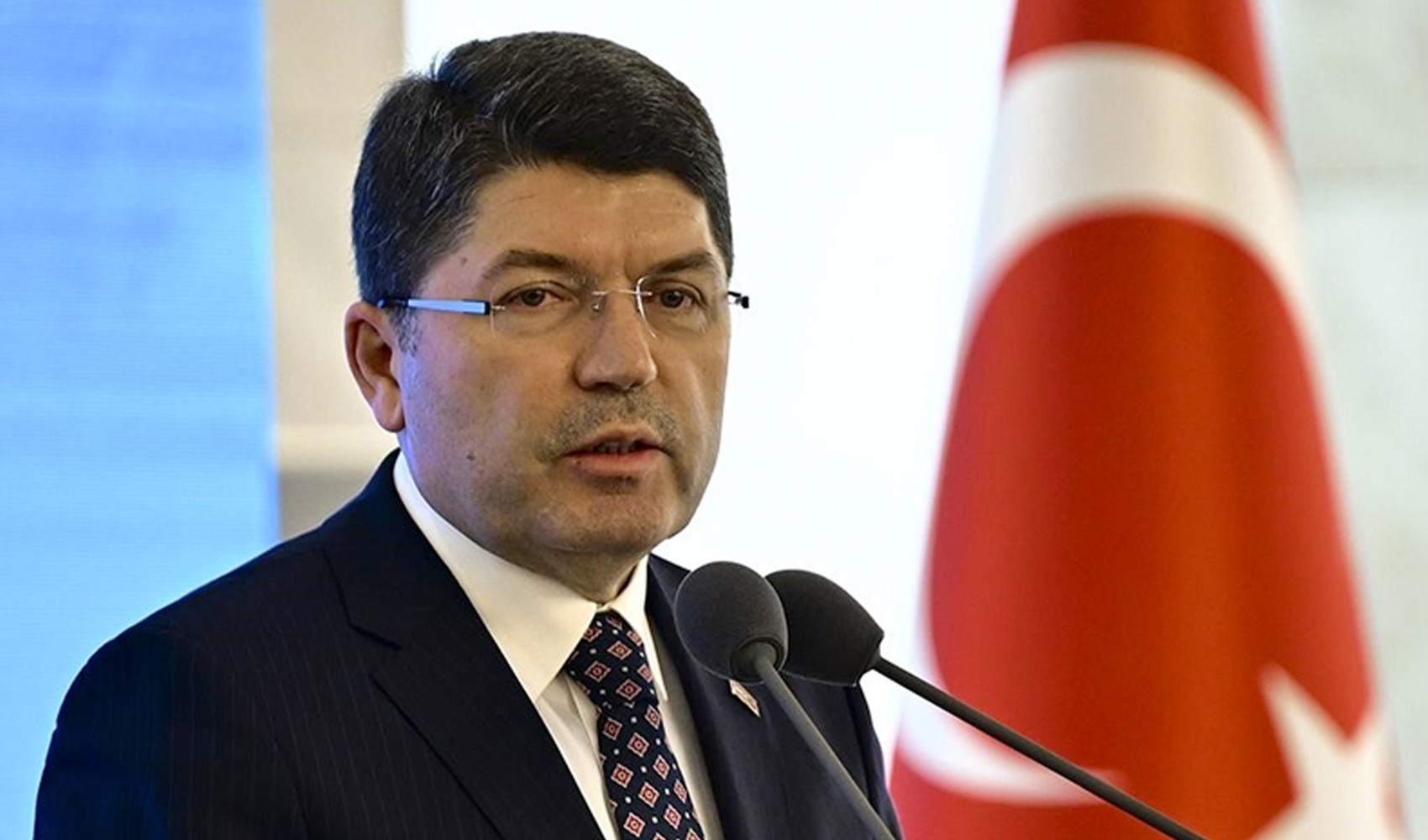
Justice Minister Yılmaz Tunç answered questions on the Gündem Özel program broadcast on the TV100 channel.
"The 5th Chamber of the Council of State had issued a decision to reinstate some judges and prosecutors who were dismissed from their profession due to their connections and affiliations with FETÖ. There have been public debates regarding this, such as 'Are FETÖ-affiliated judges and prosecutors being returned to duty?' You also said that it would be re-examined. At what stage is it now?" In response to this question, Minister Tunç replied as follows:
"We have many agenda items. One of them is the agenda that came up this week, especially regarding the decisions taken by the Council of State concerning judges and prosecutors dismissed from their profession by the Council of Judges and Prosecutors. You are right. A hesitation has arisen among our citizens. A concern has emerged: 'Is there a weakness in the fight against FETÖ?' First of all, let us state this: We will never compromise our determination in the fight against FETÖ, nor in the fight against all terrorist organizations. In this sense, we are determined to continue our fight decisively against both the PKK, FETÖ, and other terrorist organizations, and to remain vigilant against all evil networks that want to harm the peaceful future of our country."
Reminding that there were judges and prosecutors who were dismissed from the judiciary due to their connections and affiliations with FETÖ during the December 17-25 and July 15 processes, Tunç emphasized that these actions were carried out within the framework of the law.
Tunç stated, "Specifically, an Emergency Decree (OHAL) Commission was established for civil servants dismissed by emergency decrees. If there was an error in this administrative action, the OHAL Commission received these applications. There were 120 thousand applications to the OHAL Commission. 20 thousand of the 120 thousand applications were reinstated."
Stating that the dismissal of judges and prosecutors was by the decision of the Council of Judges and Prosecutors, and that 4 thousand 6 judges and prosecutors were dismissed from the profession during that process, Tunç noted that 3 thousand 888 of them filed lawsuits, some fled abroad, and the Council of State issued reinstatement decisions for 387 of those who filed lawsuits.
"OUR INSPECTORS ARE RE-EXAMINING THOSE FILES"
Minister Tunç continued his speech as follows:
"371 people who were reinstated to the profession regarding 387 files are currently on duty. The HSK Inspection Board will conduct an examination regarding these files. The examination has started now. Our inspectors are re-examining those files. There is no such thing as an appeal of the Council of State's decision. The chamber decisions of the Council of State have already been appealed. Currently, the discussion of 1286 files in the Board of Administrative Litigation Chambers is ongoing in the appeal process. Some of these are finalized decisions, and some are not."
In response to the question, "Is there still a suspicion of FETÖ in the judiciary?", Tunç emphasized that one must remain vigilant on this issue.
Regarding the question, "You said yesterday, 'The Constitutional Court should have issued a rejection decision due to lack of jurisdiction, not a decision of no grounds for judgment.' Is the final authority not given to the Constitutional Court and is this not binding?" after it was stated that the Constitutional Court had ruled on the application of the lawyers of Gezi prisoner Can Atalay regarding the revocation of his parliamentary membership, and that the Constitutional Court had concluded that there was "no grounds for judgment" in both applications, Tunç replied as follows:
"The case in which Can Atalay is being tried is the case related to the Gezi events. The Gezi events are also a case that has been finalized by our judiciary as a coup attempt. Osman Kavala was sentenced to aggravated life imprisonment, and Can Atalay and some defendants were sentenced to 18 years of heavy imprisonment, while some defendants were acquitted in this case, and the files of some defendants were separated because they fled abroad. The decision was made in the first instance at the high criminal court. The appellate court made a decision, and Can Atalay was nominated as a parliamentary candidate while the case was in the appeal stage. Of course, he was elected as a member of parliament while the Supreme Court process was ongoing, even before the Supreme Court made a decision. After being elected as a member of parliament, he applied to the Supreme Court and said: 'I have been elected as a member of parliament, I now have immunity. Stop my trial.' The 3rd Criminal Chamber of the Supreme Court said, 'You are not within the scope of parliamentary immunity.' It said this with the following justification: According to Article 83 of the Constitution, 'A member of parliament cannot be arrested, detained, or interrogated due to a crime committed before or after the election,' but there are exceptions to this. The exception to this is that there is no immunity in cases of flagrant crimes punishable by heavy imprisonment. Another is that there is no immunity regarding the situations in Article 14 of the Constitution, provided that the investigation was started before the election. The Supreme Court rejected that request with the justification that there was no immunity."
STRUCTURE OF THE CONSTITUTIONAL COURT
Touching upon the current structure of the Constitutional Court, Tunç said that the Constitutional Court handles political party closure cases, the review of laws, and the financial audit of political parties.
Reminding that they introduced individual applications with the 2010 Constitutional amendment, Tunç continued his speech as follows:
"Individual applications usually come to the Constitutional Court in the form of rights violations arising from court decisions after decisions made by judicial courts, and the main problem arises when the structural situation there is about evaluating a final judgment given by judicial courts.
In the structure of the Constitutional Court, you have had 26 criminal chamber presidents and criminal law experts who have passed through the General Assembly of Criminal Chambers make a decision, and you are having a section of the Constitutional Court that is not composed of legal experts review this decision. If there were a regulation stating, 'The section of the Constitutional Court that handles individual applications consists of members of the Supreme Court and the Council of State,' and if there were a consensus in Parliament, but it is not like that; this requires a consensus, it requires a qualified majority. This requires a constitutional amendment. A certain number of members of parliament submit a legislative proposal regarding a constitutional amendment, but if there is no consensus, it does not reach this result after failing to find the qualified number there."
RENT DISPUTES
Touching upon the issue of mediation in rent disputes, Tunç stated, "We started the mediation practice in rent disputes as of September 1st. We have introduced a mandatory requirement for tenants or landlords to apply to a mediator before filing a lawsuit if they want to file a lawsuit regarding both the rent amount and eviction. As of February 21st, applications to mediators in rent disputes across Turkey since September 1st have reached 129 thousand 259. If there were no applications to mediators, all of these would have gone to court. 69 thousand 239 of these 129 thousand 259 resulted in an agreement."
Most Read

Striking picture for Özgür Özel's 'New Party'
Özgür Özel gives a dated response regarding the number of resignations
Forest fire in Antalya brought under control

The PKK opening and Özgür Özel’s path!..

How did the newspapers view Özgür Özel's farewell to the CHP?

What did the CHP do?

Özel’s new party move in the world press

The New CHP, against CEHAPE

From self-efficacy to despair

The return of craftsmanship in the age of artificial intelligence