

New images of Supernova SN1987A released
NASA's James Webb Space Telescope has detected new details in the image of SN1987A, located 168,000 light-years away, which was previously photographed by the Hubble Space Telescope.



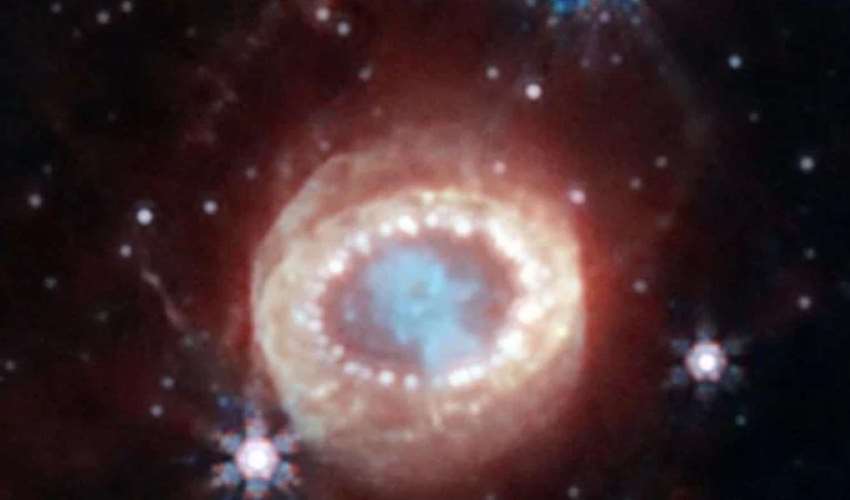
The James Webb Telescope has captured new detailed images of the supernova named "SN1987A".
The US National Aeronautics and Space Administration's (NASA) James Webb Space Telescope has recorded new detailed images of the celestial object "Supernova 1987A (SN1987A)," located in the Large Magellanic Cloud and discovered in 1987, which resembles a pearl necklace.
In a statement by NASA, it was noted that scientists, by examining Webb's data, have detected new details in the image of SN1987A, which is located 168,000 light-years away and was previously photographed by the Hubble Space Telescope.
It was reported that the new observations made with Webb's Near-Infrared Camera (NIRCam) provide important information about how a supernova develops over time and shapes its remnants.
It was stated that at the center of SN1987A, there is gas and dust in the shape of a clustered keyhole resulting from the supernova explosion, and due to the density of the dust, even the near-infrared light that Webb can detect cannot penetrate this region, making it appear as if there is a "dark hole" in the center.
In the recorded Webb image, it is seen that the keyhole in the center is surrounded by two crescent-shaped dark materials emitted from the explosion, and on the outside, there is a bright, equator-like band connecting the two faint arms of the elliptical, hourglass-shaped outer rings.
The equatorial ring, composed of material ejected tens of thousands of years before the supernova explosion, contains bright hot spots resembling a pearl necklace, which emerged when the supernova's shock wave hit the ring. Outside the equatorial ring, there are other bright spots that appear like a second ring of the pearl necklace, where the supernova shocks hit more distant material.
It was emphasized that SN1987A has also been observed by NASA's Hubble and Spitzer Space Telescopes and the Chandra X-ray Observatory, but the Webb image reveals small crescent-like structures in this supernova remnant. It was noted that these structures could be part of the outer layers of gas from the supernova explosion.
NASA scientists point out that there are many unknowns regarding neutron stars formed after supernova explosions and that additional information on the subject will be obtained with the findings of the Webb telescope.
News Source: 12punto
Most Read

Striking picture for Özgür Özel's 'New Party'

Özgür Özel gives a dated response regarding the number of resignations

Forest fire in Antalya brought under control

The PKK opening and Özgür Özel’s path!..

Houthis strike Saudi-owned tanker

How did the newspapers view Özgür Özel's farewell to the CHP?

What did the CHP do?

Özel’s new party move in the world press

The New CHP, against CEHAPE

From self-efficacy to despair