

Rogue star could bring about the end of the world
French astronomers have investigated what would happen to Earth if a rogue star were to approach the Solar System dangerously close.



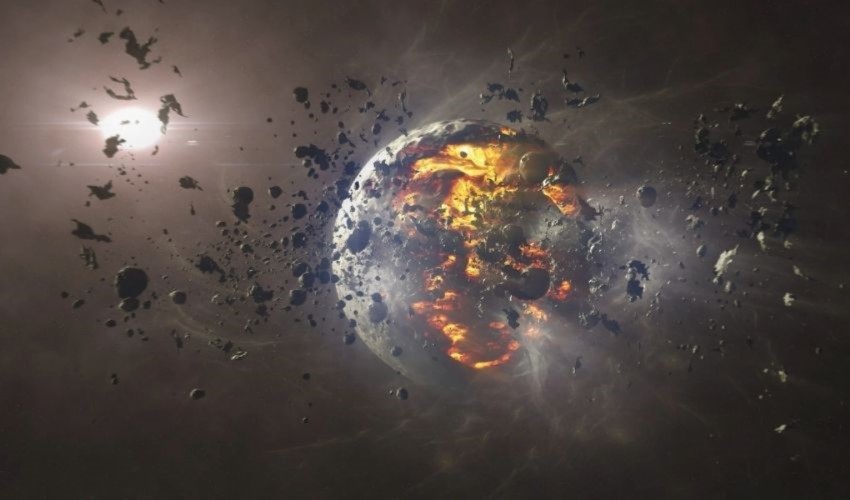
Stars generally remain bound to the galaxies they reside in thanks to gravitational forces and move in harmony with their surroundings. However, this bond can sometimes be broken. For example, if a star gets too close to a supermassive black hole, it loses its harmony and begins to wander through space as a rogue.
Such stars are called "rogue stars." According to scientists, it is not a very likely event for a rogue star to approach the Solar System and Earth dangerously close. However, there is a small possibility. If this possibility were to become reality, the gravitational bonds that allow the planets in the Solar System to move in harmony could be broken.
WHAT HAPPENS IF A ROGUE STAR APPROACHES THE SOLAR SYSTEM?
According to the study reported by Independent Türkçe, this possibility was addressed in a new research paper published in the peer-reviewed scientific journal Monthly Notices of the Royal Astronomical Society. The researchers wanted to see what would happen if a rogue star came within 100 astronomical units (AU / a unit of length based on the distance from Earth to the Sun) of the Solar System.
For this purpose, a total of 12 thousand simulations were run. The paper stated, "If a star passes within 100 AU of the Sun, the chance of all 8 planets in the system remaining in place is still very high." According to the findings, this probability is over 95 percent.
DOOMSDAY SCENARIOS
On the other hand, there were also more negative results from the simulation. The scenarios in question showed that Mercury is the most vulnerable planet. In many scenarios, it was observed that the planet collided with the Sun and was destroyed.
Other results included the possibility of Earth colliding with Venus, Uranus and Neptune being ejected from the system, only Earth and Jupiter surviving, or only Jupiter surviving.
The simulations also revealed that all 8 planets could be ejected from the system. Although all 8 planets remained in the system in most of the simulations, it was determined that there could be changes in their orbits. For example, some planets, despite remaining bound to the Sun, were pushed as far as the Oort Cloud. The Oort Cloud is a spherical belt that surrounds the Solar System and is thought to consist of millions of comets.
The researchers also listed the 10 most likely outcomes that could result in the destruction of the planets:
1. Mercury will collide with the Sun (2.54 percent probability).
2. Mars will collide with the Sun (1.21 percent).
3. Venus will collide with another planet (1.17 percent).
4. Uranus will be ejected (1.06 percent).
5. Neptune will be ejected (0.81 percent).
6. Mercury will collide with another planet (0.80 percent).
7. Earth will collide with another planet (0.48 percent).
8. Saturn will be ejected (0.32 percent).
9. Mars will collide with another planet (0.27 percent).
10. Earth will collide with the Sun (0.24 percent).
News Source: 12punto
Related News

Most Read

Striking picture for Özgür Özel's 'New Party'

Özgür Özel gives a dated response regarding the number of resignations

The PKK opening and Özgür Özel’s path!..

Forest fire in Antalya brought under control

How did the newspapers view Özgür Özel's farewell to the CHP?

He killed his wife by slitting her throat: Their children witnessed the moments

What did the CHP do?

Özel’s new party move in the world press

The New CHP, against CEHAPE

Fire at TUSAŞ engine factory in Eskişehir under control