

Controversial 'Atatürk Opera' in Germany: Stuttgart State Opera faces a barrage of questions and protests
The opera titled “Atatürk – Die Legende von Mustafa Kemal,” which the Stuttgart State Opera plans to stage in its 2027 season, has sparked major controversy in Germany even before its premiere.



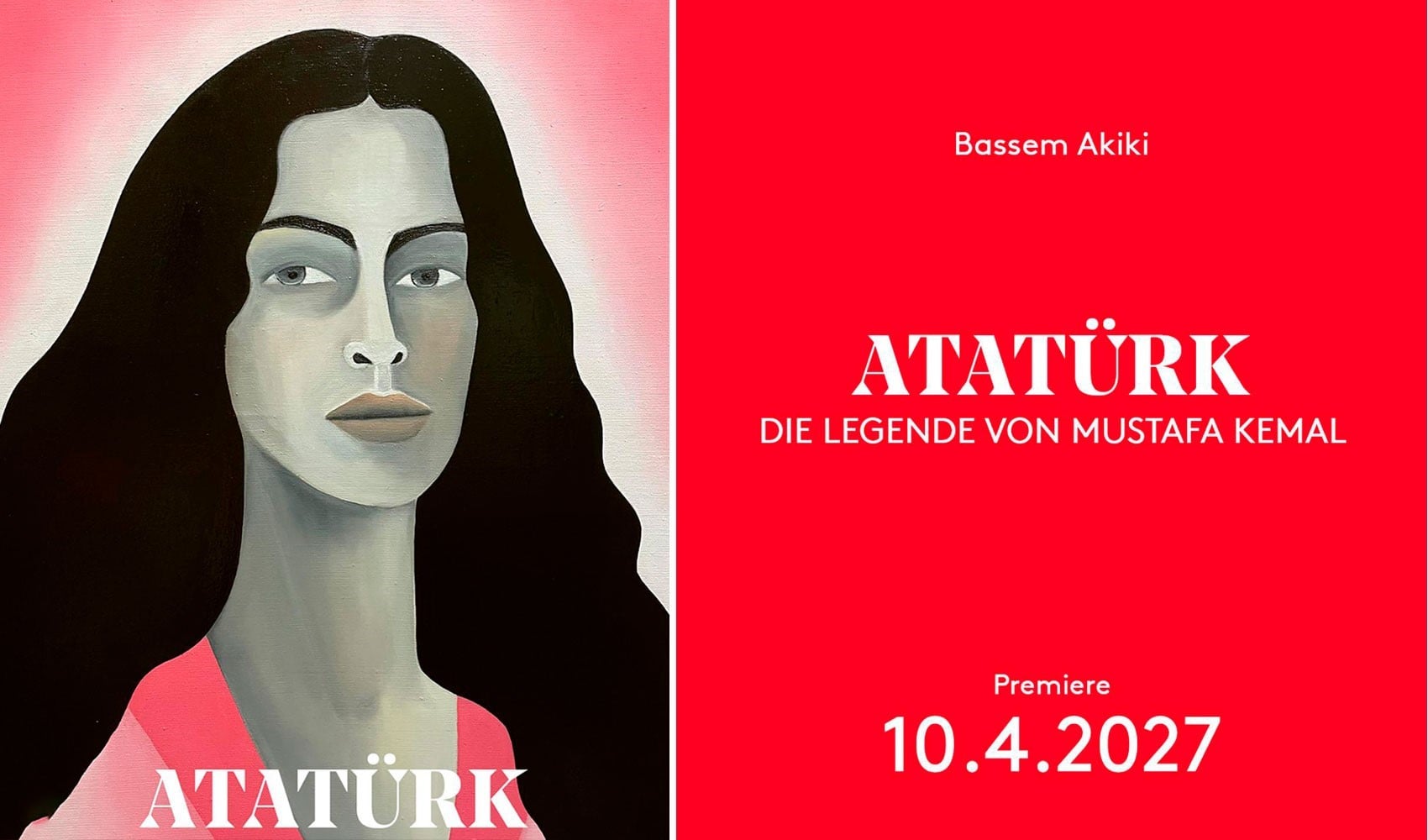
IŞIN ERTÜRK – STUTTGART
Stuttgart, the capital of the state of Baden-Württemberg, currently led by Green politician Cem Özdemir, is witnessing a new debate over art and politics. The opera titled “Atatürk – Die Legende von Mustafa Kemal,” scheduled for the 2027 season by the Stuttgart State Opera, has triggered significant social and political tension even before its premiere.
The premiere is set for April 10, 2027, with performances continuing throughout April and May of next year.
The work is being prepared by the Lebanese-born, Polish-descended composer and conductor Bassem Akiki. The libretto is by Olga Bach. The director's chair is occupied by Ersan Mondtag (Aygün), an artist of Turkish descent who has made a major breakthrough in recent years.
While Bassem Akiki handles the musical direction, the stage and costume designs also bear the signature of Ersan Mondtag. Gerrit Jurda is in charge of lighting design, and Jeremy Bines is the chorus master. The dramaturgy team includes Till Briegleb and Julia Schmitt.
A remarkable cast has been assembled for the stage. Matthias Klink will portray the character of Mustafa Kemal Atatürk. Natasha Te Rupe-Wilson will appear on stage in the role of Sabiha Gökçen.
Characters such as Fikriye Hanım, Latife Hanım, Makbule Hanım, and Zübeyde Hanım are also among the central figures of this opera.
Another notable detail in the cast is that the characters of Soghomon Tehlirian and Sheikh Said are played by the same actor. The work also features “historical figures” such as Otto Liman von Sanders, John Spencer, Dr. Fiessinger, and Paul Hindemith.
The Stuttgart State Opera Chorus and the Stuttgart State Orchestra are also among the main supporting elements of the production.
ACCUSATIONS OF ATATÜRK AS A “CONTROVERSIAL FIGURE”
However, the real controversy began with the opera's announcement texts.
This is because the Stuttgart State Opera explicitly declared that it would address Mustafa Kemal Atatürk, the founder of the Republic of Turkey, through the themes of “contradictory,” “controversial,” and “historical violence.”
And social media practically exploded.
POLITICAL FICTION AGAINST THE NARRATIVE OF THE REPUBLIC'S FOUNDATION
One of the most striking aspects of the opera is its multilingual structure.
According to statements from the Stuttgart State Opera, the work will include sections in Turkish, Kurdish, Armenian, Greek, German, French, and English.
The State Opera defines this as “the meeting of different historical narratives and experiences on the same stage.” However, for many people of Turkish descent living in Germany, this is precisely where the issue grows. Because the view is gaining strength that this structure is less of an artistic biography and more of a political fiction that carries the founding narrative of the Republic back into an ideological arena of debate.
IS THE GOAL TO QUESTION THE “ATATÜRK LEGEND”?
The following statements in the announcement published by the State Opera drew attention:
“The opera will approach Atatürk with today's historical perspective.”
“It will be necessary to speak of violence and oppression.”
“Violence against Armenians, Greeks, and Kurds will be explicitly addressed.”
“This work is not a heroization.”
Later, following intense reactions, the Stuttgart State Opera published a new statement. However, in the opera's own words, this “statement” was not enough to lower the tension.
The following defense was also made for the phrase “The Legend of Mustafa Kemal,” or “Die Legende von Mustafa Kemal,” in the subtitle of the opera's poster: “The concept of ‘legend’ here does not mean blind glorification. The goal is to question the construction of the legend surrounding Atatürk.”
The continuation of the statement included the following expressions:
“State violence, nationalist ideology, exile, shared historical wounds, and historical guilt will be among the main themes in the work.”
“Violence against Armenians, Greeks, and Kurds will be addressed explicitly.”
It was also stated that the opera would connect the German Empire's role in the Armenian issue with the history of Turkish migration to Germany.
REACTIONS POURING IN ON SOCIAL MEDIA
Following this, social media was divided.
Thousands of comments were made.
Numerous users reacted harshly to the opera with statements such as “Atatürk is not a dictator, he is the leader of the war of independence,” “Atatürk is a symbol of modernization and secularism,” “Atatürk is a pioneer of women's rights,” and “Atatürk opened doors to Jewish scientists fleeing Nazism.”
In some comments, assessments such as “The nerves of the Turkish community are being played with,” “This is not art, it is provocation,” and “An initiative that will disrupt social peace” stood out.
References made specifically through the topics of “Dersim,” “Pontus,” the “Armenian issue,” and “assimilation” caused the reactions to grow even further.
DOES GERMANY HAVE NO OTHER PROBLEMS?
The real question starts here.
While Germany is struggling with debates over a severe economic crisis…
While migration policies are polarizing the country sharply…
While Europe is in the shadow of a war atmosphere…
While the far-right is on the rise…
The question is being asked: Why is such a file being opened now against Turks who have been living in Germany for over 65 years, have reached the fifth generation, and constitute the country's largest immigrant-origin community?
Why Stuttgart?
Why Baden-Württemberg?
IT COINCIDED WITH CEM ÖZDEMİR'S PREMIERSHIP
And why exactly during the state premiership of Cem Özdemir, a politician of Turkish descent from the Green Party?
These questions are now being asked much more loudly. Because Cem Özdemir was among the strongest supporters of the “Armenian genocide” resolution in the German Federal Parliament in the past.
Now, the fact that the State Opera, supported by public funds in the state where he is premier, is coming to the agenda with such a sensitive project centered on Atatürk is found “meaningful” in many circles.
“THE RED LINE OF MILLIONS”
In this truly controversial “project,” there is no ordinary historical figure at stake. Because for the community of Turkish descent, Atatürk is not just a statesman.
Therefore, the debate has long since ceased to be just a matter of “an opera being staged.” The comment section of the Stuttgart State Opera's social media post has turned into a major ideological battlefield over the Turkish community in Germany's perception of history, identity, the Republic, Dersim, the Armenian issue, Pontus claims, secularism, and modernization.
And what is remarkable is this: The reactions are not coming only from nationalist circles. There are different tones. On one side, there are those who defend Atatürk through “modernization,” “science,” “peace,” “women's rights,” and “anti-imperialism.” On the other side, there are those who bring harsh criticisms through Dersim, the Armenian issue, and assimilation policies.
In other words, the Stuttgart State Opera's post has already exploded all the historical breaking points of the Turkish-origin community in Germany under the same heading. Even though the show is a year away, social media has already turned into an area of ideological confrontation following the opera's announcement.
That is truly the picture.
Atatürk is clearly framed as a “contradictory and controversial figure.” Composer Bassem Akiki says this directly. Moreover, he emphasizes that the opera will bring “different historical narratives” together on the same stage through languages such as Armenian, Kurdish, Greek, Turkish, German, French, and English. Therefore, this is not a classic biographical Atatürk opera. It gives the impression of a political narrative constructed more around historical conflicts, traumas, nationalism, violence, and historical reckoning.
Is the issue art, or is it playing with the sensitive points of society?
For millions of people of Turkish descent—right-wing, left-wing, opposition, or pro-government in Germany—Atatürk represents very strong shared historical values.
Precisely for this reason, many people are asking this question: Why was there a need for a project that would provoke such a large community, which lives in peace and has largely completed the process of social integration, through historical areas of tension again?
THE “FREEDOM OF ART” DEBATE
Of course, art can be critical.
Of course, history can be debated on stage.
However, the growing debate here points to another point: Does a cultural institution financed by public funds bringing a figure who is a historical and emotional red line for millions of people back to the center of ideological conflict during such a sensitive period serve social peace?
Or is it lighting the fuse of a new cultural confrontation?
Moreover, the constant emphasis on “violence,” “trauma,” “nationalism,” “oppression,” “guilt,” and “conflict” in the State Opera's statements made the reactions grow even larger instead of reducing them.
PREPARATIONS FOR PROTESTS ALREADY IN GERMANY?
It is stated that major protests are already being discussed in many Turkish-origin associations, platforms, and civil society circles…
The debate has turned into a new fault line growing over the identity, history, perception of the Republic, and shared historical sensitivities of the Turkish community in Germany.
And it seems that… this opera in Stuttgart has lit the fuse of one of Germany's biggest cultural and political crises before the curtain has even opened.
TENSION WARNING FOR MAY 2027
The picture visible already is this: The months of April and May 2027, in particular, are candidates to be extremely hot for the Turkish-origin community in Germany. The issue has already ceased to be just an opera debate.
On one side, there are millions of people who see Atatürk as the founder of the Republic, the leader of the war of independence, and the symbol of modern Turkey.
On the other side, there is the new narrative line established by the opera through the headings of “state violence,” “nationalism,” “historical guilt,” “Armenian,” “Greek,” and “Kurdish.”
One of the biggest risks starts right here.
Because such projects do not only pit the Turkish community against German institutions. They also carry the potential to trigger very sharp fractures within the Turkish-origin community itself.
The possibility of provocation grows right there.
The possibility of people who have lived in the same neighborhood and the same city for years coming face to face on social media or on the street is not underestimated.
What is even more remarkable is this: All these announcements, statements, and debates were served to the public in the week coinciding with the anniversary of May 19, 1919. That is, the anniversary of the date when Mustafa Kemal Atatürk landed in Samsun and started the founding process of the Republic of Turkey.
This timing is not seen as just a “coincidence” by many people. On the contrary, it is found to be extremely meaningful.
That is why the “Atatürk Opera” debate in Stuttgart does not seem like it will remain just a culture-arts polemic in the coming period.
This file, which touches the nerves of the Turkish community in Germany, could sit at the center of much larger political, social, and cultural debates in the coming months.
PHOTO: Ksawery Zamoyski – Staatsoper Stuttgart
News Source: 12punto
Most Read

Striking picture for Özgür Özel's 'New Party'

Özgür Özel gives a dated response regarding the number of resignations

Forest fire in Antalya brought under control

The PKK opening and Özgür Özel’s path!..

Houthis strike Saudi-owned tanker

How did the newspapers view Özgür Özel's farewell to the CHP?

What did the CHP do?

Özel’s new party move in the world press

The New CHP, against CEHAPE

4 drones shot down near US Consulate General in Erbil