

The economic bill of the Israel-Iran tension has emerged
It is estimated that Israel's military operations against Iran have placed a heavy economic burden on the country, and that a new conflict could reach costs in the billions of dollars.



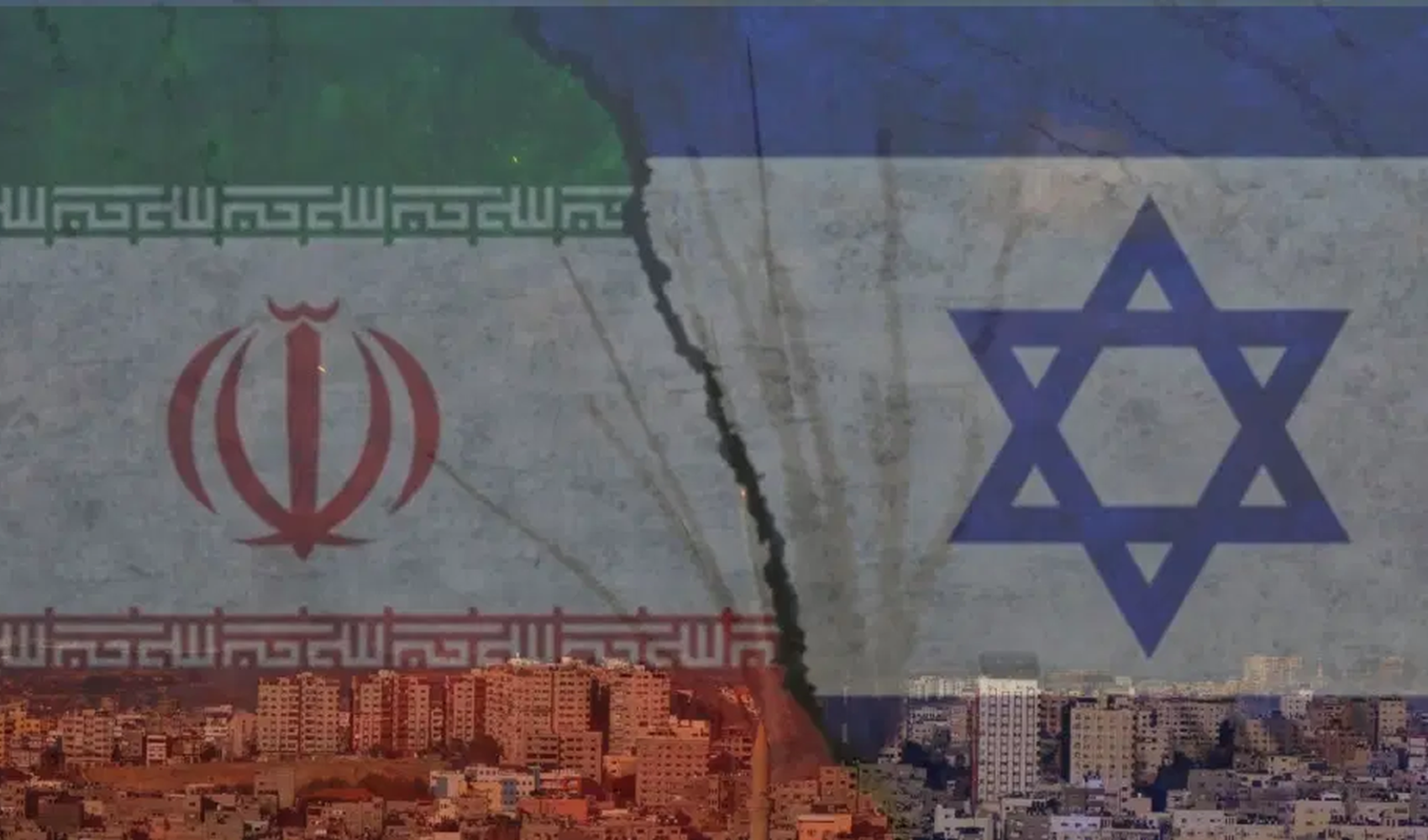
Israel's attacks on Iran, which began on June 13 of last year, have created a significant financial burden on the country's economy. According to recent analyses conducted in Israel, the military operations carried out just last year cost 20 billion shekels, or approximately 6.4 billion dollars. Security experts and former military advisors warn that in the event of a potential new conflict, these figures could rise much higher.
Reem Aminoach, the former economic advisor to the Israeli Chief of General Staff, pointed out in his assessment that even in a scenario where a war does not break out, a high price will be paid: "The relatively least costly scenario is for Israel not to launch any attacks at all." According to Aminoach, the maintenance of defense systems and security measures alone require military spending between 7 and 10 billion shekels (2.2 to 3.2 billion dollars), and this is a figure that arises without any conflict.
Similarly, Sasson Haddad, another former advisor to the General Staff, pointed out that a military operation similar to the one experienced last year could create an additional cost in the range of 15 to 25 billion shekels (4.8 to 8 billion dollars). The statements emphasized that these calculated costs only cover military expenditures, and that the civilian aspect of the matter brings an additional burden. In other words, the total burden can reach up to 30 billion shekels (approximately 9.8 billion dollars) when civilian damage and social impacts are included.
Recently, while harsh statements have been exchanged in the international arena regarding the potential for the US to launch an attack on Iran, the Israeli administration has announced that it is preparing for all possibilities.
Meanwhile, Iranian leader Ali Khamenei stated in a speech today that if the US were to launch an attack on his country, the conflict would not remain limited to just the two countries, but would turn into a regional war. Israeli Prime Minister Benjamin Netanyahu, on the other hand, increased the level of tension by stating that they would respond harshly to any attack from Iran.
During the nuclear negotiations that continued throughout last year, Israel had carried out attacks against both military and civilian targets in various Iranian cities on June 13, 2025. The US, which supports Israel, carried out an operation on June 22 against Iran's nuclear facilities in Natanz, Fordo, and Isfahan, codenamed "Midnight Hammer." It was stated that "bunker-buster" bombs, which are only found in the US inventory, were used in this operation.
While US President Donald Trump described the attack as a "great success," initial damage analyses leaked to the press showed that although the attacks did not completely disable Iran's nuclear program, they pushed it back by several months.
News Source: 12punto
Most Read

Striking picture for Özgür Özel's 'New Party'

The PKK opening and Özgür Özel’s path!..

How did the newspapers view Özgür Özel's farewell to the CHP?

He killed his wife by slitting her throat: Their children witnessed the moments

What did the CHP do?

Özel’s new party move in the world press

The New CHP, against CEHAPE

Fire at TUSAŞ engine factory in Eskişehir under control

From self-efficacy to despair

Kılıçdaroğlu's first message on Özgür Özel's new party announcement