A breakthrough for the ages: Data transfer via quantum teleportation is now a reality!
Researchers at the University of Oxford have achieved a groundbreaking study that will revolutionize the scientific world. The researchers successfully transferred data between two quantum computers located approximately two meters apart using the quantum teleportation method.
12punto
As reported by Donanımhaber, while quantum computers have the potential to revolutionize the scientific world, many technical challenges must still be overcome for large-scale use. However, researchers from the University of Oxford may have crossed a significant threshold in this field. According to a paper published in the journal Nature, scientists have succeeded in performing data transfer between two quantum computers via quantum teleportation.
DISTANCES ARE LOSING THEIR SIGNIFICANCE
In the experiment, two quantum computers were placed approximately two meters apart. However, the researchers state that, theoretically, distance is irrelevant. Thanks to quantum entanglement, it is believed that a worldwide or even interplanetary quantum network could be possible.
This progress also represents a major step forward in the scalability of quantum computers. While traditional computers use transistors, quantum computers operate using units called qubits.
Unlike the binary (1 and 0) system of classical computers, qubits can represent multiple states simultaneously. This feature is revolutionary, especially for complex calculations.
However, today's quantum computers still do not contain a sufficient number of qubits or sufficiently low error rates for large-scale calculations.
For this reason, researchers are working on the idea of creating a larger system by connecting multiple quantum computers to each other. With an approach similar to distributed computing systems in traditional computers, it may be possible to build more powerful computing systems by bringing qubits together across different machines.
NEW COMMUNICATION LINK: QUANTUM ENTANGLEMENT
Traditional computers use electrical signals or wireless networks for data communication. However, quantum computers cannot communicate directly using classical data communication methods. Instead, a phenomenon called quantum entanglement is used.
Quantum entanglement refers to a mysterious connection formed between two quantum objects. When the state of one object is measured, the other object with which it is entangled instantly assumes the same state.
If we think about this in terms of quantum computing systems, we can see that we could overcome the aforementioned insufficient qubit count by entangling two or many more systems.
Such a quantum network could provide the extra qubits needed to run more complex programs and operations. Furthermore, entangled data allows for more accurate calculations. Reading information from a quantum computer and transferring it to a traditional machine that we can interpret presents a higher error rate; this error rate has been an obstacle for quite some time.
70 PERCENT ACCURACY RATE
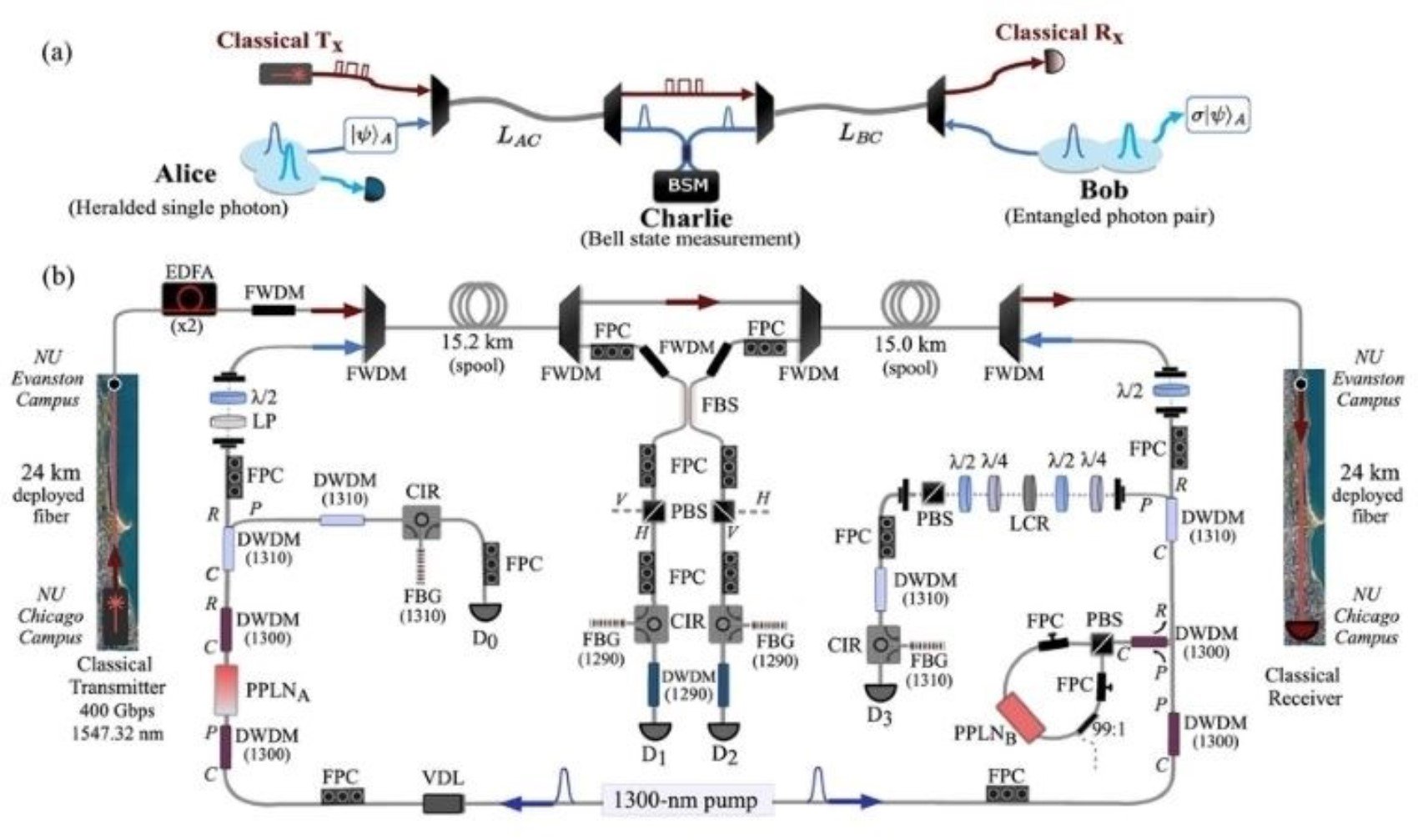
To achieve the aforementioned breakthrough, scientists created two ion traps connected by a two-meter optical cable. Each trap contained a strontium ion and a calcium ion. While the calcium ions functioned as memory units, the strontium ions served as the interface for the quantum network. Lasers sent through the optical cable initiated the entanglement process via photons.
The researchers discovered that entanglement did not occur successfully with every laser shot during the experiment, but failed attempts did not disrupt the state of the ions. As a result, the experiment could be attempted repeatedly without needing to be restarted.
Additionally, when entanglement was successfully achieved, a measurable photon emission occurred. This provided scientists with an important clue indicating that the entanglement had been successful.
In the later stages of the experiment, the scientists tested the Grover algorithm using quantum teleportation. In the analyses conducted, the quantum network performed successful calculations with a 70 percent accuracy rate.
The researchers stated that the error rates were caused by local hardware operations, not by quantum teleportation. It is believed that higher accuracy rates are possible with commercial quantum hardware.
QUANTUM NETWORKS AND THEIR FUTURE PLACE
This development could form the foundation for ultra-secure and high-capacity networks, referred to as the quantum internet, in the future. Ensuring error-free data transfer between quantum computers could revolutionize many fields such as cryptography, artificial intelligence, big data analysis, and drug discovery.
However, there are some obstacles facing this technology. Although the concept of distance is theoretically eliminated, current experiments are limited to optical cables. It remains uncertain how effective fiber optic infrastructure can be over long distances due to quantum noise.
WHAT IS QUANTUM TELEPORTATION?
Quantum teleportation is based on a physical phenomenon called quantum entanglement. Entanglement means that two particles can affect each other's state simultaneously, even when they are far apart.
With this method, the quantum state of one particle can be transferred to another particle.
However, there is no transfer of a physical particle here; information is moved from one point to another thanks to entanglement.