


The Tolga Şardan Case: Lying to the Public and Crime



Lies, disinformation, manipulation, deception, trickery, fraud... All of these are actions that seem ugly and immoral to almost everyone. They all share a few common characteristics:
1) The person committing these acts knows the truth of the matter.
2) Despite this, they knowingly and willingly present a scenario contrary to the truth to the recipient.
3) In doing so, they are trying to gain an advantage.
Information Asymmetry
To commit these acts, there must be an information asymmetry between the perpetrator and the recipient. The greatest of these information asymmetries is likely the one between the state and the citizen. It is certain that there is also information asymmetry between companies and consumers, or between company management and company employees.
To carry out the act in question, there must first be such an information asymmetry, and the perpetrator must have the opportunity and intent to mislead the recipient. There is no doubt that the structures most capable of all this are states. Let us recall the US: The lie that Saddam possessed nuclear weapons was effective on a global scale. Well... some said, "After all, the US must know something."
As a precaution against the deception of the masses for various purposes and in various forms, modern law has criminalized the act of publicly spreading misleading information. This type of crime is now in effect in many countries. In our legal system, it is regulated in Article 217/A of the Turkish Penal Code as follows:
Publicly spreading misleading information
Article 217/A- (Added: 13/10/2022-7418/29 art.)
(1) Any person who publicly spreads false information regarding the internal and external security, public order, and general health of the country, in a manner capable of disturbing public peace, with the sole intent of creating anxiety, fear, or panic among the public, shall be sentenced to imprisonment from one to three years.
(2) If the perpetrator commits the crime by concealing their true identity or within the framework of an organization's activities, the sentence given according to the first paragraph shall be increased by half.
As can be seen, for this crime to be committed, the conditions of having the intent to create the mentioned type of effect on the public (i), spreading false information (ii) regarding specific subjects (related to the country's internal and external security, public order, and general health), and doing so in a manner capable of disturbing public peace (iii) must be met.
In our Penal Code, the "intent" part as the subjective element of this crime has been defined so broadly and its determination has been made so difficult that it has become impossible to determine whether the perpetrator harbored this intent or not. Moreover, the ambiguity of the mentioned subjects allows for the scales to be tipped too far.
More importantly, it is not clear what is meant by "false information." Does this mean a proposition that is not true? Or does it mean any narrative that is not entirely consistent with the truth? These are not clear. In other words, a journalist who receives information incompletely can very well spread "false" information. Moreover, they can do this not only without knowing it, but also by conveying it as far as they know (and therefore, without reflecting the whole truth) in order to reveal the entirety of the truth. With this form of legal regulation, the authority to determine what is true is left entirely to the state. Because the party that will determine the falsity will, in practice, unfortunately be the prosecution.
Most importantly, it is left to an entirely vague expression called "public peace." For example, if information that would increase the conflict between two different social or economic classes is given in an incomplete or careless manner, this news could very well be considered a crime under this law. For example, if a journalist reports and publishes that workers are being exploited by certain segments with striking (but not entirely accurate) data, and while doing so, aims to spread the anxiety among the public that "our labor is being stolen" and thus aims to mobilize the public, and if the class struggle tends to harden with this panic or anxiety, this journalist will certainly be convicted under this article.
The matter may not be this clear-cut either. For instance, if a journalist accesses a part of a report from a secret unit of the state and reports on the important information within it as required by their duty to inform the public, what will we do if a prosecutor who should not have seen this secret unit's report, or has not seen it, or even if they have seen it, whose own knowledge of the truth is questionable, accuses this journalist of this crime? Let's use an even worse example. If a prosecutor placed in the state by a clique, as in the past, accuses everyone who does not strictly adhere to the truth of this crime, will there be any possibility left for journalism?
In conditions where the monopoly on the truth or the monopoly on judging what is true lies with a single party, it is practically impossible to make behind-the-scenes affairs a subject of journalism while this law is in effect. The situation is familiar, isn't it? For example, in the case of Tolga Şardan, is it a prosecutor who has seen the report in question who is accusing Tolga Şardan of this crime? Or is there no such report? In an era where the state uses information asymmetry most to its advantage, this law only works against the public.
When an institution or a state official does not make a truthful statement to the public, what will we do about the false statement of this institution or official? Do we have an opportunity? Today, who has the most power to deceive the public, the intent to deceive, and the possibility that the public's deception will disturb public peace? Of course, those who govern the state, company owners, and institutions, organizations, and offices that have the authority to audit and question... Given this, don't you think this law is ineffective?
Is there any brave soul who will attempt to apply this law to institutions, organizations, and officials who present wrong inflation figures, wrong legal interpretations, wrong historical information, and unscientific statements? Even if there were such a person, how would they prove their claim?
In an environment where it is so difficult to reveal the truth, the law has not forgotten the citizen who is worried about their safety or freedom. If such a citizen hides their true identity as a precaution, this time the citizen's penalty will be increased. How will it be possible for the citizen to reach the truth? Will they receive a revelation? God forbid! The emergence of material truth is a process. In this process, information emerges in stages, that is, incompletely, and in this state, it is contrary to the truth. Fortunately, information asymmetry is not absolute.
Tolga Şardan has been released. However, a travel ban will be applied as a precautionary measure. Why? Can't criminals hide within the country?
Tolga Şardan is not an isolated case. In its current form, the law allows for major human rights violations.
I hope that one day our legal experts will have the opportunity to review this article. In its current form, this article encourages everyone to remain silent and gossip in friendly circles.
The truth has a habit of coming out. But sometimes it takes a long time. I wish patience for all of us until the truth comes out, and I wish a speedy recovery to Tolga Şardan and his loved ones.
Would you like to get notifications about new developments and save news?
- NotificationsNew developments and breaking news
- SaveNews is stored in the app
Most Read

Video response to Kim Jong-un claims

Murat Ağırel’s police statement has been revealed
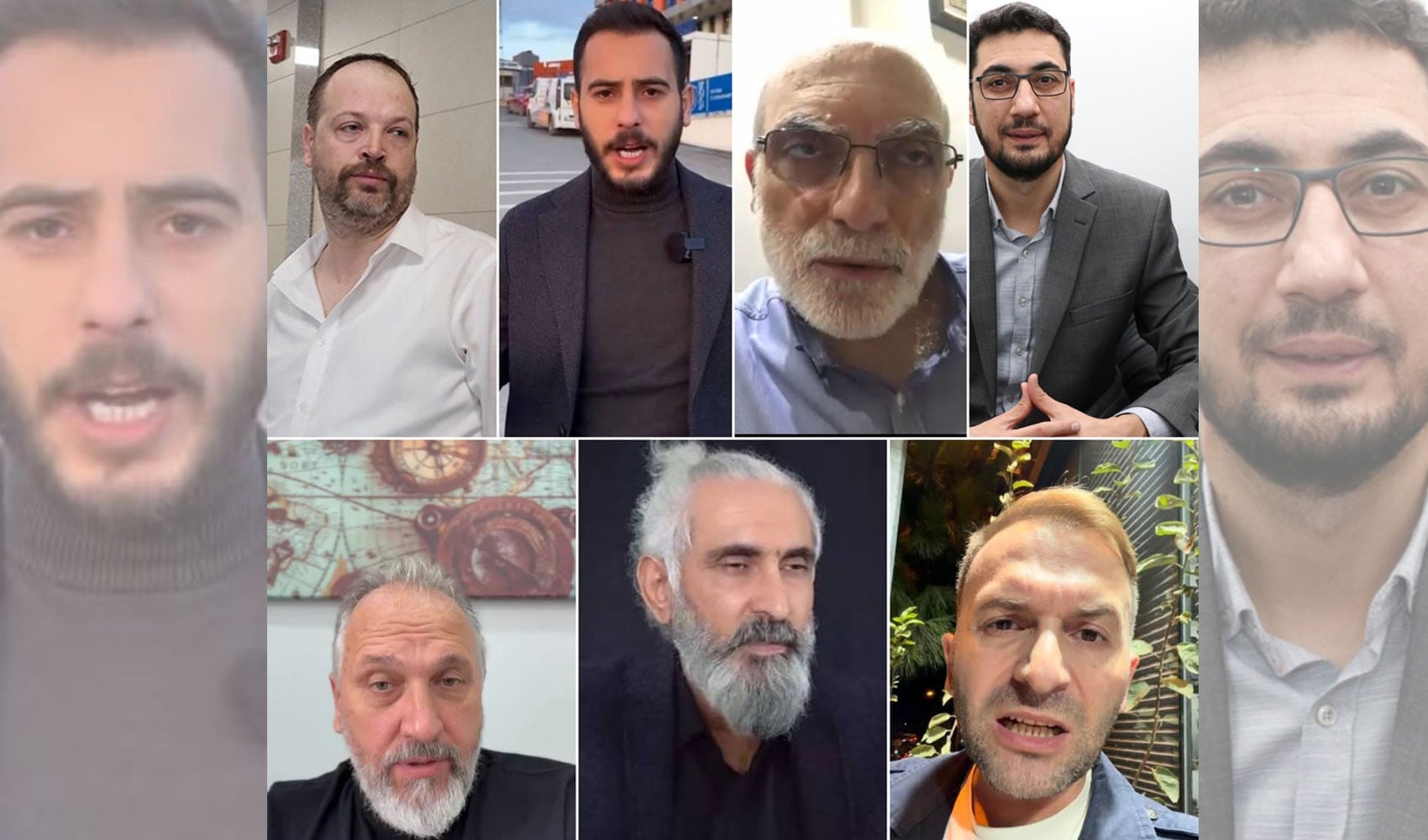
Azerbaijan issues arrest warrants in absentia for 7 people living in Turkey

The Orionid meteor shower will be visible from Turkey!

The penalty for Ronaldo, who left the national team camp, has been announced

Fatoş Seğmen reveals the cause of her daughter's death

Latest status in the race between AKP and YENİ Party revealed

Injury shock at Liverpool: He may miss the Fenerbahçe match

Who authorized the concert held in a parking garage?

From brotherhood to a distant partnership...