


The price of globalization: Turkey's domestic brands are falling into foreign hands one by one



The liberalization policies that began in the 1980s and the privatizations that gained momentum in the 2000s have fundamentally transformed the ownership structure of the Turkish economy. Domestic brands, unable to access the resources needed for growth and exports due to capital inadequacy, high financing costs, and currency instability, sought solutions in foreign funds. However, this process has made the delicate line between "capital inflow" and "loss of sovereignty" more pronounced with each passing year. While participation in global networks provides access to financing and technology in the short term, the relocation of profit and decision-making centers abroad has deepened economic dependency in the long term. The neoliberal era's unlimited trust in the "invisible hand" has grown financialization rather than production; it has increased vulnerability rather than prosperity.
Brands that were once a "national pride" — from tea to sugar, milk to energy, fashion to digital services — are now part of the portfolios of global giants. As Turkey transforms into a link in the international capital chain with this picture, the debate over the "change of ownership of domestic brands" has reignited. While foreign capital offers financing, technology, and export opportunities in the short term, the risks of profit transfer, loss of strategic control, and economic dependency deepen in the long term. Today, Turkey is trying to strike a delicate balance between the allure of global capital and the struggle to protect its economic sovereignty.
WHY ARE THEY BEING SOLD? STRUCTURAL NECESSITIES
Behind the acquisition of domestic brands in Turkey by foreign capital, there are often structural necessities rather than voluntary choices. As summarized in the table below; capital inadequacy, high financing costs, currency volatility, and the need for scaling up drive many brands toward external resources. The extensive distribution networks, financial strength, and global brand management experience of international giants appear attractive in the short term. Privatization policies have also accelerated this process by facilitating the entry of foreign investors into the market.
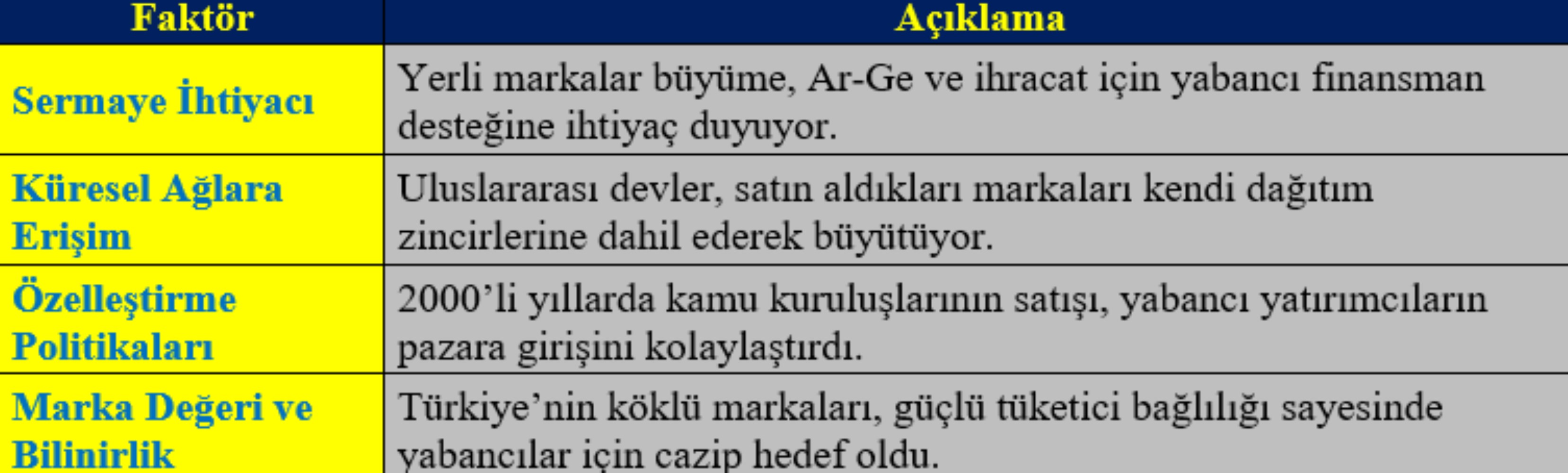
However, the short-term vitality brought by capital inflow carries the risk of turning into a loss of sovereignty in the long term. Because even if production facilities remain in Turkey, decision-making and strategic management centers are increasingly being moved abroad. Ultimately, these sales made to meet capital needs weaken the control power of domestic brands over time, turning Turkey into a structural dependency that makes it a subcontractor for global networks.
TURKEY CHANGING HANDS SECTOR BY SECTOR: The Journey of Domestic Brands to Foreign Capital
Brands that Turkey once mentioned with pride are now managed from different country headquarters. This picture, extending from food to digital, paint to energy, points to a loss of sovereignty beyond economic borders.
Food and Beverage Sector: The Global Journey of National Tastes
Turkey's food brands have faced intense interest from international companies since the 2000s. Many domestic brands were transferred to foreign investors because they could not meet their capital needs. As summarized in the table below; the food sector, where Turkey was strong in the 2000s, became the focus of foreign interest: examples such as İçim (Lactalis), Doğadan (Coca-Cola), Banvit (BRF & QIA), Oltan Gıda (Ferrero), and Kent (Mondelez) are the most well-known of this process. With these sales, although production continued, decision centers were moved abroad; net foreign exchange losses occurred due to profit transfers.
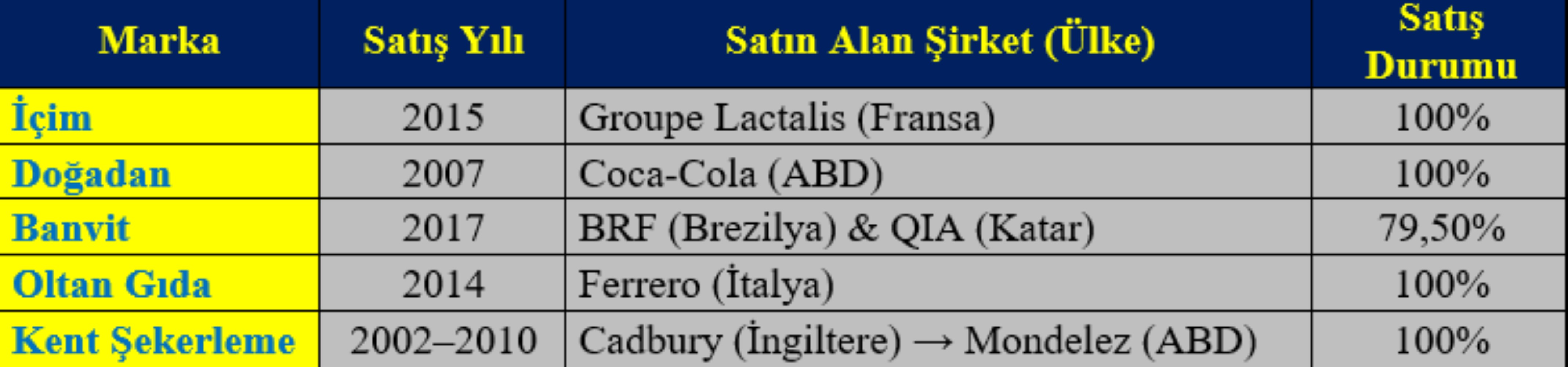
With these sales, the decision center in the fields of milk, tea, confectionery, and meat processing, where Turkey was strong, has now moved abroad. Although production and employment were protected in the short term, net foreign exchange losses occurred in the long term due to profit transfers.
Water and Carbonated Beverage Market: The Dominance of Global Companies
A similar picture emerges in the water and carbonated beverage market. Well-established brands such as Erikli (Nestlé), Hayat and Sırma (Danone), and Çamlıca Gazoz (DyDo) have joined the structures of global giants.
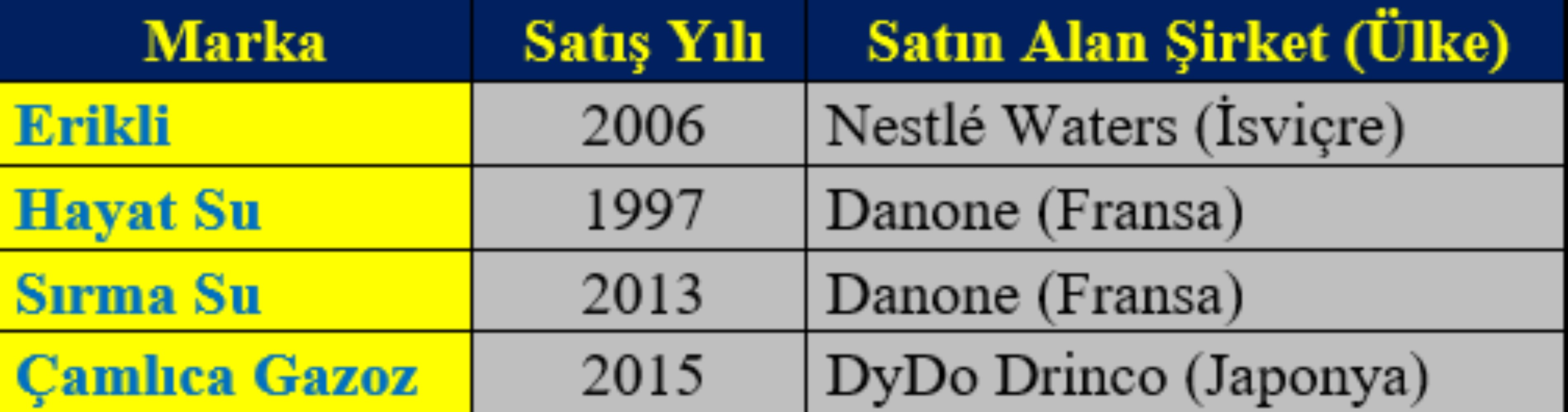
Today, multinational companies like Nestlé and Danone control a large portion of Turkey's water market. Price policies, marketing strategies, and product positioning are now determined by decisions based abroad. In short, the "local palate" has turned into a small sub-segment within the standard portfolios of global brands; even though the source of the water is still in Turkey, the direction of the earnings has long since crossed the country's borders.
Paint and Chemicals: The Strong Entry of Japanese Capital
In recent years, the presence of Japanese companies in the paint and chemical sector in Turkey has been noteworthy.
Filli Boya and Polisan are the most symbolic examples of this transformation.

These investments increased the production capacity of the sector; however, R&D and decision-making processes were largely transferred to Tokyo-based management. While Turkey continues its role as a production base, it has lost its technology and design center.
Retail and Fashion: The Change of Hands in Luxury
The influence of foreign capital has also become evident in the retail and fashion sector.

While the Beymen example symbolizes the transition of the luxury segment in Turkey to Gulf capital, the Migros example stood out as a rare step toward "re-nationalization."
Technology and Digital Services: The Alienation of the New Economy
Brands that played a pioneering role in Turkey's digital transformation have also come under the control of foreign capital in recent years.

With these sales, the foreign share in Turkey's digital market has approached 70 percent. Now, data security, competition policies, and the control of consumer data are largely in the hands of centers outside of Turkey. This is not just an economic issue, but also a strategic dependency problem.
Foreign capital weight is gradually increasing in the e-commerce, digital services, and logistics sectors, which are the locomotives of the new economy. As data becomes as critical a resource as energy in today's world, the relocation of the management centers of this field abroad makes the "digital sovereignty" debate inevitable.
Energy and Industry: External Dependency in Strategic Areas
A similar picture is noteworthy in Turkey's strategic sectors. The share of foreign companies in critical areas such as energy, transportation, and industry has increased rapidly in recent years.
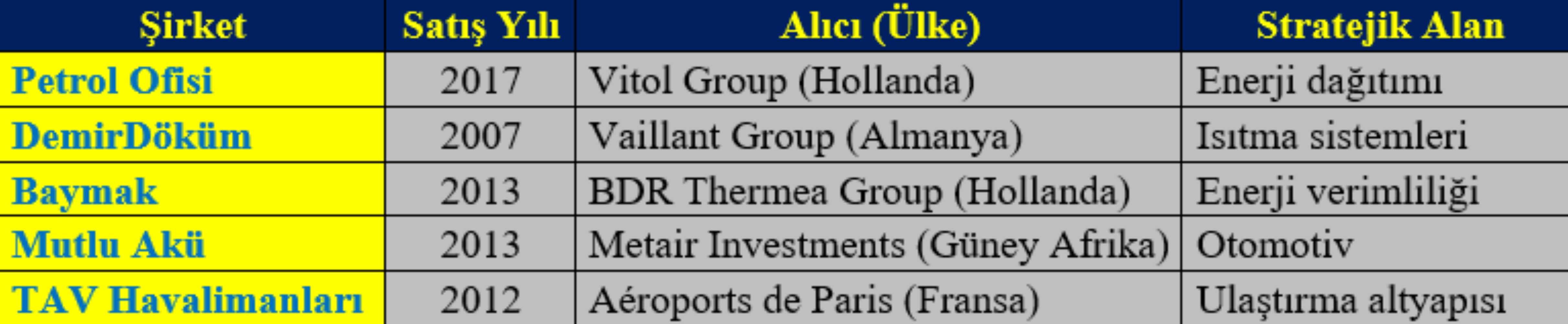
These sales have had not only economic but also geopolitical consequences. The increase in foreign oversight in strategic infrastructure such as energy and transportation limits the state's decision-making capacity. While Turkey maintains its role as a production base, it is losing its technology and strategy centers abroad. This situation creates a significant risk area in terms of national security and development planning, as well as economic sovereignty in the long term.
SHORT-TERM REVITALIZATION, LONG-TERM VULNERABILITY
Although foreign direct investments provide a certain vitality to the Turkish economy in the short term, these effects reverse over time. Capital inflows can temporarily relieve the current account deficit, increase production and export capacity, and strengthen corporate governance understanding. However, within a few years, profit transfers erode these gains; net welfare loss deepens as strategic control and technology-design capabilities shift abroad.
The amount of profit transferred from Turkey abroad, which was approximately 11 billion dollars in 2023, rose to 16 billion dollars in 2024, and exceeded 12 billion dollars in the first eight months of 2025, reaching 17 billion dollars in the last 12 months. This picture shows that direct investments, which initially brought foreign currency into the country, lose their effect in a short time.
A deeper problem is the loss of strategic control. In basic sectors such as energy, transportation, and food, decision-making processes are largely shaped in foreign centers; Turkey's innovation and technology development capacity weakens as R&D units are moved abroad.
This process creates not only an economic but also a cultural transformation. Consumers do not realize that earnings are being transferred abroad while shopping from brands they think are domestic; this leads to an erosion of belonging at the level of national identity. Furthermore, since most foreign capital investments are concentrated in large cities, regional inequalities deepen, and Anatolia's development potential is left behind.
As a result, the short-term contributions of direct investments are overshadowed by long-term dependency and income transfer. Turkey's transition from the position of a "country that attracts investment" to a "country that protects and grows its brands" is no longer a preference, but a matter of economic sovereignty and development security.
CONCLUSION: BALANCE BETWEEN CAPITAL INFLOW AND SOVEREIGNTY
Turkey is paying the price for being a center of attraction for global capital by losing its brands, decision-making power, and strategic independence. While foreign investments provide foreign currency inflow and production increases in the short term, profit transfers, R&D loss, and external dependency deepen in the long term. The issue is no longer just attracting investment; it is to establish an economic sovereignty model that manages the entire chain from production to design, from capital to strategy with domestic intellect, and can grow its own brands. True development is measured not by who the capital comes from, but by who it is for and where it stays.
Foreign capital is, of course, important for developing economies; however, the problem in Turkey is that these investments take place in the form of ownership transfer rather than production partnership. Although this model offers a short-term economic revival, it erodes the country's brand memory and decision-making capacity in the long term. Many "Turkish brands" that we see on the shelves today are effectively under the control of administrations outside of Turkey; while only production and employment remain within the country, strategy and profit have long since moved across borders.
To reverse this picture, Turkey needs to move from the position of a "country that attracts investment" to a "country that protects and grows its brands." The way to do this is possible by creating a broad policy framework, from legal regulations that will protect the domestic share ratio in strategic sectors to financing mechanisms such as the National Branding Fund. Tax regulations that limit profit transfers, programs that encourage R&D centers to remain in Turkey, and the Turkey Wealth Fund strengthening domestic capital in strategic areas with its active investor identity will form the cornerstones of economic independence.
Cooperation with foreign capital may be inevitable; however, this partnership should not move our brands into the shadow of global giants, but to the center of their own power. Turkey's future will be shaped not by what it sells, but by what it gets the world to accept under its own name. True economic independence comes from building a Turkey that does not transfer its brands, but carries its brands to the world with its own identity.
Would you like to get notifications about new developments and save news?
- NotificationsNew developments and breaking news
- SaveNews is stored in the app
Most Read

National Anthem surprise from Japanese Ambassador

Diesel protest in Italy brings roads to a standstill
Kılıçdaroğlu sends formal notice to YENİ Party

Diyanet Foundation, which claimed 'we have no resources,' owns 73 percent of the fund!

Is it time for the Turkish Parliament to revoke its 31-year-old 'Casus Belli' decision?

No to the 'opening' bar masked as change, yes to the Republic's bar

Ezel Akay and his brother's test results came back positive

Why is Paris burning? The crisis of the welfare state and the revolt of social justice

'From a Journalist’s Pen: The Tüfekli File'

The politics of particles and the financing puzzle: 'Calamitous questions'