


Vulnerabilities accumulating in the shadow of tight monetary policy: Hidden costs despite a bright macro picture



While the Turkish economy navigated the narrowing circle of tight monetary policy throughout 2025, the CBRT's November 2025 Financial Stability Report is generous in detailing the highlighted successes of this process, yet equally reticent in revealing its hidden costs. While the banking system's robust balance sheet, the increase in profitability, and the improvement in external financing conditions are carefully placed in the display window, the narrowing room for maneuver in the real sector, the fact that households are trapped in the highest-cost borrowing channels, and the weakening resilience of SMEs against mounting pressures find their place only between the lines. The resilient economic picture drawn on a macro scale changes its tone when placed side-by-side with micro realities: high interest rates that dampen investment appetite, the risks accumulated by an overvalued Turkish Lira due to long-suppressed exchange rates, and selective asset quality deterioration show that the reality is more complex despite the report's polished surface.
For this reason, questioning clearly who is paying the price for the tight monetary policy maintained for the sake of the disinflation target, and whether the achieved balance is permanent or merely a fragile transition, is no longer just an economic analysis, but a social necessity.
THE UNREAD LINES OF THE FINANCIAL STABILITY REPORT: Balanced but Fragile, the Silent Cost of Tight Monetary Policy
Although the CBRT's November 2025 Financial Stability Report presents a broad data set regarding the effects of tight monetary policy on the economy, a point left incomplete for those reading this picture immediately catches the eye: the real costs of the rebalancing process have not yet been brought to light. While the report highlights the financial system's strong liquidity structure, robust capital buffers, and the improvement in the banking sector's access to external financing, it virtually puts in parentheses the pressures that the same tight policy creates on the real sector, households, and SMEs.
Although indicators frequently voiced in public, such as "household debt remaining at low levels relative to national income" or the "increase in the financial asset/debt ratio," present a positive picture on the surface, it is seen that these data have a language reluctant to explain which social segments are paying which prices. The real question, however, still stands on the table: Are these balances sustainable, or are only the vulnerabilities behind a well-arranged display being polished?
The difficulty of the global environment is known: high interest rates, geopolitical risks, and a weak growth outlook are testing both emerging countries and middle-income economies like Turkey. The fact that the syndication renewal rate of Turkish banks has reached 135% is, of course, an important indicator of resilience; however, it also does not let us forget the structural dependence of our financial architecture on external resources. Although the extension of external debt maturities is gratifying, the permanence of this improvement remains a question mark in a period of increasing global volatility.
Fluctuations in commodity prices, the costs of geopolitical tensions reflected in trade corridors, and the fragility in global financing conditions also make the "structural adjustment process" discourse of the Turkish economy controversial. This is because how this adjustment is achieved, which segments bear which burdens, and what the social cost of this transformation is, are not clearly addressed in the report.
The Monetary Policy Committee, gathering in the shadow of all these uncertainties, cutting the policy rate by 150 basis points to 38% makes the picture even more complicated. This step, explained with technical justifications, brings with it the question of what kind of impact it will create on different segments of the economy. The points where the report remains silent are precisely where this becomes important: Who is paying the social cost of tight monetary policy, and does this cost point to a sustainable balance or a deeper fragility?
WHO IS LEFT BEHIND WHILE WALKING ON THE PATH OF DISINFLATION?: Resilience Indicators, Socioeconomic Costs, and Structural Vulnerabilities
Uncertainty in global markets refuses to give way to stability. Geopolitical tensions, protectionist trade policies, and a high-interest-rate environment continue to hover like a heavy shadow, especially over emerging countries. In this turbulent atmosphere, the decline observed in credit default swap (CDS) premiums, while offering a comforting appearance on the surface for many economies including Turkey, reminds us how fragile this relief is due to the stubborn tightness in external financing costs.
The fact that US Treasury yields, accepted as the global risk-free return, have been anchored at the 4% level since the end of 2022 is one of the fundamental elements that still makes access to global capital costly for emerging economies.
The course of capital flows also carries the same dual structure: the slowing of sharp fund outflows seen in the first half of 2025 (excluding China) in the second half of the year shows that interest in Turkish assets has not completely extinguished; however, it also clearly reveals that foreign capital is still cautious and that a permanent inflow trend is not just around the corner. In other words, there are external dynamics supporting financial stability, yes; but each is fragile enough to change direction rapidly in the face of the next global wave.
REAL SECTOR AND HOUSEHOLD BALANCE: Uneven Diffusion of Tightening and Debt Composition Challenges
Although the indebtedness of the non-financial sector still appears low relative to GDP at first glance, it is necessary to look at the direction and quality behind this indicator to understand the effects of tight monetary policy. The fact that the Debt/GDP ratio of the real sector rose to 36% in the first half of 2025 and flattened in the second half of the year shows that firms' appetite for borrowing has decreased and investments have been postponed in a high-interest-rate environment. This flatness is more of a silent barometer of economic caution and postponed investment decisions than a healthy balance.
Although the slowdown in foreign currency borrowing appears to have been achieved through the tightening of credit limits and a decrease in exchange rate volatility, this does not mean that firms have turned to TL loans. On the contrary, the narrowing of growth limits in TL loans and the increase in financing costs further squeeze the real sector's borrowing channels. On the other hand, the fact that the share of firms' TL commercial deposits in the total has risen to 61% and the TL deposit/GDP ratio has exceeded 8% shows that businesses prefer to wait in cash rather than take risks. This accumulated liquidity silently erodes not only today's cautious business world but also tomorrow's growth capacity.
A similar vulnerability is also noticeable in households. Although the Debt/GDP ratio remains well below international averages at 9.7%, the composition of the debt rapidly changes the picture. The rapid increase observed recently in the use of individual credit cards and overdraft accounts (KMH) shows that households are forced to meet their financing needs through the most expensive and riskiest channels. Since these types of borrowing tend to deteriorate most rapidly during crisis periods, they make the pressure of tight monetary policy on narrowing incomes more visible.
The segments most severely affected by tight monetary policy are households and small businesses with the lowest income elasticity. It is no coincidence that the deterioration in banks' asset quality is concentrated precisely in these segments; because these are the groups with the most limited resilience to absorb interest rate shocks.
All these indicators reveal that financial stability, which appears strong on the surface, harbors significant socioeconomic cracks deep down. The story of resilience told at the macro level turns into an increasingly heavy cost at the micro level. For this reason, the question of who bears the burden of tightening and how sustainable this burden is becomes more critical every day for understanding the true picture of the economy.
BANKS IN PROFIT, THE VULNERABLE IN TROUBLE: Profitability Shines, Asset Quality Sounds the Alarm
The banking sector has been presented as one of the most solid pillars of the Turkish economy throughout 2025. The report's data also support this perception: high liquidity, strong capital buffers, and the improvement in access to external financing show that banks have maintained a resilient stance against global fluctuations. The renewal of syndicated loans at high rates proves that the confidence placed in Turkish banks in international markets continues to be maintained. However, behind this bright picture lies another reality that needs to be read more carefully.
While credit growth has followed a moderate course with tight monetary policy, and although the share of TL loans has increased, this process has brought with it a deterioration in asset quality, albeit limited. The distribution of this deterioration is not equal: individual loans and the SME segment diverge much more negatively compared to corporate loans. The rise in non-performing loan ratios in SME loans and individual loans shows that the burden is placed on the most financially vulnerable segments. The fact that the restructuring opportunity introduced in July temporarily braked the deterioration in individual loans indicates that the problem has been postponed but not solved.
On the profitability front, the picture is different. The outlook, which flattened in the second quarter due to interest rate hikes, improved significantly in the third quarter. Although the increase in return on equity from 23.2% to 27.6% and return on assets from 2% to 2.3% seems impressive at first glance, this increase largely stems from the credit-deposit interest margin opened by cuts in the policy rate. The fact that the contribution of net interest income to return on assets has risen to 3.9% shows that the banking sector's profitability is based on the advantages offered by the monetary policy cycle rather than structural strength.
However, this bright appearance in profitability does not overshadow the vulnerabilities on the risk side. The rise in credit risk cost reveals that banks are forced to reflect the pressure accumulated, especially in individual and SME loans, onto their balance sheets. The fact that the first links broken by the high-interest-rate environment are borrowers with low income elasticity makes the sensitivities of the financial system more visible.
As a result, the banking sector may present a strong balance sheet today; however, this strength does not eliminate the vulnerabilities accumulated in other parts of the economy. Behind the bright figures, a layer of risk that needs to be managed more carefully is thickening rapidly.
THE SAVER CAUGHT IN THE POLICY WAVE: A Deepening Market or Swaying Preferences?
The rapid increase observed in both the portfolio value and the number of investment funds in recent years shows that savers' interest in non-deposit instruments has risen significantly. As of November 2025, the fact that the total fund size has exceeded 10 trillion TL and the number of funds has exceeded 3 thousand reveals that the expansion in capital markets has reached a scale that can no longer be ignored. Within this growth, securities investment funds and pension funds lead the way.
The momentum in securities funds, in particular, is remarkable. These funds, which gained speed from the second quarter of 2023 with the effect of tight monetary policy, have reached a volume of 7.3 trillion TL in November 2025. 1.3 trillion TL of this consists of money market funds, and 5 trillion TL consists of hedge funds. The 2.8 trillion TL in foreign currency funds within the hedge funds reminds us that the investor still holds foreign currency as a safety cushion. Although the 2 trillion TL size of pension funds shows an increase in savers' orientation toward long-term instruments, this trend alone is not enough to establish a stable investment culture.
Although this diversification in saving behavior points to financial deepening on the surface, it is seen that investors' decision-making process is still tightly bound to the rhythm of monetary policy. While the orientation toward short-term high-yield funds increases during periods when interest rates rise, the investor returns to deposits during periods of easing. This cyclical movement shows that although capital markets are growing quantitatively, a permanent investment culture has not yet been established in a qualitative sense. In short, savers are changing; but this change bears the traces of a temporary swaying shaped by monetary policy waves rather than a transformation.
For this reason, while the increase in fund size is important, questions regarding to what extent this deepening is permanent and whether the saver has truly transitioned to a more rational, long-term investment understanding still await answers.
ANALYTICAL SUMMARY OF KEY FINANCIAL INDICATORS: The True Story of Silent Risks Beneath the Shiny Picture
The numerical indicators of the Financial Stability Report summarize the Turkish economy's journey over the last year with the simple but striking language of numbers. However, each of these numbers, beyond being just technical data, also whispers through which channels the economy breathes, at which points it struggles, and which risks it carries within itself. The table below summarizes the report's main findings and inferences, presenting the analytical basis of the analysis in a single framework:
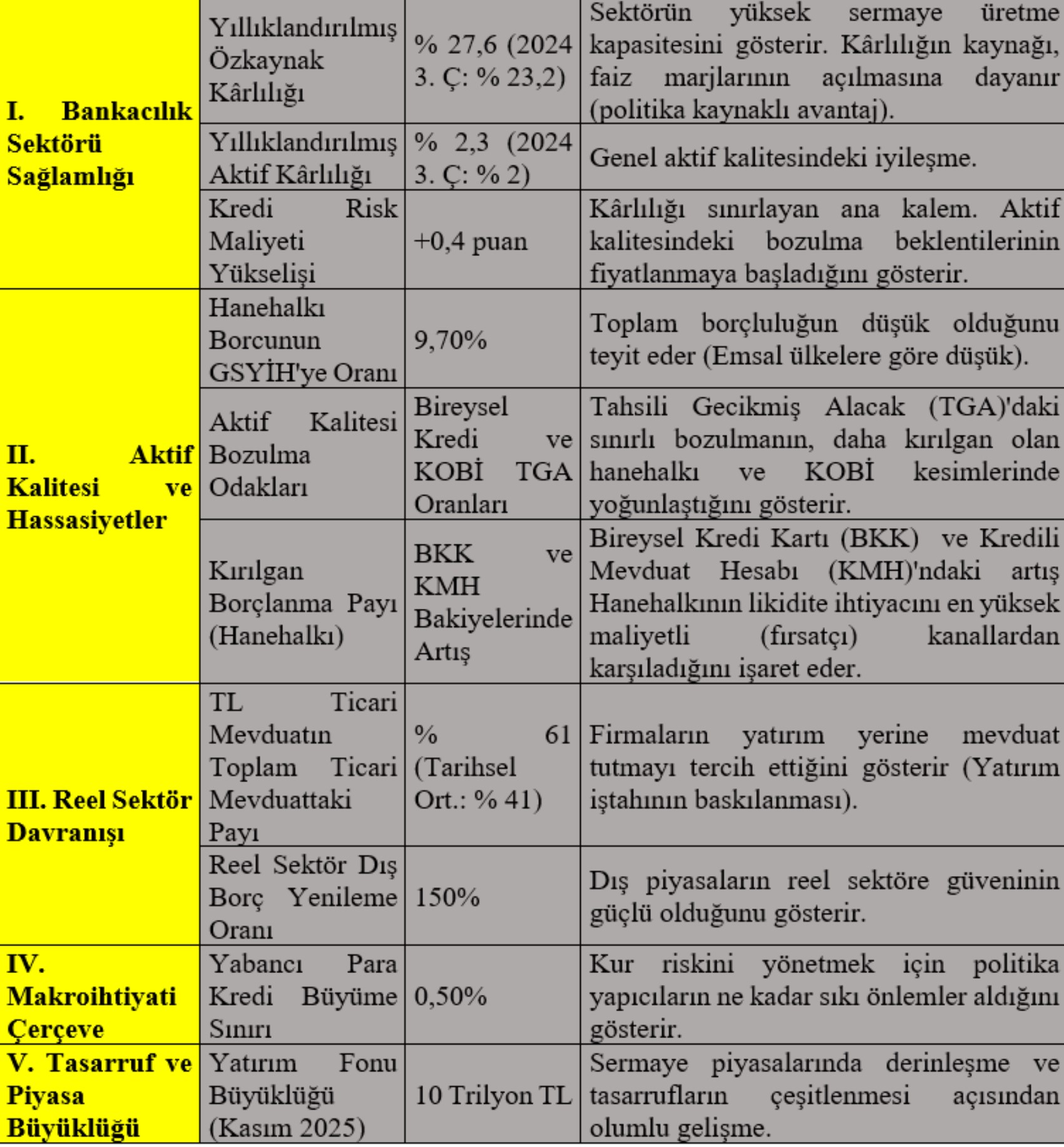
When we read the table as a whole, the following clear result emerges: Although the data offer a strong surface narrative, behind every line are the unevenly distributed costs of the rebalancing process, postponed investment decisions, and social vulnerabilities. The strength of the economy is hidden in the numbers, and its risks are hidden where the numbers do not speak.
THE YEAR'S FINAL INTEREST RATE MOVE: A Decisive Step Focused on Disinflation from the CBRT
Following the publication of the November 2025 Financial Stability Report, eyes turned to the year's final Monetary Policy Committee (MPC) meeting. The fact that inflation fell to 0.87% monthly and 31.07% annually in November strengthened expectations for a measured cut in the market. The expectation was realized, and the MPC cut the policy rate by 150 basis points to 38%. Thus, the year's final move was recorded as a controlled easing step compatible with the monetary policy's disinflation target.
The justifications for the decision are included in the report in technical language: a moderate course in food prices, a slowdown in the main trend of inflation, and third-quarter growth exceeding estimates. However, after the technical framework, a more fundamental question emerges: Which segment of economic actors will this interest rate cut give breathing room to, and which will it increase the pressure on?
The CBRT emphasizes that the tight stance will be maintained until price stability is achieved and that policy decisions will be continued within a meeting-based framework compatible with intermediate targets. The signal of re-tightening if inflation deviates from the target path shows that monetary policy has not yet passed into the easing phase; on the contrary, a cautious line is being attempted to be maintained.
The policy path followed throughout 2025 also confirms this picture: the easing steps at the beginning of the year were interrupted by an interim hike in April; the policy rate was kept constant in June; easing began again in the summer months, and the cutting process was confirmed once more in December. This zigzag course reveals that monetary policy is progressing on a ground sensitive not only to inflation but also to global financing conditions, domestic demand, and exchange rate pressures.
However, the real truth that stands out at the end of the year is that despite changes in policy direction, the social and sectoral costs of tightening are still being felt heavily. Although the interest rate cut offers a short relief for some segments, the landscape remains challenging for firms whose investment appetite has weakened, households trapped in high-cost debt, and SMEs with fragile financing structures.
For this reason, the year's final interest rate decision is not just a technical regulation; it is a critical turning point that opens the door to a more comprehensive discussion about the future of the rebalancing process, who bears the burden, and the social reflections of this process.
CONCLUSION: The Silent Bill Hidden by the Bright Balance and the Economy's Challenging Sustainability Test
The balanced appearance presented by the Turkish economy today looks promising when looking at balance sheets and statistics; however, behind this balance is a cost table that is growing silently. The price of tight monetary policy accumulates on the shoulders of firms forced to postpone investment decisions, households trapped in high-interest debt channels, and SMEs struggling to hide their fragility. Although the CBRT's November 2025 Financial Stability Report offers a reassuring framework through the banking sector's strong liquidity, robust capital buffers, and high profitability (Return on Equity 27.6%), this macro resilience discourse is intertwined with inequalities deepening at the micro level and accumulated vulnerabilities.
The Burden of Tightening is Not Clearly Distributed Equally: While the controlled slowdown in credit growth turns into more intense pressure on households and SMEs, the increase in individual credit cards and overdraft accounts (KMH) becomes the most visible indicator of financial distress. The fact that the Household Debt/GDP ratio remains at a low level of 9.7% is not enough to mask the fragility in the composition of the debt (especially the weight of BKK/KMH). The narrowing breath in the economy is felt most in the most vulnerable segments.
Suppression of Investment Appetite: In the real sector, liquidity accumulation instead of investments is concretized by the share of TL commercial deposits rising to 61%. This cautious waiting silently erodes growth potential while also shadowing the economy's medium-term dynamism.
Source of Profitability: The fact that the increase in banking profitability largely stems from the widening of interest margins and the contribution of net interest income to return on assets rising to 3.9% makes the sector's performance dependent on the monetary policy cycle. The increase in credit risk cost shows that the fragility in asset quality has not yet fully surfaced, but is beginning to be felt deep down.
Fluctuations observed in the behaviors of savers remind us that despite the rapid increase in fund sizes, a stable investment culture has not yet been formed in the financial system. Capital markets are growing, yes; but this growth gives the impression of a movement swaying according to the rhythm of monetary policy rather than a structural transformation.
When all these indicators are read together, it is revealed how fragile the ground is upon which the balanced picture presented by the economy today actually sits. While the disinflation process continues, the question of who bears the social and sectoral costs that arise in this process stands before us as the report's most important missing heading.
The real issue is this: Is the balance established today a solid bridge to tomorrow's healthy growth, or is it merely a fragile structure standing behind a well-lit set? This delicate balance between monetary policy, the banking system, and the real sector can only reach a permanent ground through a fairer sharing of the burden, the taking of structural steps that will stimulate investment appetite, and the strengthening of micro-policies aimed at vulnerable segments.
The economy must now face not only the successes placed in the display window but also the costs left in the shadows…
Would you like to get notifications about new developments and save news?
- NotificationsNew developments and breaking news
- SaveNews is stored in the app
Most Read

National Anthem surprise from Japanese Ambassador

Diesel protest in Italy brings roads to a standstill
Kılıçdaroğlu sends formal notice to YENİ Party

Diyanet Foundation, which claimed 'we have no resources,' owns 73 percent of the fund!

Is it time for the Turkish Parliament to revoke its 31-year-old 'Casus Belli' decision?
No to the 'opening' bar masked as change, yes to the Republic's bar

Ezel Akay and his brother's test results came back positive

Why is Paris burning? The crisis of the welfare state and the revolt of social justice

'From a Journalist’s Pen: The Tüfekli File'

The politics of particles and the financing puzzle: 'Calamitous questions'