


Was there autonomy in Turkey's founding paradigm?



TWO THESES OF MY PROFESSOR Yıldızhan Yayla
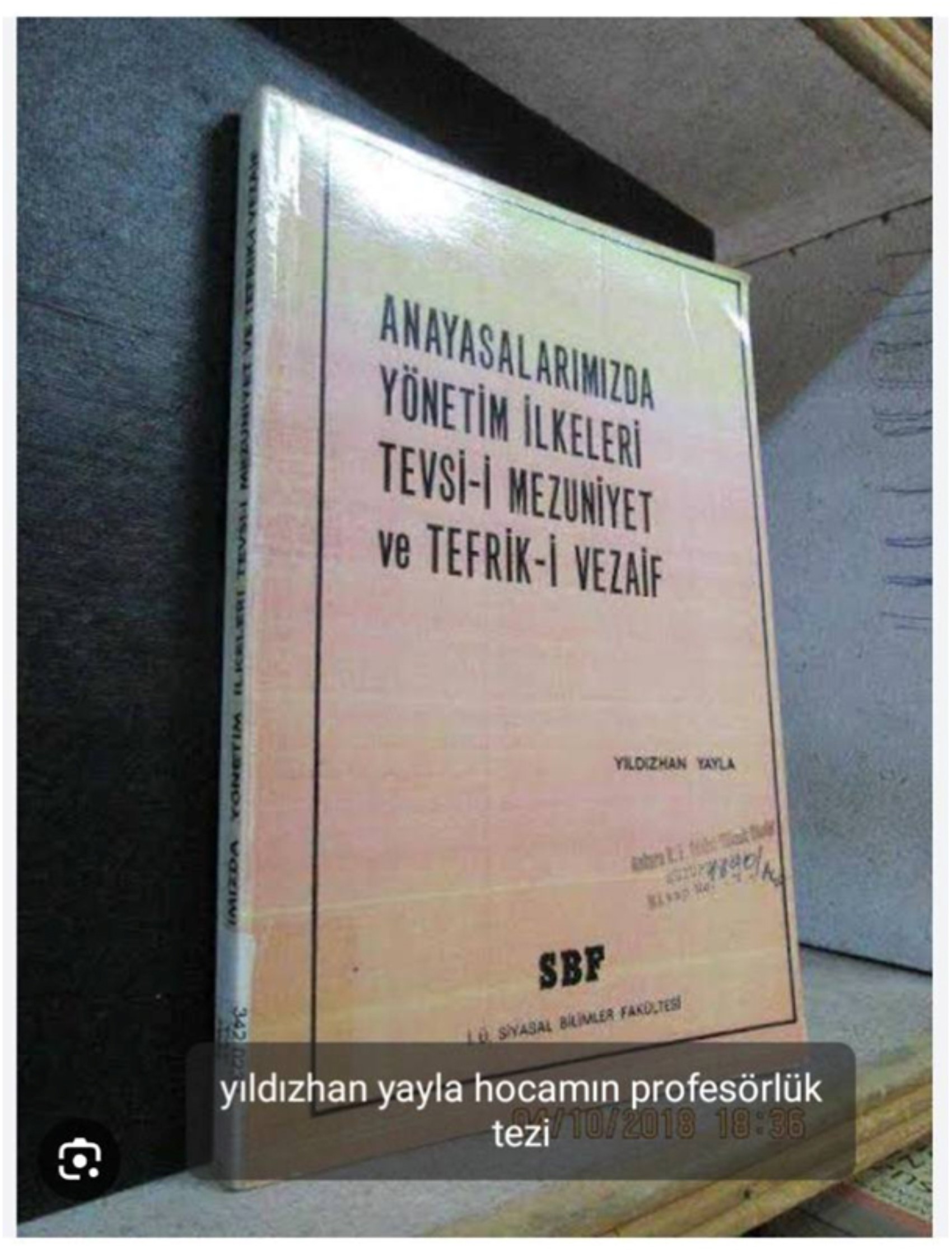
Prof. Dr. Yıldızhan Yayla, the founding rector of Galatasaray University, was my Administrative Law professor at the faculty (Istanbul University Faculty of Political Sciences). Both of my professor's theses have been published. These publications are significant works in terms of our administrative history. First, let me mention his professorial thesis: It bears the title 'Tevsi-i Mezuniyet ve Tefrik-i Vezaif' (Delegation of Authority and Separation of Duties in Our Constitutions). The book was published in 1982 as an Istanbul University Faculty of Political Sciences publication.
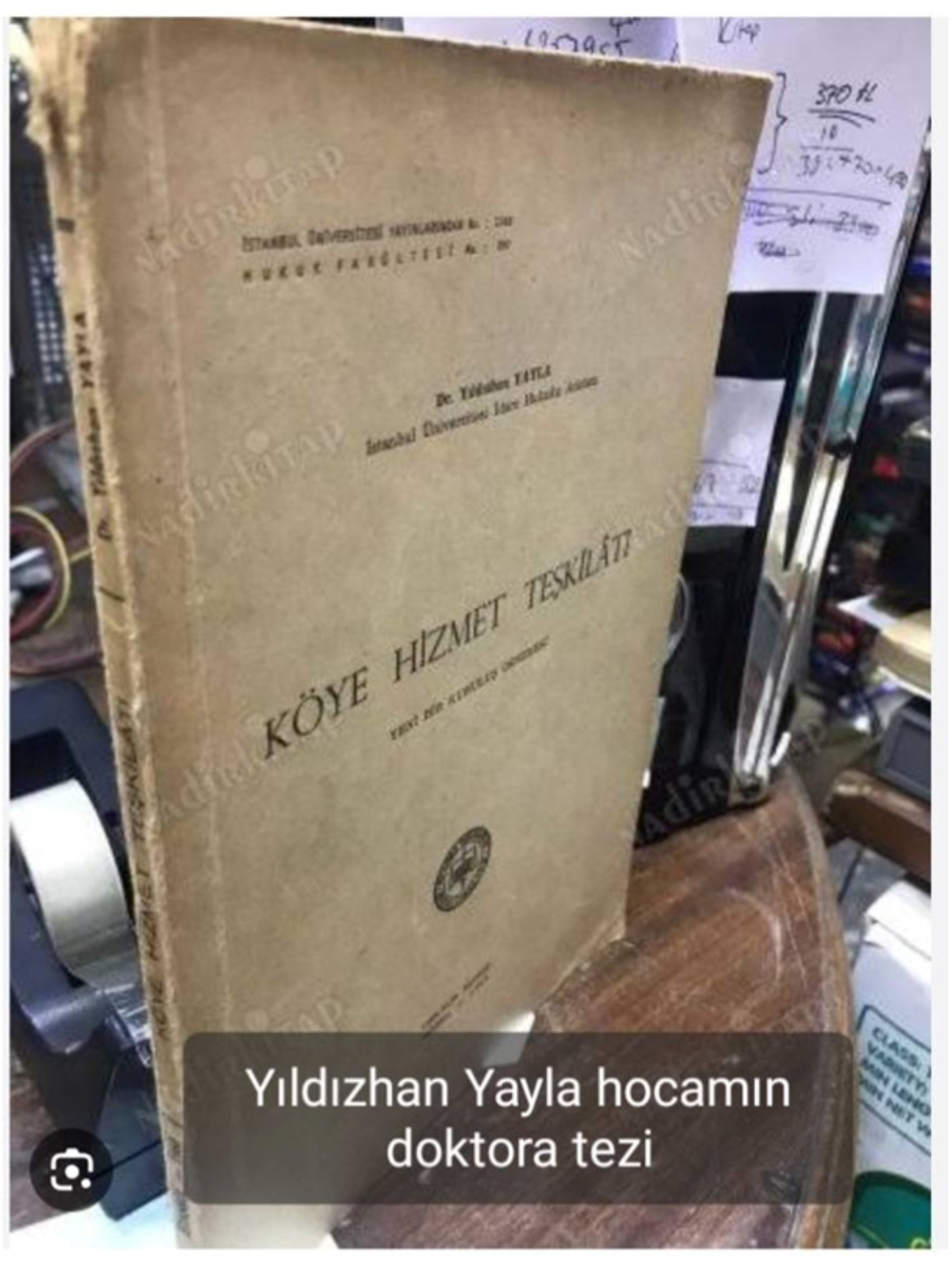
 The other is his doctoral thesis: It bears the title 'Köye Hizmet Teşkilatı' (Village Service Organization). The thesis dates back to 1963. It was published as a book in 1968 by the Istanbul Faculty of Law. It was printed at the famous Faculty Press.
My professor, Yıldızhan Yayla, addressed two extremely important topics in both of his theses in terms of Turkish Administrative History. 'Tevsi-i Mezuniyet' (Delegation of Authority) and 'Tefrik-i Vezaif' (Separation of Duties) were significant administrative principles from the 1876 Constitution until the Republican revolution.
In essence, these concepts refer to the highest administrative official of the central administration (civil administration) in the provinces exercising their authority at their own discretion within the framework of the law, without consulting the center. It is the delegation of decision-making power to them.
The civil authority mentioned here is the governor. However, the governorship has undergone changes in scope and meaning since the Tanzimat era. 'Tevsi-i mezuniyet' is a concept of civil administration. It is not related to local administration or autonomy.
THE AUTONOMY DEBATE AT LAUSANNE
After Mustafa Kemal Pasha crossed into Anatolia in his capacity as an army inspector, he did not only contact military and civil officials. He established relations with regional powers (tribal leaders and feudal lords) whom he had known since the years of the First World War. Some of these were from the local notables, and some were from the clergy. It can be seen that these hegemonic classes were represented at the Erzurum and Sivas congresses.
The Representative Committee of the Association for the Defense of Rights, established after the Sivas Congress, included local elites alongside the bureaucratic elite who would lead the national war of liberation.
To use the words of my mentor Bülent Tanör, the Grand National Assembly of Turkey was established as a "Congress government" on a national scale. There were many delicate balances within this assembly. Mustafa Kemal Pasha, as the Speaker of the TBMM and Commander-in-Chief, took care to maintain the established status quo until victory was achieved.
From the Great Victory until the signing of the Treaty of Lausanne (during the negotiation process), there were Allied maneuvers seeking to exploit the de facto situation following the First World War. As one might expect, the British were the most skilled in this regard. By bringing up the Kurds, Armenians, and other non-Muslim minorities, Britain sought to weaken the position of the TBMM Government's delegates.
The Allies' fundamental strategy was to demand autonomy for minorities. The Turkish delegation (İsmet Pasha, Rıza Nur, Hasan Saka), however, put forward the secular law being established on the basis of equal citizenship. They defined a defensive line that signaled a new state and a new society. Our delegation acted uncompromisingly against attempts to extract minority rights from within the concept of "citizenship." The "political aspect" provided by the TBMM to the delegation when sending them to the Peace Conference served as a guide.
WHOM DID ATATÜRK HOLD A PRESS CONFERENCE WITH AT THE İZMİT MANSION?
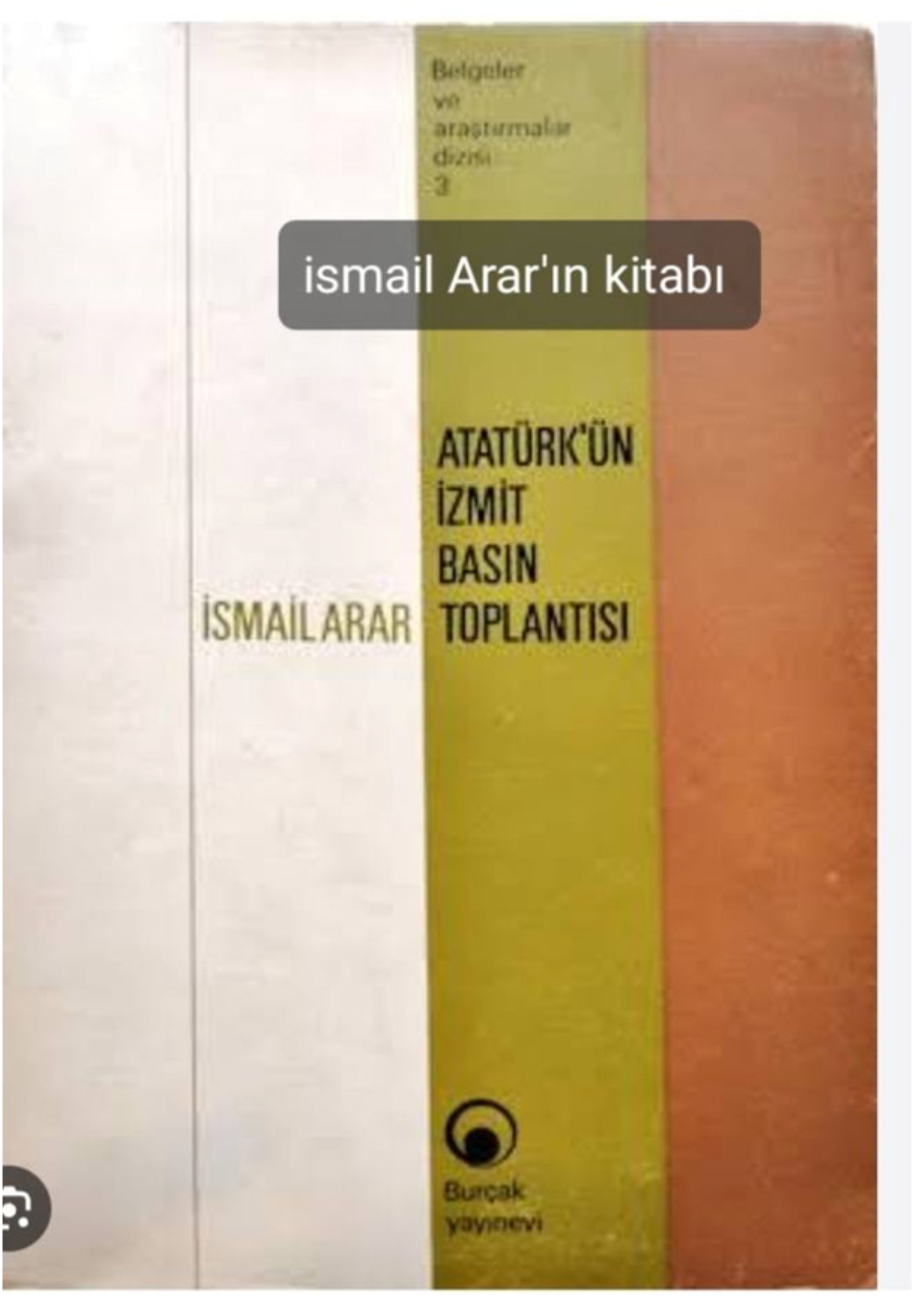
While peace negotiations were ongoing in Lausanne, significant developments were also taking place in domestic politics. In this context, it is possible to find important clues regarding the administrative and political shaping of the new Turkey in the minutes of Atatürk's İzmit press conference. The most essential source on this subject is the booklet "Atatürk's İzmit Press Conference" by İsmail Arar. Leading figures of the Istanbul press were invited to this meeting.
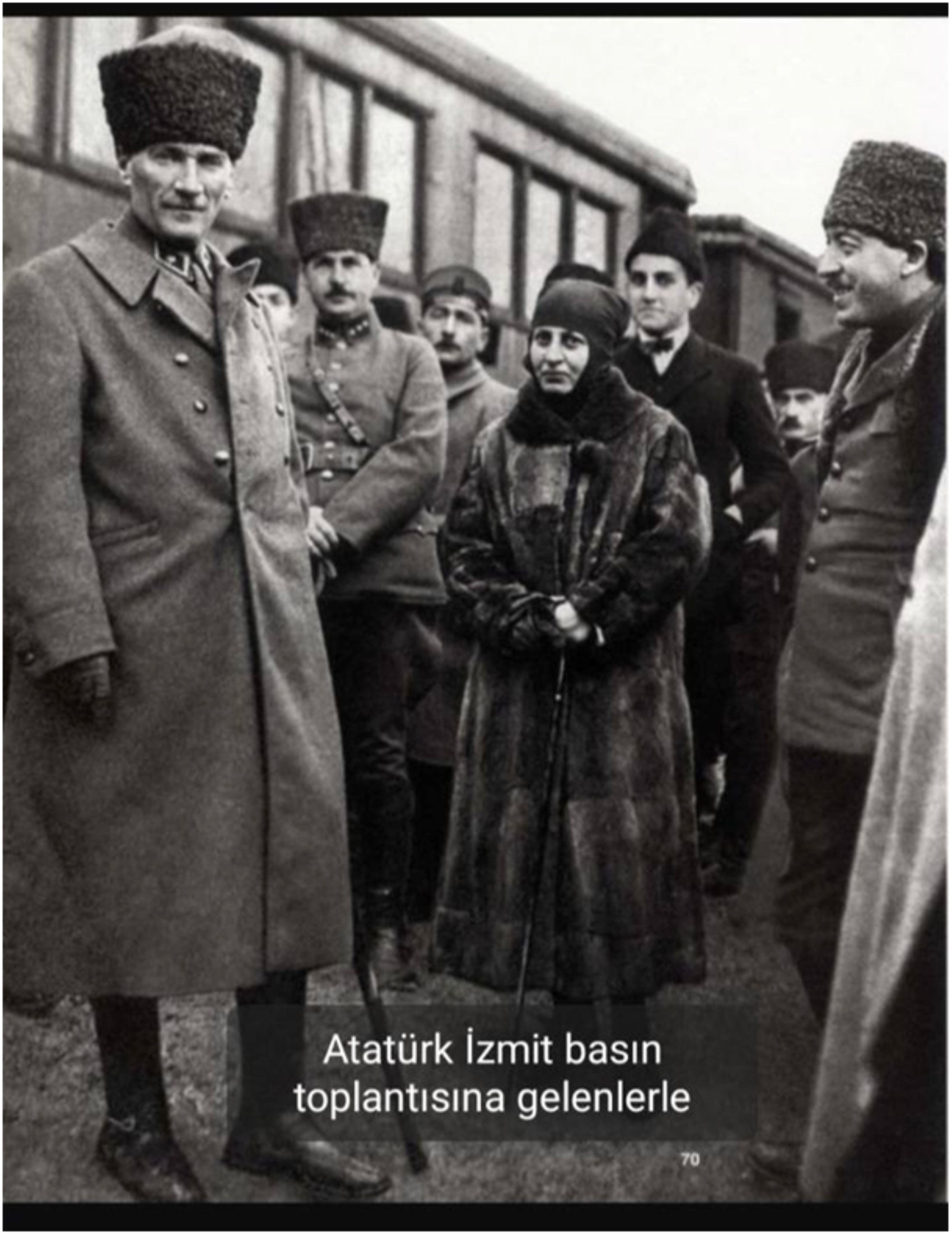
 The journalists were brought to İzmit by steamer by Dr. Adnan Adıvar, the representative of the Ankara Government in Istanbul, and his wife, Halide Edip Hanım. At that time, the pier was located near the İzmit Train Station and the Abdülaziz Mansion, where the meeting was to be held. The meeting was recorded by four stenographers. Topics such as the Caliphate, the republic, new elections, the People's Party, the issue of autonomy for Kurds, and the status of non-Muslim minorities in general were addressed.
The press conference began at 9:30 PM on January 16, 1923, and continued until the morning of the following day. The writers invited to the meeting were: Ahmet Emin Yalman (Vakit), Velit Ebüzziya (Tevhidi Efkar), Suphi Nuri (İleri), Yakup Kadri (İkdam), İsmail Müştak Mayakon (Tanin), Falih Rıfkı (Akşam), and Yunus Nadi (Yenigün).
This meeting was planned as part of the TBMM (Grand National Assembly of Turkey) Speaker's tour of Western Anatolia in early 1923. The tour took place along the route of Eskişehir, Arifiye, İzmit, Bursa, Balıkesir, and İzmir.
HOW DID THE ISSUE OF KURDISH AUTONOMY COME UP AT THE İZMİT PRESS CONFERENCE?
During the days the İzmit press conference was held, the first phase of the Lausanne Conference was still ongoing. The British were attempting to create a rift on the Turkish front through the issue of "Kurdishness." At the meeting, Ahmet Emin Yalman and Falih Rıfkı Atay brought the matter to the agenda. It is useful to recall the most striking sentences of the views expressed by Atatürk under this heading here. For example, Atatürk says: "If we want to draw a border in the name of Kurdishness, we would have to destroy Turkishness and Turkey..." It is necessary to look for a border that goes as far as Erzurum, or even Erzincan. Furthermore, one should not ignore the Kurdish tribes in the deserts of Konya. Therefore, rather than thinking of a Kurdish entity on its own, a kind of local autonomy will already be established in accordance with our Law of Fundamental Organization (Teşkilat-ı Esasiye Kanunu). In that case, whichever province's people are Kurdish, they will govern themselves autonomously... Not only the Armenians, but also the Chaldeans and Assyrians are demanding a homeland. If we were to give a homeland to all of them, there would be no homeland left for us."
From these statements, it is understood that Atatürk did not contemplate an autonomy beyond the "autonomy in local affairs" mentioned in Article 11 of the 1921 Constitution. This thought of Atatürk is quite ordinary.
After the signing and ratification of the peace treaty, all postponed issues regarding the regime were brought to light more clearly and were resolved over time.
The full determination of the political and administrative structure of the new Turkey (the Republic of Turkey) was realized with the 1924 Constitution.
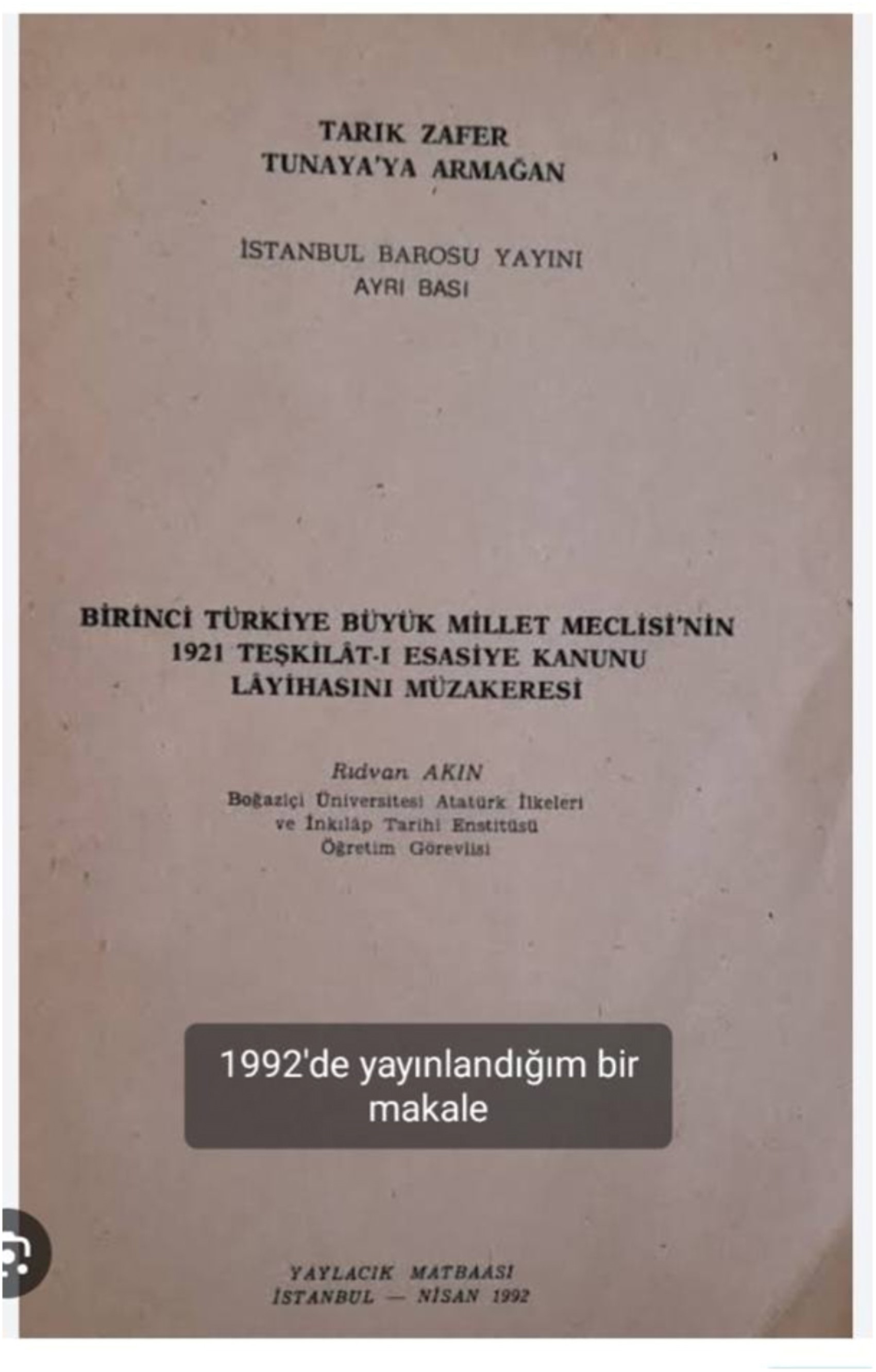
THE PROVINCE IS THE LOCAL ADMINISTRATION OF THE NATIONAL STRUGGLE AND THE REPUBLIC.
Since the Constitutional Era, the fundamental administrative unit of Turkey (in terms of civil and local administration) has been the province. The province is an administration with legal personality and autonomy in local affairs.
Although the content of the concept of autonomy in local affairs was narrowed by the 1924 Constitution, the institutional principle maintained its existence. It was historically and politically impossible for the leadership of the national liberation movement to hold an idea of local administration beyond these boundaries.
The founding cadre of the republic, including Atatürk, were closer to the centralist thought of Ahmet Rıza Bey rather than the decentralist line of Prince Sabahaddin within the Young Turk movement. This must always be kept in mind.
MUNICIPALITIES CANNOT BE CONSIDERED A LOCAL ADMINISTRATION UNTIL 1963
Since the Ottoman period, the municipality has not been viewed as a local government unit. It was seen as an administrative organization that would ensure the effective provision of public services.
During the period when the Committee of Union and Progress was in power, the Istanbul Municipality was governed by the Dersaadet Municipal Regulation. After the republican revolution, the Ankara Municipality, like Istanbul, was delegated to the highest local civil administrator (the Governor). This preference demonstrates the limits of the republicans' understanding of local administration.
For the republican administrators, the municipal organization carried no meaning beyond the establishment of councils to oversee municipal services in the small-to-medium-sized urban settlements of Anatolia.
The central administration would appoint the most reliable municipal council member as the mayor. This person was often someone from the local notables or the elite. When their lineage is examined, it can be traced back to the signatories of the 1808 Deed of Alliance (Sened-i İttifak). With this statement, I want to point to the class basis of the municipalities.
Before the 1930 Municipal Law, draft laws had been prepared in 1924 and 1926. However, it had not been a high-priority issue. Other important matters needed to be resolved before the CHP's 1931 Congress.
From that date until the 1961 Constitution, the municipality was seen as a secondary (subordinate) local administration in Turkey. The first municipal elections held in 1963 were a turning point. After this date, mayors and municipal council members began to be determined by direct/single-stage elections. This was a natural result of social and demographic transformation. Turkey was no longer a rural society and had begun to become an urban-weighted country. After the 60s, the province (Special Provincial Administration) institutionally declined.
WHY WERE COMMUNE (NAHIYE) ADMINISTRATIONS ESTABLISHED?
Initially, they were established under pressure from the West. In the Ottoman Empire, demands for establishing local governments primarily came from external actors who took on the role of spokespersons for the Christian subjects. After the Bosnian Crisis, the 1876 Regulation on Commune Administrations (Nevahi İdaresi Nizamnamesi) was issued. It was implemented in the provinces of Rumelia, Crete, and Bosnia.
Similar methods were attempted in the Ottoman lands of Anatolia. However, the regulation served no purpose other than legitimizing the existing feudal structure in the Eastern provinces (Vilayat-ı Şarkiyye). The state granted commune (nahiye) status to tribes. For example, the Hartuş tribe in Beytüşşebap, Hakkari, became a commune. The traditional feudal order was thus legalized in the eyes of the state.
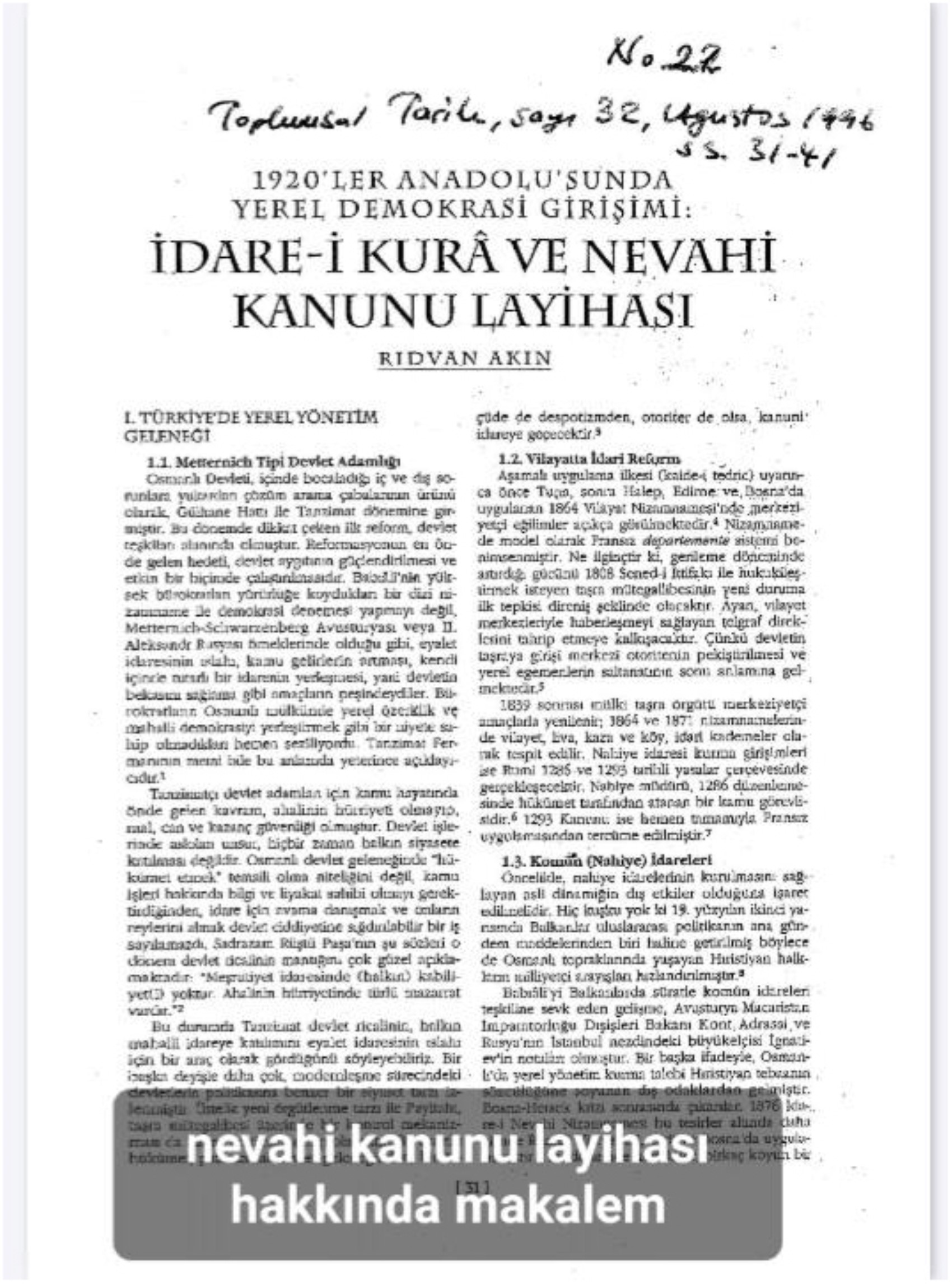
A DRAFT LAW THAT THE FIRST PARLIAMENT ATTACHED GREAT IMPORTANCE TO: THE DRAFT LAW ON VILLAGE AND COMMUNE ADMINISTRATION
There are three draft laws that the First Parliament debated the most: the Executive Deputies Committee, the Law of Fundamental Organization (Teşkilat-ı Esasiye), and the Commune Administration Law. It is possible to translate the name of this draft into modern Turkish as follows: The Village and Commune Administrations Draft Law.
In the Draft Law on the Administration of Nahiyes (districts), the government (Council of Ministers) wanted to treat the nahiye not so much as an administrative unit, but as a social unit—that is, as a social reality. For those unfamiliar with the terminology, let me explain: administrative unit refers to a management division, while social unit refers to a societal division.
The draft was a reflection of the 'Politics Towards the People' movement, which had been on the rise since the constitutional era. It was viewed as a talisman that would solve all the country's problems and was debated with great fervor.
Just as the Young Turks viewed the Constitution (Kanun-ı Esasi) as a magical institution, the First Parliament saw the commune administration as a miraculous formula that would ensure the country's salvation.
Mahmut Esat Bozkurt interpreted the 'Commune Administration Law' as handing over the state of Turkey to the peasants who had defended it for centuries.
There were also those who had concerns. For instance, figures like Mehmet Vehbi Bolak and Yusuf Ziya Bey were not very optimistic. On the contrary, they believed that if the draft became law, it would serve no purpose other than to increase the influence of local notables over the public. The de facto situation would be legalized.
HOW WILL THE PUBLIC GET USED TO VOTING (LOCAL DEMOCRACY)?
Some members of parliament suggested that the public, who were largely illiterate, should not vote with ballots but through more concrete methods, such as the 'round system' (using colored balls or containers).
Non-Muslims had been familiar with the nature and results of elections since the adoption of their own community regulations (such as the Greek Millet Regulation). It is recalled that, thanks to this, they won municipal elections in many places after the declaration of the constitutional monarchy, despite being in the minority. For example, in Kuşadası, where 6,000 Muslims lived alongside 2,000 Greeks, the Greeks won the election.
WILL THERE BE CENTRAL ADMINISTRATION OVERSIGHT IN COMMUNE ELECTIONS?
It is considered very important that the central administration does not interfere in the election process. There is a significant reaction regarding this issue. In my opinion, this stance is the reaction of the periphery (the provinces) against the center.
A member of parliament who would say regarding the proposal for the civil administration (the district governor) to oversee the election: 'Stationing a district governor at the ballot box is nothing more than demonstrating the tyranny of the state.'
It is necessary to take note of the words of Sivas deputy Emir Pasha (Marşan): 'There is no need for the approval of high authorities to save the villagers from taxes and arbitration.'
Müfit Bey (Kırşehir) would join him with the words: 'Giving the power of approval to the administration means going to the center, not to the people.'
It is envisioned that the governor's intervention in the commune administration should only be possible in cases of 'deviation from primary duties and disruption of public order.' Another point is this: it is advocated that a control mechanism for the central administration over provincial and sub-district administrations be established through 'regional inspectorates.' This institution already exists in the Law of Basic Organization (Teşkilat-ı Esasiye Kanunu).
In conclusion, it is possible to say this: The dissolution of provincial and sub-district councils would only be possible if they pose a threat to the constitutional order and the political regime.
WHO WILL THE COMMUNE DIRECTOR REPRESENT? THE STATE? OR THE LOCAL ADMINISTRATION?
Council rapporteur Zekai Bey clarifies a crucial point that continues to be debated today: he uses the expression, 'the nahiye (sub-district) director will be both the head of the local administration and the representative of the government.' He emphasizes that if such a balance is not established, the nahiye would not be autonomous, but independent.
Autonomy is not independent administration. Commune and provincial administration cannot be absolutely independent from the state. If that were the case, it would mean establishing a separate government. Van deputy Haydar Bey (Vaner) would argue that the commune having a legal personality (corporate identity) does not prevent it from being tied to a government. It is autonomous in local affairs (nahiye hayatı hususiyesinde). It cannot be independent. The province, district, and sub-district are also political administrations. Autonomy cannot mean complete independence.
THE NAHIYE (SUB-DISTRICT) DRAFT LAW EQUALIZES ALL SETTLEMENT UNITS UNDER THE COMMUNE LEGAL PERSONALITY
The Nahiye Draft Law equalizes all settlement units (villages, towns, cities) under the commune legal personality. Only the scale changes. The nahiye, with its administrator and council, is envisioned as the primary public unit of the new Turkey. For this reason, the office of the muhtar (village headman) and the council of elders are being abolished. Tunalı Hilmi Bey strongly objects to the abolition of the muhtarlık. According to him, the muhtarlık and the council of elders are historical institutions dating back to the administration of Turkish tribes.
Since the Tanzimat era, the kaza (district) had been the primary center for the village's relations with the state. The draft law, however, seeks to establish the nahiye (commune) as the primary center in all official records.
According to the draft, procedures regarding population, military service, land registry, and family law will begin at the nahiye level. All registry books, land transfers, successions, and property relations will originate in the commune.
WHAT IS THE HISTORICAL MEANING OF THE PROVINCE (VILAYET)?
The province has existed since the classical Ottoman centuries, but its meaning is different. After the Tanzimat, the province emerged as a unit of administrative reform. The capital implemented changes in provincial administration to carry out reforms in regions where non-Muslims lived. The first area of implementation was the lands of Rumelia.
During this process, Armenians and Greeks received protection from Tsarist Russia, Austria-Hungary, and partly from France. The principle of "equality before the law" established by the Tanzimat did not satisfy either Muslims or non-Muslims. The 1864 Vilayet Law underwent changes due to regional reasons. For example, the Lebanon Regulation was created for the Mount Lebanon Sanjak. Special laws were enacted for the Danube and Crete provinces.
Lebanon was one of the regions with the most complex ethnic structures within Ottoman lands. The regulation, which equalized all communities, led to new problems in Lebanon. Under the influence of the powers forcing the Ottoman Empire to reform, the Sublime Porte was reduced to a spectator. Pashas Ali and Fuat made significant efforts to implement reforms in Lebanon. They tried to harmonize local sensitivities with the center. They were not successful. The method they applied was to grant authority to local authorities in administrative and financial matters. In Lebanon, divided among Maronites, Druze, Catholics, and Orthodox, no representative institution provided a solution. The members of the established councils were mostly ethnic-religious leaders or local notables.
Similar situations were encountered in the Bosnia and Crete provinces. The Crete Province Regulation enabled non-Muslims to be active in administration. The provincial institution meant autonomy for Christians in these places.
Thanks to the requirement that half of the members be non-Muslims,
Christians entered administrative councils, municipalities, and courts as members.
THE ENTRY WRITTEN BY ŞERİF MARDİN FOR THE ISLAMIC ENCYCLOPEDIA: DECENTRALIZATION
I found it very meaningful that this entry was commissioned to Şerif Mardin. Mardin has penned an instructive piece. The professor explains the development of the decentralization institution in the West through the evolution of the feudal order. I think so too. Feudal fragmentation gave way to central administration in England and France.
But the sovereignty and judicial powers of the lords, dating back to the Middle Ages, continued in a weakened state. I would like to remind you that until recently, the highest court of appeal in England was the Council of Law Lords in the House of Lords. There is a historical reason for this: the right to judge was a feudal privilege for many centuries.
Şerif Mardin writes that there was no feudalism in the Ottoman state like in the West, and therefore decentralization emerged with different dynamics. To be honest, I had approached the article with a bit of prejudice. But in this piece, I found Mardin to be right in many places.
THE YOUNG TURK REVOLUTION AND DECENTRALIZATION
It would be accurate to evaluate the Young Turk Revolution as a collection of alliances. Although Unionist officers were at the forefront, a series of anti-monarchy centers, including bourgeois revolutionaries, the Thessaloniki Masonic lodge, and Armenian and Greek organizations, had gathered under the umbrella of Unionism. Their common denominator was opposition to the Yildiz monarchy: Sultan Abdulhamid II.
For the Armenians, "liberty, fraternity, equality" meant reforms that would grant broad autonomy to the Six Provinces (Vilayat-i Sitte). For Prince Sabahaddin, it meant "Individual Initiative and Decentralization."
The leaders of the Committee of Union and Progress collaborated with these centrifugal forces for a while. But only for a while. Then they did what realpolitik required. The 1913 Provisional Law on the General Administration of Provinces definitively shelved the idea of decentralization, which had been debated since the 1902 Young Turk Congress. World War I became a period in which centralism was applied uncompromisingly.
THE REPUBLICAN REVOLUTION SHELVING THE COMMUNE BILL
The Fourth Term Chamber of Deputies was able to work for a very short period. It was raided by the British on March 16, 1920. It suspended its work to convene in a safe place in the country. This extraordinary situation gave the Great Atatürk the opportunity to convene the Ankara Convention.
The legislative agenda of the Ottoman parliament, which could only work for three months, is politically important. For example, under these extraordinary conditions (1920), the Ministry of the Interior sent a delegation to European countries to examine local governments and write a reform report.
Undersecretary Hamit Bey was also on this delegation. The same person became the Undersecretary of the Ministry of Interior after the national government convened in Ankara. In my opinion, this is a significant choice.
The delegation sent by the Istanbul Government examined the commune administrations and reported their findings. They held contacts in Bulgaria, Romania, Central European countries, and France.
When the Draft Law on Districts (Nevahi Kanunu Layihası) was brought to the agenda of the Ankara Assembly and discussions began, Undersecretary Hamit Bey defended the draft law on behalf of the Ministry of Interior.
The law was debated for a long time with amendments made. The Draft Law on Local Administration and Districts was the most extensively debated bill of the First Assembly period. However, it became obsolete. This result is important in two respects. The Grand National Assembly of Turkey (TBMM) handled the issue seriously, and heated debates continued until the end of the legislative term. This is certainly important. But the second point, as significant as the length of the debate, is that the law became obsolete. The leaders of the Republic found the centrifugal potential in the District Law to be problematic in terms of the revolution.
Would you like to get notifications about new developments and save news?
- NotificationsNew developments and breaking news
- SaveNews is stored in the app
Most Read
Statement from Nihat Zeybekci on the fund investigation

New 75,000-seat stadium plan for Fenerbahçe
Interpol and MIT tracking yields results in Izmir

ID convenience for KPSS candidates

2027 Budget: Taxes for the people, tax exemptions for capital

The reality of Akkuyu and the longing for national nuclear power

To whom and how was the Petition of Intellectuals submitted? Who accepted the petition?

The Çanakkale robbery -1- How was the Troy treasure smuggled out?

Artificial intelligence and the new imperialism

Ministry investigation into unauthorized promotional messages