



The Aegean Sea and its surroundings, Greece, Western Anatolia, and the Eastern Aegean lands are the environment where the most fundamental principles of democracy first emerged.
In the early days, ages ago, "Democracy," the rule of the people, was practiced through "representatives determined directly or by elections" in which the male majority of society participated, excluding slaves and foreigners.
It evolved over time and, through various practices, became the most acceptable form of method today.
"Direct Democracy," where the entire public makes decisions directly, can be applied today in certain matters through procedures such as referendums.
***
However, the technical and practical difficulty of the entire public constantly coming together to make decisions on every current issue leads to democratic governance being carried out through "Representatives."
This practice is also called "Representative Democracy."
Across the country and locally, "Political Parties," formed by those in "ideological unity or social interest unity," guide society in determining these "Representatives."
Of course, for this to happen, an "election" must be held, and for an election, "Representative candidates" are needed.
Apart from independent candidates, "Political Parties" determine the "Representative candidates" to be presented for national and local governments.
Most political parties also apply the same method within themselves to elect their own leaders.
***
In our country and wherever it is applied in the world, the scope and application details of "Representative Democracy" are determined by laws.
Accordingly, either "appointments" made by Party Headquarters or "rank-and-file members or delegates elected by members" determine the Members of Parliament and Mayoral candidates who will represent the people in general and local government.
However, the processes of determining "candidates" through "appointments" or "elections by delegates" lead to widespread controversy.
The determined candidates and the rankings made are often not accepted and do not satisfy the members of the relevant party or the public.
It is believed that the determinations made for "candidates" do not yield correct results and do not ensure "social representation."
***
In the "appointment" method made from the "Center," some Party Administrators or "narrow" executive boards determine candidates using various methods.
It is claimed that with data obtained through surveys, interviews, and inquiries, "candidate appointments" are made with great care and that this is in the interest of the party and society.
However, it is clear that procedures such as "public opinion research and trend polling" are more about "recognition within society and whether the person is a celebrity" than the legitimacy of the right of recognized, announced, known, or expected individuals to be chosen as candidates.
Furthermore, it is doubtful that the advantages a "candidate nominee" will gain through "advertising, creating verbal and visual impact" will meet the real social need.
Those who oppose the "candidate appointment" method emphasize that the administrators who determine the candidate have also mostly come to that position through the same method, by the votes of the same members and delegates.
Going even further, they argue that they insist on determining the future of society by not losing their decision-making powers and by protecting their governing authority.
It is claimed that appointments made at the central level reflect the internal and external political tendencies and stance of the center making the appointment rather than the expectations of society.
The fact that the criteria for selecting "candidates" from the center are unknown, that they are subjective rather than objective, and therefore not fair, are serious criticisms made against determining candidates through "appointment."
***
In the functioning of the "Representative Democracy" method within parties, party members elect delegates, and delegates determine higher-level administrators.
However, the situation changes when it comes to determining candidates for public offices such as Members of Parliament and Mayors.
In determining candidates for such public offices, holding a "primary" or an intra-party "preference poll" other than "central appointment" means that party members or the delegates they elect will make the selection.
This is a method desired by the broad base of parties with the thought that their opinions will also be asked, but it is also argued that wrong choices can emerge from this as well.
Determining candidates through a primary or preference poll where ballot boxes are placed before provincial and district administrators, party delegates, or all members, who are called party "elites," may be seen as more democratic than the "appointment" method.
However, the view that the decision to be made by a small number of elites, who may have certain disconnects from the general public or who are under the control of local cliques, will not reflect the true public trend may hold validity in certain points.
These cliques can be professional politicians, guided individuals, ethnic, sectarian, or hometown communities.
The possibility that the members or delegates who will choose the candidates under such influences do not/cannot fully represent society may raise concerns about the democratic nature of the election to be held.
The thought may arise that individuals or delegate groups will not act correctly/fairly in choosing candidates and that manipulations may occur.
****
As a result of all these types of negativities, not only are political and social mistakes made with the wrong candidates determined, but the hopes of many people regarding the future and the political labor of party volunteers and workers can go to waste.
Wrong candidates who win the election due to the political conjuncture can cast a shadow on the reputation of that party's worldview, program, the party itself, and its members with negative actions.
In appointments; the fairness and appropriateness of determining a "Candidate" through public opinion research and surveys, as well as "Primaries and Preference Polls," can be questioned and criticized in every aspect.
This situation comes to the agenda and is discussed in every election period.
This attitude can even lead to results that will alienate the public from democracy and discourage them from going to the ballot box.
The public may not see candidates determined from the top as their own candidates, even before and after they are elected.
Against the drawbacks listed above, searches continue today for methods that can lead to fewer mistakes, respond to the real wishes of the people, and ensure that the most correct decision is made for the benefit of society.
***
So, what should be done to prevent administrators, decision-makers, members, and delegates from determining the wrong candidates?
Of course, the most correct path is "Direct Democracy," although it is quite difficult, it is for party members and their representatives to choose the candidate directly with the necessary and sufficient information.
Communities can, of course, directly determine the representatives who will make decisions about them.
These choices can be right or wrong.
A wrong decision that a society can make likely causes less harm to society than a wrong decision that an inadequate administrator or decision-maker can make.
However, every social decision is a shared lived experience.
It is hoped that as technological opportunities develop and become widespread, "Direct Democracy" will develop and increase, with "the public's direct election and decision-making" practices, by providing easy access to objective information.
***
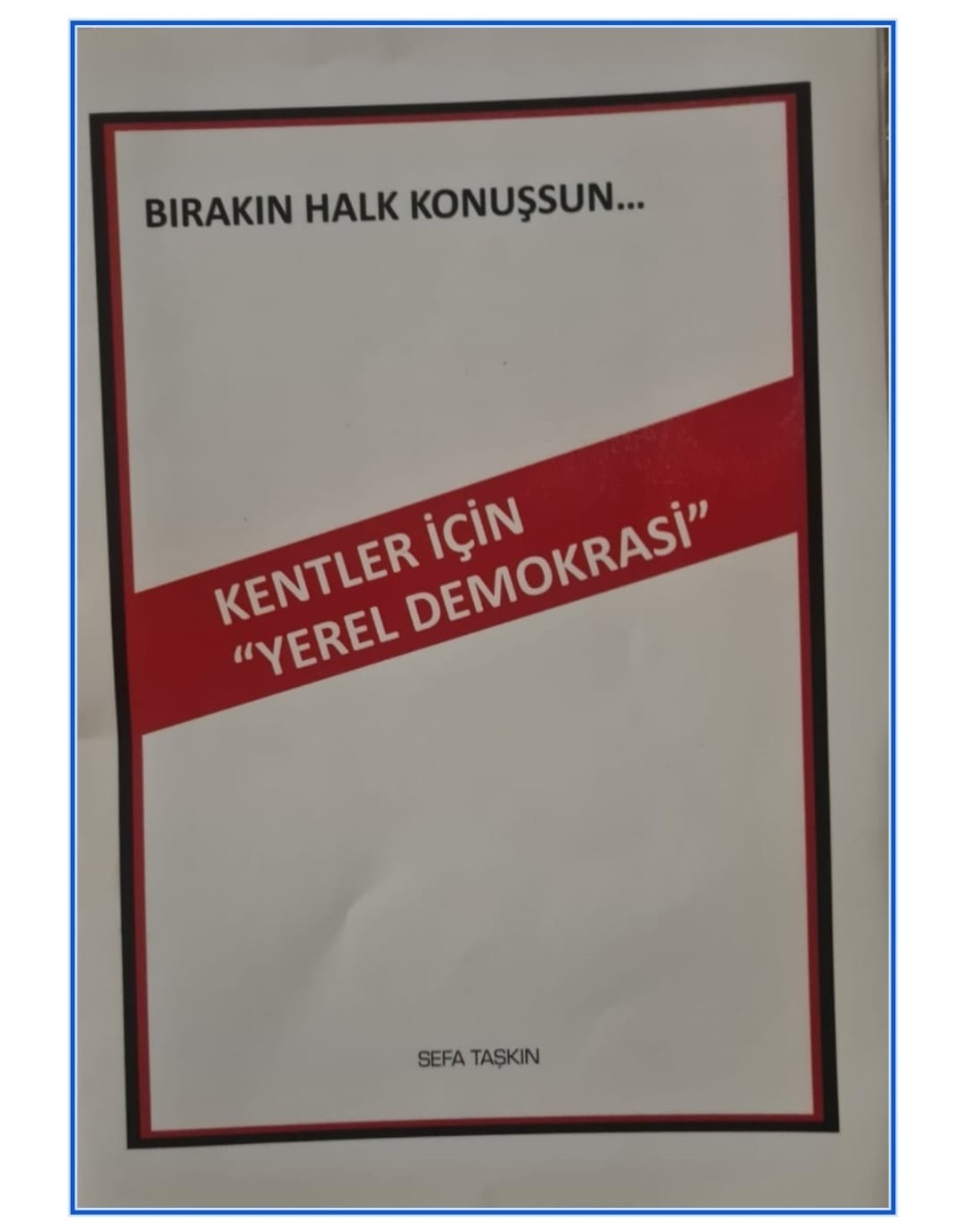
(A brochure we published in İzmir in 2013 regarding the subject.)
So, if "democracy" and "the rule of the people" are to be realized through "Representatives and Deputies," how should this determination be?
How should the least erroneous "candidate" determination method be realized?
In this direction, "Participatory Democracy" methods, which are discussed all over the world and are being applied or starting to be applied in many places, are attracting attention.
"Participatory Democracy" means the participation of the vast majority of the public in management and decisions regarding general and local issues before and after the election.
Of course, it is very important here that those who will participate in the decision are correctly informed and informed.
Look, there is an interesting and applicable example on this subject.
***
In this context, Prof. James Fishkin from Stanford University in the USA developed, and "Deliberative Democracy" in a sense, an example of "Participatory Democracy" can be enlightening.
This example was implemented in Greece in 2006 by George Papandreou, who was the President of the Socialist International and PASOK (Greece's Social Democratic Party), in the "Marousi" district, one of the suburbs of the capital Athens, where the Olympic Village is also located.
MAROUSI-ATHENS
Marousi is a residential area where the headquarters of multinational companies such as Philips, Kodak, Bayer, Microsoft, and Nestle are located, which is gradually turning into the financial center of Athens, and where generally wealthy people live.
It is a part of the Greek capital, Athens. Its population was 69 thousand according to the 2001 census and 72 thousand according to the 2011 census.
J. Fishkin's "Participatory Democracy" method was applied to determine the PASOK Mayoral candidate for Marousi:
A "Party Board" determined six people (four men, two women) from those who applied to be candidates as "candidate nominees."
Using the scientific "random sample" method; 160 urban citizens representing different segments of society were identified through population registers, address lists, the internet, telephone, etc.
This number was approximately two per thousand of the city population, whether party members or not. (69,000*0.02<160).
These people were invited to a meeting to be held in a hotel or a hall as "Participants" to make the "election" that would determine the Mayoral candidate from among the candidate nominees.
(Theorist J. Fishkin states that the number of participants may differ in different applications in different regions/cities. Such as approximately 3 per thousand, 4 per thousand).
In the application in Athens-Marousi, 160 participants who came together in one venue were informed about 19 urban problems identified by experts.
In the closed-door meeting, the participants listened to the 6 candidate nominees in turn for a day, got to know their personalities, learned their views on urban problems, questioned their human relations, and evaluated them.
At the end of ten hours of work, the participants filled out a survey given to them regarding the status of the candidate nominees and cast their secret votes in a ballot box placed in a closed area.
In the opened ballot box, it was seen that Lawyer Aleksandris, who was the least known among the candidate nominees at the beginning, came in first with 24% of the votes.
Afterwards, since no candidate received an absolute majority of votes, a second vote was held between the candidates who took the first two places.
This time, Lawyer Aleksandris came in first and received an absolute majority.
***
But was this result correct?
For this, the "Party Board" went to another evaluation to ensure this result.
Again, using the scientific "random sample" method, this time a group of about 100 people from among the eligible voters was invited as Participants.
The Participants who would choose the candidate were determined from among Party delegates, Party members, representatives of Democratic Mass Organizations, and opinion leaders. These were people who were more politically experienced than the previous participants.
Before the meeting, an information survey regarding urban problems was distributed to the participants.
They were not informed about the decision made in the previous evaluation meeting.
Afterwards, the participants were again informed by experts in sessions where they came together in small groups or collectively in a hall or halls.
Again in these sessions, the participants directed the questions they prepared to the candidates who were called to the presence.
Party officials also attended these meetings.
At the end of the interviews, all participants filled out the survey regarding the candidate nominees given to them at the beginning.
And they moved on to secret voting. The participants voted for one of the candidates.
In the voting, Lawyer Aleksandris came in first again, just as in the previous evaluation.
Moreover, his vote rate had increased from 24% to 39%.
This was still not an absolute majority, but because the participants were more interested in the city, more knowledgeable about urban problems, and more political, Aleksandris's votes had increased dramatically.
In the second secret vote held between the two candidates remaining in the final two, the gap widened even further and Aleksandris came in first again.
The party nominated Aleksandris, who came in first in both applications, as the "candidate" in the elections.
In this application, which is quite democratic, an important step in ensuring public participation, and can be considered an example in finding the exact right candidate, the fact that the less known candidate won the election is instructive.
****
So, can this method be applied in our country in Mayoral elections, and if so, how would it be applied?
This is of course possible, and it can yield truly democratic results.
***
In this application, first, a special Board formed by the Party Headquarters, Provincial Organization, and District Organization determines six people from among those who applied for Mayoral candidacy.
There must definitely be female candidates among them.
In this process, again under the supervision of a special Board, for example, within the framework of cooperation with universities or independent organizations, using the scientific "random sample" method, if the population of that city is 50 thousand, 100 people, which is 2 per thousand, are determined as participants reflecting all segments of society.
This rate can of course be changed and increased.
If the city population is larger, more participants may be involved. However, meeting conditions should be taken into account.
The meetings to be held by the participants who come together in special venues such as hotels, holiday villages, and large halls; the "information and decision-making process" can last one or two days.
These meetings are closed to the outside, and there is no communication with the outside except in mandatory cases.
Overnight stay (if any), food and beverage, and hosting expenses will naturally be covered by the Party.
If the meetings are to last one day, the participants are informed by experts in the first half of the day, and if they are to last two days, on the first day, in groups or collectively, in a discussion meeting.
Afterwards, the "candidate nominees" appear before the participants one by one and collectively and introduce themselves. They answer the participants' questions.
At the end of at least ten hours of interviews, the participants fill out a survey given by the organizing Board regarding urban problems and candidate nominees.
Afterwards, they choose one of the candidate nominees for candidacy by secret ballot.
If one of the candidate nominees cannot achieve an absolute majority, those who took the first two places in the voting are voted on again, and the one who receives 51% of the majority's votes is announced as the Party's "candidate."
***
What are the benefits of such an application to ensure that the party makes a democratic, correct, or near-correct decision?
First of all, this project:
Opens the way for everyone who trusts themselves to be a candidate nominee for the party.
There is no ground left for criticisms directed at previous candidate determinations regarding them not being democratic. Because the election was truly made by the people, the first-hand representatives of the people.
The possibility of manipulation is eliminated or minimized.
The fact that this arrangement is made transparently by a joint board formed by high-level party officials prevents distrust.
Against the possibility that the selection of not-so-well-known people as candidates through such an evaluation (which is the weakest side of this project in terms of public relations) might provide an advantage to other parties, party organizations can apply fast and intensive promotion and propaganda methods.
The Party Organization and party members can easily unite around a candidate determined by such an open and clear method.
This application can always be open to creative innovations.
And of course, to criticisms and corrections.
****
Is it utopian to determine a Mayoral candidate with such a method?
Since it has been applied and is applicable and practical, why should it be imaginary?
Moreover, this method was used to determine the public's demand in solving the traffic problem in Argentina and the nuclear power plant problem in Japan, and it was very useful.
Since the goal is "the rule of the people, to meet the public's expectations in the most correct way," why shouldn't this method be applied in Turkey as well?
While such new proposals are open to discussion, it is clear that determining candidates with this and similar methods is more democratic and in the interest of the public.
"Hasn't the time come to say 'Let the people speak'?"
Most Read

Galatasaray announces injury updates for Osimhen, Lemina, and Singo

Attention online sellers: Tax monitoring expanded
VAR for the Fenerbahçe-Beşiktaş derby has been announced!
Bridges and highways are being privatized: 15 July and FSM are also on the list

Peugeot September 2026 price list is out

New details emerge in 'panel' operation targeting lawyers

Gökçek era detail in ABB investigation

First statement from Osimhen after injury in Başakşehir match

Özlem Şanver: 'He said he would change, I believed him; should I be beaten just because I didn't leave?'

The Süper Lig's new team becomes the transfer champion