



CYANIDE DIARIES FROM BERGAMA-2.
Turkey's great "cyanide gold adventure," which for some is tragic and for others joyful, and which ranges from wealth to death, began with information obtained by the ESAN company, affiliated with Eczacı Holding, that gold had been found in the vicinity of Bergama Ovacık-Çamköy.
The Eczacıbaşı family, which is involved in pharmaceuticals, ceramics, and cultural and artistic activities, was of course going to be interested in "gold mining" both for the national interest (!) and to make more money!
As reported by ancient history expert David Magie, there were gold mine pits dating back to ancient times in the Çamköy-Alacalar region of Bergama. It was also said that gold mines were operated in this region during the Byzantine period.
It was told that in the past, gold was also collected in the form of grains from among the pebbles in the Selinos stream, which descends from Kozak to the Bakırçay Plain in Western Anatolia.
Perhaps this is why cyanide companies have set their sights on İzmir's Kozak plateau today.
They are trying to overcome the judicial gains that environmentalists have obtained to protect Kozak!
There are historical traces everywhere in these lands, which are one of the cradles of civilization.
However, until recent times, gold was not obtained with poisons, but by extracting it from ore veins in the ground with a pickaxe and washing the soil with water in a sieve.
***
Initially, the Republic of Turkey had placed the business of gold exploration and operation under a State monopoly.
The country, which suffered greatly from the concessions granted to foreigners and the colonial plunder during the Ottoman period, had nationalized 21 privileged companies such as railways, coal and copper enterprises, and the tobacco monopoly between 1925 and 1933 with the Republic.
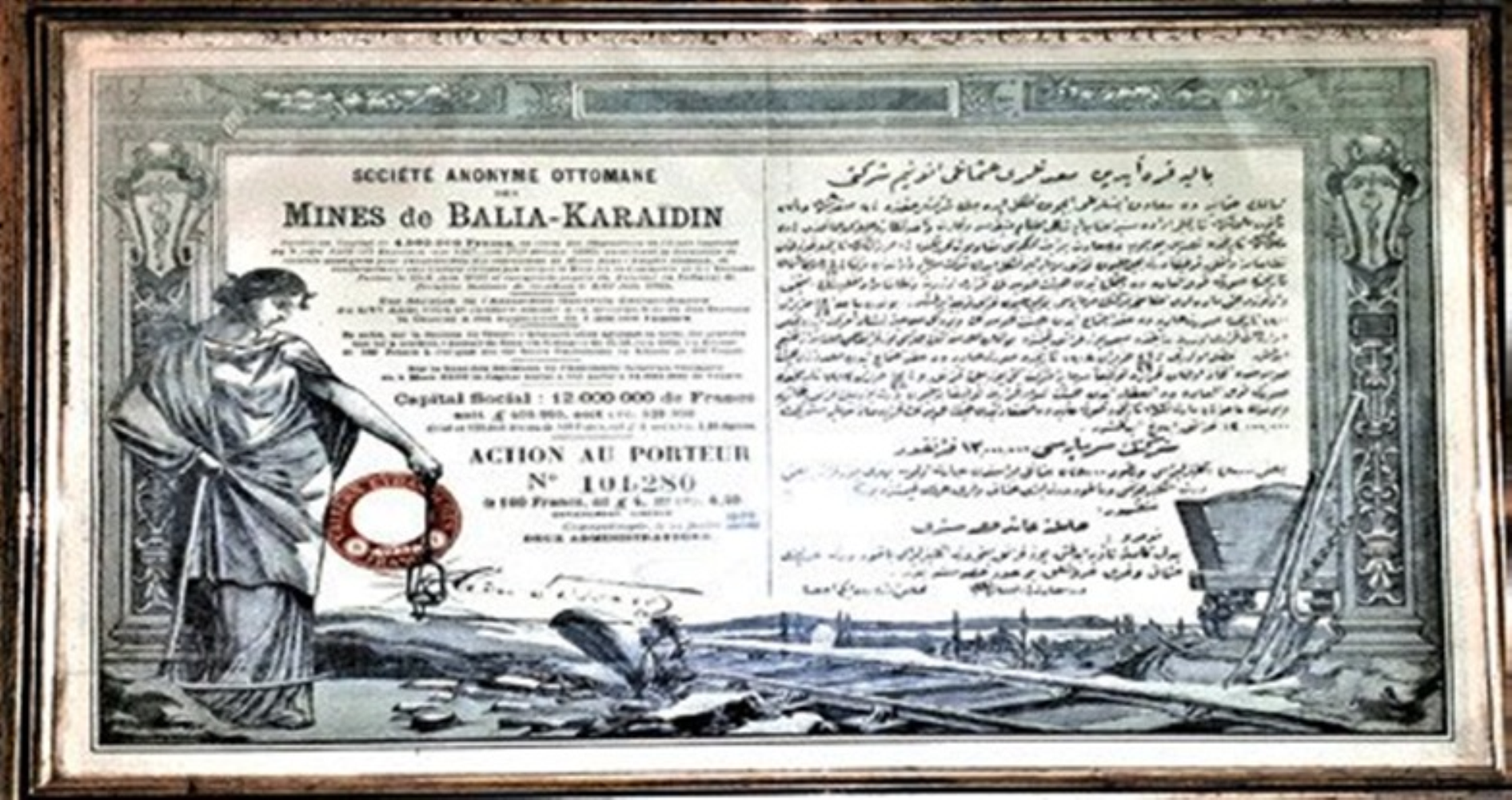
Sultan Abdul Hamid II had granted mining concessions in the Balya district of Balıkesir to the French-capitalized Balya Karaaydın Company.
With the 1st article of the "Petroleum Law" numbered 792, enacted on March 24, 1926, all mines were nationalized with the provision that "the operation of all mines, including petroleum, within the borders of the Republic of Turkey belongs to the State."
The young Republic wanted to utilize its underground wealth.
In 1933, upon Atatürk's directive, two independent institutions were created under the "Ministry of Economy" named the "Petroleum Exploration and Operation" and "Gold Exploration and Operation Administration."
The importance of natural resources for the country's development was certainly known.
Following these institutions, the "Mineral Research and Exploration" (MTA) Institute was established on June 14, 1935, with Law No. 2804, which also included the previously established "Petroleum and Gold Exploration and Operation Administrations," for the geological and geophysical research, laboratory, and mining work necessary for mines.
According to Article 7 of the law, it was decreed that "no licenses shall be granted to other persons for the minerals it is searching for until it completes its work in the fields where the MTA has announced it will conduct exploration"; and according to Article 8, "if exploration is being conducted in fields where the presence of minerals is known, these mining fields cannot be transferred or tendered to anyone until the MTA completes its work."
In other words, the State and the Public had absolute control and ownership over underground wealth.
The new administration had learned lessons from the past, from the bankruptcy situation the Ottomans had fallen into. It knew the robbery of the imperialists and held its underground values tightly in its hands.
***
In this context, the Mineral Research and Exploration Institute (MTA) conducted mineral deposit exploration work in many parts of Turkey and contributed to the economy of the young Republic.
The MTA played a major role in searching for and finding the raw materials for many industrial facilities related to coal-lignite, petroleum, iron and steel, aluminum, boron, chromium, and cement in our country.
A public institution named ETİBANK was established on June 14, 1935, to ensure the processing of the found minerals and to enable many related enterprises to start production.
Thus, the State made many investments in this direction through ETİBANK.
In this way, the minerals that were searched for and found were mostly evaluated by public institutions such as ETİBANK or companies owned by Turkish citizens.
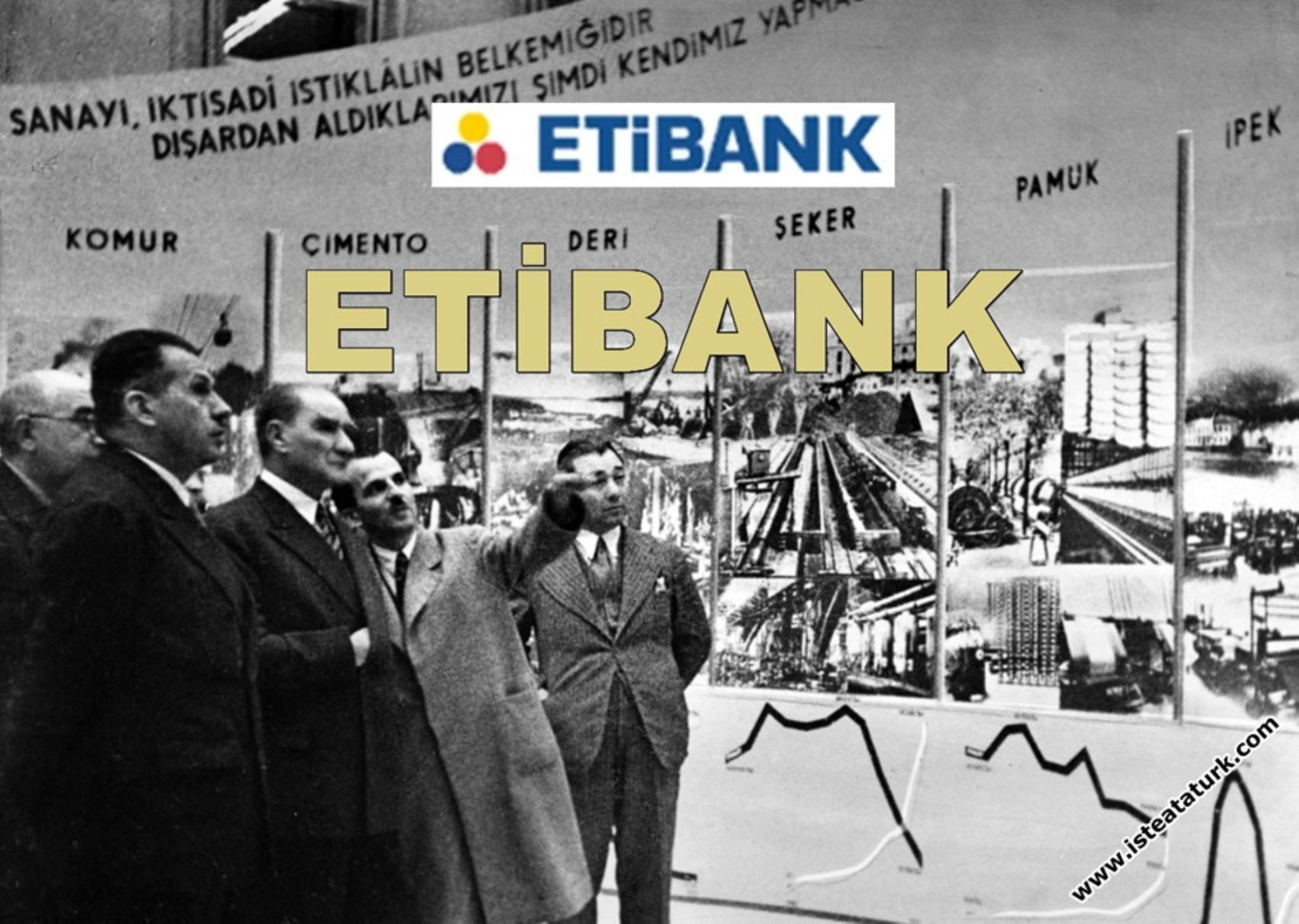
Already, Article 7 of the ETİBANK Law had the condition that the "shareholders" of the companies to be established by the Bank must be "Turkish."
However, in this process, no effective work was heard regarding "gold mines/operations," which resemble "open-air chemical manufacturing" more than mining.
***
For years, mining in Turkey was carried out with the legislation brought by the MTA Law.
However, many things changed after the 1950s.
The initial principles of the Republic in the economy began to be abandoned.
With the changes made by the (Petroleum Law) numbered 6326 enacted in 1954 during the Democrat Party government and the laws numbered 6987 in 1957, our petroleum and mines were handed over to foreign companies again.
In 1985, the situation was generalized.
With the law numbered 3213 accepted by the Grand National Assembly of Turkey on June 4, 1985, Mining was placed into a framework with a law called the "Mining Law" (!).
In Article 1 of the law, it was stated: "This Law regulates the principles and procedures regarding the exploration, operation, ownership, and abandonment of mines in accordance with national interests."
It was requested that the mining to be done be "in accordance with national interests."
What were these "national interests"?
In Article 8, under the heading "mining rights," it was specified who would do mining:
"Mining rights are granted to Turkish citizens who are competent to use civil rights, (…) companies with legal personality established according to the Laws of the Republic of Turkey (!), 'state economic enterprises' and institutions, their subsidiaries and affiliates, and other public institutions, organizations, and administrations authorized in this regard."
In other words, the doors of mining done and to be done in the country were now wide open to foreign companies. By law!
***
1985 is the year the "Mining Law" was published, in which imperialist companies were invited to the country.
The country had just emerged from the September 12 fascism.
The Motherland Party and Turgut Özal were at the head of the political power.
With privatizations, every value of the country, whose waves of continuation still continue, had been put up for sale.
International capital had entered the country to its marrow.
This was "globalism," the cure for everything!
Everything was for making money, for profit.
This was called "national interests"!
"Development" was going to happen this way!
Attack, attack the values/minerals under and above the ground without taking any necessary and effective precautions!
The State had not yet dared to do "cyanide gold mining."
But it knew about silver.
And that "cyanide" was used to obtain it!
This process existed in Kütahya!
Let the silver come out, let the gold come out!
Let the cyanide flow in streams!
Let the poisons wash the soil, let them be a sherbet for the waters!
If our country is to get rich, let nature die! What does it matter?
ETİBANK, which Atatürk established for the development of national mining enterprises, has now become a "cyanide user" too.
Kütahya was going to cry!
Forget about the environment!
Time is flowing!
This was just the beginning!
Sefa Taşkın
04.08.2024
Dikili/İzmir
Most Read

Galatasaray announces injury updates for Osimhen, Lemina, and Singo

Attention online sellers: Tax monitoring expanded
VAR for the Fenerbahçe-Beşiktaş derby has been announced!
Bridges and highways are being privatized: 15 July and FSM are also on the list

Peugeot September 2026 price list is out

New details emerge in 'panel' operation targeting lawyers
Gökçek era detail in ABB investigation

First statement from Osimhen after injury in Başakşehir match

Özlem Şanver: 'He said he would change, I believed him; should I be beaten just because I didn't leave?'

Mourinho explains why he substituted Arda Güler