



To better understand Turkey, following news bulletins alone is not enough. Often, history books and the memoirs of various historical figures can help you understand a country's contemporary history. Two years ago, at the Izmir Book Fair, a book caught my attention—or rather, the author of that book did, because it is a name I have heard since childhood from books and history lessons at school. The author of the book is Mikhail Frunze. For those who do not know, Mikhail Frunze was a Bolshevik leader who played a very important role during the 1917 Russian Revolution, one of the founders of the Red Army, a member of the Central Committee of the Communist Party of the Soviet Union, and chairman of the Revolutionary Military Council (which was referred to as the Ministry of Defense at the time). Mikhail Frunze was born in Bishkek (the current capital of Kyrgyzstan). His father was of Romanian descent, and his mother was Russian.
But let us return to his book! The book consists of travel notes from the Russian General's visit to Turkey between November 1921 and January 1922. His visit coincided with the years of Turkey's War of Independence against Western imperialist powers. The Soviets, who wanted to export the Bolshevik Revolution to Asia, knew they had to pass through Turkey first. The fact that Western imperialist powers were a common enemy brought Mustafa Kemal Atatürk and Bolshevik leader Vladimir Lenin closer together. Soviet Russia was also one of the first states to recognize Turkey's political and economic independence.
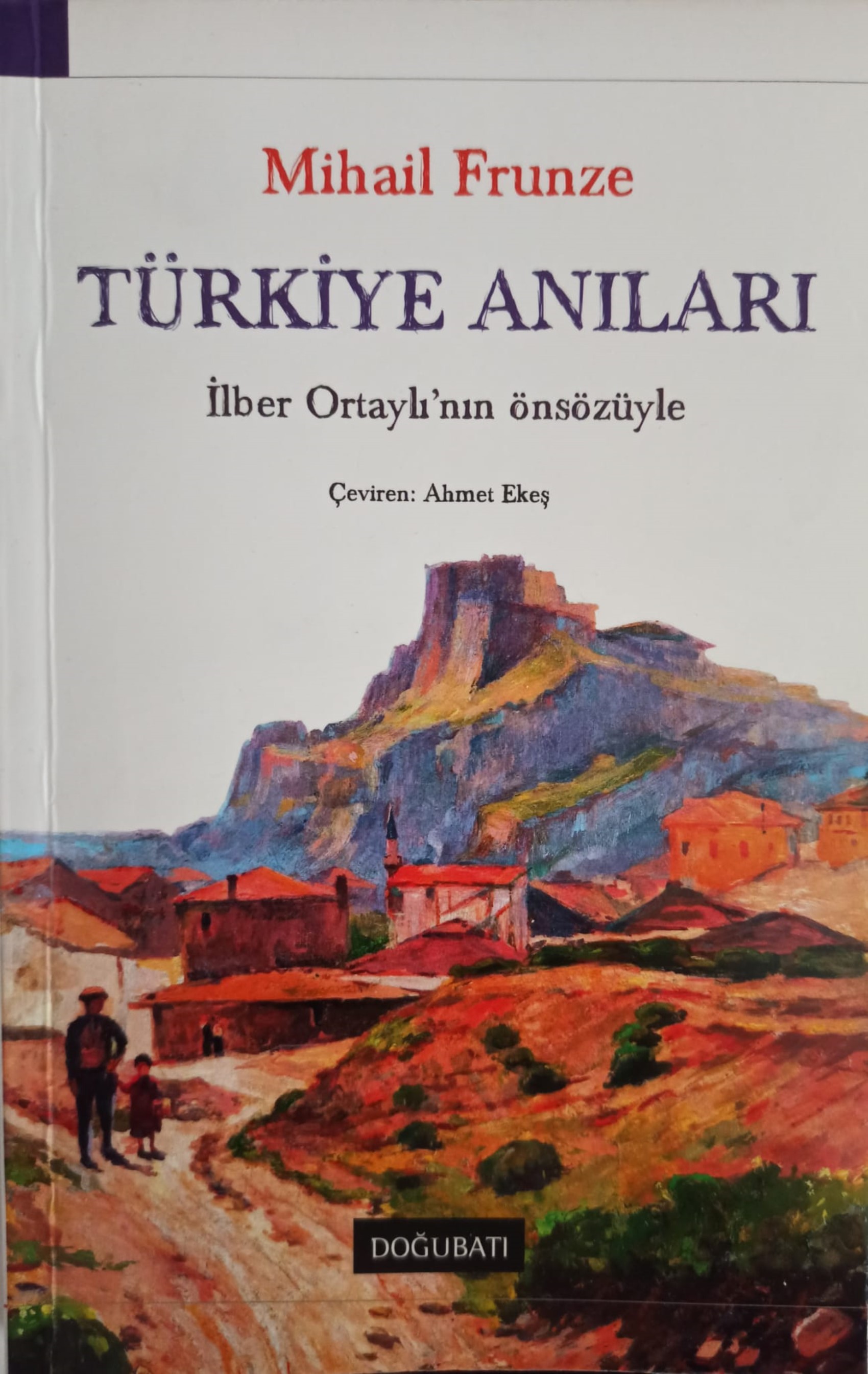
Mikhail Frunze was sent to Turkey as the Extraordinary Plenipotentiary Representative of Soviet Russia and Ukraine. Here, he was to sign a treaty of friendship and resolve the issue of how the military and financial aid that the Soviet government would later send to Turkey would be delivered. Frunze, who set out from Kharkiv (the city currently being bombed by the Russian army in Ukraine) on November 5, 1921, reached Trabzon on January 26, and then reached Ankara by following the route through Samsun, Çorum, and Yozgat. Frunze contributed to the establishment of relations between Turkey and Soviet Russia, and thanks to him, the remaining 3.5 million rubles of the 10 million gold rubles promised as aid at the Moscow Conference were sent to the Government of the Grand National Assembly of Turkey on May 3, 1922.
General Frunze's travel notes contain important details about the period from the final years of the Ottoman Empire to the years of the War of Independence. He describes the people, cities, villages, and especially the Turkish peasantry and their quite difficult lives in the countryside in detail. The effects of the war are visible to the naked eye, as all of Turkey's villages had been dragged into terrible poverty.
Upon arriving in Trabzon, Frunze is surprised by the excessively high prices of basic necessities in Turkey and says that Batumi and Kharkiv were much cheaper. The Russian general is also shocked by the large number of child beggars on the streets. He notes that as he moved away from Russia and approached Baku or Tbilisi, poverty increased. In Samsun, Frunze visits a cigarette factory where 300 workers, mostly women and children aged 9-10, work about 11 hours a day (the REJI cigarette factory belonged to a French company that held a monopoly on cigarette production until the year it was taken over by the government).
Arriving in Keskin, a district of Ankara, Frunze could not even get warm in the hotel where he stayed due to the freezing cold at night. Apparently, in 1921, the Turks still did not know how to prepare delicious tea. The author mentions that, unlike other peoples, the Turks did not know how to prepare delicious tea and did not have a special teapot for it. He noted that they boiled the tea in a bowl like soup and, as a result, had to drink very dark tea. Frunze could not have known in those years that the Turks would later become experts in producing and preparing the world's best tea.
He complains while walking on cobblestone roads because the gaps between the stones were too wide. Because it was not possible to walk comfortably on such a road. Even horses could get injured while walking on such a road. Frunze learns information about Mustafa Kemal Atatürk, who led a very modest lifestyle, traveled to different cities, chatted with ordinary people as well as soldiers, and earned the respect and admiration of his people. Frunze is still surprised by the poor quality of the soil from which the Turks obtained a fairly large harvest. He saw that poverty was great in the villages he visited and that the people had almost no clothes to wear. The world seemed tired of war; everyone wanted peace as soon as possible.
Frunze says that the Turks are dignified people. They are extremely docile and polite people. When food was served at the table, there were not enough forks and knives for all the guests, but this poverty was overshadowed by the respectful and warm behavior of the Turks. In a village where the official delegation passed through, he witnessed the wedding of two young people. The groom was 17 years old, still a child, and the bride was 15. The clothes were tattered, but what caught Frunze's attention were the groom's extremely dirty hands, "as if he had not washed since he was born." Also, the unusual dance movements of the bride and groom. In his accounts, General Frunze does not hesitate to make fun of this plague, describing how he could not sleep all night in one of the hotels he stayed in due to "uninvited guests" (referring to fleas or lice), and rhetorically questions whether they were local or brought from somewhere else. Frunze is impressed by the resistance of Turkish children to the cold. He is surprised at how these children, who walked barefoot in the snow with almost no clothes or shoes, could endure these conditions. After seeing these children, he understood how the Turkish soldier could endure the harsh conditions of the war. The author also does not forget to mention that there were almost no men in the villages. They had either been martyred in the war or were still fighting.
Frunze's travel notes on Turkey are a unique and important source of information about the final days of the Ottoman Empire and the first signs of the founding of the Republic of Turkey. At the Republic Monument in Taksim Square, the statue of General Frunze is located right behind Mustafa Kemal Atatürk as an expression of gratitude. Right behind Atatürk are two Russian generals, Kliment Voroshilov and the other, Mikhail Frunze, who played an important role in establishing cooperation and friendship between the two states.
Most Read
Galatasaray announces injury updates for Osimhen, Lemina, and Singo

Attention online sellers: Tax monitoring expanded
VAR for the Fenerbahçe-Beşiktaş derby has been announced!
Bridges and highways are being privatized: 15 July and FSM are also on the list

Peugeot September 2026 price list is out

New details emerge in 'panel' operation targeting lawyers
First statement from Osimhen after injury in Başakşehir match
Gökçek era detail in ABB investigation

Özlem Şanver: 'He said he would change, I believed him; should I be beaten just because I didn't leave?'
Mourinho explains why he substituted Arda Güler