

Putin in Beijing for the first time since the Ukraine War to cement strategic partnership
Russian President Vladimir Putin has visited China, which he views as a "strategic partner," at a time when tensions with the US and the West persist due to the war in Ukraine.



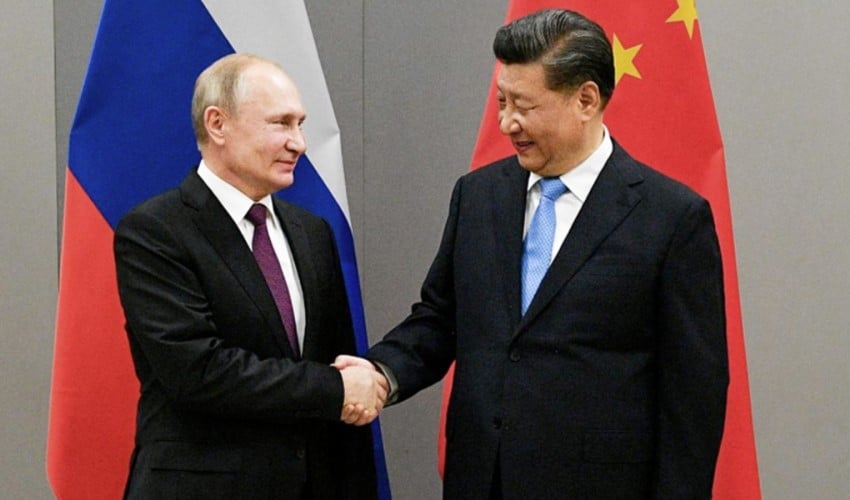
Arriving in Beijing this morning to attend the 3rd Belt and Road Forum held in China, Putin will meet with Chinese President Xi Jinping following his speech at the forum tomorrow.
The Russian leader is making his first visit to China since the start of the Russia-Ukraine War, which has now surpassed its 600th day.
The visit is expected to cement the rapprochement between the two countries, defined as a "comprehensive strategic partnership of coordination," at a time when international and regional tensions are rising.
During Putin's visit, it is expected that, in addition to "Belt and Road" cooperation and economic relations between the two countries, the Russia-Ukraine War and the escalating tension between Israel and Palestine in the Middle East will also be discussed.
"BELT AND ROAD IS AN EFFORT FOR COOPERATION, NOT DOMINATION"
In an interview with Chinese state television CCTV prior to his visit, Putin stated that they view the Belt and Road Initiative, which China launched with the goal of reviving East-West trade along the historic Silk Road route, as a "desire for cooperation" rather than an effort for "global domination."
Pointing out that Belt and Road cooperation is not based on coercion, unlike what "colonial countries" have done, Putin said, "Some see the Belt and Road Initiative as China's attempt to dominate others; for us, it is not like that. We see a desire for cooperation."
Emphasizing that the initiative is in harmony with Russia's regional development vision, Putin assessed, "We welcomed the plan that President Xi launched 10 years ago. Our establishment of the Eurasian Economic Union and our vision of building a 'Greater Eurasia' completely overlap with the Belt and Road Initiative."
Putin stated, "The best part of the cooperation China proposes within this framework is that no one imposes anything on others. The essence is to seek solutions, projects, and approaches that are acceptable to all parties in line with a common goal. There is no imposition or coercion; there are opportunities."
COOPERATION ON EUROPEAN AND SIBERIAN ROUTES
Russia is actively cooperating with China on transport and infrastructure projects along the two main land routes of the Belt and Road Initiative.
The first route, called the "New Eurasian Land Bridge" (NELB), which extends from China to Europe, creates a railway transport network starting from the Xinjiang Uyghur Autonomous Region in northwestern China, passing north of the Caspian Sea through Kazakhstan to western Russia, and from there to Eastern Europe and Germany.
The second route, called the "China-Mongolia-Russia Economic Corridor" (CMREC), aims to connect northern China through the Mongolian steppes to Russia's Siberian territory. The project, supported by a joint investment fund established by the Chinese and Russian governments, is intended to increase regional integration.
The Russian leader also attended the two previous Belt and Road Forums held in 2017 and 2019.
"CHINA-RUSSIA COOPERATION IS A FACTOR OF GLOBAL STABILITY"
At the Valdai International Discussion Club meeting held in the city of Sochi on October 6, the Russian President stated that Russia-China cooperation is an "important factor of global stability" and announced that Moscow would increase cooperation with Beijing in the fields of security and economy against the West's "confrontational" policy.
Assessing that the US policy toward China is based on "geopolitical fears" stemming from Beijing's growing power and that the West's effort to create blocs to maintain its hegemony threatens world peace, Putin used the expression, "Cooperation between Russia and China, of course, functions as an important stability factor in the world."
Emphasizing that Russia will develop cooperation with China against NATO expansion, Putin assessed, "The desire of Western countries, and especially the US, to expand NATO's borders toward the territory of the Russian Federation was one of the most important reasons for the crisis in Ukraine. Now they are doing the same in the East (Asia), creating different closed military groupings."
In his meeting with Chinese Foreign Minister Wang Yi, who visited his country in September, the Russian leader called on China to "resist unipolar hegemony" while sending a message to "deepen strategic cooperation."
Describing Chinese President Xi's visit to Moscow in March as "epoch-making," Putin said, "The current international situation confirms President Xi Jinping's strategic judgment that the world is going through changes not seen in a century."
Expressing his belief that BRICS has taken a successful step toward expansion through the joint efforts of Russia and China and that this will carry cooperation to a new level, Putin stated, "Russia is ready to continue close coordination with China in multilateral frameworks such as the Shanghai Cooperation Organization and BRICS to resist unipolar hegemony and inter-camp confrontation, and to protect international peace and justice."
RELATIONS WITH RUSSIA ARE THE CORNERSTONE OF CHINA'S GLOBAL POLITICS
The Chinese administration also views maintaining and developing its strategic partnership with Russia as critical in its geostrategic competition with the US.
The Chinese leader made his first foreign visit to Russia after being re-elected president at the National People's Congress held in March, extending his rule to a third term.
During the visit, addressing Putin, Xi said, "Right now, the world is going through a change that is seen once in a century, and we are the ones driving this change."
During the visit, the two leaders reached a consensus on elevating relations to a new dimension, and emphasis was placed on expanding strategic cooperation between Beijing and Moscow on a global scale.
CHINA'S STANCE ON THE RUSSIA-UKRAINE WAR
The Russia-Ukraine War, which began at a time when geostrategic competition and regional tensions between China and the US were increasing, brought Moscow and Beijing, which face similar challenges, closer together.
The joint statement by the Chinese and Russian leaders, which emphasized that "there are no limits to the friendship between the two countries" during the meeting held during Putin's visit to China for the Beijing Winter Olympics on February 4, 2022, just before the war began, was interpreted as a sign that the Beijing administration was aware of the war that would soon begin and gave its tacit approval.
Although China did not join the international sanctions against Russia after the war, it largely complied with the framework of the sanctions so as not to harm its economic relations with the US and Europe.
On the other hand, Beijing also benefited from trade that shifted direction as sanctions restricted exchanges between Europe and Russia, and it was observed that the trade volume between the two countries increased after the war, especially in the energy sector.
While the US and Europe warned China not to provide arms support to Russia in the war, Beijing continued its military and industrial cooperation with Moscow, including joint military exercises, even if it did not sell weapons directly.
FROM PEACE PROPOSALS TO MEDIATION
On February 24, the anniversary of the war, China announced a 12-point "position paper" containing its proposals for a political solution to the crisis, in which it was emphasized that tensions should be gradually reduced to achieve a ceasefire.
The ceasefire proposal was not accepted by the US and the European Union, nor by Ukraine, which perceived the proposal as formalizing the status quo. The Kyiv administration stated that a peace under these conditions would mean "freezing the war."
Russia also stated that it attaches importance to China's view but that the necessary conditions for a transition to the path of peace in the resolution of the Ukraine issue have not been met under current circumstances.
Although President Xi called for a political solution to the Ukraine problem during his Moscow visit in March, the emphasis placed on expanding strategic cooperation on a global scale during the visit was interpreted as a sign that China continues its support for Russia.
China sent its Special Representative for Eurasian Affairs, Li Hui, to Ukraine, Russia, and other countries in May to seek a basis for mediation, but no concrete results were obtained from the contacts.
"COMPREHENSIVE STRATEGIC PARTNERSHIP OF COORDINATION"
China defines its relations with Russia as a "comprehensive strategic partnership of coordination." The two countries, which are permanent members of the United Nations (UN) Security Council, often demonstrate policy preferences that support each other on global issues against the weight of the US and its Western allies.
The two countries continue their cooperation in multilateral platforms such as the Asia-Pacific Economic Cooperation (APEC) and the G20, as well as the Shanghai Cooperation Organization (SCO) and BRICS communities, which they led the establishment of.
News Source: AA
Most Read
Galatasaray announces injury updates for Osimhen, Lemina, and Singo

Attention online sellers: Tax monitoring expanded
VAR for the Fenerbahçe-Beşiktaş derby has been announced!
Bridges and highways are being privatized: 15 July and FSM are also on the list

Peugeot September 2026 price list is out

New details emerge in 'panel' operation targeting lawyers
Gökçek era detail in ABB investigation

Özlem Şanver: 'He said he would change, I believed him; should I be beaten just because I didn't leave?'

First statement from Osimhen after injury in Başakşehir match

The Süper Lig's new team becomes the transfer champion