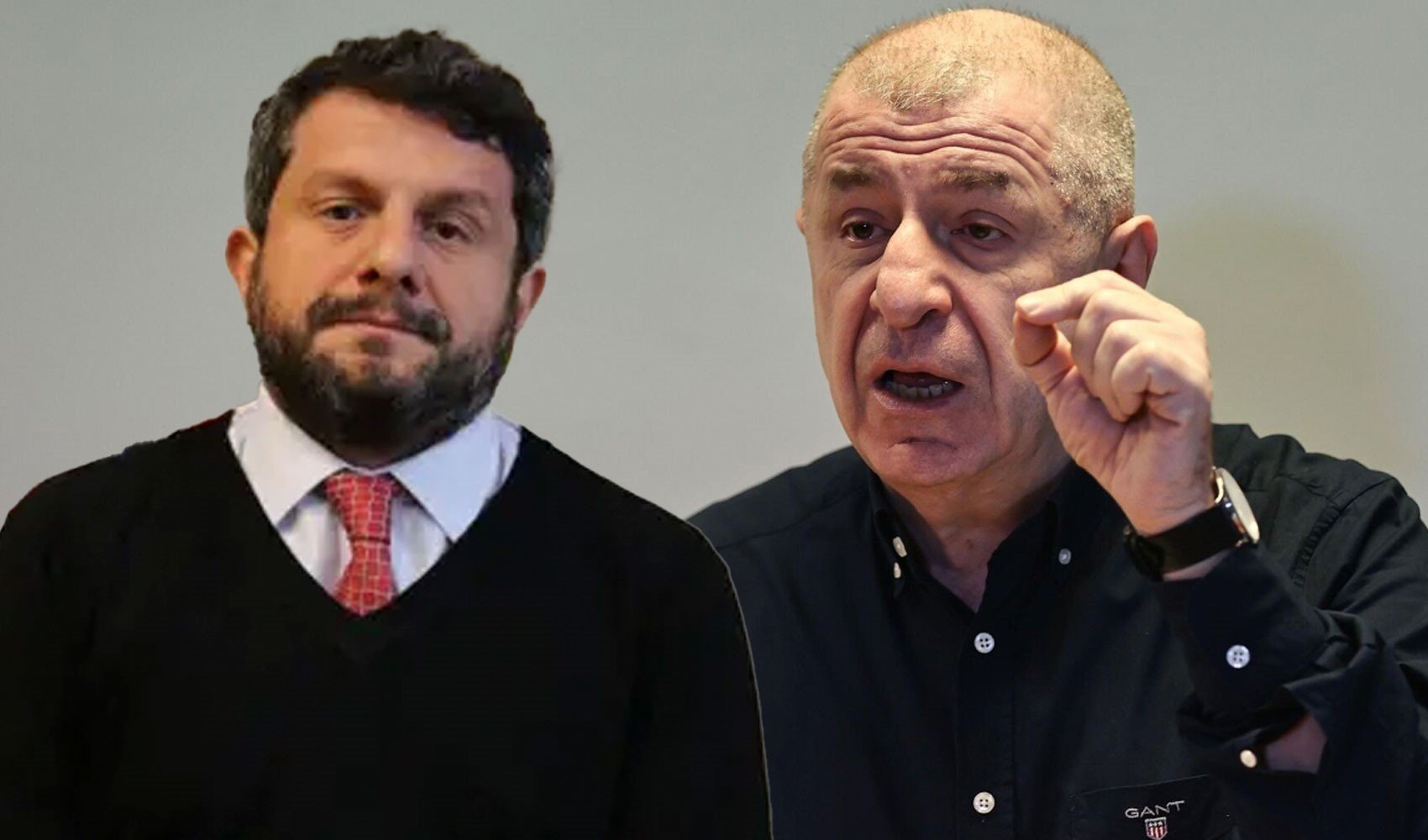
Imprisoned Workers' Party of Turkey (TİP) MP Can Atalay penned an article titled "Four Reasons to Object to 'Dual Law' in the 'Ümit Özdağ Case'" before Zafer Party Chairman Ümit Özdağ appeared in court.
Zafer Party Chairman Ümit Özdağ is appearing before a judge today at the courtroom in Silivri Prison, where he is being held.
Gezi prisoner and Workers' Party of Turkey (TİP) Hatay MP Can Atalay wrote a striking article ahead of Özdağ's hearing.
"Zafer Party Chairman Ümit Özdağ is appearing before a judge after months. As the chairman of a political party, I will justify the lawlessness he is facing under four headings," Atalay stated, adding: "First, the groundlessness of the indictment; second, that he has been deprived of his liberty through an authoritarian understanding of 'law'; third, that it is a case where the grounds of 'politics and law' are conflated; and fourth, that the 'process of bidding farewell to arms' must also be open to critical views."
HE LISTED THE REASONS
Atalay's article titled "Four Reasons to Object to 'Dual Law' in the 'Ümit Özdağ Case'" is as follows:
"First Reason: The Process of Forming the Indictment.
How was the 'file' created for which Özdağ is being held in prison?
He was detained in Ankara on the instruction of the Istanbul Chief Public Prosecutor's Office on allegations of insulting the President during a speech he gave in Antalya on January 19, and was brought to Istanbul. Naturally, when the investigation turned into an indictment, the file was supposed to be sent to the competent Antalya Court. Since the intention was different, the process did not proceed according to the law, but according to the desired outcome.
While Özdağ was being kept 'on hand' at the Police Department and the Courthouse, a second file for 'openly inciting the public to hatred and hostility' was quickly created. The basis of the claim was tweets. I think it is unnecessary to state that I do not agree with their content. Three of the tweets were from 2020, one from 2021, ten from 2022, thirteen from 2023, and two from 2024. They were not deemed necessary for investigation until the 'political conjuncture' changed.
He was detained in Ankara by the Istanbul Chief Public Prosecutor's Office due to the speech in Antalya, and while his residence was in Ankara, he was arrested on the grounds of the second case file and placed in prison in Istanbul. Years and locations were not important.
Because the 'conjuncture had changed,' his criticisms of the President had 'pushed the government's patience to the limit,' and a new criminal allegation had been created by gathering his posts, some of which were made while he was an MP. The first criterion to be sought legally for 'inciting the public to hatred and hostility' was the 'clear and present danger' criterion. However, it was not important that the 'clear and present danger' of a significant portion of the 'outdated' statements be legally convincing. In the indictment, this 'clear and present danger' link is either not established at all or the 'link' is far from being legally convincing.
The indictment, prepared with a selective and collectionist method, could not be legally convincing.
Second reason: The Same Law for All Citizens.
The second reason for Özdağ's freedom is that he is in prison as a result of 'dual law' or 'enemy law,' which is another name for the suspension of law in our country.
Özdağ took a clear stance against this danger long before he went to prison. He participated in the march organized by the Union of Turkish Bar Associations during the critical turning point regarding the non-recognition of the Constitutional Court's decision in the 'Can Atalay Case' and the filing of a criminal complaint against Constitutional Court members, and voiced his objections.
He continued his warnings about 'dual law/enemy law' while in prison. He wrote and said that he saw the 'event' was multi-faceted more clearly while in prison.
He wrote that he understood the lawlessness Osman Kavala faced much better 'now/in prison.' He emphasized the connection between what was done in the 'Gezi Case' and 'enemy law.' He wrote that the prevention of Ayşe Barım's release through procedures not found in the Law, despite the release decision, was an important example.
Özdağ continues to write/explain his assessment through the concepts of 'equal citizenship,' 'dual law,' and 'enemy criminal law.'
The issue of equal citizenship has been on humanity's agenda, and in a sense a common achievement, since the 1793 French (Jacobin) Constitution and the 1848 revolutions that radically transformed Europe.
The concepts of 'dual law' and 'enemy criminal law' are concepts that democratic circles have used at an international level since the defeat of fascism in World War II.
Özdağ emphasizes that all citizens outside the political power and the circle thriving around it are not treated as equal citizens, that a different law is applied to 'opponents,' and that this 'difference' takes on the character of 'enemy criminal law.' He defines the state of lawlessness built depending on the survival of the political power as 'dual law.'
The concepts Özdağ uses are important. They are warning/noteworthy concepts.
Third reason: It is a Case Where the Grounds of Politics and Law are Conflated.
We must strongly object to the method of threatening politicians, making them struggle with courts, and even depriving them of their freedom by stuffing years-old articles and posts into a 'bag' at any moment the government needs.
We must discuss 'politics on the ground of politics and law on the ground of law.' In the Özdağ Case, these two different grounds were forcefully inserted into each other. It has become almost the dominant method in recent years. Every citizen should raise their voice against this dangerous trend.
Fourth reason: Freedom for Every View in the 'Process of Bidding Farewell to Arms'...
While Özdağ sees the process of bidding farewell to arms as disadvantageous for our country, I find it important and necessary. What is primary is not our differences. All political movements and citizens who oppose/support/are undecided about the process must be able to freely express and discuss their ideas. Such a democratic environment is the necessary first step for the solution of the Kurdish Question.
Since the government is concerned with 'fictions' for the continuation of its power, it chose the path of 'removing those who get in its way' as it does in every subject, and sent Ümit Özdağ to prison. It is not possible to expect favorable results in the direction of unarmed politics with such illegal, anti-democratic interventions.
Those who are against it, like Ümit Özdağ, and those who support it should be able to have a free discussion in front of the public. Because our goal is a free, democratic Turkey where every view can express itself freely."
WHAT HAD HAPPENED?
The first hearing of Zafer Party Chairman Ümit Özdağ, who was detained on allegations of insulting AKP Chairman and President Recep Tayyip Erdoğan and arrested on charges of inciting the public to hatred and hostility and sent to Silivri Prison, was held at the Istanbul 18th Criminal Court of First Instance in Silivri.
It was decided that Özdağ's detention would continue.
News Source: 12punto