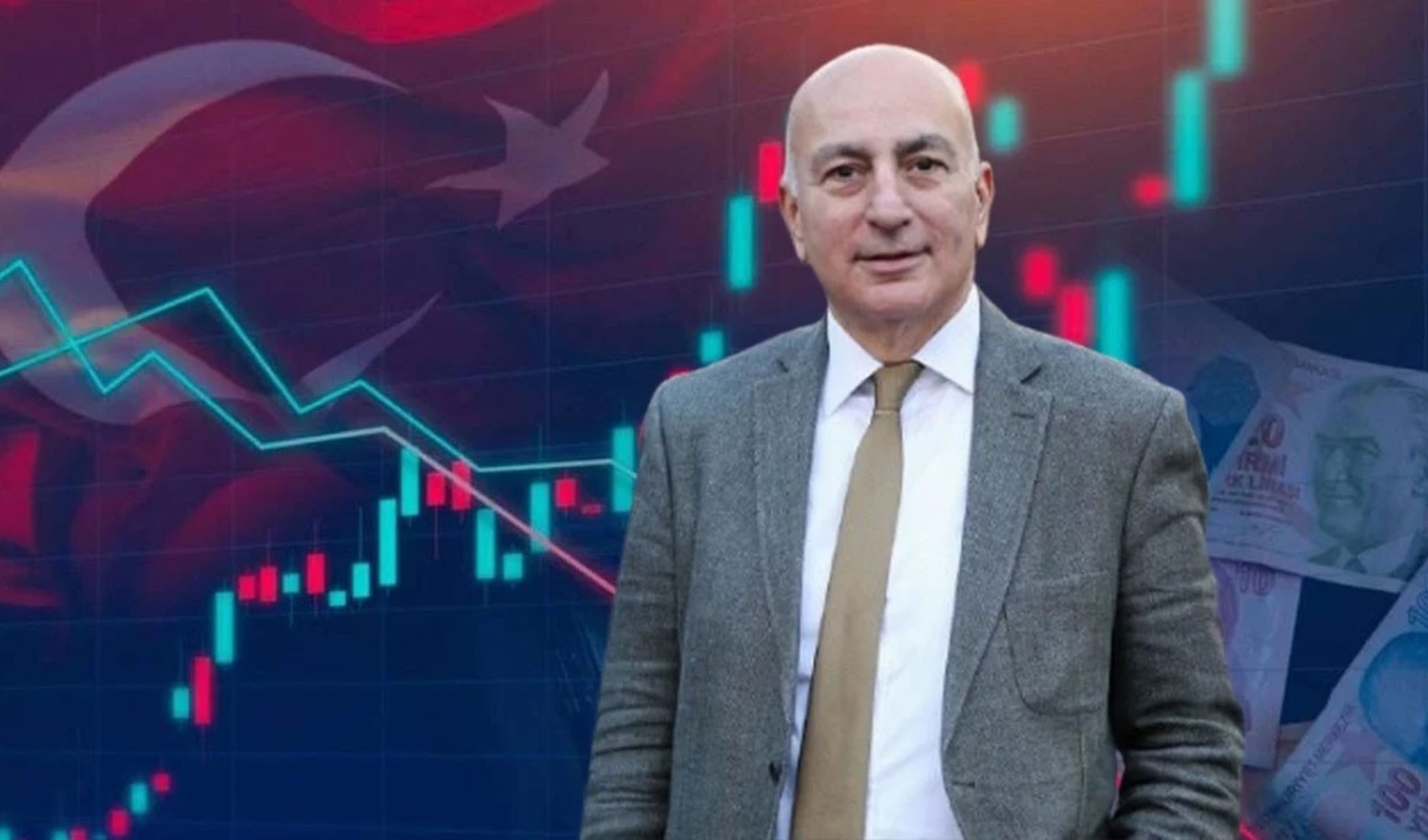
In his latest analysis, economist Mahfi Eğilmez examined the current situation and future expectations of Germany, one of the world's leading economies.
Having previously evaluated the US, China, and Japan, Eğilmez now includes Germany in his assessments, stating that the decline in the German economy bears similarities to Japan in many respects, though significant differences also exist.
Pointing out that the German economy has entered a serious slowdown process in recent years, Eğilmez listed three main reasons for the growth problem: rising energy costs following the Russia-Ukraine War, a contraction in global demand, and a decline in industrial production. In the country's industrial powerhouse sectors—automotive and machinery—increasing competition and the costs associated with the transition to electric vehicles are notable.
Emphasizing that industrial production has been at a near-standstill since 2018, Eğilmez noted that the rise in energy costs during this period has forced some firms to move production abroad. He also touched upon how the European Central Bank's interest rate hikes, aimed at curbing inflation, have restricted investments.
GERMANY'S POPULATION IS AGING
Germany's economic problems are not limited to this. An aging population and a decline in fertility rates are increasing the need for skilled labor while creating obstacles to long-term growth. While it is a matter of debate whether Germany will enter a prolonged stagnation like Japan, low growth, an aging population, and a structure dependent on foreign trade create striking similarities between the two countries.
However, there are fundamental characteristics that distinguish Germany from Japan. Explaining that Japan has historically struggled to find solutions to its labor shortage due to being an economy closed to immigration, Eğilmez noted that Germany has been able to mitigate this problem relatively well through its immigration policy and integration within the EU, while also mentioning that being part of the Eurozone strengthens solidarity mechanisms during times of crisis. Furthermore, Germany has not experienced a period where a massive asset bubble burst, as was the case in Japan.
NO RAPID COLLAPSE EXPECTED
The German economy is not expected to experience a sudden collapse in the near future, but it is projected to continue on a low-growth trend for a long time. An economy like Germany's, which provides growth around 1 percent, may lose its former dynamism and take on a more stagnant structure.
Under these conditions, Germany has several decisive steps ahead of it. More effective management of immigration policies, increasing the participation of women and older age groups in the workforce, turning to alternative and cheaper energy sources, and accelerating the transition to electric vehicles, especially in the automotive sector, could increase the country's competitiveness once again. Stimulating domestic demand will play a key role in reducing dependence on exports.
Pointing out that the impact of economic difficulties in Germany on Turkey will not be limited to trade between the two countries, Eğilmez made the following assessment: Turkey conducts approximately 9 percent of its exports to Germany and sources 7 percent of its imports from Germany. This picture shows that Turkey has a surplus of approximately 6 billion dollars in foreign trade with Germany. However, the issue is not just about Germany, but is closely related to developments across the EU. Since Germany acts as the locomotive of the European Union, if the slowdown in Germany spreads to the entire EU, the negative impact on Turkey's economy could go far beyond bilateral trade.
In conclusion, the growth problems in Germany, the challenges faced in the energy and labor sectors, and the uncertainties in global markets seem set to closely affect both the European Union and economies integrated with the EU, such as Turkey. For Turkey, this process carries risks that must be managed carefully, as well as new opportunities for developing alternative export markets and diversifying its production structure.
News Source: 12punto