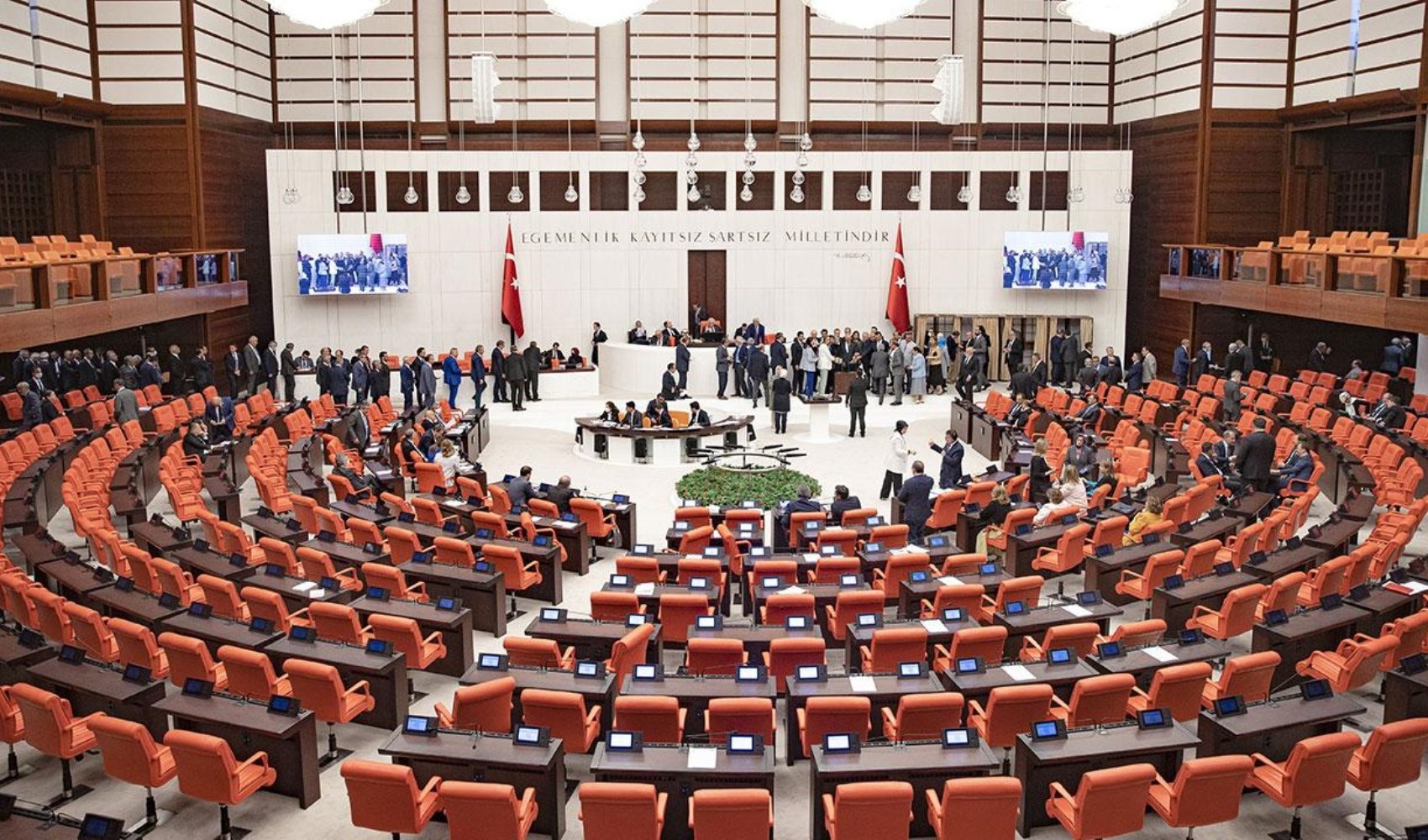
In the Grand National Assembly of Turkey (TBMM), 14 more articles in the first section of the Draft Law on Amendments to the Criminal Procedure Code and Certain Laws and the Decree-Law No. 659, known publicly as the "8th Judicial Package," have been approved.
According to the approved articles, a regulation will be introduced regarding the appeal process against final decisions rendered by the civil chambers of regional courts of justice, in accordance with the Enforcement and Bankruptcy Law.
Appeals against these decisions may be filed within 2 weeks from the date of notification, and the appeal process and review will be conducted in accordance with the provisions of the Code of Civil Procedure.
The regulation in the Anti-Terror Law concerning "terrorist organizations" will be harmonized with the amendment made to the Turkish Penal Code.
The proposal envisions amendments to the Turkish Civil Code in line with a Constitutional Court ruling. The institution of restriction due to a custodial sentence is being modified, and the state of being in a penal institution is being removed as a direct cause for restriction.
Based on the principle that adult individuals possess legal capacity, their will is prioritized; while the restriction of a convict serving a finalized prison sentence is left primarily to their own request, the restriction of a convict serving a total of 5 years or more of a finalized prison sentence is tied to the criterion of protecting their personality or assets, granting the guardianship authority discretionary power in this matter.
Accordingly, an adult person in a penal institution for the execution of a finalized prison sentence will be restricted or have a trustee appointed upon their request.
An adult person in a penal institution for the execution of a total of 5 years or more of a finalized prison sentence may be restricted if deemed necessary for the protection of their personality or assets, even without their request.
The authority responsible for executing the sentence will immediately notify the guardianship authority that the execution of the prison sentence has begun.
The guardianship authority will hear the convict before making a decision. The provisions of the Law regarding trusteeship will also apply to this regulation to the extent that they are compatible with its nature.
According to the amendment made to the Turkish Civil Code in accordance with the Constitutional Court ruling, the provisions of the article titled "procedure" in the law may be invoked to obtain the official health board report required for a decision on restriction due to mental illness or mental weakness.
TERMINATION OF GUARDIANSHIP
According to the amendment made to the Turkish Civil Code in the context of the Constitutional Court ruling, samples such as hair, saliva, and nails, as well as blood or similar biological samples, may be taken from the person's body to ensure the acquisition of the official health board report.
Necessary medical interventions may be performed on the person, and if necessary, the person may be placed in a health institution for a maximum of 20 days based on a preliminary physician's report.
The placement decision made based on the preliminary physician's report will be immediately notified to the person concerned and their relatives.
The person concerned or their relatives may object to this decision to the supervisory authority within 10 days from the notification. The objection filed will not stay the execution of the decision. The objection will be decided upon urgently by the supervisory authority.
The proposal regulates the circumstances under which guardianship may be terminated during the continuation of imprisonment, in line with the Constitutional Court ruling.
Accordingly, the guardianship over a person restricted due to a conviction for a custodial sentence will automatically cease upon the lawful termination of the imprisonment.
The termination of guardianship during the continuation of imprisonment will be possible in cases of restriction decisions based on the execution of a total prison sentence of less than 5 years, provided there is a request from the person, and in cases of restriction decisions based on the execution of a total of 5 years or more of a finalized prison sentence, provided the reason for the protection of the person's personality or assets ceases to exist upon the person's request.
COMMITTING A CRIME ON BEHALF OF AN ORGANIZATION
According to the amendment made to the Turkish Penal Code, the lower limit of a one-day judicial fine will be increased from 20 liras to 100 liras, and the upper limit from 100 liras to 500 liras, in order to combat crime more effectively and ensure deterrence. This regulation will enter into force on June 1, 2024.
Taking into account the cancellation grounds of the Constitutional Court, the act of committing a crime on behalf of an organization without being a member of that organization is regulated as a separate crime with the amendment made to the Turkish Penal Code.
Accordingly, a person who commits a crime on behalf of an organization without being a member of it will be additionally punished with imprisonment from 2 years and 6 months to 6 years. Depending on the nature of the crime committed, the sentence to be imposed may be reduced by up to half. This provision will only apply to armed organizations.
A person who commits a crime on behalf of an organization will be punished separately for both the crime they committed and the offense of committing a crime on behalf of an organization.
CRIMES AGAINST THE CONSTITUTIONAL ORDER
Regarding "crimes against the security of the state and crimes against the constitutional order and the functioning of this order" specified in the TCK, a person who commits a crime on behalf of an organization without being a member of an armed organization will be additionally punished with imprisonment from 5 to 10 years. Depending on the nature of the crime committed, the sentence to be imposed may be reduced by up to half.
With the amendment made to the Criminal Procedure Code, the scope of compensation claims due to protective measures is being expanded.
According to the regulation, in addition to apprehension and arrest procedures, individuals who are not allowed to benefit from the application opportunities provided by law against judicial control procedures will be able to file compensation claims.
It is made possible for those who are decided to have no grounds for prosecution or who are acquitted after being subjected to judicial control obligations, including not leaving their residence or being subject to treatment or examination measures, such as hospitalization to be cleansed of drug, stimulant, or volatile substance and alcohol addiction, to file compensation claims.
Compensation claims due to protective measures are intended to be made to the established Compensation Commission, and it is aimed to conclude these claims quickly through administrative application.
Thus, it will be ensured that decisions on compensation claims that do not require a trial are made in a short time. These provisions will enter into force on June 1, 2024.
DEFERRAL OF THE PRONOUNCEMENT OF THE JUDGMENT
In the Criminal Procedure Code, within the scope of the pronouncement of the judgment and the deferral of the pronouncement of the judgment, if the sentence imposed at the end of the trial for the crime charged to the defendant is a prison sentence of 2 years or less or a judicial fine, the court may decide to defer the pronouncement of the judgment.
Provisions regarding reconciliation will remain reserved. The deferral of the pronouncement of the judgment, excluding provisions regarding confiscation, will mean that the established judgment does not produce any legal consequences for the defendant.
For a decision to defer the pronouncement of the judgment to be made, it is required that the defendant has not been previously convicted of an intentional crime, that the court is convinced that the defendant will not commit a crime again by considering the defendant's personality traits and their attitude and behavior during the hearing, and that the damage suffered by the victim or the public due to the commission of the crime is fully compensated by restitution, restoration to the state before the crime, or indemnification.
In case of deferral of the pronouncement of the judgment, the defendant will be subject to a probation period of 5 years.
During the probation period, a decision to defer the pronouncement of the judgment cannot be made again for the person due to an intentional crime.
During this period, for a duration to be determined by the court not exceeding 1 year, it may be decided that the defendant, as a probation measure, attend an education program to ensure they acquire a profession or art, work in a public institution or under the supervision of another person practicing the same profession or art privately in return for a fee, be prohibited from going to certain places, be obliged to attend certain places, or fulfill another obligation to be appreciated. The statute of limitations for the case will stop during the probation period.
If the condition that the damage suffered by the victim or the public due to the commission of the crime is fully compensated by restitution, restoration to the state before the crime, or indemnification is not fulfilled immediately; a decision to defer the pronouncement of the judgment may also be made on the condition that the damage caused to the victim or the public is fully compensated by the defendant in monthly installments during the probation period.
If no new intentional crime is committed during the probation period and the obligations regarding the probation measure are complied with, the judgment whose pronouncement was deferred will be eliminated and it will be decided that the case be dismissed.
In case a new intentional crime is committed during the probation period or the obligations regarding the probation measure are violated, the court will pronounce the judgment.
The court, by evaluating the situation of the defendant who cannot fulfill the obligations imposed on them, may decide that a portion of the sentence, to be determined up to half, will not be executed, or that the prison sentence in the judgment be suspended or converted into alternative sanctions.
The pronounced or newly established judgment may be appealed.
APPEAL PROCESS AGAINST THE DEFERRAL OF THE PRONOUNCEMENT OF THE JUDGMENT
Except for provisions written as final in the laws, an appeal may be filed against the decision to defer the pronouncement of the judgment.
If the decision to defer the pronouncement of the judgment is rendered by a regional court of justice or the Court of Cassation in the capacity of a first-instance court, an appeal to the Court of Cassation may be filed. Decisions and judgments will be reviewed in terms of procedural and substantive legal violations in the appeal and cassation processes.
The decision to defer the pronouncement of the judgment will be recorded in a special system. These records can only be used if requested by the public prosecutor, judge, or court in connection with an investigation or prosecution.
The provisions regarding the deferral of the pronouncement of the judgment will not apply to crimes related to the revolution laws protected by the Constitution.
Deputy Speaker of the Parliament Bekir Bozdağ adjourned the session after the 16th article of the proposal was approved. After the break, as the commission did not take its place, he closed the session to reconvene at 14:00.
News Source: AA