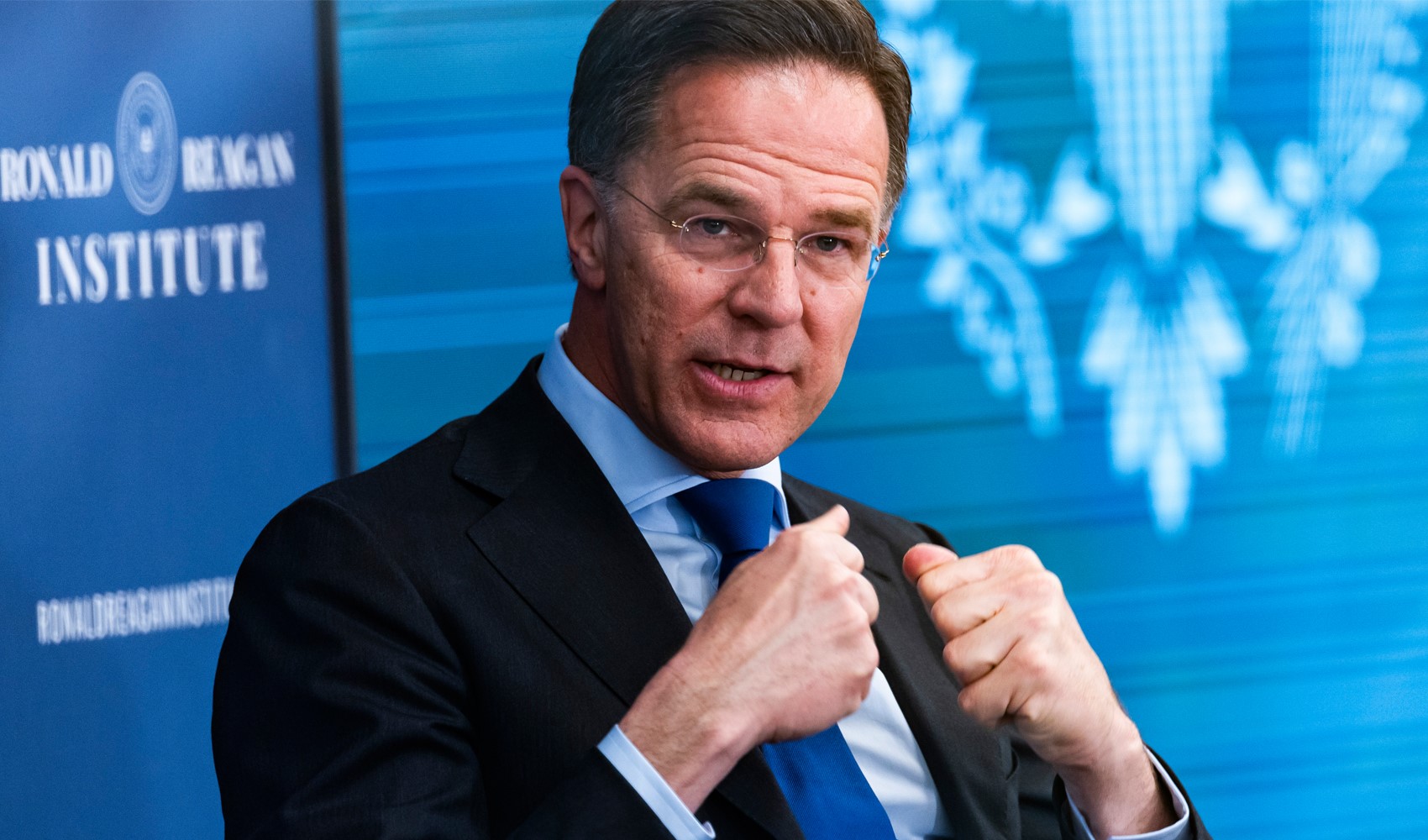
NATO Secretary General Mark Rutte spoke at a memorial event held at the 9/11 Memorial and Museum in New York. Rutte drew attention to the fact that Article 5, the collective defense principle which stipulates that an armed attack on one member country is considered an attack on all alliance members, was invoked for the first time in history for the US following the attacks on September 11, 2001, and highlighted the solidarity shown by NATO countries after the terrorist attack.
"The relationship between the US and NATO is extremely strong"
In an interview held after the speech, when asked about the current state of relations between the US and NATO, the NATO Secretary General said, "This relationship is extremely strong."
Stating that US President Donald Trump is a president who is "fully committed to NATO" but "extremely uncomfortable with Europe and Canada getting a free ride," Rutte said that thanks to the decision to increase defense spending to 5 percent of gross domestic product, spending between Europe, Canada, and the US is becoming more balanced. Rutte said, "This makes us all stronger. We have to do this because we know that our rivals are rapidly expanding their armed forces."
When asked whether tensions within NATO are pushing Russia to test "how determined the alliance is," Rutte replied, "I think Russia's calculation is that NATO is strong and will not be defeated. The Russians know that we will defend every single square centimeter of NATO territory."
Pointing to the losses Russia has suffered in the war in Ukraine, Rutte said, "The Russians are losing more than 40 thousand personnel every month. To give an exact figure, 43 thousand dead or seriously wounded. This is possible thanks to the support of NATO allies. Thanks to them providing the necessary weapons, including air defense systems, for Ukraine to defend itself and protect its interests."
"NATO is responding to Russia's cyber and hybrid attacks"
Expressing that NATO is also prepared for cyber and hybrid attacks from Russia, Rutte said, "We have all the options available for a response. Not all of these are public. That is why we cannot always talk about them. The responses we give are not always symmetrical. It is not always a one-for-one retaliation. But I assure you that the Russians know what is happening."
Rutte stated, "The shadow fleet is an example of this. This fleet, consisting of old and leaking tankers trying to maintain Russia's oil exports, is being slowed down more and more thanks to the steps taken by Sweden, the UK, France, Belgium, and other allies."
When asked for his assessment of the Greenland agreement signed by the US with the governments of Denmark and Greenland, Rutte said, "The Greenland Agreement is a good agreement."
Emphasizing that the steps were taken against the access of Russia and China to the Arctic Region, Rutte said, "They solved this issue. The agreement signed this week was welcomed by Denmark, Greenland, and of course the US President. I think this is a very solid agreement. So the matter is now resolved."
When asked about the situation in the war in Ukraine, Rutte replied, "Russian President Vladimir Putin had received information from his top generals that the job would be finished in two or three weeks. There was even a big celebration planned in Moscow. I think it was set for four or five days after the full-scale invasion. The celebration still hasn't happened."
The NATO Secretary General said, "The US lost about 60 thousand people in 14 years in Vietnam. Here, we are talking about 43 thousand in one month. The Soviets lost 20 thousand people in 10 years in Afghanistan. Here, we are talking about 43 thousand in one month. Compared to other major events, these are truly staggering figures."
"Ukrainians are in a much better position to hold the front line"
Expressing that Ukraine is in a much better position on the battlefield than before, Rutte said, "The Ukrainians are in a much better position to hold the front line and strike critical infrastructure deep inside Russia. Here, some cities in Kramatorsk, Slovyansk, and Donetsk are of critical importance. It is necessary to ensure that these fortified cities remain in Ukrainian hands. The current assessment is that it is very difficult for the Russians to capture these places. In fact, it is much more difficult than the assessments of one or two years ago."
Rutte said that the best answer to Russia's hybrid attacks on European countries would be "more support for Ukraine." Rutte said, "As Polish Foreign Minister Radoslaw Sikorski said, if there is a hybrid attack, we will provide more money for Ukraine's Priority Urgent Requirements List (PURL). In this system, the US provides critical military support to Ukraine, and the financing is covered by Canada and Europe."
When asked if he felt any fatigue within the alliance regarding the continuation of the war in Ukraine, Rutte replied, "Of course, it has a wearing effect. But on the other hand, I feel very clearly in Europe, Canada, and the US that: The Ukrainians are putting up a heroic fight. It is of critical importance that Russia does not succeed in taking over this country. We must end this war with a dignified peace."
"If it were NATO at war with Russia, it would be a different war"
When asked about the lessons NATO has learned, given that Ukraine has gained a lot of experience in the war and that the outlook would look like this if a new war broke out in Europe, Rutte replied, "If it were NATO at war with Russia, we would have more capabilities than Ukraine currently has to show the Russians our stance. It would be a different war."
On the other hand, explaining that they have learned lessons from the battlefield regarding drones, anti-drone technologies, and artificial intelligence becoming a part of the war, Rutte said, "We have a joint NATO-Ukraine organization in Poland. It collects all the lessons learned from the war. We identify what these are and make them part of our defense plans."
Giving drone production as an example of this issue, Rutte said, "A conclusion we are increasingly reaching is that while we need drone technology, it is better to have drone production capacity rather than producing and stockpiling drones in advance. Because the impact and quality of these drones change almost every six to nine months. The technology used against drones changes in the same way. For example, look at the jet-powered drones that the Russians and Ukrainians are currently using. This is one of the new developments of the last 2-3 months. If you had produced these in advance and kept them in storage, they would have been obsolete by today. We are learning these lessons. Our goal is to maintain our superiority."
When asked about security guarantees for Ukraine, the NATO Secretary General said, "Allies, including the US, are ready to provide the necessary security guarantees. In January, we reached an agreement on a comprehensive package of security guarantees in Paris under the leadership of French President Emmanuel Macron. So this is ready and completed. It can be implemented as soon as it is ready. Therefore, we essentially know in all detail who will do what to ensure that security guarantees are in effect in the event of a peace agreement."
"Putin is on the verge of panic"
When asked about the possibility of the war spreading to Europe, Rutte replied, "The Danish intelligence service announced just today that it is extremely unlikely that Russia will launch a full-scale invasion of NATO territory. I think this assessment is correct."
Rutte said, "I have a few messages for Europeans, Canadians, and all of NATO. First; stay calm. We know what is happening. Putin is in a difficult position. He is suffering huge human losses. He is not winning the war in Ukraine. I have had many meetings with Putin and I know him a little. I think he is on the verge of panic."
Stating that the impact of invading Ukraine on the Russian economy is huge, Rutte said, "He knows we are stronger. If he tries to make a move against us, he knows that we will defend every centimeter of NATO territory."
Listing his other messages as keeping defense spending strong and keeping Ukraine strong, Rutte stated, "We are aware of the situation. We are ready. There is unwavering determination. They cannot win."
When asked what NATO's response to hybrid attacks is, Rutte replied, "Not all of these are public. When something happens, we decide how to respond. At a time of our own choosing, in the form we want, and in a way that will create the greatest impact. Sometimes you will see this."
Stating that NATO allies launched the Baltic Air Policing mission when the undersea connection cable between Finland and Estonia was cut, for example, Rutte said, "The Russians hate this because it brings them serious costs. It is becoming increasingly difficult for them to continue their shadow activities. This is an example of a symmetrical response."
Emphasizing that Russia is not winning the war in Ukraine and that NATO allies should "stay calm" regarding hybrid attacks, Rutte said, "We have many preparations against this. We are stronger. Look at what is happening in the war in Ukraine in Russia and how much support the West is giving for Ukraine to be successful. Do not fall into the trap. Everything they do should lead to more, not less, support for Ukraine."
News Source: 12punto