


PaxSilica: The 'Technology NATO' – Where does Turkey stand?


PaxSilica is being referred to in Washington as a "Technology NATO." It is the name behind the San Francisco Declaration, signed by ten countries under the leadership of the US. Literally, it means "silicon peace": Pax for peace, and Silica for silicon—the element that is the raw material for chips. But the peace it promises is based on a club that divides the world into "trusted" and "untrusted" through chips, critical minerals, and data centers. So, where does Turkey stand in this alliance?
The founding core consists of the US, Japan, South Korea, Singapore, the UK, Israel, and Australia. They were followed by the Netherlands, the UAE, Qatar, India, Sweden, Finland, the Philippines, and Norway. Germany, Argentina, Chile, Kazakhstan, and the European Union (via the Commission) have also signed. Greece officially joined in June 2026. Turkey is not there.
This is not an oversight. Turkey is the natural crossroads for Europe-Middle East-Central Asia logistics; the rare earth reserves in Beylikova are an added bonus. The problem is a trust deficit: deep economic dependence on Russia is flagged as a risk in Ankara's file. The club's door is open, and two words are written on the threshold: choose your side.
The Real Risk of PaxSilica
The real danger is not membership itself. Whether we join or not, the risk is that Turkey becomes fixed in a position in the chain of "providing raw materials but having no say." If the ore extracted from Beylikova is exported without being processed, separated, or turned into magnet or battery materials, Turkey becomes the lowest value-added, most easily replaceable link in the supply chain.
Worse: even if the facility is established in Turkey, if the separation technology, equipment, and final customer relationships remain outside, the appearance of "domestic production" hides a de facto guardianship. The land is ours, the factory is within our borders; but the production decision, license, and export target are on someone else's desk. PaxSilica's working groups titled "secure harbor" and "processing" tend to reserve this intermediate stage for their own members.
A distinction is necessary here: the problem is not foreign investment itself, but the conditions. Investment that does not include technology transfer, local employment, and partnership in export decisions, but only sets up an assembly or processing line, is merely a polished version of raw material sales.
The World is Dividing in Two
PaxSilica does three things on a global scale. First, it weaponizes the supply chain: everything from silicon to rare earths, from port cranes to data centers is considered "sensitive infrastructure." Second, it cuts the technology map with the "trusted" criterion; its expansion trajectory draws an arc from the Indo-Pacific to the Middle East, and from there to Europe. China's reaction is clear: it opposes "exclusionary AI groups." Third, it declares economic security as national security; the reverse is also true—every economic dependency can be rewritten as a security vulnerability.
An internal draft that emerged in August 2026 reveals the nature of the club: the US informs partner countries that those who join PaxSilica cannot simultaneously join the China-led equivalent initiative. "Participating in everything means participating in nothing."
Ankara's Difficult Choice
Turkey's position has not yet become clear; the real issue is not to wait for this uncertainty, but to build a place where it has a say and does justice to its reserves. Membership is not an open buffet; you cannot reap the benefits of supply chain cooperation while avoiding the constraints of export controls. At least three of the five working groups are directly related to policy harmonization and security oversight. On the other hand, if PaxSilica becomes the main channel for advanced AI computing power and semiconductor equipment, the cost of technology access for those left outside will constantly increase.
Time is also running out. In less than a year, the initiative grew from seven countries to over twenty, the EU joined as a whole, and Greece is already inside. While Athens is settling into Washington's architecture on the technology map of the Eastern Mediterranean, Ankara is waiting at the door. If this asymmetry continues, the bargaining chips on the table will diminish.
But it is not as if Turkey has no cards to play. Its position as a logistics hub and its rare earth potential are real. The problem is that this potential has not yet turned into verifiable capacity. It is necessary to prove that ports are not used for restricted technology transfer, to show that the refinery is a traceable export terminal, and to demonstrate that the data center complies with the "trusted" standard. These may seem like technical issues; yet each is the product of a political choice.
While energy dependence on Russia, which is placed before Turkey, is defined as a trust deficit, why is Europe, which has the same dependence, not referred to with this label? Because Europe was also dependent on Russian energy—it is still partially dependent. The EU reduced its Russian gas imports from 45% in 2022 to 12% in 2025, and oil from 27% to 2%, but the picture does not change for uranium. Rosatom has expanded its enrichment business within the EU; Russian-designed reactors are operating in five countries. Brussels calls this a "blind spot in energy policy." The difference is not in the dependency itself, but in how it is managed: Europe framed the dependency as a "transition cost," activated alternative suppliers (Norway, US LNG, Azerbaijan, Canadian uranium), and increased the share of renewable energy to 47% in electricity production in 2024. The reason it sees Russia as a security threat is not the gas pipeline; it is sabotage, arson, and cyberattacks. In other words, for Europe, the issue is not "am I dependent?" but "with what schedule and what verifiable steps am I reducing my dependency?" What Turkey can bring to the table is not saying "I am not dependent on Russia"; it is a concrete solution plan and schedule that reveals whether it sees dependency as a problem. If dependency is not seen as a problem, there is no answer to be given—and that is exactly the biggest trust deficit in the eyes of the club.
Conclusion: Who Makes the Decision?
The paradox of silicon peace lies here: the prosperity it promises is based on dividing the world into "trusted" and "untrusted." A country left out of this division falls into a position where the definition and the cost of security are determined by someone else. Turkey's issue is not whether to accept this definition, but whether to be one of those who define it. The prerequisite for this is not waiting in a position that has not yet been fixed; it is establishing a position now where it can bring its reserves, logistics, and market access to the bargaining table.
The real card in Turkey's hand is not a decision that has not yet been made; it is a capacity that has not yet been built. No real say can arise at any table until the ore in Beylikova is separated, the refinery becomes traceable, and the ports are registered as a trusted terminal. Being a reserve owner is one thing, doing justice to the reserve is another.
Would you like to get notifications about new developments and save news?
- NotificationsNew developments and breaking news
- SaveNews is stored in the app
Most Read
Opening date set for new metro line in Istanbul
CHP congress postponed, Kılıçdaroğlu plan revealed

First statement from Çiğdem Batur after investigation launched against her
Mansur Yavaş's condition for presidential candidacy revealed
Google and Meta will pay for news

GTA 6 prompts police action
Party transfers, Turgut Özal, Cem Boyner, and the words of İsmet Paşa
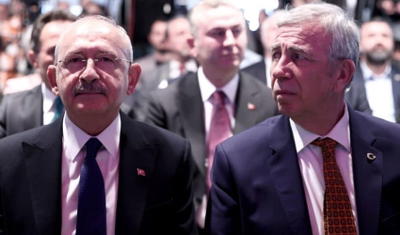
CHP statement on Kılıçdaroğlu and Mansur Yavaş
PaxSilica: The 'Technology NATO' – Where does Turkey stand?
The retiree in the inquisition chair