


The State of Turkey and autonomy in the 1921 Constitution



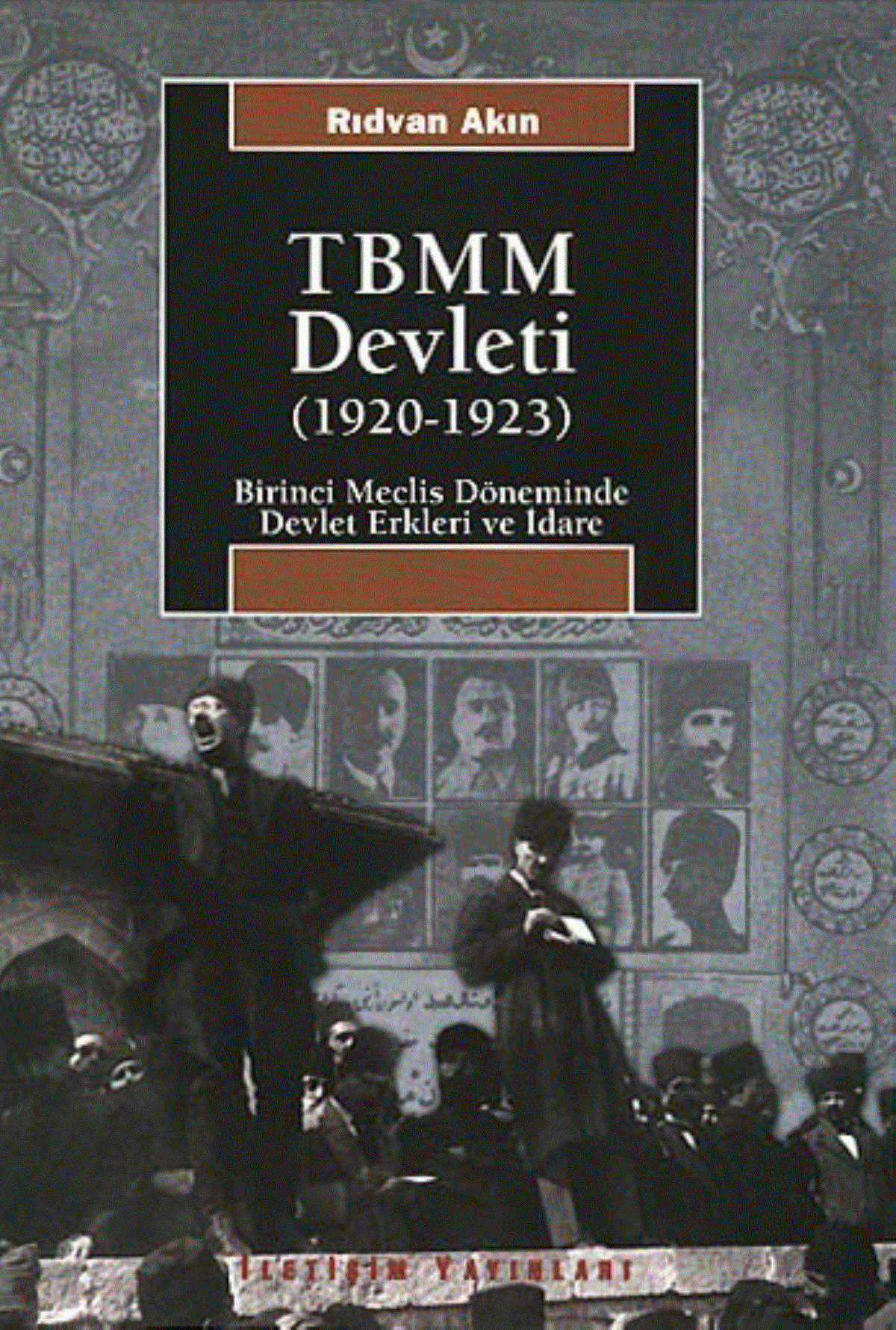
I spent the first decade of my academic life studying the first parliament. My first published article is titled “The Deliberation of the Draft Law of the Fundamental Organization of the First Grand National Assembly of Turkey.” The title of my doctoral thesis, which I defended in the field of public law, is “State Powers and Administration in the First Term of the TBMM.” I believe I have some knowledge of this period in its military, political, and legal aspects. Debates on autonomy and federation in Turkey are mostly conducted with reference to the first parliament period. In recent weeks, we have witnessed two examples of this (Z. Yapıcıoğlu and S. Demirtaş). Following these developments, I wanted to explain my own views.
A GOVERNMENT PROGRAM OR A CONSTITUTIONAL DRAFT?
The 1921 Constitution (Teşkilat-ı Esasiye Kanunu/TEK) represents one of the main milestones of our public law. First, it is necessary to look at how the Assembly that created this constitution was established. The TBMM (Grand National Assembly of Turkey) is an assembly that gathered with extraordinary powers (possessing extraordinary authority) upon the call of the Representative Committee (Heyet-i Temsiliye). It is a constituent assembly. The moment this assembly legitimized itself with Decision No. 1, a new state was actually born.
By January 1921, when the Constitution was adopted, three important laws that formed the cornerstones of the political regime had been enacted: The Law on the Election of Executive Deputies, the Candidacy Law, and the Law on the Quorum of Deliberation. The constitution of the new state established in Anatolia completed these.
This assembly, which gathered all state powers within itself, established the state of the Anatolian revolution. The republican spirit in the first nine articles of the Constitution was legitimized with populist discourse and became the harbinger of the political regime that would be declared in the near future.
The draft constitution came to the agenda as the political program of the government (Council of Executive Deputies). This program is known as the “Populism Program.” The government's appearance before the assembly with a program has been interpreted in various ways. The first of these is the political conjuncture of the period. This program can be evaluated as a response to the winds of Bolshevism that continued from May 1920 to March 1921. Indeed, during this period, alternative formations such as the TKP (Communist Party of Turkey), the People's Participation Party, and the People's Group existed outside the Association for the Defense of Rights.
The Council of Executive Deputies appearing before the assembly with such a program could, first and foremost, mean that it was accepted that parliament-government relations continued as they did in constitutional parliamentarism. Of course, such a thing could not be the case. As Dr. Tevfik Rüştü (Aras) stated, there could not be an executive committee separate from the assembly; the following explanation by Dr. Tevfik Rüştü seems sufficient to explain the political regime of the period: There is no government before us, nor are we the Chamber of Deputies. There is no executive government outside of us that has appeared before us with a program.
However, in practice, there are TBMM decisions that contradict this abstraction. For example, the “Decision on the Formation of Executive Power” dated April 25, 1920, is at the forefront of these. With this decision, a “Provisional Executive Committee” was first established, and then the Law on the Election of Executive Deputies was enacted. These decisions and laws point to the existence of a TBMM government.
Although the principle of assembly government meant that deputies (ministers) were elected individually, in practice, the existence of a party government under the presidency of Mustafa Kemal should be mentioned. The deputies were largely appointed from among the members of the unnamed Kemalist majority party. According to the study conducted by the late Professor Ergun Özbudun, the fact that 79% of the draft laws came through the Council of Deputies points to the existence of a majority party government in the assembly. This is the most important evidence that pulls the executive towards the parliamentary government line.
The Decision No. 1 regarding the Establishment of the TBMM and the decision to amend and implement the Internal Regulations of April 26, 1920 (Internal Regulations of the Chamber of Deputies) indicate that the assembly opened in an atmosphere of a Third Constitutional parliament. However, this constitutionalism did not derive its legitimacy from the monarch, but from the national will.
This assembly consists of “the members elected this time and the members who joined from the Istanbul Chamber of Deputies.” There is a TBMM decision on this matter. In other words, the assembly defined for itself who its members were. The Assembly, which had 115 members present at its first meeting, would become a crowded delegation with five new members coming from each of the 66 electoral districts. According to the data, it is estimated that there were around 360 deputies in Ankara in the summer of 1920. Since there were resignations and those who preferred civil service due to the Law on the Quorum of Deliberation, the number of those who actively participated in the negotiations was mostly below 200.
This image of a third Constitutional parliament would gradually weaken until January 20, 1921, and it would be understood that the emerging will was more radical. This would be embodied in the words of a deputy: “The Revolutionary Government has no Constitution.”
The cornerstones of the emerging political regime would be the Law on the Quorum of Deliberation (the quorum for the assembly's meeting and decision-making), laws numbered 3, 47, and 244 regarding the election and powers of the Council of Executive Deputies, and the Law on Fundamental Organization.
THE CONSTITUTION OF THE NEW STATE OF TURKEY: THE LAW ON FUNDAMENTAL ORGANIZATION
The process that would result in the Constitution first came to the agenda in the summer of 1920 as the Legal Articles on the Form and Nature of the Grand National Assembly, caused discussions in the general assembly, and the draft was rejected in the session dated August 22, 1920.
The government draft, which we can consider as a draft aimed at stopping the left-wing initiative of the People's Group, was presented to the general assembly on September 18, 1920. The Assembly formed a mixed commission and began working on the proposal.
The first four articles of the government draft, titled “Purpose and Profession,” turned into a TBMM declaration. It was accepted and announced in this way. The declaration part of the TEK is in the nature of an anti-imperialist manifesto. Like the Populism program, the declaration, as a constituent element, now speaks of the people of Turkey instead of the expressions “Islamic populace” or “majority Islamic populace.”
The draft constitution was negotiated between 27.10.1920 and 20.01.1921 (in the 95th-135th sessions). The draft law coming from the Council of Deputies underwent significant changes in the commission and the general assembly, and it became a constitution that left deep marks in our constitutional history with 23 articles and one separate article (single article). The 1921 TEK contains nine articles under the heading of fundamental articles. These articles are articles related to the regime. The remaining articles are generally devoted to administration. In this division, provinces, districts, sub-districts, and general inspectorates (regional governorships) are discussed.
The first nine articles clearly reveal the break from the old regime. Here, the principle of the unity of powers and the supremacy of the assembly is mentioned. The expression “Sovereignty belongs unconditionally to the nation” in Article 1 is proof that the constitutionalism where power was shared with the monarch no longer exists. As is known, in the Constitutional regime, sovereignty belongs to the sultan despite elections and parliament. Here, the monarch (sultan) shares part of his power with the elected. However, the TEK bases the “system of administration on the people managing their own destiny directly and in practice.”
Article 2 gives “executive power and legislative authority” to the Grand National Assembly, and all state powers are concentrated in the convention. In Article 8 of the Council of Deputies draft, there is a meaningful mention of the “People's Government of Turkey.” This expression is an expression with strong left-wing connotations. This expression was preserved in the commission draft. However, we see that this expression was removed during the negotiations of the law and the expression State of Turkey was inserted. The winds of Bolshevism of the period can be sought behind this. Perhaps the assembly preferred to draw the boundaries of the Ankara regime in this way. Here, it is no longer a government, but a state that is being spoken of. This state is a new state established on Ottoman lands.
Doubts regarding the birth of this new state would be overcome with TBMM decisions numbered 307 and 308. These decisions would declare that “Since that time, the Ottoman Empire has passed into history and a new and national State of Turkey has replaced it” and that “the TBMM is the true representative of the Rights of Sovereignty and Rule.”
Another point that should be emphasized here is Article 13 of the government draft. The system proposed in this article was rejected by the assembly. With this article, the Council of Deputies put forward a “Small Assembly (reduced) formulation.” According to this, after the first four months of the assembly's legislative term, it would separate one-third of its members by secret ballot and allow the two-thirds to leave. Until the next term, one-third of the members would remain in the assembly and continue legislative activities with full authority. In other words, the Assembly would have the character of a Grand Congress at the beginning of each meeting year. This proposal bears the traces of the Ottoman parliament. As is known, the Chamber of Deputies was an institution that worked in the period between November and March and could be dissolved when necessary by being called to a meeting by the head of state. However, it had been decided that the TBMM would be in constant session (continuously meeting) until liberation. It was contrary to the nature of things for an assembly that was in constant session and held both legislative and executive power to accept such a proposal. The proposal was rejected.
Election and representation issues were considered very important in the negotiations. The basic legislation is the Law on the Election of Deputies. In the words of Mehmet Vehbi Bolak, the TBMM was both a constituent assembly and a chamber of deputies. The members were elected by the defense of rights organizations and local administrative councils. The agency relationship in the election mandates was established this way for the first assembly.
The First Assembly wanted to tie elections to more representative principles due to Populism. There was a widespread belief that this would be possible with “representative professional” systems, which were very popular at the time. The view that imagined the assembly as a kind of professional corporation was discussed. The proposal was not accepted. The system defined by Bolu deputy Tunalı Hilmi Bey as “from here to there” as an election was also not accepted. It can be debated whether Tunalı brought his proposal to the agenda due to the influence of Bolshevism or as a method of democracy from the bottom up. As a result, the Law on Fundamental Organization adopted the principle of general representation with the provision “Each of the members of the Grand National Assembly is not a separate deputy of the province that elected him, but a deputy of the entire nation.”
PROVINCIAL AND SUB-DISTRICT ADMINISTRATION ACCORDING TO THE LAW ON FUNDAMENTAL ORGANIZATION
In the 1921 Constitution, a serious epistemological break is seen in administration. This constitution is decentralized to an extent not seen in Ottoman-Turkish constitutional history. With the 1921 Constitution, the first assembly wanted to establish a provincial democracy. The Draft Law on Sub-district Administration, which was discussed more than the constitution during this period but became obsolete at the end of the period, is a very meaningful initiative. The TEK granted legal personality only to the province and the sub-district and delegated the expansion of authority. It considered the district (county) as an administrative unit. The province envisioned by the TEK is not like the provincial administration of the Republican Era. As in our other constitutions, the governor is the representative of the state in 1921 as well. The governor is authorized to “intervene in case of a conflict between the general duties of the state and local duties.”
The governor is not the president of the provincial council. The council elects its president from among its own members. Broad powers were envisioned regarding provincial administration: The draft coming from the commission contained the expression, “The province has legal personality and full autonomy in local affairs.” However, the expression full autonomy was met with suspicion. For an administration to possess “full autonomy” would mean it is independent and autonomous. Therefore, the word full was replaced with the word autonomous.
During the negotiations, there were many deputies who looked at decentralist delegations with suspicion. For example, while Bursa deputy Operator Emin Bey said, “Transferring all administrative powers to the people in a hurry will not yield good results. If we leave our people free like this all of a sudden, I don't think it will be very auspicious,” Tokat deputy Rıfat Bey joined him with the words, “Too much expansion of authority does not bring benefit.” Some deputies expressed their concerns by saying that thousands of independent governments (communes) would be formed in Turkey with this law.
Before this law, large provinces and the districts attached to them were abolished, and all independent districts (mutasarrıflık) were made provinces. Thus, the provinces of the national struggle period became relatively small provinces. Decisions of the assembly stating that many independent districts were made provinces can be seen in the minutes.
In the meantime, it is necessary to mention a topic that was forgotten later. There are two more important draft laws during the First Assembly period. These are, respectively, the “Law on Social Organization” and the Sub-district Laws. With the Law on Social Organization, a view that was not conflict-oriented and tried to resolve class struggle with corporative unionism was put forward. Its connections with Gökalp's solidarism seem worth researching.
Sub-district administration is a topic that has been handled specifically. The Draft Law on Sub-district Administration was discussed for a very long time and became obsolete as it was not enacted until the end of the legislative term. In fact, the TEK wanted to establish an administrative structure based on the commune (sub-district) and considered this a requirement of populism. While the sub-district was seen as the smallest administrative unit in the commission report, the TEK defined the sub-district in its 16th article as “a legal entity possessing autonomy in its private life.”
As in the provincial council, the sub-district council would also consist of elected members. The sub-district council would elect a permanent executive committee and a sub-district director. The point that should be emphasized here is that according to Article 20, the sub-district administration possesses judicial, economic, and financial authority. However, the limit (degree) of these powers would be determined by a special law.
The sub-district was thought of as a union of towns or villages. Zekai Bey, an expert on French public administration, says, “Since the 17th century in France, even a village with five households is a commune in Paris,” and advocates for all settlement units to be organized on the basis of the commune.
Although the TEK handled decentralization in this way, it had established general inspectorates to prevent centrifugal tendencies. Articles 22 and 23 regulated how general inspectorates would be established. However, it cannot be said that the relations between the central state, local administrations, and general inspectorates were well defined in these articles. It is not clear whether the inspectorates were a higher supervisory body like the Ottoman Anatolian and Rumelian inspectorates or a coordination authority. The assembly did not make a legal regulation on this matter either. However, there were general inspectorates during the 1924 Constitution period (between 1927-1952). However, this is a special administration for the Eastern provinces that replaces martial law. It is a kind of state of emergency regional governorship.
ASSEMBLY, ASSEMBLY PRESIDENT, AND GOVERNMENT ACCORDING TO THE 1921 CONSTITUTION
Ottoman parliamentarism included the principle of the dissolution of the assembly by the executive. The last three Ottoman sultans also used this power. Therefore, one of the foundations of the Turkish Revolution is the principle of the continuity and non-dissolvability of the assembly. In addition to this, the TEK reduced the duration of the legislative mandate to two years. This meant bringing the deputy-constituent relationship even closer. The First Assembly must have thought of this as a requirement of populism. The TEK adopted the general representation theory and introduced the principle of the Assembly gathering on its own at the beginning of November. These were undoubtedly very radical changes.
However, the renewal of elections was tied to an additional article only for the first assembly. According to this, this assembly would continue its work without interruption (continuously) until liberation and would remain in office until the goal was achieved. When it was decided by two-thirds of the total number of members that the goal had been reached, the elections would be renewed.
As is known, the First Assembly decided to renew the elections by a simple majority. The relevant assembly decision is in the form of “The decision to renew elections has been taken.” With this decision, the assembly changed a provision of the constitution, which it had put into effect by a simple majority, again by a simple majority. As in this example, the power to make decisions, change laws, and the constitution by a simple majority points to the constituent and revolutionary character of the first assembly.
The TEK regulates the special position of the assembly president with Article 9. Unlike the assembly vice-presidents, the president is elected for one election term. That is, the assembly president in the 1st Term is the president until the second term. The presidency position to which Mustafa Kemal Pasha was brought on April 24, 1920, with 115 votes (the consensus vote of those who participated) continued until the end of the term. Since the assembly contains both legislative and executive powers, the president is the president of both powers. The expression “In this capacity, he is authorized to sign on behalf of the assembly and to approve the decisions of the Council of Deputies” points to the power of de facto head of state. This power results in performing functions such as accepting and sending ambassadors and approving government decisions. The TBMM president carries out the presidency of the legislature by signing on behalf of the assembly and the natural presidency of the executive by approving the decisions of the Council of Deputies.
The president elected by the Council of Executive Deputies from among themselves is not the prime minister of the Republic. He is a negotiation president. He is not first among equals among the other deputies. The TBMM Government maintained this structure until Rauf Orbay was elected president of the Council of Executive Deputies with Law No. 244.
DISCUSSION
There is a debate about the 1921 and 1924 constitutions that flares up from time to time in Turkey. For example, the right-wing in Turkey uses the 1924 constitution to legitimize their own majoritarian understanding of democracy. Before the AKP government, Bayar, Menderes, and Özal were the main actors of this line. In the 1921 constitution debates, there are essentially two circles. The first of these are the former Marxists-second republicans who emerged during the Özal period, who define themselves as the left-liberal circle.
They argue that Turkey entered a democratic path with the 1921 constitution and that the republic established an authoritarian regime by deviating from this path during the nation-state building process. The second circle is the ethnic Kurdish parties. According to them, autonomy was promised to the Kurds in the 1921 Constitution. But in the end, the Kemalists did not keep their promises to the Kurds, with whom they were in alliance throughout the war of independence, and turned to an assimilation policy. At the root of both criticisms is the assumption that Kemalism established a wrong republic in Turkey.
I think that how the national liberation leadership established the state has been sufficiently explained in the distinctions above. What is and is not in the Constitution has been clarified. As can be understood at first glance, the most important part of the Constitution is the fundamental articles section. This chapter defines the existing state. Here we see the break from the old regime. In the first nine articles, state powers (executive power-legislative authority) are defined in a way that leaves no room for doubt. This is followed by the administration heading. In this chapter, there is a projection for the future. The powers of these administrations, which exist partially, will be regulated by special laws to be enacted (in accordance with the laws to be enacted by the Grand National Assembly). The TEK envisioned autonomy not for a specific region but for all provinces. The limit of autonomy was drawn as “autonomy in local affairs and private life.” These local administration principles set by the Constitution can be understood by considering that the powers allocated to the central administration are internal and external politics, religious, judicial, and military affairs, international economic relations, and general taxation of the government (Internal and external politics, religious, judicial and military affairs, international economic relations, general taxation). As a result, in a political regime based on the unity of powers and the supremacy of the assembly, autonomy cannot mean political autonomy.
Would you like to get notifications about new developments and save news?
- NotificationsNew developments and breaking news
- SaveNews is stored in the app
Most Read
Statement from Nihat Zeybekci on the fund investigation

New 75,000-seat stadium plan for Fenerbahçe
Interpol and MIT tracking yields results in Izmir

ID convenience for KPSS candidates

2027 Budget: Taxes for the people, tax exemptions for capital

The reality of Akkuyu and the longing for national nuclear power

To whom and how was the Petition of Intellectuals submitted? Who accepted the petition?

The Çanakkale robbery -1- How was the Troy treasure smuggled out?

Artificial intelligence and the new imperialism

Ministry investigation into unauthorized promotional messages