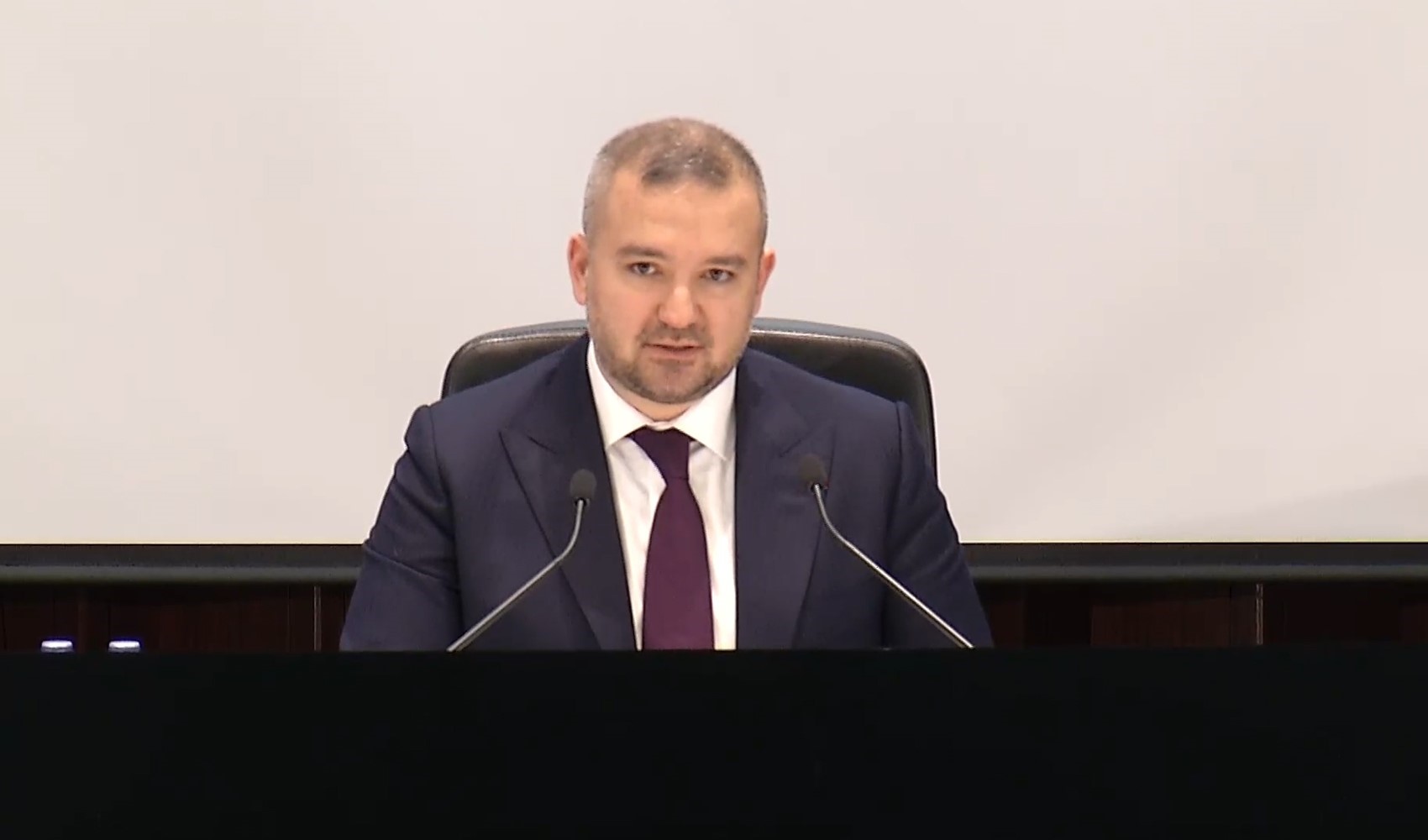
The 92nd Ordinary General Assembly Meeting of the Central Bank of the Republic of Türkiye was held under the chairmanship of Fatih Karahan. In his speech, Karahan stated that a decline in growth rates has been observed in countries to which exports are made, and that central banks are above their targets.
Karahan said, "On the production side, the services sector has emerged as the primary driver of growth. The industrial sector made a negative contribution to growth in the first half of the year due to the effects of the earthquake and the weak trend in external demand, while its contribution turned positive in the second half. On the expenditure side, while the contribution of final domestic demand remained at a high level, it declined in the second half of the year, partly due to the slowdown in private consumption growth. Our net exports, meanwhile, made a negative contribution to annual growth throughout the year due to the weak trend in global economic activity. However, with the effect of the tight monetary policy, imports decreased in the second half of the year, while our exports remained relatively strong." he stated.
While noting that the current account deficit was 45.4 billion US dollars in 2023, Karahan said, "The highest negative contribution to the current account deficit came from the energy balance. While the foreign trade balance, excluding gold and energy, made a negative contribution to the current account balance due to strong domestic demand, the positive contribution of service items to the current account balance continued to increase."he added.
"DUE TO THE EARTHQUAKE..."
He stated that the earthquake increased pressures on inflation and shared the following remarks:
"Annual consumer inflation was 64.8 percent in 2023. In the first half of the year, inflation declined due to base effects, the horizontal trend in the exchange rate, the decrease in foreign currency-denominated import prices, and the impact of energy subsidies. Thus, annual inflation was 38.2 percent in June. High rates of increase observed in credit growth due to the impact of monetary conditions, wage updates, and transfers to households made demand-side effects on inflation more pronounced in the first half of the year."
Supply-demand imbalances caused by the earthquakes we experienced in February, along with the short- and medium-term effects of reconstruction activities on public finance, increased pressures on inflation. These developments negatively affected pricing behaviors, setting the stage for inflation, which had declined in the first half of the year, to rise in the second half.
In the third quarter of 2023, the cumulative effects of the persistent strong trend in domestic demand, tax adjustments, exchange rate developments, wage increases, stickiness in services inflation, and the sudden rise in crude oil prices were influential on inflation dynamics. Furthermore, the simultaneous occurrence of multiple historically high-magnitude shocks accelerated the pass-through of these shocks to prices, causing inflation to rise significantly in the third quarter. Within the framework of these developments, inflation increased by 23.3 points between June and September, reaching 61.5 percent. In the fourth quarter of the year, with the improvement in the underlying trend, annual consumer price inflation closed the year at 64.8 percent."
Discussing the tight monetary policy process, he explained their determination to maintain a tight monetary policy until the target is reached with the following sentences:
"I had summarized the negative reflections of the strong trend in domestic demand in the first half of the year on the current account balance and financing conditions. This process, accompanied by a decrease in international reserves, increased volatility in financial markets and led to a significant deterioration in pricing behaviors. In the face of these developments, in June 2023, we initiated a strong monetary tightening process to establish disinflation as soon as possible, anchor inflation expectations, and bring the deterioration in pricing behaviors under control. In this context, we communicated to the public that we raised the policy rate, which was 8.5 percent, to 15 percent in June, 17.5 percent in July, and 25 percent in August, and that the monetary tightening process would continue until a significant improvement in the inflation outlook is achieved."
Because inflation in the third quarter of the year exceeded our forecasts and the stickiness in service prices and the deterioration in inflation expectations continued to create upward pressure on inflation, we continued monetary tightening in the September-December period and raised the policy rate from 25 percent to 42.5 percent. Simultaneously with monetary tightening, we carried out a simplification process within the macroprudential framework in a way that would increase the functionality of market mechanisms and strengthen macro-financial stability. We also supported this process with selective credit and quantitative tightening steps. In summary, we raised the policy rate by a total of 34 points from 8.5 percent to 42.5 percent in the June-December period."
When we reached January 2024, assessing that the rebalancing that had begun in inflation expectations and pricing behaviors was continuing, we raised the policy rate to 45 percent; in February, we kept it constant, taking into account the lagged effects of monetary tightening and other policy steps supporting monetary transmission."
However, the underlying trend of monthly inflation in February was higher than anticipated, led by services inflation. Taking into account the risks to inflation and the deterioration in the inflation outlook, we raised the policy rate by 5 percentage points to 50 percent in March. Furthermore, we made changes to the operational framework, deciding that the Central Bank's overnight borrowing and lending rates would be determined with a margin of +/- 300 basis points relative to the one-week repo auction rate. I would like to emphasize once again that this change is a technical adjustment made in view of the high level reached by interest rates. In other words, we will continue to use the one-week repo auction rate as the primary policy rate.
In March, the underlying trend of monthly inflation was higher than our forecasts, despite the ongoing weakening. While the trend in consumer goods and gold imports contributed to the improvement in the current account balance, other recent indicators pointed to continued resilience in domestic demand. On the other hand, financial conditions tightened significantly due to our policy actions in March. We are closely monitoring the effects of the monetary tightening we have implemented on loans and domestic demand. In this context, I would like to underline that while we kept the policy rate constant at our April meeting, taking into account the lagged effects of monetary tightening, we maintain our cautious stance against upside risks to inflation.
The effects of the monetary tightening we have been implementing since June have been observed on financial conditions and have partially reflected on demand conditions. In the second half of 2023, a significant improvement in external financing conditions, an increase in reserves, an improvement in the current account balance, an increase in the share of Turkish lira deposits, and a strengthening in demand for Turkish lira assets were observed. All these developments have contributed to a stable course in the Turkish lira and the effectiveness of monetary policy.
With the support of monetary tightening, we see that the improvement in 12- and 24-month inflation expectations, which began as of September, continues, while year-end inflation expectations are still above the forecasts we shared in the Inflation Reports.
Within the scope of simplification, we observe the effects of the decisive steps we have taken in the form of increased functionality of the market mechanism and the strengthening of the monetary transmission mechanism. In this process, while the share of Turkish lira deposits in the financial system increases, the decline in the share of FX-protected and foreign currency deposits strengthens monetary transmission as well as financial stability. The ability of the banking system to perform its intermediation function with maximum efficiency is a prerequisite for the successful realization of the disinflation process. In this framework, while implementing simplification steps on one hand, we are taking steps to support the monetary transmission mechanism in case of developments in credit growth and deposit interest rates that are outside of what is foreseen. With the effect of the monetary and quantitative tightening steps we have implemented, we expect that the total credit growth, which has slowed significantly since March, will weaken the resilient course in domestic demand. Thus, we assess that we will enter a healthy disinflation process along with rebalancing in domestic demand.
IN THE SECOND HALF OF 2024...
Pointing to the second half of 2024 for disinflation, Karahan stated that if the desired target in inflation is not reached, they will proceed more tightly. Karahan said:
"We are closely following monthly price developments. We will maintain our tight monetary policy stance until a significant and permanent decline in the underlying trend of monthly inflation is achieved and inflation expectations converge to the projected forecast range.
In the event of a significant and persistent deterioration in the inflation outlook, we will tighten our monetary policy stance. We anticipate that our resolute stance in monetary policy will lower the underlying trend of monthly inflation through the rebalancing of domestic demand, real appreciation of the Turkish Lira, and an improvement in inflation expectations, and that disinflation will be established in the second half of 2024.
As I explained in detail in the previous part of my speech, we have implemented strong monetary tightening since the second half of 2023 to establish disinflation as soon as possible, anchor inflation expectations, and bring the deterioration in pricing behavior under control.
However, the effective communication of these policies and their coordination with other stakeholders are as important as our monetary policy implementations. In this framework, we have pursued a lean, transparent, and two-way communication policy to explain the policy decisions we have taken in line with our primary objective of ensuring price stability to all stakeholders and to ensure effective expectation management."
FAST TRANSACTIONS
Touching upon the regulations made for FAST transactions, Karahan used the following sentences:
"In 2023, we took steps to use our technological and financial infrastructure more intensively and effectively. I would like to briefly mention some of these.
We strengthened the IT infrastructure for cash transactions. With the technological investments we made, we increased our daily banknote processing capacity.
In the field of information technologies, we continued our efforts in 2023 to create the necessary systems in line with our vision of a superior technological infrastructure and to ensure the security and continuity of these systems."
Considering the intense interest in the FAST system and the dynamic requirements of the payment ecosystem, we have increased the transaction limits for money transfers via FAST.
We have shared the findings obtained within the scope of the first phase of the Digital Turkish Lira Project in a comprehensive evaluation report."
THE PRIMARY GOAL IS TO ENSURE PRICE STABILITY
He concluded his remarks by stating that their priority is to ensure price stability:
"I would like to emphasize once again that the primary goal and priority of the CBRT is to ensure price stability. We will continue to determine monetary policy in line with this goal, in a way that will provide the monetary and financial conditions to bring inflation down to single digits first, and then to the 5 percent target in the medium term."
News Source: 12punto