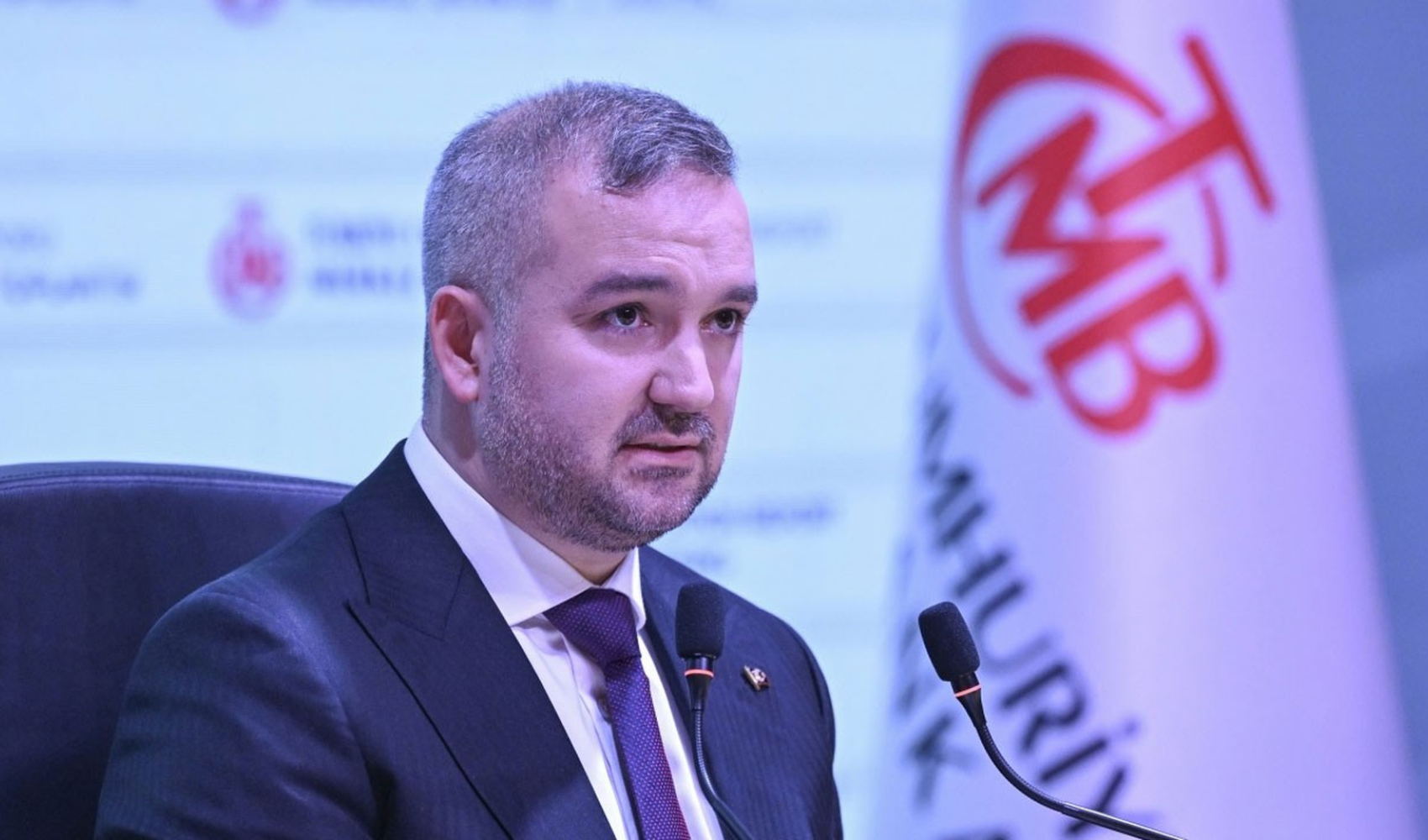
Central Bank of the Republic of Türkiye (CBRT) Governor Fatih Karahan said that different policy tools could be used to support demand for the Turkish Lira.
Karahan stated that in addition to the policy rate, liquidity and macroprudential measures could be activated if needed. He expressed that additional measures, such as withholding tax regulations, could also be on the agenda.
Evaluating the course of inflation, Karahan announced that the underlying trend of inflation, which rose to 30 percent during the US/Israel-Iran War period, fell to 24 percent in October.
Karahan made the following statements on the subject:
"This is 6 points below the current annual inflation and tells us that disinflation will be more visible if supply-side effects improve."
Stating that annual inflation may rise in November due to the base effect in food prices, Karahan said that tight monetary policy has limited the deterioration in inflation expectations following the war.
STATEMENT FROM THE CBRT REGARDING TL DEMAND
Stating that they have different tools in reserve management and liquidity policies, Karahan expressed that they have adopted a flexible and controlled approach in this area.
Pointing out that demand for the Turkish Lira has remained stable despite various shocks, Karahan stated that this situation shows confidence in the implemented policies.
Karahan said, "Our primary priority is to ensure the continuation of the disinflation process and to achieve price stability."
Expressing that in addition to the policy rate, macroprudential and liquidity tools can be used when demand for the Turkish Lira needs to be supported, Karahan noted that additional steps such as withholding tax regulations can also be taken in coordination.
Central Bank Governor Karahan gave the following answers to questions:
QUESTION: You have a busy agenda as the Central Bank. You also hosted various meetings at COP31 held in our country. How did those go?
ANSWER: Because COP31 was hosted by our country, we are on the Steering Committee of the NGFS (Network for Greening the Financial System). On this occasion, we hosted a conference in Antalya that brought together leading central banks. Climate change is no longer just an environmental issue. It is a macroeconomic risk that directly affects inflation, financial stability, and growth. As central banks, we discussed how we can better measure these effects and how we can benefit from our experiences. It was a productive meeting.
INFLATION MESSAGE FROM CBRT GOVERNOR KARAHAN
QUESTION: We are approaching the end of 2026, a year in which we have felt the effects of the war in our region closely. At the beginning of the war, you stated that there could be pressure on inflation and the current account balance due to energy prices, but that the policy steps taken could limit these pressures. How do you evaluate the course of inflation at this point?
ANSWER: In October, annual inflation was 29.8 percent. Inflation can follow a volatile course on a monthly basis. We look at various indicators to see the general trend behind these fluctuations. In some of these, we exclude certain product groups, and in others, we examine the distribution of price increases among products. Thus, we evaluate the underlying trend of inflation, that is, which direction it is moving and how widespread this movement is, more accurately. In the March-June period, when the effects of the war became evident, the indicators pointed to an increase in the underlying trend. As a result of the policies we implemented, we have seen a decline in the underlying trend again since July. When we look at it on an annualized basis, the underlying trend, which rose to the 30 percent level during the war period, points to the 24 percent level as of October. This is 6 points below the current annual inflation and tells us that disinflation will be more visible if supply-side effects improve.
One of the items supporting this improvement has been core goods. Despite negative supply-side factors, the three-month average of core goods inflation has fallen to 12 percent on an annualized basis. The decrease in inertia in services, especially in rent, also contributes to this improvement in the underlying trend. Disinflation continues in sub-items such as restaurants and hotels, which are relatively highly sensitive to demand conditions. When we look at the three-month averages on an annualized basis, services inflation has come down from 39 percent last year to 31 percent in October. Leading indicators point to this positive trend continuing in November. However, annual inflation may rise in November due to the base effect in food prices.
When we look at the risks to inflation, we see a more balanced outlook compared to the past. In the past, upward risks stemming from the war were at the forefront. Although these risks have decreased somewhat, they still remain alive. On the other hand, the slowdown in demand conditions balances the upward risks.
Finally, it is necessary to mention expectations regarding the inflation outlook. Our tight monetary policy limited the deterioration in expectations in the post-war period. Household expectations, after increasing somewhat in the first months of the year, have declined and are hovering below pre-war levels. However, the improvement we anticipated in expectations at the beginning of the year has not yet been achieved. This outlook continues to pose a risk in terms of disinflation and requires us to maintain our cautious stance.
"WE FORECAST THE CURRENT ACCOUNT DEFICIT TO BE BELOW ITS LONG-TERM AVERAGE"
QUESTION: Energy prices also put pressure on the current account balance. How do you evaluate current account balance developments?
ANSWER: High energy prices increase our import bill. The weakening of external demand also limits our exports. With these effects, the current account deficit for the last 12 months rose from approximately 30 billion dollars at the end of 2025 to 41 billion dollars in August. In September, it fell to 39 billion dollars.
On the other hand, with the strong course of tourism revenues and the slowdown in domestic demand limiting imports, the increase in the current account deficit was not as high as expected at the beginning of the war. In line with these developments, we forecast that the ratio of the current account deficit to national income will be below its long-term average in 2026.
"POSITIVE TREND CONTINUES IN INFLATION AND CURRENT ACCOUNT DEFICIT"
QUESTION: We see significant volatility in global financial markets. How do you read these developments?
ANSWER: Recently, the risk appetite of global investors has decreased. There are many reasons behind this. On one hand, geopolitical tensions keep uncertainties regarding energy supply alive. High energy inflation creates pressure for monetary policies to remain tighter for longer through the global inflation outlook. Developed country central banks have started to make additional interest rate hikes, and these hikes are expected to continue. These expectations also put pressure on gold prices.
On the other hand, uncertainties regarding artificial intelligence investments increase volatility in global financial markets. Losses in value are seen in global equity markets, led by technology. As we approach the end of the year, we see that investors are bringing forward profit realization due to these uncertainties. The portfolio and liquidity preferences brought about by this also affect the course of asset prices.
We have also felt the effects of the global outlook I mentioned through capital flows. We can clearly say that this volatility in capital flows does not stem from a deterioration in our basic macro indicators. As I mentioned a moment ago, despite the negative effects of the war, the positive trend continues in our basic macro indicators such as inflation and the current account deficit. However, non-residents who also have investments in our country can withdraw from emerging markets in some periods to compensate for their losses in other markets or to balance the risk they have taken. The losses in global capital markets, which we have seen especially in the last few weeks, have led to such a movement in our country as well.
QUESTION: There has been a decline in reserves recently. What are the prominent factors in this development? We witnessed you using your reserves proactively when the war started at the beginning of the year. Are similar operations on the agenda in this decline as well?
ANSWER: The main determinants of our reserves are global capital movements, the current account balance, and fluctuations in gold prices. Geopolitical developments also affect global capital movements from time to time. As I stated a moment ago, the losses experienced in global equity markets recently can also affect us through international investors. This year, we have seen movements in both increasing and decreasing directions in our reserves due to such effects. Under these conditions, we diversify our reserve tools with transactions such as gold-foreign currency swaps and Turkish lira-foreign currency swaps, and we use our buffers when necessary.
Gross reserves, which were 210 billion dollars in the pre-war period, reached the 159 billion dollar level on November 13. Approximately 32 billion dollars of this decrease stemmed from the gold valuation effect. In the last week, we saw an additional drop in gold prices and a rapid deterioration in risk perception in global markets. Both of these factors caused our reserves to decrease last week.
In recent years, we have observed a decline in our reserves during periods of capital outflow. With the decrease in the environment of uncertainty, we have witnessed the reserves recover strongly again. We accumulate reserves to limit the risks that temporary shocks may create on the economy and the financial system. The main role of foreign exchange reserves is to be a buffer against shocks.
As in previous periods, we evaluate that our reserves will increase again with the normalization of risk perception.
At this point, we see the limited domestic foreign exchange demand as an achievement of our policies. The fact that demand for the Turkish lira has continued stably despite various shocks reflects confidence in our policies.
Our tight monetary policy stance and macroprudential framework keep demand for Turkish lira assets strong. If it becomes necessary to support demand for the Turkish lira, we can use our macroprudential and liquidity tools, primarily our main tool, the policy rate. In coordination, other steps that will support the Turkish lira, such as withholding tax regulations, can also be taken. Our primary priority is to ensure the continuation of the disinflation process and to achieve price stability.
"THE PURPOSE OF ALL OUR STEPS IS TO STRENGTHEN PRICE STABILITY AND FINANCIAL STABILITY"
QUESTION: Gold holds an important place in your reserves. What tools do you have to use your reserves effectively?
ANSWER: As I just stated, approximately 60 percent of the decline we saw in our reserves in the period from the beginning of the war to November 13 stems from gold prices. In the additional decline in recent days, in addition to gold prices, capital outflows originating from non-residents, which I mentioned earlier, were also effective. In the past, we have seen capital inflows strengthen again when global conditions improved.
In this period, household foreign exchange demand remained limited. Despite the shocks we have experienced, I see the fact that demand for the Turkish lira has remained stable as an indicator of confidence in the policies we follow and an important achievement. Our tight monetary policy and macroprudential regulations support demand for Turkish lira assets.
As for the subject of tools, we have many instruments in terms of adjusting reserve composition and liquidity management. We follow a proactive, flexible, and controlled approach regarding our reserve management and liquidity tools.
Our country is among the few countries at the global level in terms of the diversity of domestic and international gold transactions. For this reason, the share of gold in our central bank's total reserves is higher compared to similar country central banks. The share of our gold reserves in total reserves is over 60 percent. This situation requires gold to be used as an active reserve management and policy tool in domestic and international markets. We have successfully achieved this in the recent period. After the war started, we made gold swap transactions and closed them when they matured. If necessary, we can proactively use all kinds of tools linked to gold to strengthen our foreign exchange position.
After the war started, banks began to demand swap transactions with the Central Bank again. We had restarted foreign exchange-denominated Turkish lira swap transactions. The transactions here were continuing on a small scale according to the demand of the banks. Recent liquidity developments indicate that banks can use this tool more.
If we see a weakening in demand for the Turkish lira, we evaluate its effect on the inflation outlook. The policy rate is our main tool. When necessary, we can also activate our macroprudential and liquidity tools. If needed, steps that can support Turkish lira savings, such as withholding tax regulations, can also be evaluated in coordination with the relevant institutions. The purpose of all our steps is to support price stability and strengthen financial stability.
News Source: 12punto