
Eğilmez's assessments are as follows:
WHAT IS THE BASE EFFECT?
It is the misleading effect created on the comparison period by an extreme drop or rise that occurred in the first of the two periods subject to comparison. If you drop a rubber ball to the ground, it hits the bottom when it touches the ground and then bounces to reach a peak. Then, it hits the bottom again with a slower drop, followed by another peak with a slower rise; these ups and downs continue for a while, and eventually, the ball stops somewhere.
I had previously shared the graph showing the Consumer Price Index (CPI) and the Central Bank policy rate together from January 2021 to October 2023. Let me share this graph once again (the left axis shows inflation, and the right axis shows the Central Bank policy rate). If one pays attention, a rapid rise in inflation begins following the interest rate cuts that started in September 2021. This rise is located in region A. In this region, interest rates continue to be cut. In region B, even though interest rates remain low, inflation also begins to fall. In region C, inflation starts to rise again, and this time, interest rates are also rising.
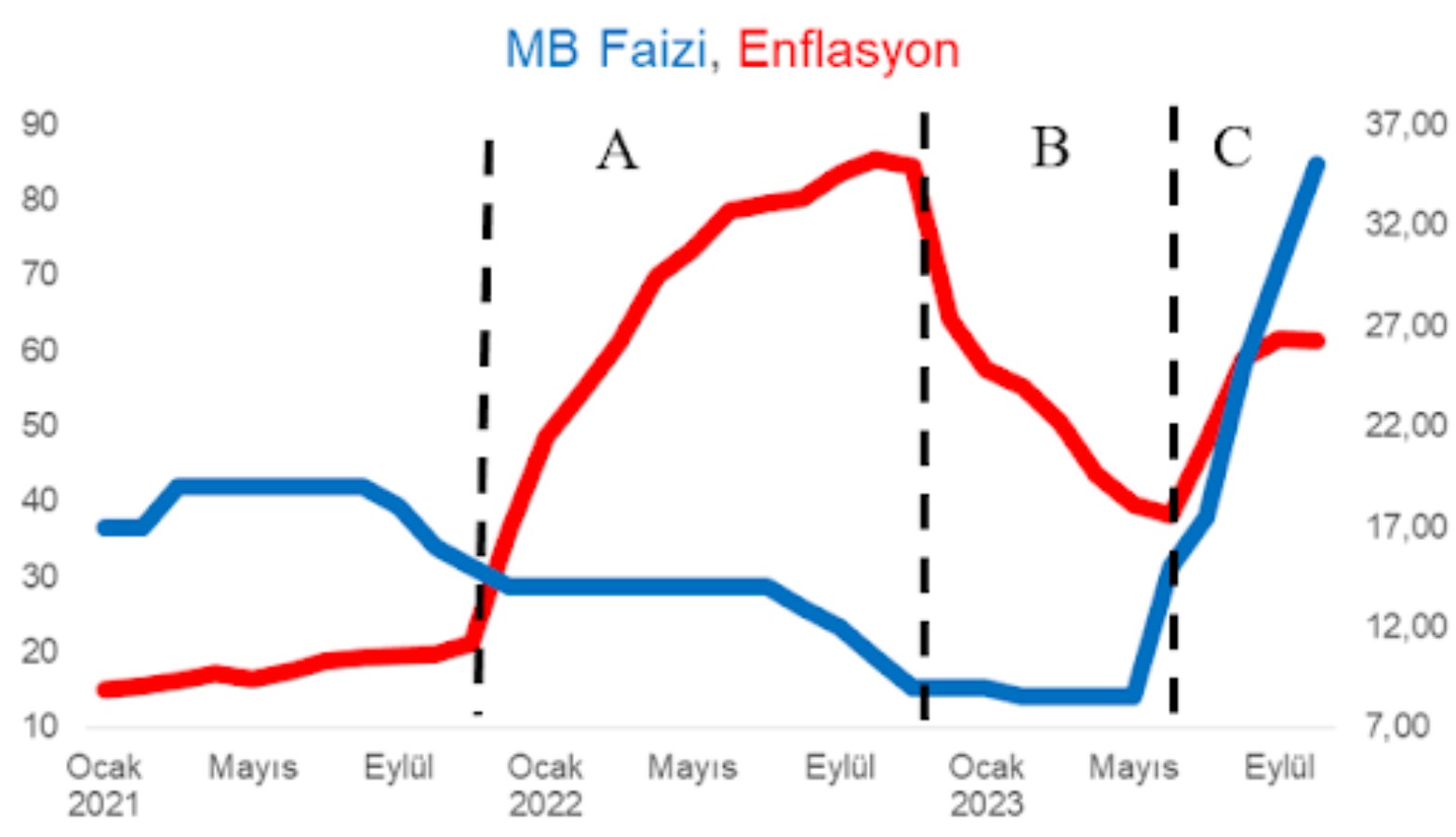
When I shared this graph on social media without dividing it into regions, I learned that some people interpreted the situation in region B as "inflation fell because interest rates remained low," which led me to the conclusion that it is necessary to explain the base effect once again.
Just like in the rubber ball example I gave when defining the base effect, the faster inflation rises, the more it moves back toward its former position once the developments causing that speed end. Let's look at the graph again: Inflation rises above its normal speed as a result of the interest rate cuts (region A). In those months, the inflation rate reaches unusually high levels. A year later, when those high rates are not repeated, inflation begins to fall (region B). This is what is called the 'base effect in inflation decline.' Once the base effect passes, and since interest rates are not raised, inflation begins to rise again at unusual rates (region C). This time, the Central Bank begins to raise the policy rate to curb inflation, and inflation eventually begins to turn downward.
Let's go back to the beginning. If, when inflation was 19 percent and the Central Bank policy rate was 19 percent, interest rates had been raised by one or two points instead of being cut, inflation in Turkey would be at a level one-third of what it is today, income distribution would not have deteriorated this much, and the wage-earning segment would not be complaining so much.
The practice implemented starting in September 2021 regarding inflation and interest rates, which was based on the belief that low interest rates would reduce inflation, is a major economic policy error. Trying to explain or interpret this error as if it were not an error, or even as a good thing, by looking at inflation falling due to the base effect, is something that goes beyond being just an error.
News Source: Gizem Yaralı