INITIAL PROCEDURES BY THE PRESIDENCY/ADMINISTRATION/TOKİ
Depending on which unit will carry out the implementation, a sequence must be followed by the Presidency, the Administration, or TOKİ. First, in order to ensure zoning and construction, a program must be created, and at the very least, the current situation must be preserved and new construction prevented to allow for the planning of new development. To this end, zoning and construction activities must be temporarily halted in the designated reserve areas.
The Presidency, or TOKİ or the Administration if they are executing the implementation, may temporarily halt all kinds of zoning and construction activities in risky areas and reserve building areas for a period of TWO YEARS. If the implementation requires it, the temporary suspension of zoning and construction activities may be extended for ONE MORE YEAR. In fact, considering that many deadlines are kept quite short, it is observed that this period is kept quite long.
Properties determined by the Presidency to have not been used in accordance with their purpose within three years from the date of allocation and transfer, and within the extended period where deemed necessary, cannot be sold, leased, allocated, or subjected to preliminary permits or easements until the transfer procedures are finalized. If this provision is not applied, new legal consequences may arise, and there is a possibility of experiencing yet another procedure that must be overcome. Therefore, this regulation was introduced based on the principle of preserving the current situation.
During the implementation, if requested by the Presidency, TOKİ, or the Administration, and after taking the opinions of the rights holders, electricity, water, and natural gas will not be provided to structures in areas covered by this Law and to risky structures, and the services provided will be stopped by the institutions and organizations. This is a regulation closely related to people's rights and freedoms to live. Therefore, taking the opinions of the rights holders is an important regulation in terms of the specific characteristics of each region, the risk levels of existing buildings, and the provision of physical and vital needs until the evacuation of individuals is completed.
WHAT WILL BE THE SUPPORT PROVIDED TO PROPERTY OWNERS?
Since the high interest of the public is taken as the basis, we have mentioned the limitations on individuals' property rights and even the provision that the relevant properties will be disposed of by institutions and organizations.
Risky buildings, whether through agreement with owners and rights holders or by determining the risk status ex officio and evacuating them, can open the doors to a different life that owners might not even imagine by carrying out renewal, a new settlement order and organization, and if necessary, relocation to a different geography, etc. First and foremost, the buildings accepted as risky will be removed from their disposal, demolished, perhaps there will be on-site transformation, but perhaps they will have to leave the region where they live. Although it does not sound pleasant at all, there is a possibility that such events will occur. Some procedures have been envisaged for this implementation to take place.
In the demolition of risky structures and in the applications in the areas where they are located, as well as in risky areas and reserve building areas, it has been accepted as a principle to primarily seek an agreement with the owners.
For the *owners, *tenants, and *holders of limited real rights on the condition of residing in the structure of the buildings evacuated by agreement, temporary housing or workplace allocation or rental assistance "and assistance for construction" may be provided.
"The procedures and principles of the assistance to be provided for construction will be determined by the President." The relevant institution will propose suitable spaces for temporary workplace or housing allocation. Rental assistance should be an amount that we hope will be determined according to current conditions. Especially in environments where disasters occur, since the values of scarce resources will increase, rental prices unfortunately reach exorbitant figures for buildings that can remain standing. It would be appropriate for the amount to be determined as rental assistance to be updated in accordance with these realities.
If the implementation requires it, temporary housing or workplace allocation or rental assistance "and assistance for construction" may also be provided to persons who are not *owners, *tenants, and *holders of limited real rights on the condition of residing in the structure but who are using the structures within the scope of the Law. Who could these people be? For example, parents living with their children, people who have taken refuge with their siblings because there is no other settlement opportunity, distant relatives or non-relatives who reside with a family for the purpose of mutual assistance even though they are not family members, etc., can be listed.
The procedures and principles of the agreement to be made with the owner, the holder of real rights, or the group just mentioned, the provision of assistance to them, the payment of debris value, and the interest support to be provided from the special account of transformation projects for the loans they will use from banks will again be determined by the President.
For the demolition of risky structures, the owners of these structures are given a period not exceeding NINETY DAYS. If the structure is not demolished by the owner within this period, it is notified that the structure will be demolished by administrative authorities. If the owners do not proceed with the demolition within this given period, the evacuation of these structures from people and belongings and the demolition procedures are carried out or caused to be carried out by the local administrative authorities with the participation of local administrations, with the demolition costs and other necessary assistance and loans primarily covered by the special account of transformation projects. Under all circumstances, risk assessment, evacuation, and demolition expenses will be demanded and collected from the owners in proportion to their shares.
The demolition of risky structures determined not to have been demolished in time according to the procedure explained above is notified to the Administration in writing by the Presidency, and these structures are demolished/caused to be demolished by the Administration. If the implementation requires it, the Presidency may also personally carry out the assessment, evacuation, and demolition work and procedures mentioned in the paragraphs above. In case the evacuation of the structures within the scope of the Law is prevented; upon the request of the Presidency/Administration, the evacuation is carried out or caused to be carried out by opening or having the locked doors/areas opened by sufficient law enforcement officers based on the written permission to be given by the local administrative authority. The costs of risky structure assessment, evacuation, and demolition made or caused to be made by the Presidency or the Administration are collected from the owners in proportion to their shares in accordance with Law No. 6183.
Considering the urgency of the situation and perhaps even the conditions where notifications become impossible due to the disaster, an application very different from the current legislation regarding notifications has been regulated in this law.
The notification to be made to the holders of real and personal rights regarding the evacuation and demolition of the structures within the scope of the Law is made by hanging the minutes regarding the evacuation and demolition on the structure, notifying the owners via the e-Government Gateway, and announcing it at the relevant headman's office (muhtarlık) for fifteen days. The procedure regarding evacuation and demolition is deemed to have been notified to the holders of real and personal rights on the last day of the announcement made at the headman's office. The structures requested to be evacuated are also announced on the Presidency's website for fifteen days.
Keeping the periods very short, taking the announcement as the basis instead of personal notification, and procedures such as sending notifications via e-government despite the high probability that internet access may be impossible under current conditions will not, in essence, be sufficient for individuals to truly learn about the evacuation and demolition process subject to notification. The rule is that notification is made against signature. Although procedures other than this rule pose a risk for true notification, other issues have had to be ignored due to the extraordinary nature of the conditions. It is clear that this also carries the risk of experiencing grievances.
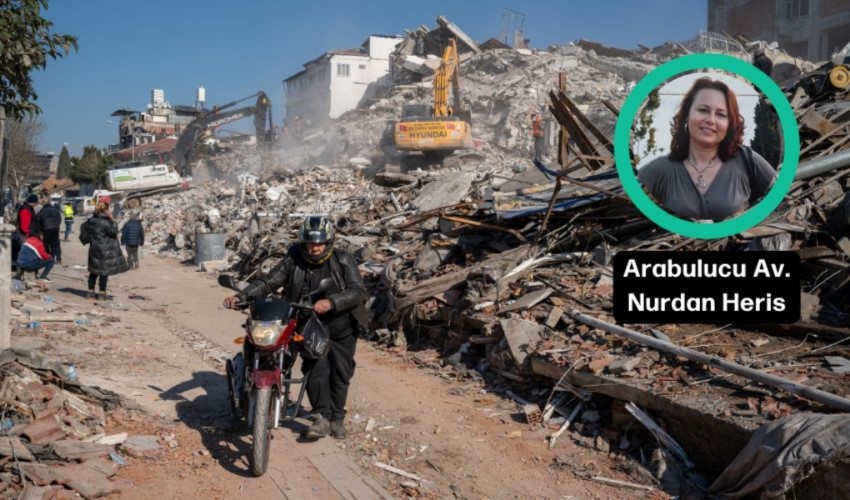
Mediator and Attorney NURDAN HERIS
News Source: 12punto