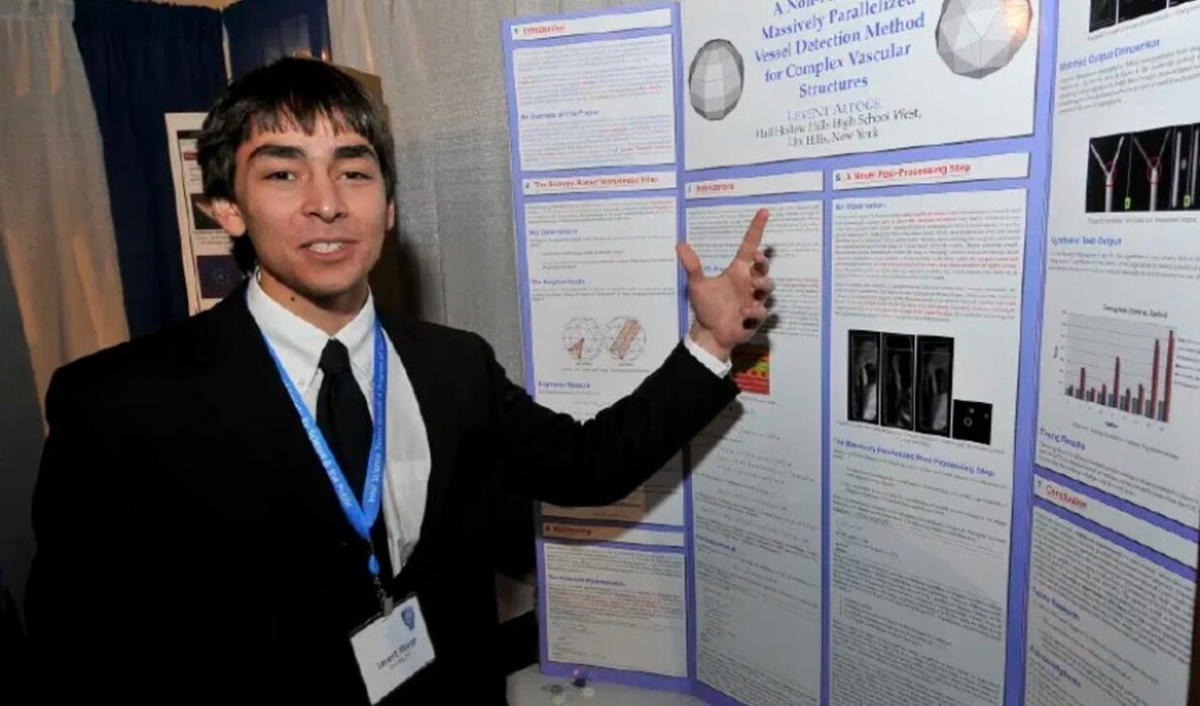
Levent Alpöge, a researcher at the AI company Anthropic, has claimed to have proven the Riemann Hypothesis, one of the most important open problems in mathematics, with the help of the company's AI model Claude.
In a four-page note he published, Alpöge stated, “I believe that by working with Claude, I have found a proof of the Riemann Hypothesis.” Although the claim has caused a stir in the mathematical world, it has not yet been verified by independent experts; the proof must undergo peer review and detailed examination processes.
The hypothesis, proposed by German mathematician Bernhard Riemann in 1859, is based on a fundamental question regarding the distribution of prime numbers. The problem is considered one of the greatest unsolved topics in pure mathematics. Alpöge stated that his method covers not only the classical Riemann Hypothesis but also the more comprehensive Generalized Riemann Hypothesis.
PROOF PREPARED WITH CLAUDE AND LEAN
According to Alpöge, the version of the proof shared at this stage was written in the Lean programming language, which allows mathematical arguments to be verified in a computer environment. The researcher noted that the full-length written text would be very long, that he has not yet fully mastered all the mathematical details in the work, and that he plans to write the text in due form later.
Brian Conrey, one of the experts in the field of the Riemann Hypothesis, described the development in an assessment for AFP as “a very big moment in human history.” Conrey said he had not yet seen the written draft, had only read the notes on Alpöge's website, and had requested a copy of the text.
Conrey remarked, "It looks seriously complicated. I don't think any human has come close to finding this."
TWO-YEAR REVIEW REQUIREMENT FOR ACCEPTANCE
The Riemann Hypothesis is one of the seven Millennium Prize problems announced by the Clay Mathematics Institute in 2000. The institute offers a 1 million dollar prize for the solution of each of these problems. However, for a solution to be accepted, it must be published in a peer-reviewed journal and successfully pass a two-year review process.
In August, Anthropic announced that an unreleased version of Claude had improved upon a long-known result related to the Riemann Hypothesis, but specifically emphasized that this did not mean the hypothesis had been proven.
Alpöge also stated that he consulted with Anthropic CEO Dario Amodei before announcing the result. The researcher acknowledged, without going into detail, that the timing of the announcement might be met with skepticism. The statement in question came immediately after Anthropic's record-breaking first day of trading on the stock market.
Discussions regarding the role of artificial intelligence in mathematics have also been brought back to the agenda with this claim. Nestor Guillen of New York University found it positive that Alpöge clearly stated he did not yet fully understand the proof, and assessed that the described work process positions artificial intelligence “more as a tool.”
News Source: 12punto