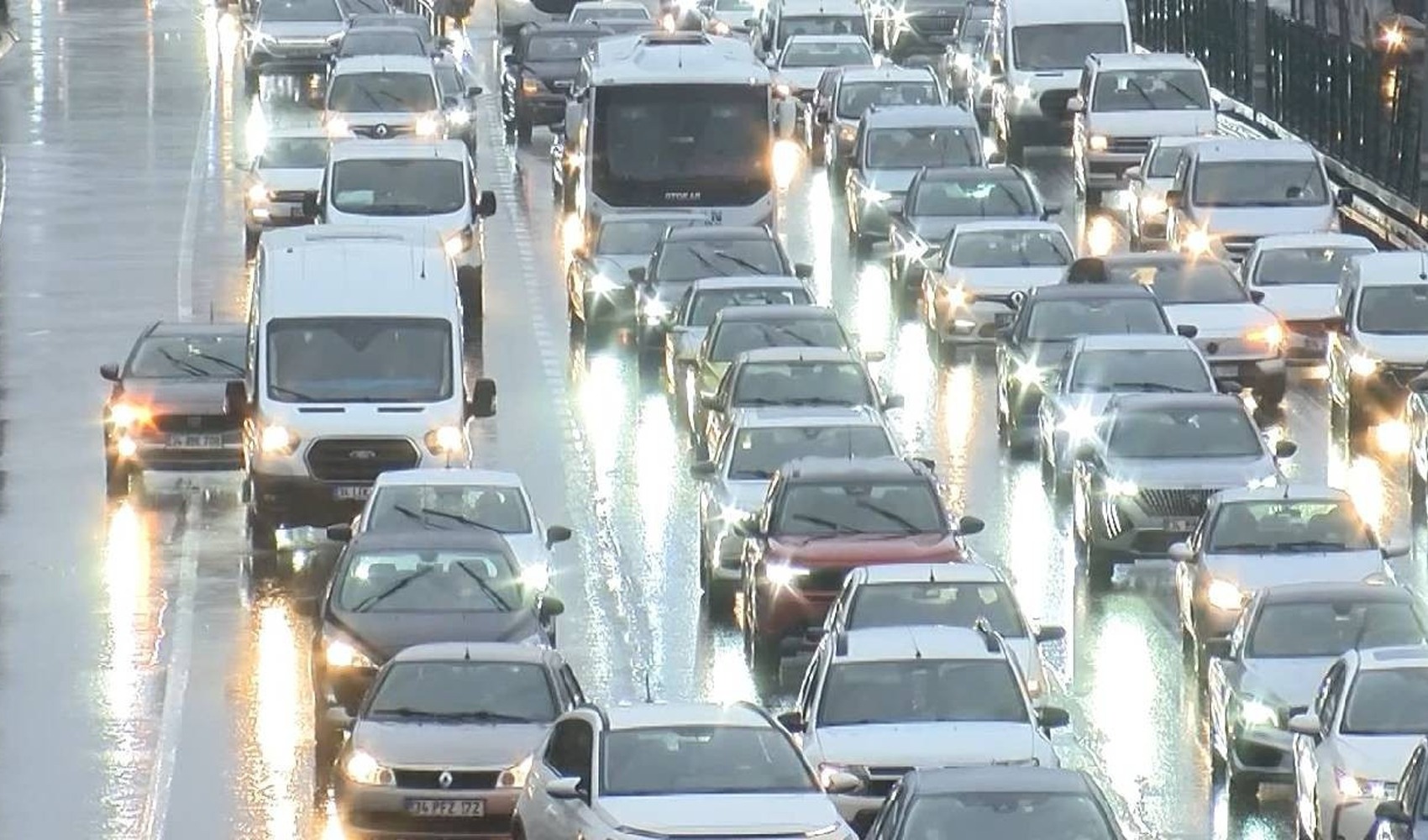
Traffic density in Istanbul increased significantly during the morning hours on the third workday of the week. As rainfall added to the movement of those heading to work and school, vehicles struggled to move along main routes on both the Anatolian and European sides.
Congestion occurred on the D-100 highway, the TEM Motorway, connecting roads, and bridge crossings. Traffic flow slowed down at times at the connection points of the 15 July Martyrs Bridge and the Fatih Sultan Mehmet Bridge.
On the Anatolian Side, traffic came to a standstill in both directions on the Göztepe-Kozyatağı section of the D-100 highway. Density was also observed at some points between Maltepe-Kartal and Pendik-Tuzla.
On the TEM Motorway, it was observed that the congestion starting in Sancaktepe in the direction of Edirne extended to Ataşehir, while vehicles moved slowly from Ferhatpaşa to Sultanbeyli in the direction of Ankara. On the Şile Highway, traffic moved slowly from the Ihlamurkuyu location to the 15 July Martyrs Bridge in the direction of Üsküdar.
Congestion for the transition to the Fatih Sultan Mehmet Bridge began in Kozyatağı, and for the transition to the 15 July Martyrs Bridge, it began in Ataşehir. On the European Side, traffic moved slowly between Beylikdüzü-Bakırköy and Zeytinburnu-Şişli on the D-100 highway in the direction of Ankara. Density also formed between Gaziosmanpaşa and Kağıthane on the TEM Motorway in the direction of Ankara.
The slowdown in traffic was also reflected at public transport stops; the number of passengers waiting at the stops was seen to have increased. According to the Istanbul Metropolitan Municipality traffic density map, density across the city reached 78 percent. The rate was measured at 89 percent on the Anatolian Side and 71 percent on the European Side.
News Source: 12punto