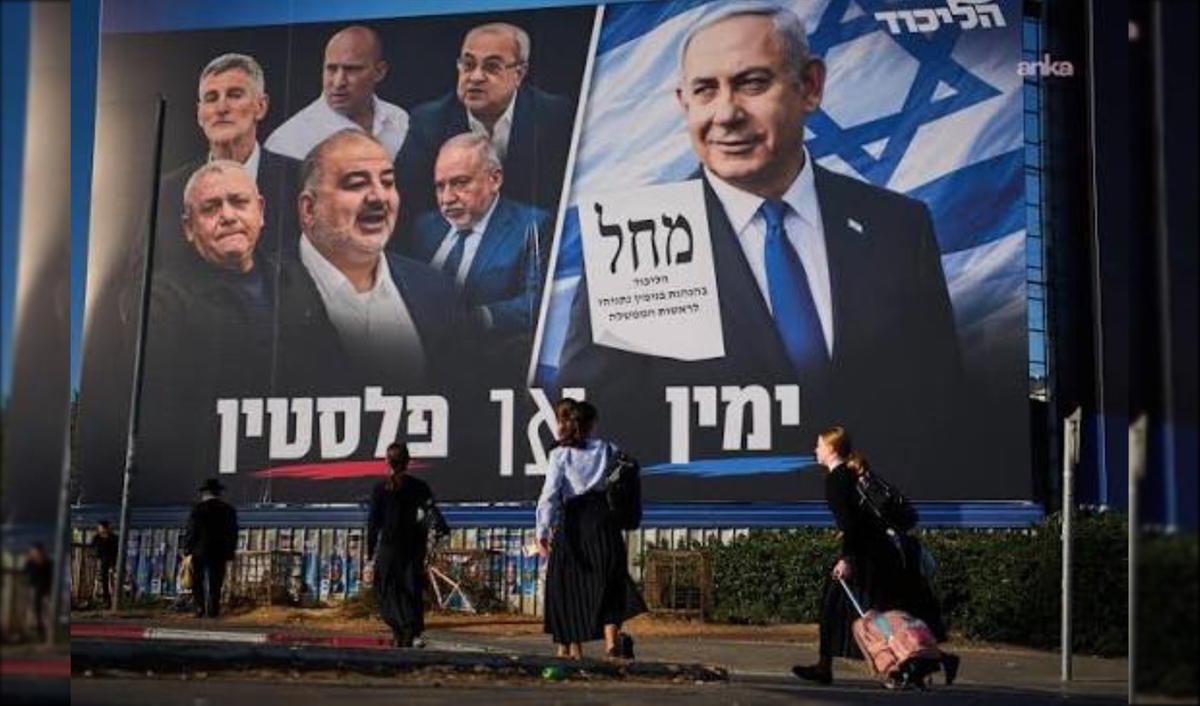
In the first general election held in Israel following the start of the war in Gaza and the genocide, exit polls have revealed that the government led by Prime Minister Benjamin Netanyahu has lost its parliamentary majority. Exit polls showed that in the 120-seat parliament, Eisenkot's bloc won 52 to 53 seats, while the Netanyahu bloc remained at 50 seats. The number of seats held by Arab parties was between 17 and 18.
According to the exit poll by Israel's public broadcaster KAN, Netanyahu's Likud party won 25 seats, while Eisenkot's Yashar party won 21 seats. On the other hand, the total number of seats obtained by the anti-Netanyahu bloc led by Eisenkot surpassed the coalition led by Netanyahu. The results showed that there was no clear winner in the elections and that neither of the two main blocs reached the 61 seats required for a majority.
Evaluating the results, Eisenkot said the outcome showed that Israeli citizens do not trust Netanyahu and his government. Eisenkot announced that he would take action as soon as possible to form a government.
Foreign Minister Gideon Saar, in a statement released via social media, said, "It is too early for the left to celebrate. The smugness of biased commentators is ridiculous. What is clear is that Likud is Israel's largest party."
"NETANYAHU BLOC SUFFERED A CRUSHING DEFEAT"
Main opposition leader Yair Lapid stated, "Do not let anyone confuse you. The Netanyahu bloc has suffered a crushing defeat. This is a complete collapse, and the public has told them to go home."
At the election headquarters of the Joint List, an alliance of Arab parties, the announcement of the exit polls was met with whistles and applause. Arab parties, which obtained a total of ten seats in the 2022 elections, are expected to increase their seat count by 7 to 8 seats according to current results.
If the official results of the general election remain the same, both blocs are expected to begin efforts to form a coalition, and Israeli President Isaac Herzog is expected to task the candidate with the strongest chance of forming a government with the mandate to do so.
NEW ELECTIONS MAY BE HELD WITHIN A FEW MONTHS
While it is possible that former Chief of General Staff Eisenkot may attempt to form a minority government with the support of two Arab parties, it is not yet known whether all of Eisenkot's political partners will accept this.
If both sides fail to succeed, Israel is expected to head to the polls again within a few months, and there is a possibility that the country could be dragged into a political crisis process similar to the 2019-2022 period, during which five elections were held.
News Source: 12punto