
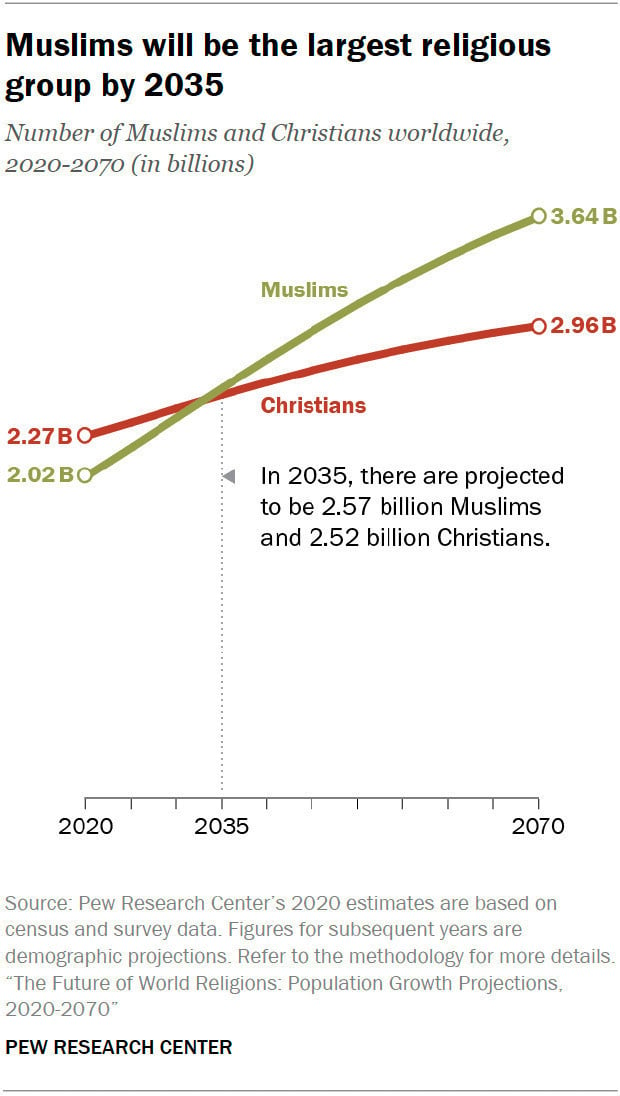
New population projections from the Pew Research Center indicate that a remarkable shift could occur in the global religious population rankings by 2035. According to the research, the number of Muslims is expected to surpass the number of Christians in the coming years, becoming the world's largest religious community.
The study examines global religious population changes for the 2020-2070 period. According to Pew's calculations, Christianity remains the largest religious community today; however, due to the faster growth of the Muslim population, this picture is projected to change by 2035.
DEMOGRAPHICS ARE THE MAIN REASON FOR THE CHANGE
The projections state that the determining factors are birth rates and the age structure of religious communities. For the 2020-2025 period, the average fertility rate per Muslim woman was calculated at 3.1 children. This rate was measured at 2.5 for Christian women and 1.6 for the total of other groups.
According to Pew, the Muslim population is expected to increase by approximately 1.6 billion people between 2020 and 2070 due to natural growth resulting from the difference between births and deaths. The projected natural increase for the Christian population in the same period is given as approximately 792 million people.
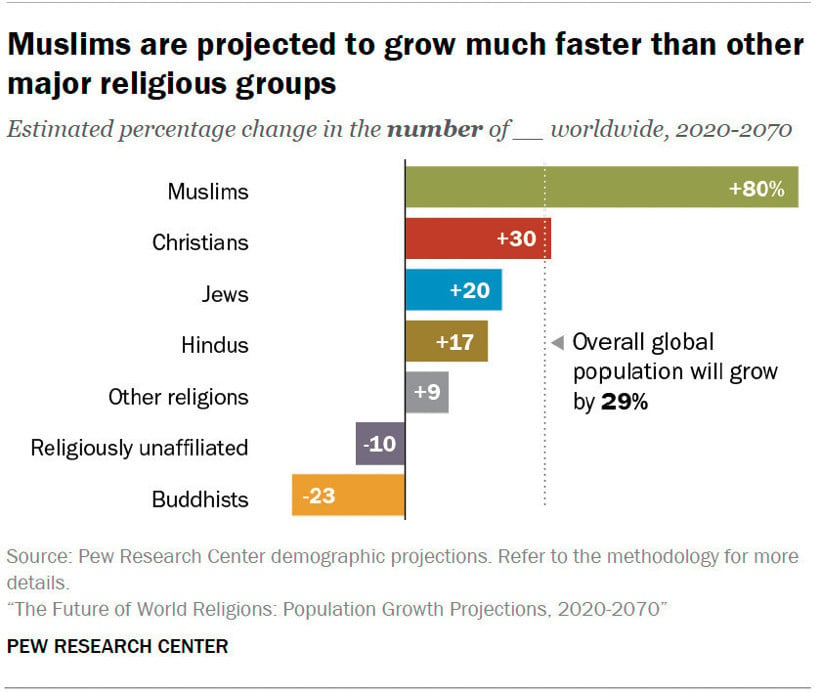
The research emphasizes that the Muslim population becoming the largest religious community does not mean that the Christian population will decrease in absolute terms. Pew's projections state that the populations of both communities will continue to grow, but the difference in their growth rates will change the global rankings.
The study was prepared using data obtained from 201 countries and territories, covering 99.98 percent of the world's population. The projections took into account censuses, surveys, fertility rates, migration movements, and changes in religious affiliation.
Pew also notes that the calculations are based on demographic trends and that wars, pandemics, natural disasters, and major social changes could affect future religious population distribution. The study was conducted in collaboration with researchers from the Center for Population and Religious Studies at the Krakow University of Economics.
News Source: 12punto