The report, titled Nigeria: Lifting the Lid, analyzes internal company emails, audit reports, and confidential assessments that emerged during lawsuits filed against Shell in the United Kingdom, revealing a scandal far greater than previously reported. While Shell claims its operations comply with global standards, the documents point to issues such as allegations of complicity in oil theft raised by the Nigerian military, suspicions of collusion between personnel and contractors, exemptions from safety standards, persistent neglect of pipeline integrity risks, missing well data, and faulty leak tracking.
Shell was aware of the risks of its aging and leaking infrastructure, including an old pipeline known internally as a "sieve," but did not stop the flow of oil. Instead of covering the massive cost of cleanup and decommissioning—which internal estimates placed at $10.9 billion—the company ended its onshore operations. 375 square kilometers of mangrove forest have been damaged. Amnesty International shared its findings with Shell on July 3. Shell responded: "Your characterization and description of Shell are not accepted by us. Shell is committed to the principles of honesty, integrity, and respect for people and conducts its business in an ethical and transparent manner."
Reminding that Shell is one of the world's largest investor-owned fossil fuel companies, Amnesty International Nigeria Director Isa Sanusi said:
"For many years, Shell blamed oil theft and sabotage for the pollution in the Niger Delta. The public denial that has continued for years is now being debunked by its own documents. The scandal is not just illegal 'bunkering' or oil theft. The real scandal is that Shell pursued profit at the expense of people's rights. In Nigeria, Shell was prepared to accept environmental damage that would never be tolerated elsewhere. The issue is whether governments will take action by considering these documents. Nigeria must comprehensively review its oil industry oversight process, while UK and Dutch authorities should investigate whether Shell misled shareholders, regulators, and affected communities about the true state of its liabilities. Shell must stop hiding behind the divestment, fund the cleanup and compensation processes, and ensure that affected communities finally gain access to justice."
The report was published in collaboration with The Corner House, Hawkmoth, HEDA Resource Centre, Kebetkache Women Development & Resource Centre, Miideekor Environmental Development Initiative (MEDI), Recommon, Social Action, and Amnesty International. The findings confirm what has been stated for decades: while oil pollution damages water, farmland, fish farms, health, and livelihoods, companies have continued to profit and deny responsibility.
Shell's potential role in oil theft, rule violations, and inadequate infrastructure
According to the documents, even when Shell blamed criminal gangs for oil theft, senior employees allowed illegal taps to remain on pipelines because "the system would be down for a long time," meaning profitable crude oil flows would be temporarily halted. A senior Shell executive wrote in 2013 that this led the Nigerian security force responsible for pipeline security to accuse Shell of being "complicit" in oil theft, explaining, "Because we are not removing the bunkering points." A Shell presentation asked the question: "Are we comfortable with continuing production knowing that further environmental damage WILL OCCUR?"
The report also reveals that Shell exempted its Nigerian subsidiary, the Shell Petroleum Development Company (SPDC), from key elements of global health and safety standards. This allowed oil to continue flowing through compromised pipelines even when they were assessed as unsafe. This was an approach that the senior Shell official apparently acknowledged would not be tolerated elsewhere. Internal documents show that Shell managers suspected some employees and contractors were involved in oil theft. An internal email stated, "We must operate on the assumption that bunkering contractors have easy access to SPDC planning data." A 2012 review found that SPDC flowlines were supposed to be replaced every 15 years but this was "not implemented," with only "breakdown maintenance" being performed.
"Lost" oil wells, poor tracking, and faulty leak monitoring
An internal report prepared for Shell's then-CEO in 2014 stated that "hundreds" of SPDC's onshore wells were not in the electronic well tracking system or their status could not be verified. In a subsequent "well integrity campaign" launched by Shell, 750 overdue maintenance tasks were identified, leading to an "inadequate" rating in audit scores. A 2013 report determined that SPDC did not have a real-time monitoring system for its pipelines. Without such tracking, anything other than a major rupture could go unnoticed.
Shell's claim that oil theft is the primary cause of pollution was also debunked by its own documents, which show that personnel lacked sufficient equipment to determine whether leaks were caused by corrosion or third-party interference. This is significant because companies are required to clean up leaks regardless of the cause, but under Nigerian law, communities are only entitled to compensation when it is determined that leaks were caused by operational failures rather than sabotage or theft.
"Sieve" pipeline not cleared of crude oil
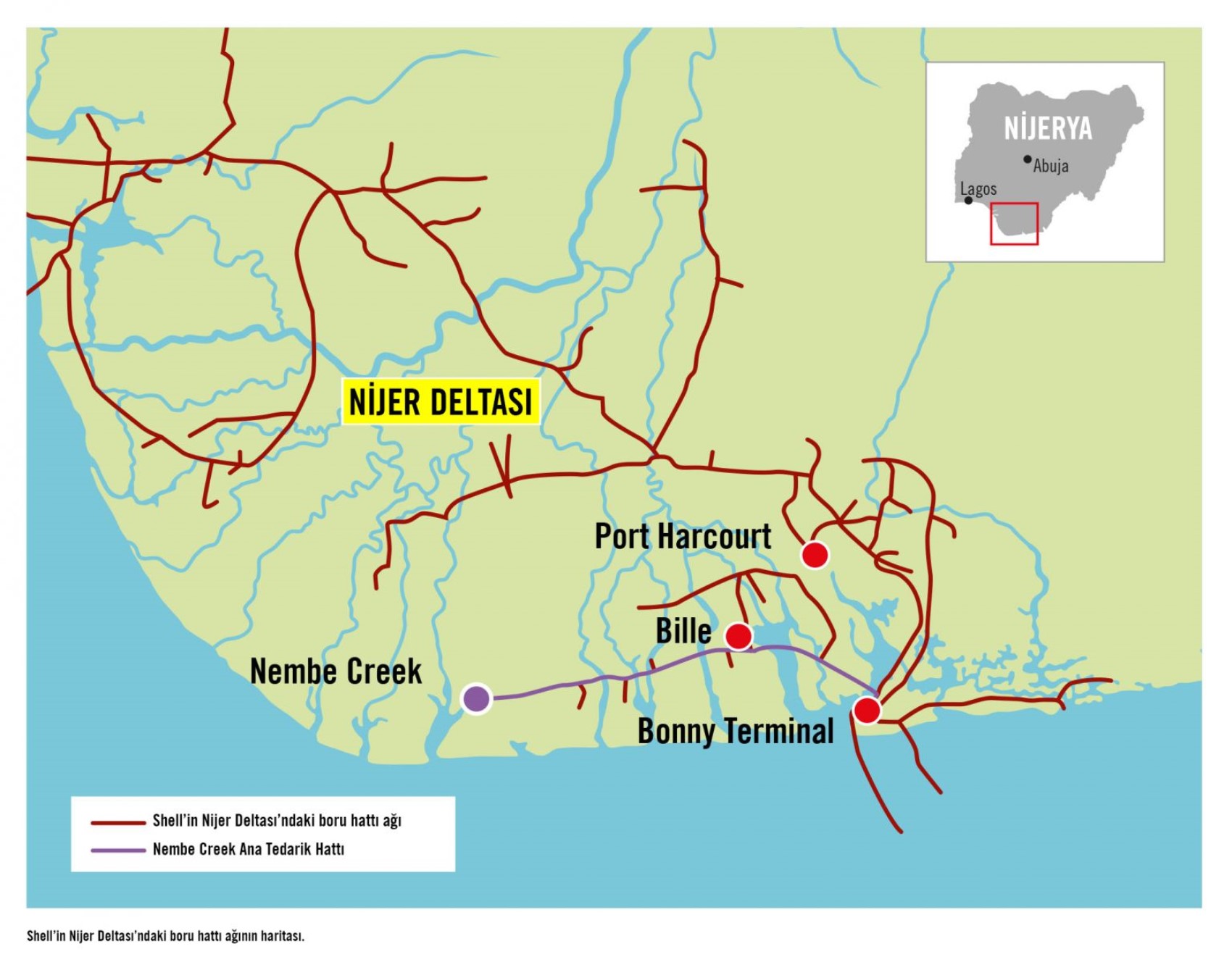
The report shows that Shell did not properly decommission the old Nembe Creek Trunk Line after replacing it in 2010. A 2014 internal email stated that approximately 80 kilometers of the old pipeline were still full of stagnant crude oil, that six operational leaks had occurred since 2010, and that these sections could not be decommissioned due to budget constraints. The email used the term "sieve" for the pipeline and warned that if urgent measures were not taken, further leaks would occur. The response to the email acknowledged that measures needed to be taken to reduce environmental impact and liability, but the reason for not decommissioning was largely financial.
In an internal report sent to the then-Shell CEO in 2014, it was stated that decommissioning all existing SPDC assets would take decades and cost $10.9 billion. This amount, which does not include cleanup costs, is equivalent to $14 billion today. Another internal presentation on past oil spills noted that 375 kilometers of mangrove forest were affected and asked whether Shell had the "appetite" to deal with this "open-ended problem." Shell later sold SPDC to Renaissance Africa Energy in 2025, despite concerns about the new company's capacity, limited public financial information, and the need for a $1.2 billion secured loan from Shell to support the sale.
Isaac Osuoka, director of Social Action, a civil society organization working on environmental justice, community rights, and accountability in the Niger Delta, commented: "Shell's divestment cannot be a corporate escape route. After profiting from Niger Delta oil for decades, Shell cannot offload the risks of aging infrastructure and legacy pollution onto communities or a buyer whose capacity remains subject to serious questions. Whether it has the 'appetite' for accountability or not, Shell must pay its share."
Amnesty International and partner organizations are calling on Nigerian authorities to comprehensively review the oil industry oversight system, mandate accessible audits for all active and decommissioned infrastructure, and establish a well-resourced Niger Delta Cleanup Fund.
News Source: 12punto