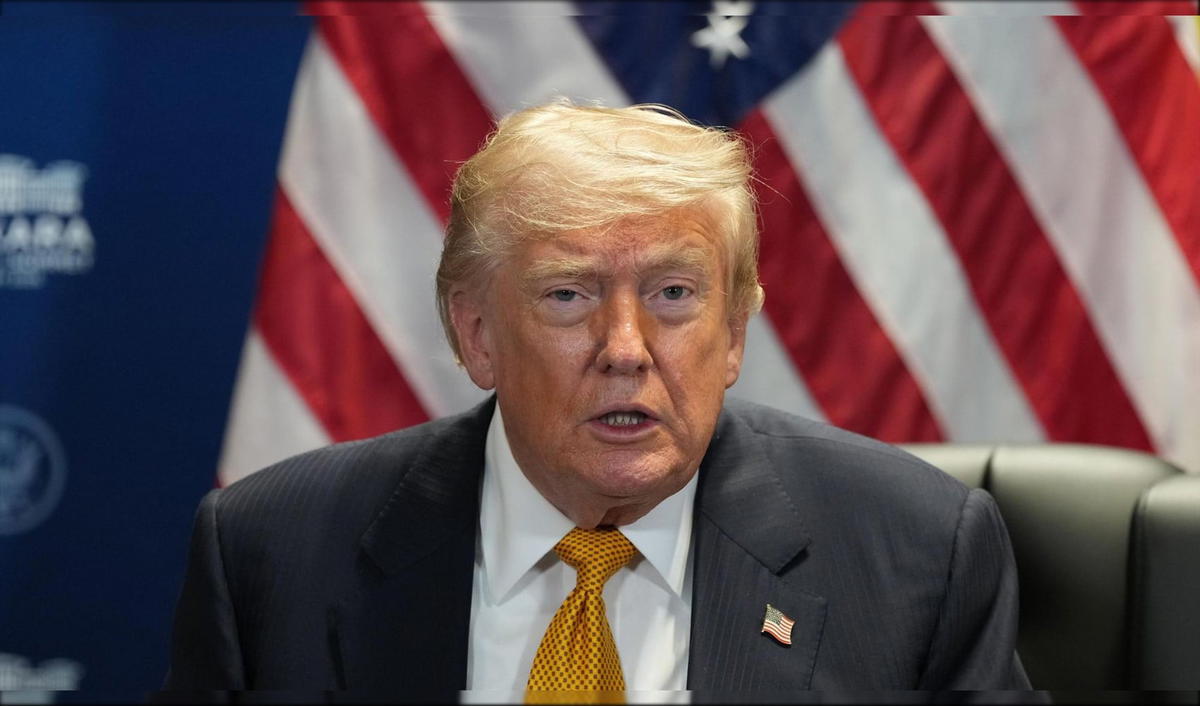
The Washington administration, led by U.S. President Donald Trump, has proposed new tariffs on 14 trading partners, citing the need to combat "structural overcapacity" in industry. The announcement follows the conclusion of an investigation launched by the Office of the United States Trade Representative—the presidential agency that sets U.S. foreign trade policy—into allegations that certain countries have created production capacity exceeding market demand through state subsidies, thereby harming American industry.
Following an 8-month investigation, the Trump administration proposed today that new tariffs of up to 20 percent be applied to China, the European Union, and 12 other major U.S. trading partners, to take effect next year.
With the new proposal, the 20 percent tariffs on Chinese products would be added to existing tariffs, meaning the highest total tax burden is projected to be applied to China.
A U.S. official who briefed reporters before the announcement said, "We know China doesn't like these steps, but we are looking for stability with them. China is also looking for stability with us." The official also stated that the meeting Trump held last week with Chinese President Xi Jinping went "really great."
The official explained that the new tariffs would not go into effect without additional sessions and the completion of a public comment process. The U.S. official also stated that this would "likely happen in January at the earliest."
Countries targeted by the new tariffs
The senior U.S. official said the administration has proposed tariffs on the European Union, Bangladesh, Indonesia, South Korea, India, Switzerland, Japan, Cambodia, Malaysia, Singapore, Thailand, Taiwan, and Vietnam, in addition to China. No steps are currently planned for Mexico and Norway, which were part of the investigation, as the evaluation of evidence regarding them is ongoing.
According to the new proposal, some other Asian countries, in addition to China, will also face high tariffs. The proposal suggests a 20 percent new tariff for Vietnam, while a rate of 18 percent is envisioned for Cambodia, Indonesia, and Malaysia. For India, a rate of 17 percent is proposed only if ongoing negotiations result in an agreement.
"The 20 percent tariff on China is a negotiating rate"
The official stated that the rates could rise further depending on the response from the countries, describing the 20 percent tariff proposed for many Chinese products as "a negotiating rate." Pointing out that this rate could increase depending on the course of the negotiations, the senior official noted that the investigation actually concluded that applying new tariffs of 40 percent to China and 35 percent to Vietnam was "justified," but that lower rates were proposed for now due to ongoing discussions.
The new tariffs target state subsidies and aggressive trade policies that the Trump administration claims foreign countries provide to create excess production capacity. U.S. officials believe these are "unreasonable, burden U.S. commerce, or restrict trade."
The senior U.S. official said, "Unfortunately, this is not a new issue. The situation has created serious imbalances on a global scale and has specifically harmed U.S. trade."
"New tariffs will not exceed negotiated rates"
The U.S. official also said that the new tariffs would not exceed the limits set in trade agreements made with the Trump administration. Therefore, the impact of the new measures on some partners is expected to be more limited.
Accordingly, partners such as the European Union, South Korea, and Japan are expected to be subject to the 15 percent rate they agreed upon with the Trump administration in recent months. The trade truce reached with China a year ago also stipulates a ceiling rate of 20 percent, but that agreement expires on January 10.
The tariffs are also intended to replace tariffs that were canceled by the U.S. Supreme Court in February. In this context, the new tariffs are expected to replace, in some cases, the 10 to 12.5 percent tariffs that began to be applied to the U.S.'s 60 largest trading partners in July due to the issue of "forced labor." Country-specific rates are expected to be announced in a new notification.
Trump had begun applying tariffs to 60 trading partners
U.S. President Trump had imposed tariffs of up to 25 percent on many Chinese products starting in 2018 during his first term. The broad-ranging tariffs he applied in his second term were canceled by the Supreme Court in February of this year, after which the Trump administration began applying 10 to 12.5 percent tariffs to 60 trading partners in July based on a different legal justification.
The new proposal envisions replacing these tariffs with higher rates. The 20 percent rate proposed for China also replaces the 12.5 percent rate from July. In the case of China, the 25 percent tariffs remaining from Trump's first term also continue to apply.
News Source: 12punto